
DTC and subscription brand ad monetization is earning revenue from advertiser placements in your owned customer experiences with the aim of adding income without weakening product sales or subscriber retention. This 2026 guide focuses on brands operating AI chat applications, where contextual ads must coexist with shopping assistance, account support, and paid membership expectations.
- Ad monetization for DTC and subscription brands fits owned AI chat experiences, not every checkout or support interaction.
- Elo provides an SDK-based adserver for developers embedding contextual, conversational ads in AI chat applications.
- Protect subscription promises, separate sponsored content from answers, and measure publisher revenue alongside commerce contribution.
- Start with a limited placement test; keep ads out of cancellation, refund, and payment-resolution conversations.
Why ad monetization matters for DTC and subscription brands
Treat ad revenue as a separate business line, not a substitute for commerce economics. A brand showing third-party ads becomes a publisher as well as a merchant. That creates a different decision: whether advertiser income justifies using a customer’s attention inside an experience you own.
For subscription businesses, the decision also depends on the membership promise. An explicitly ad-free experience rules out placements for that entitlement. Other subscriptions still require a deliberate policy; payment alone does not tell you which experiences customers expect to contain advertising.
Your 2026 plan should distinguish buying ads to acquire customers from selling placements inside your own application. This guide addresses the second model. For the membership decision, see whether an AI chatbot can combine subscriptions and ads.
DTC teams must also distinguish third-party advertising from merchandising their own products. Recommending your own replenishment item can support commerce, but it is not publisher revenue from an outside advertiser.
How to build a controlled monetization program
1. Define the publisher surface
Start manually with an inventory of your customer-facing chat experiences. Mark each experience by its primary job: product discovery, product use, account management, or problem resolution. Do not treat every assistant response as sellable inventory.
Best for initial validation: a placement map reviewed by product, commerce, and support owners. A spreadsheet is enough to establish where advertising belongs before you write integration code. Its limitation is maintenance: the map needs updating when conversation flows change.
Separate general advice from transactional help. A customer exploring complementary activities presents a different situation from someone trying to recover a failed subscription payment.
- List each chat surface and its customer task.
- Assign an owner to approve placement eligibility.
- Exclude checkout, payment disputes, refunds, and cancellation flows.
- Record which surfaces serve subscribers versus non-subscribers.
- Define an answer-only fallback for every proposed placement.
2. Establish membership and advertiser boundaries
Write an eligibility policy before recruiting advertisers or choosing software. Begin with a manually maintained allowlist of acceptable categories and a blocklist of unsuitable contexts. Make these rules inspectable by the people responsible for customer experience.
Best for subscription brands: explicit entitlement rules rather than assumptions about paid users. The benefit is a clear connection between the membership promise and the interface. The limitation is operational: your application must enforce those rules consistently across devices and sessions.
For a 2026 launch, settle competitor treatment in advance. A complementary advertiser and a direct substitute create different commercial trade-offs. Neither belongs in the assistant simply because the offer matches a keyword.
- Document any ad-free subscription commitments.
- Decide whether competing brands are eligible.
- Block placements during unresolved customer complaints.
- Define prohibited categories and sensitive conversation topics.
- Require review when membership terms or advertiser categories change.
3. Choose the delivery model
Validate the concept manually with a clearly labeled sponsorship placeholder in a staging environment. Test where it appears, how it reads, and what happens when it is absent. A placeholder validates interface behavior; it does not validate advertiser demand or revenue.
For SDK-based delivery, Elo provides an adserver that lets developers embed contextual, conversational ads in applications built on OpenAI, Anthropic, or custom LLMs. The SDK offers a packaged integration path instead of requiring your team to build the entire adserving layer.
Elo is best for DTC and subscription brands monetizing their own AI chat applications with contextual ads. The boundary is clear: this is an application integration, not a replacement for your storefront, subscription platform, or placement policy. Your team still owns eligibility, rendering, and measurement decisions.
- Test the proposed placement with non-production creative first.
- Separate application policy from ad-delivery logic.
- Identify the developer responsible for integration and rollback.
- Confirm current integration requirements before implementation.
- Keep the assistant usable when no ad is returned.
4. Build the eligibility gate before the ad request
Start with application rules that decide whether a conversation is eligible for advertising. Do this before sending context to an advertising service. The assistant should not request an ad and then rely on the generated answer to decide whether showing it is appropriate.
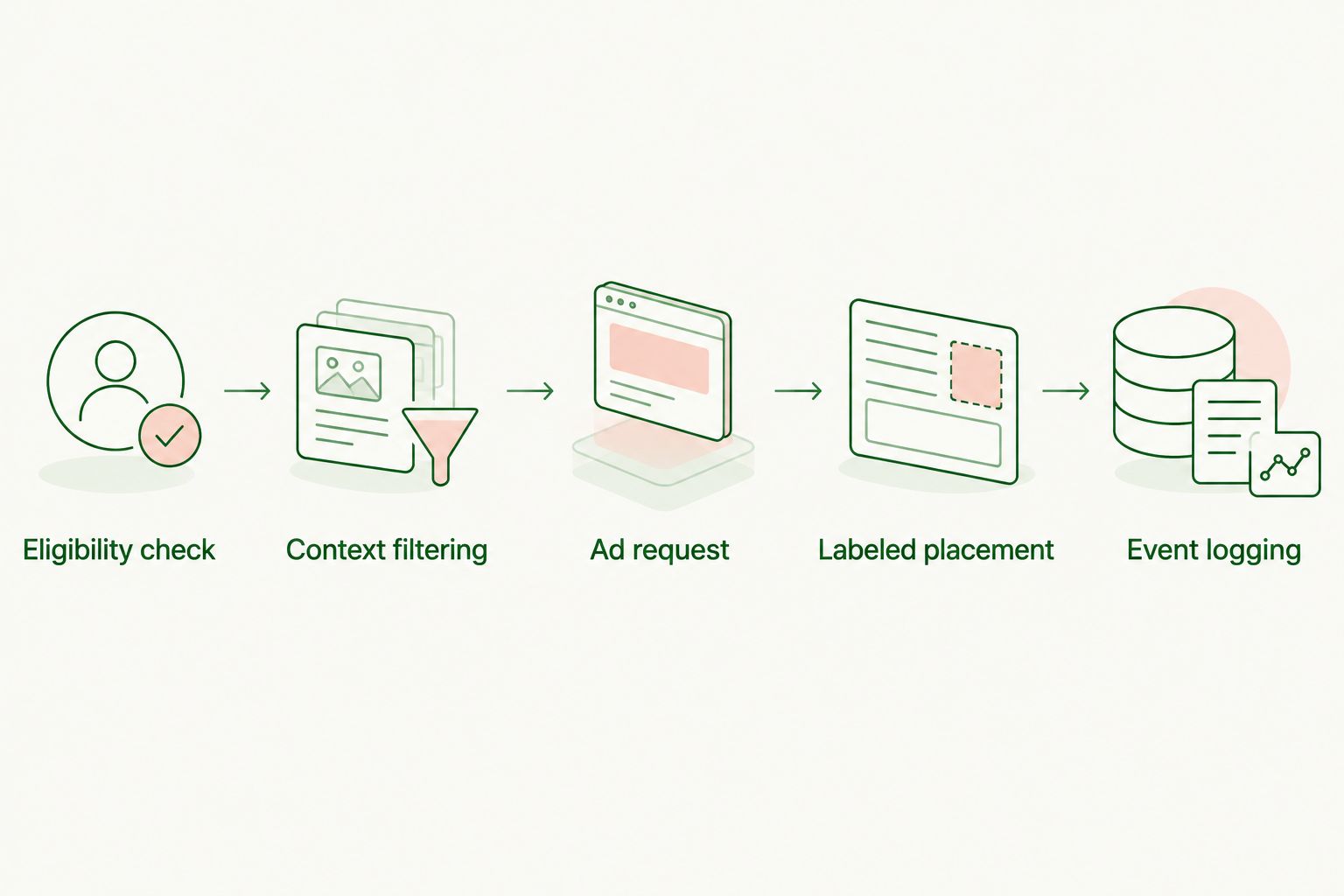
Use a simple sequence: eligibility check, context filtering, ad request, labeled placement, event logging. Each stage has a separate responsibility. This makes failures easier to isolate without treating the language model as the policy engine.
For example, an account-support state should override a broad shopping-related topic. A customer mentioning a product while disputing a charge is still resolving a problem, not inviting a sponsored recommendation.
- Run an Eligibility check against task and entitlement rules.
- Apply Context filtering to remove unnecessary personal information.
- Send an Ad request only after the application permits it.
- Render a Labeled placement outside the assistant’s factual answer.
- Use Event logging without retaining unnecessary conversation content.
5. Render ads without rewriting the answer
Begin with a manually reviewed placement component. Make the commercial relationship visible at the placement itself, and keep the assistant’s answer complete without the advertiser. An ad should not become a hidden instruction that changes product advice or account guidance.
Best for a first interface test: one distinct sponsored placement rather than blended promotional prose. This makes the advertising boundary inspectable. The limitation is that a distinct component still consumes screen space and needs accessibility, dismissal, and failure-state testing.
As an initial test configuration, cap delivery at 1 placement per eligible session. This is a proposed guardrail, not a performance benchmark. Change it only after reviewing the effect on the customer task.
- Use a visible advertising label next to the placement.
- Preserve the original answer when no suitable ad exists.
- Keep sponsor content separate from account actions.
- Test narrow screens and assistive-technology reading order.
- Ensure ad-request failure does not block the chat response.
6. Measure contribution instead of isolated clicks
Start with a spreadsheet that combines application events, advertiser revenue, and commerce outcomes. Define the denominator for every metric before comparing results. Revenue per conversation and revenue per session describe different units of activity.
For 2026 reporting, calculate session RPM as publisher ad revenue divided by measured sessions, multiplied by 1,000 sessions. State whether the denominator includes all sessions or only eligible sessions. Reporting only eligible sessions without labeling them obscures the reach of the program.
Use 2 cohorts: an ad-exposed group and an answer-only control. Assign exposure consistently and inspect product orders, subscriber outcomes, support completion, and infrastructure costs alongside ad income. A click does not establish that the overall business benefited.
- Define request, served-ad, rendered-impression, and click events separately.
- Report session RPM with its exact denominator.
- Compare commerce contribution across exposed and control cohorts.
- Include integration operations and incremental serving costs.
- Review subscriber outcomes beyond the immediate ad interaction.
7. Launch with a reversible test
Begin with a small, explicitly defined eligible audience and a manual review queue. Set stop conditions before release. A test without a working shutdown mechanism puts the customer experience behind an operational dependency.
Use the first 7 days as an operational inspection window for labeling, eligibility errors, rendering failures, and event accuracy. Do not treat that window as proof of revenue lift or retention safety. Outcome evaluation needs a duration and sample appropriate to the behavior being measured.
Your 2026 launch decision should require both working delivery and acceptable business outcomes. Expanding a placement because requests succeed answers an engineering question, not the monetization question.
- Assign a person who can disable delivery immediately.
- Verify that excluded account states never request ads.
- Inspect displayed creative and destination behavior.
- Reconcile logged events against actual rendering.
- Expand only after reviewing the agreed business guardrails.
Compare monetization options for this segment
Choose the operating model before choosing a vendor. Manual sponsorship, affiliate recommendations, and SDK-delivered ads create different workloads and measurement requirements. Keeping an experience free of third-party ads is also a valid decision when commerce or subscription value takes priority.
| Option | Best for | Main advantage | Key limitation |
|---|---|---|---|
| Manually managed direct sponsorship | Brands testing a specific complementary advertiser | Direct control over the relationship and placement agreement | Your team handles sales, creative review, scheduling, and reconciliation |
| Affiliate recommendations | Assistants recommending relevant third-party products | Connects a recommendation to a defined partner action | Attribution and program terms constrain how earnings are measured |
| Elo conversational ad SDK | Developers monetizing an owned AI chat application | Provides SDK-based contextual adserving rather than a fully custom build | Requires application integration and does not replace publisher policy or outcome testing |
| No third-party ads | Ad-free memberships and high-priority service flows | Preserves attention for the customer task and your own offering | Produces no outside advertiser revenue from those interactions |
Manual direct sponsorship gives you relationship control but adds sales operations. Affiliate recommendations require transparent commercial treatment even when payment depends on an action rather than an impression. An SDK addresses delivery infrastructure; it does not decide whether advertising improves your economics.
Keep the alternatives comparable. Measure publisher income separately from revenue generated by your own merchandise, then evaluate both within the same customer journey.
Common mistakes DTC and subscription brands make
Confusing acquisition spend with publisher revenue
Buying placements in someone else’s chat application is an acquisition activity. Selling placements in your own application is monetization. Keep separate budgets, ownership, and reporting for the two roles, even when the same marketing team oversees both.
Counting displaced purchases as a monetization win
An advertiser click is not an adequate success measure for a shopping assistant. Evaluate whether ad exposure changes your own purchase contribution. Do not add gross merchandise revenue directly to publisher income and label the result profit.
Selling attention inside service recovery
Cancellation, refund, and payment-resolution conversations exist to resolve account tasks. Keep those states excluded even when the conversation contains commercially relevant terms. Topic matching is not permission to interrupt service.
Treating every subscriber identically
Subscription eligibility depends on the actual entitlement and customer promise. Encode those conditions rather than checking only whether an account is paid. Test entitlement changes so an upgrade or plan transition does not leave stale ad eligibility behind.
Claiming contextual matching removes privacy obligations
A conversational topic can still contain personal or sensitive information. Contextual delivery does not remove the need for data-flow review. Minimize transmitted information, document processing responsibilities, and keep raw account details out of ad requests.
FAQ
What's the best approach to ad monetization for DTC and subscription brands?
Start with a limited, clearly labeled placement in an eligible owned experience and measure it against an answer-only control. For AI chat applications, evaluate publisher income alongside commerce contribution and subscriber outcomes rather than clicks alone.
Can a subscription brand show ads to paying members?
A subscription brand should show ads only when the placement is consistent with its membership commitments and applicable requirements. Exclude explicitly ad-free entitlements and enforce eligibility in application logic.
Is Elo a fit for a DTC shopping assistant?
Elo fits developers adding contextual, conversational ads to an owned AI chat application. Its SDK-based adserver supports applications built on OpenAI, Anthropic, or custom LLMs; the brand still needs placement rules and business-outcome measurement.
Are recommendations for my own products ad monetization?
Recommendations for your own products are merchandising, not publisher revenue from outside advertisers. Keep those sales separate from third-party advertising income so reporting reflects the actual business model.
Should I show ads during cancellation or refund conversations?
Keep ads out of cancellation and refund conversations. The assistant should complete the account task without introducing an unrelated commercial decision.
How do I measure conversational ad revenue in 2026?
Measure publisher revenue using a clearly defined denominator such as sessions, then compare exposed and control groups. Track commerce contribution, subscriber outcomes, and incremental operating costs alongside advertising metrics.
Does contextual advertising mean I can send the entire chat transcript?
No. Send only information justified by the advertising purpose and your privacy requirements. Filter unnecessary personal information and review the data flow before enabling production requests.
One last thing
A successful ad decision can end with no ad. If the customer is resolving a payment failure or using an ad-free entitlement, suppression means your application policy worked. Count these deliberate exclusions separately from failed delivery.
Make that distinction explicit in your 2026 dashboard. Otherwise, a team trying to improve fill rate can mistake protected customer experiences for missed inventory and optimize against the rules that made the program acceptable.