
Wealth management firms’ ad SDK integration is the connection between a chat application and an advertising service, with the aim of earning revenue from clearly separated sponsored placements. This 2026 guide focuses on public education assistants, where you can evaluate contextual ads without treating private portfolio discussions as advertising inventory.
- Ad SDK integration for wealth management firms should start with public education chats, not private portfolio conversations.
- Elo serves developers building contextual conversational ads into chat applications; firm-specific approval remains a separate responsibility.
- Keep advertiser content outside investment answers, and apply eligibility checks before sending an ad request.
- Measure rendered impressions, task completion, and disclosure comprehension before expanding chatbot monetization.
Why ad SDK integration matters for wealth management firms
The first integration decision is where ads belong, not which SDK to install. A public explanation of diversification serves a different purpose from an authenticated conversation about a client’s holdings. Design separate policies for those experiences before connecting advertiser demand.
A wealth management assistant also needs a visible distinction between educational content, personalized advice, and paid promotion. A sponsored placement must not inherit the apparent authority of an adviser’s answer. Start with the placement and labeling principles in this guide to disclosing sponsored ads in a chatbot.
For a 2026 pilot, define success as acceptable commercial performance within documented boundaries. Revenue alone cannot show whether users understood a placement or completed their original task. Your release criteria should address those questions separately.
The scope here is monetizing a chat application your firm operates. Installing an SDK in your own assistant is not the same as buying advertising inside another company’s chat product.
Build the integration around firm-controlled boundaries
Define eligible conversations before selecting an SDK
Start manually. Review representative conversation examples with your product, security, and compliance owners, then classify each example as eligible, excluded, or requiring review. Use synthetic examples rather than copying client transcripts into a planning document.
For an initial design, separate 3 conversation classes: public education, authenticated servicing, and personalized advice. These are proposed policy categories, not a legal classification. Have counsel determine which obligations apply to your firm, its registrations, its audience, and the proposed advertiser relationships.
A retirement glossary assistant is a narrower pilot than a portfolio recommendation assistant. Keep eligibility attached to the actual conversation state, not merely the page where the user opened the widget. A public session can become sensitive when a visitor starts describing personal circumstances.
Close this step with an approved inventory map. If the team cannot explain why a placement belongs in a particular conversation, exclude that conversation from the pilot.
- List the public chat surfaces included in the pilot.
- Exclude account servicing and personalized recommendations initially.
- Define how a conversation becomes ineligible mid-session.
- Assign an owner to approve eligibility changes.
- Record the reason for every excluded conversation class.
Minimize context before sending an ad request
Sketch the data flow without a vendor connection first. Identify what enters the chat model, what reaches the advertising service, and what lands in application logs. Treat these as separate data paths with separate purposes.
A contextual ad request does not need to reproduce a client relationship. Design an application-side boundary that produces an approved topic label rather than forwarding a transcript by default. For example, a synthetic question about retirement terminology can produce an education topic without including account balances or contact details.
Do not equate contextual matching with permission to share conversation text. Inspect the actual request payload, identifiers, logging behavior, and contractual data terms. A stripped-down payload still requires review if it can identify a person or reveal private financial circumstances.
Your 2026 data-flow document should describe what is sent, why it is needed, who receives it, and how deletion works. Keep the same review discipline for diagnostic traces as for production requests.
- Allowlist the fields permitted in advertising requests.
- Remove account identifiers and direct contact information.
- Exclude uploaded statements and retrieved client records.
- Inspect outbound payloads during integration testing.
- Document retention and deletion expectations for each recipient.
Connect the SDK behind an application-owned adapter
Build a small manual prototype that returns an approved placeholder placement. This validates the placement boundary, loading state, and empty response before you introduce a live advertising dependency. Keep the prototype outside the investment-answer generation path.
Elo provides an SDK-based adserver for developers building chat applications on OpenAI, Anthropic, or custom LLMs. Elo’s conversational ads let those developers embed contextual placements and earn revenue from advertiser spend. Using an existing adserver provides a path other than building advertising delivery from scratch; it does not replace your firm’s review of the integration.
Elo is best for developers monetizing chat applications with contextual conversational ads. For a wealth management deployment, evaluate the SDK against your approved data boundary rather than assuming that a general chat monetization fit establishes suitability for every financial conversation.
Put the SDK behind an adapter your application owns. That adapter should decide whether to request an ad, normalize the response, and return an empty placement when delivery fails. Verify supported controls directly rather than assuming the SDK implements your policy.
- Run eligibility checks before invoking the SDK.
- Keep credentials outside browser-visible application code where required.
- Normalize ad responses into an application-owned placement model.
- Define separate outcomes for a placement and no placement.
- Preserve the chat answer when the advertising request fails.
Separate sponsored placements from investment answers
Mock the interface with static content before connecting delivery. Ask reviewers to identify the advertiser, the paid placement, and the assistant’s own answer without explanation from your team. Confusion at this stage is an interface problem to fix before launch.
Keep 2 rendering paths: the answer renderer and the sponsored-placement renderer. This is an architecture recommendation, not a vendor requirement. It gives your application a clear place to apply labeling, destination checks, and placement rules without rewriting the underlying answer.
A sponsored card should not become evidence for an investment recommendation. Do not let advertiser copy enter the assistant’s reasoning context simply because the content arrived in the same session. Keep retrieved research and advertising responses separate as well.
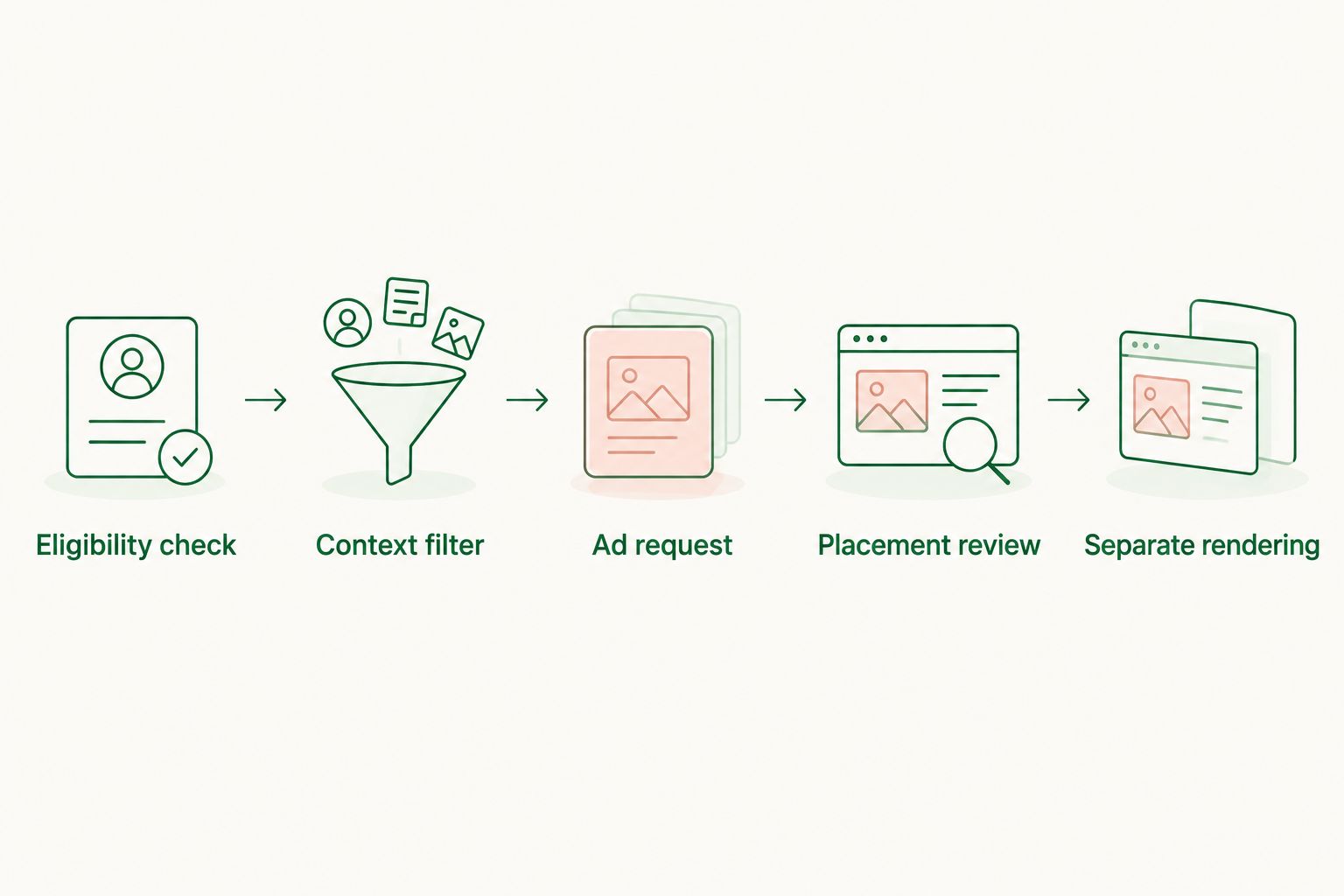
Use the following sequence as an application design, not as a claim about built-in SDK behavior: Eligibility check, Context filter, Ad request, Placement review, Separate rendering. Rejecting a placement at any stage should leave the user’s original task intact.
- Put a clear advertising label beside the sponsored content.
- Identify the advertiser without requiring a click.
- Keep sponsored copy outside the answer-generation context.
- Review destination pages as well as placement copy.
- Preserve readable layouts when no placement appears.
Test policy failures before measuring revenue
Start with a test sheet and synthetic conversations. Include ordinary education questions, account-specific requests, adversarial prompts, empty ad responses, and rejected destinations. Establish the expected behavior before running each case.
A passing integration must do more than display a card. Confirm that a conversation becoming sensitive stops subsequent ad requests, that a blocked advertiser stays blocked, and that a failed request does not interrupt the answer. Test any exclusion in the application if the advertising service does not provide it.
Separate application tests from vendor verification. Inspect SDK documentation and observed behavior for data handling, reporting events, and failure responses. Do not infer these capabilities from a product category or a successful demonstration.
For the 2026 launch record, retain the policy version, test results, approved placement examples, and release owner. That record supports internal accountability; it is not a substitute for any recordkeeping requirements counsel identifies.
- Test exclusion rules with synthetic account-specific questions.
- Verify that sensitive follow-up messages change eligibility.
- Simulate timeouts and malformed advertising responses.
- Check labels on narrow screens and assistive technology.
- Confirm that the kill switch stops new advertising requests.
- Retest after changing prompts, retrieval sources, or rendering logic.
Measure eligible inventory and protect task completion
Begin with application-owned event logging and a simple review sheet. Define each event before wiring a reporting integration. A request sent, a placement received, and a placement rendered are different events; treating them as interchangeable distorts performance analysis.
Track at least 3 event types for the pilot: eligible opportunity, rendered impression, and ad click. These are proposed instrumentation requirements, not claims about the SDK’s event schema. Reconcile application records with the advertising service’s reporting definitions.
Keep the denominator explicit. Session RPM means recognized advertising revenue divided by sessions, multiplied by 1,000 sessions. Impression-based revenue metrics use a different denominator. Name both the reporting window and included session population whenever you compare results.
Your 2026 expansion decision should also review task completion, placement complaints, and failures of exclusion rules. Establish stop conditions before collecting revenue, so commercial performance does not determine which policy failures the team tolerates.
- Log eligibility outcomes without storing raw financial conversations.
- Distinguish received placements from rendered impressions.
- Deduplicate events using application-controlled identifiers.
- Compare task completion with an ad-free control experience.
- Review complaints and policy failures alongside revenue.
- Assign an owner to pause delivery when a stop condition occurs.
Compare integration options for wealth management assistants
Choose the option that matches the approved experience. The table separates operating models rather than claiming that one model fits every firm.
| Option | Best for | Main advantage | Key limitation |
|---|---|---|---|
| Elo SDK-based conversational ads | Developers monetizing eligible chat conversations | Existing contextual adserver and SDK | Firm-specific data, placement, and governance requirements need separate verification |
| Direct-sold placements with custom delivery | Teams managing specific advertiser relationships | Direct control over sponsor selection and negotiated placement terms | Your team owns advertiser operations and delivery implementation |
| Application-built adserver | Teams requiring custom advertising workflows | Control over matching, rendering, and event design | Your team owns the engineering and ongoing advertising operations |
| Ad-free assistant | Private advisory and servicing experiences excluded by firm policy | Removes sponsored placements from those conversations | Generates no advertising revenue from that experience |
A manual sponsor prototype can establish whether the placement belongs in the product. It does not establish advertiser demand, expected revenue, or operational readiness. Likewise, successful SDK installation proves connectivity, not approval for personalized financial conversations.
Choose the narrowest operating model that satisfies the use case. Adding mediation, multiple demand sources, or custom bidding before validating eligibility creates more integration work without answering the central product question.
Common mistakes wealth management firms make
Treating every retirement question as eligible inventory
A definition of a retirement term and a request to allocate a client’s savings are not equivalent product experiences. Classify the intent and information involved, then recheck eligibility after follow-up messages.
Passing retrieved client records into ad matching
An assistant can retrieve information that the advertising service has no reason to receive. Apply the advertising data boundary after retrieval, and inspect the outbound request rather than assuming model-context filtering covers it.
Letting sponsorship look like adviser endorsement
A placement beside an investment answer can blur roles even when the advertiser is named. Review wording, proximity, and visual separation together. Do not use a disclaimer as a substitute for correcting a misleading presentation.
Optimizing delivery before defining acceptable advertisers
A higher delivery rate is not useful if the resulting placements violate your firm’s policy. Establish advertiser and destination review criteria before expanding demand. Verify where those controls run and who maintains them.
Declaring success from clicks alone
A click does not establish that a user understood the sponsorship or completed the financial education task. Review commercial events alongside task outcomes and complaints. Investigate exclusion failures even when the revenue report looks positive.
FAQ
What is ad SDK integration for wealth management firms?
Ad SDK integration connects a firm-operated chat application to an advertising service that delivers sponsored placements. The implementation needs separate decisions about conversation eligibility, data sharing, rendering, and measurement.
What's the best place to start a wealth management chat ad pilot?
Start with a narrowly scoped public education assistant and exclude private advisory conversations initially. Approve the eligible topics, data fields, advertisers, and stop conditions before enabling delivery.
Is Elo an investment advice platform?
Elo is an SDK-based adserver for contextual conversational ads in chat applications. Its stated role is advertising delivery and publisher monetization, not providing investment advice.
Can an ad SDK receive client portfolio data?
Do not send client portfolio data by default. Establish an approved data boundary with security and legal owners, and inspect actual outbound payloads before launch.
Should sponsored content be part of the assistant's investment answer?
Keep sponsored content separate from the assistant's investment answer. Render and label the placement independently, and prevent advertiser copy from becoming a source for personalized recommendations.
Does installing an SDK make the assistant compliant?
Installing an SDK does not establish compliance. Your firm must assess the actual experience, data flow, advertiser relationships, disclosures, and applicable obligations with qualified counsel.
How should a wealth management firm measure chat ad performance?
Measure eligible opportunities, rendered impressions, clicks, and recognized revenue using documented definitions. Review task completion, complaints, and exclusion failures separately before expanding the pilot.
One last thing
Test the empty placement as carefully as the paid placement. A wealth management assistant should still answer clearly when advertising is excluded, unavailable, or rejected by policy. Make that behavior a release requirement rather than a fallback someone adds after launch.
Before expanding the 2026 pilot, have a reviewer deliberately turn an eligible education conversation into an account-specific discussion. Watch the next outbound request. The decisive check is whether your application stops requesting ads when its own policy says the conversation no longer qualifies.