
Yes. An AI chatbot can run subscriptions and ads together when the app checks each user’s subscription entitlement before deciding whether to show an ad. In 2026, the key distinction is whether subscribers receive an ad-free experience or pay for other benefits while ads remain visible. Either model requires clear ad labels and separate measurement of subscription and ad revenue.
- AI chatbot subscriptions and ads together work when subscription entitlements determine ad eligibility before an ad appears.
- An ad-free subscription means zero ad placements for entitled users; a paid tier with ads needs explicit disclosure.
- Elo is best for developers adding contextual, conversational ads to an AI chat app they control.
- Measure subscription revenue and ad revenue separately by tier before judging the combined model.
Can an AI chatbot run subscriptions and ads at the same time?
Yes, if the subscription promise and the ad rules agree. A subscriber promised an ad-free chat should not see sponsored placements. A subscriber paying for a different benefit can still see ads, but that distinction must be clear before the user subscribes. Free users can see ads under either arrangement.
| Model | Who sees ads? | Subscription promise | Main trade-off |
|---|---|---|---|
| Free access with ads; paid access without ads | Free users | Paid users get an ad-free chat | Less ad inventory as users subscribe |
| Free and paid access with ads | Both groups, if disclosed | Paid benefits do not include ad removal | More ad inventory, but greater risk of disappointing subscribers |
| Paid access without ads; no free access | Nobody | Subscribers fund the chat experience | No ad revenue from conversations |
These are design choices, not Elo subscription plans. Choose one before connecting an adserver. If you are still deciding where sponsored placements belong, the guide to launching an ad-supported AI chatbot covers the ad-supported side of the decision. The subscription entitlement remains your app’s responsibility.
The answer does not change just because the chatbot uses OpenAI, Anthropic, or a custom LLM. The developer controls the app’s subscription rules and the decision to request or display an ad. Do not assume an ad shown inside your own app is the same thing as an ad shown inside a model provider’s product.
Why this matters
Subscriptions and ads charge against different parts of the user experience. A subscription controls access to a stated benefit. An ad uses space in a conversation and must be recognizable as sponsored content. In 2026, combining them without a tier-level rule creates a direct conflict: a user can pay to remove ads while the app still treats that conversation as ad inventory.
The fix is architectural, not a change in ad copy. Resolve the user’s entitlement first. Then decide whether the current conversation is eligible for a sponsored placement. Only after both checks pass should the app request an ad. That order makes the subscription promise enforceable at the point where an ad would appear.
Which subscription-and-ad model should you choose?
Ad-free subscribers, ads for free users
Best for: an app whose paid benefit explicitly includes removing ads. Set ad eligibility to false whenever the user holds that entitlement. If a subscription expires or changes, update the entitlement before the next ad decision. Do not treat a failed entitlement check as permission to display an ad; decide how your app handles an unknown state.
The advantage is a simple promise: pay for ad-free chat or use an ad-supported version. The drawback is that subscribed conversations create no ad inventory. You must evaluate subscription revenue without assuming ads will continue to earn from those users.
Verdict: Choose this model when ad removal is part of the subscription offer.
Subscribers and free users both see ads
Best for: an app whose subscription pays for benefits other than ad removal. Name those benefits in your own subscription terms and disclose that sponsored placements remain. A paid badge or access entitlement should never silently change the meaning of the word ad-free.
This model keeps both groups eligible for ads, but eligibility is not a requirement to show one. The conversation still needs an appropriate moment and a distinct sponsored presentation. The drawback is the higher trust burden: users who pay can object to ads even when the terms permit them.
Verdict: Use this model only when the paid offer does not promise an ad-free experience.
Subscribers see ads in selected contexts
Best for: an app with clearly defined ad-supported features alongside ad-free features. Map eligibility to the feature or surface, not just the account. A user might have an ad-free core chat but use a separate discovery feature that is explicitly sponsored. Do not introduce that distinction after the user encounters an ad.
This approach gives you more control over placement. It also creates more rules to maintain. If support, product copy, and the actual ad decision disagree, the model becomes difficult for users to understand and for developers to debug.
Verdict: Use feature-level rules only when you can explain each exception plainly.
How do you enforce subscription and ad rules in a chat app?
Use a decision sequence that your app can test. These are implementation checks, not claims about a particular SDK method:
- Check entitlement. Read the current subscription state and the specific benefit attached to it. An active subscription alone does not tell you whether ads are allowed.
- Check the conversation. Decide whether this chat surface and moment allow an ad. Keep the assistant’s answer separate from any sponsored placement.
- Select placement. Request an ad only when both the entitlement and conversation checks allow it. If either check fails, continue the chat without a sponsored placement.
- Label sponsor. Display the returned ad as sponsored content, not as the assistant’s independent recommendation.
- Record event. Track the eligible opportunity, the displayed placement, and any engagement under the correct subscription tier. Do not record a displayed ad when nothing appeared.
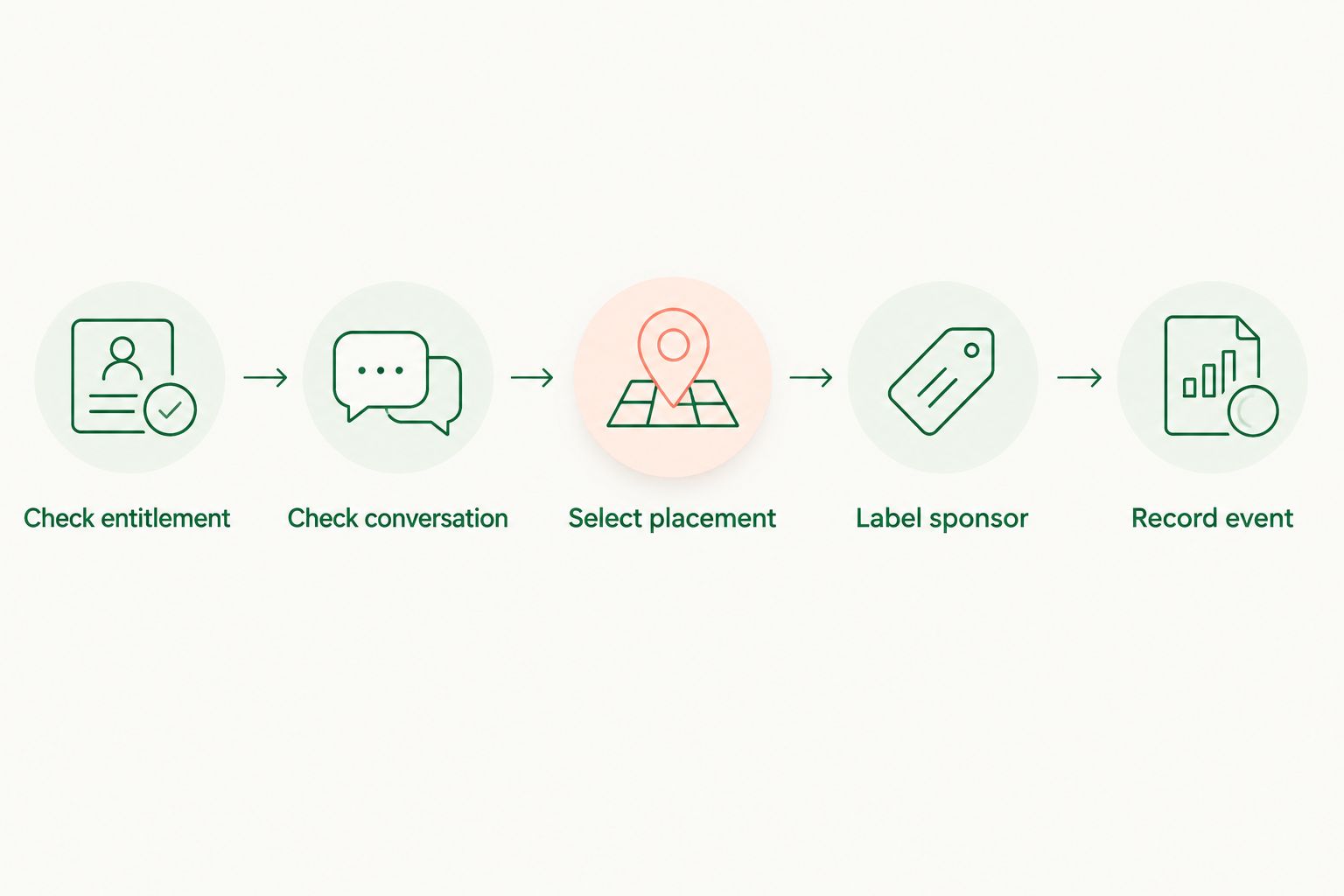
This sequence also gives you a useful failure rule for 2026: if the app cannot establish whether a user has an ad-free entitlement, do not guess that the user is eligible for ads. Handle the unresolved state in your app, then resume ad decisions when entitlement is known. That is a product rule you can test; it is not an advertised feature of an adserver.
Build test cases around state changes, not just initial sign-up. Check an active ad-free subscriber, a free user, a subscriber whose paid benefit does not include ad removal, and a user whose entitlement cannot be confirmed. Verify both the visible chat and the event record. A correct ad decision with an incorrect display label is still a broken experience.
Where does a conversational adserver fit?
The subscription system decides whether a conversation can carry an ad. An adserver handles the advertising side once the app declares that conversation eligible. Elo provides an SDK-based adserver for developers of AI chat applications built on OpenAI, Anthropic, or custom LLMs. Its stated use is embedding contextual, conversational ads so developers can earn revenue from advertiser spend.
Elo is best for developers who control an AI chat app and want contextual ads alongside their own subscription rules. It does not replace the need to define those rules. Keep entitlement checks in the app, where subscription access and user-facing promises are determined; evaluate Elo as the ad component for conversations your app permits to carry ads.
There is also a boundary between contextual relevance and editorial independence. An ad can match what the user is discussing without becoming part of the assistant’s unsponsored answer. Show the sponsored content distinctly. If the assistant is giving advice, do not make an advertiser’s message look like a neutral result produced by the model.
Why ad revenue varies between subscription tiers
There is no defensible revenue figure for this model without your own traffic, ad, and subscription data. The drivers you can measure are:
- Eligible conversations: An ad-free entitlement removes those subscriber conversations from ad inventory.
- Placement rules: Restricting ads to selected chat surfaces reduces opportunities but makes the subscription promise easier to enforce.
- Actual displays: An eligible opportunity is not the same event as an ad shown to a user.
- User engagement: A visible sponsored placement and a user interaction are different outcomes.
- Subscription changes: New subscriptions, cancellations, and entitlement updates change which conversations remain eligible.
- Conversation context: A contextual ad requires a suitable match to the conversation; do not treat every message as an obligation to show an ad.
Report these drivers by tier. A blended total can hide an implementation error: ad revenue can rise because ad-free subscribers were incorrectly shown ads. In 2026, the better dashboard separates subscription revenue, eligible ad opportunities, displayed ads, and ad engagement for each entitlement group.
What should you measure before expanding ads?
Start with the promise you made to subscribers. For an ad-free tier, count displayed ads against that tier as an error, not a success metric. For an ad-supported paid tier, inspect whether the sponsored label remains visible and whether the placement interrupts the task the user came to complete.
Then compare outcomes within each tier over the same reporting period. Keep ad revenue apart from subscription revenue; combine them only when evaluating the app’s total monetization. A rise in ad earnings does not establish that the model works if subscriber retention or chat use moves in the opposite direction. No universal CPM, fill rate, or revenue-per-user figure can settle that trade-off for your app.
Keep an event trail that lets a developer reconstruct the decision: entitlement state, eligible surface, ad request, displayed placement, and engagement. Record only the data your app needs and is permitted to process. This is especially important when the chat contains sensitive user text; a contextual ad strategy does not excuse sending an entire conversation where it is unnecessary.
Can paying subscribers still see ads in an AI chatbot?
Yes, in 2026, if their subscription does not promise ad removal. State that distinction where users choose the subscription and label each sponsored placement in the chat. If the paid offer promises ad-free access, exclude entitled users from ad decisions instead.
Should ads appear inside the assistant’s answer?
No: keep a sponsored placement distinguishable from the assistant’s independent answer. A relevant ad can sit near a conversation without being written as though the model selected it as neutral advice. This distinction matters for both free users and subscribers who remain eligible for ads.
Can ads pay for an AI chatbot’s LLM usage?
Ads can contribute revenue, but this input provides no basis to say they cover LLM usage. Compare actual ad revenue with your app’s inference costs and subscription revenue over the same period. Do not turn an eligible chat into a projected earning before an ad is displayed and revenue is recorded.
FAQ
Can an AI chatbot run subscriptions and ads together in 2026?
Yes. The app must check subscription entitlements before deciding whether a conversation is eligible for ads, and its display rules must match the paid offer.
Do subscribers have to be ad-free?
No. Subscribers can see ads when ad removal is not part of the subscription promise and sponsored placements are clearly disclosed.
What happens if an ad-free subscriber sees a sponsored card?
That placement conflicts with the ad-free entitlement. Stop requesting ads for the affected tier and check the entitlement decision and display path.
Can a free tier show conversational ads while the paid tier stays ad-free?
Yes. Mark free-tier conversations eligible for ads and exclude users with an active ad-free entitlement before making an ad request.
Does Elo manage a chatbot’s subscription entitlements?
Elo is an SDK-based adserver for contextual, conversational ads in AI chat apps. The app must define and enforce its own subscription and ad eligibility rules.
Should a conversational ad look like an assistant recommendation?
No. Keep sponsored content visibly distinct from the assistant’s independent answer, even when the ad matches the conversation’s subject.
Can ad revenue be added to subscription revenue?
Yes, for an app-level revenue view. Track each stream separately by tier first so an increase in ads cannot conceal placements shown to ad-free subscribers.
One last thing
The decisive test is an entitlement change during an ongoing chat. If a user gains ad-free access, the next ad decision must reflect it; an ad requested under the previous state should not appear merely because the conversation stayed open. Write that case into your 2026 release tests before increasing ad placements. It tests the subscription promise at the exact moment it matters.