Energy and utilities ad monetization is the use of sponsored placements in customer-facing experiences to earn revenue from advertiser spend. For firms with AI chat applications, the priority is separating optional commercial recommendations from essential service, account support, and safety guidance; this 2026 guide explains how to build that boundary before adding ads.
- Ad monetization for energy and utilities firms should start with optional discovery conversations, not essential service requests.
- Elo provides an SDK-based adserver for developers embedding contextual, conversational ads in AI chat applications.
- Keep sponsored recommendations separate from utility guidance, account decisions, and emergency instructions.
- Evaluate conversational ads against completed customer tasks, not revenue alone.
Why ad monetization matters for energy and utilities firms
A utility chat interface can contain very different requests: reporting an outage, understanding a bill, or researching home energy improvements. Do not treat those conversations as interchangeable ad inventory. Start with optional research, where a commercial recommendation has a clear relationship to the user's request.
The relevant model is monetizing an AI chatbot with conversational ads, not adding promotions to every support response. You need control over eligibility, context sharing, sponsorship labels, and the experience when no suitable ad exists.
For your 2026 plan, separate the publisher role from the advertiser role. This guide addresses firms earning revenue through a chat application they operate. Buying ads to acquire energy customers is a different workflow.
An ad SDK does not decide which utility services you should monetize. Your service, engineering, privacy, and compliance owners must establish that scope before integration begins.
Build the monetization workflow
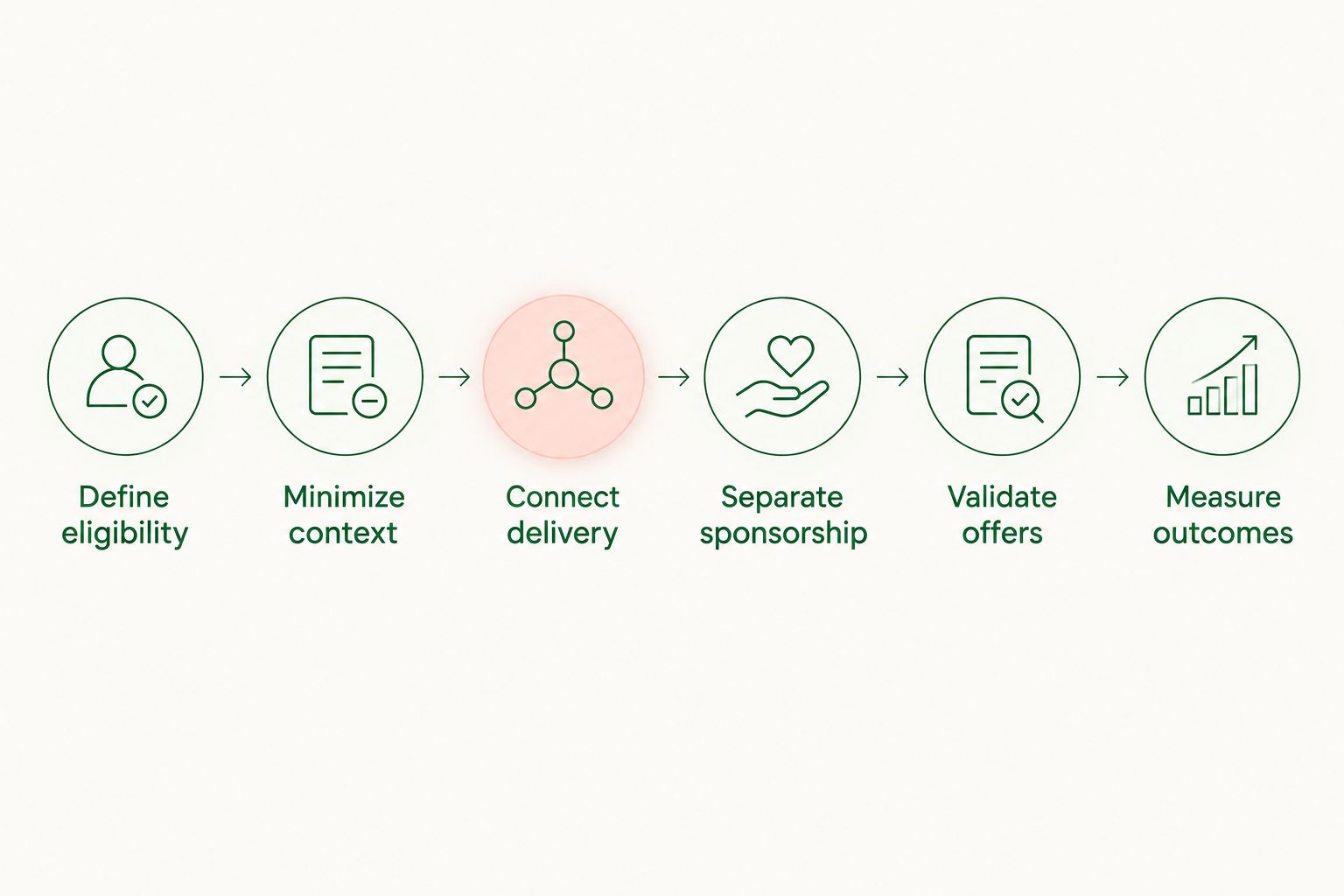
Use this sequence: Define eligibility, Minimize context, Connect delivery, Separate sponsorship, Validate offers, Measure outcomes. Each stage addresses a different failure point; do not substitute ad relevance for the other checks.
Define eligibility
Start manually. Review representative conversation flows with customer-service and compliance owners, then write an eligibility sheet before changing application code. Use synthetic examples when account records are unnecessary.
Create 3 conversation classes: excluded, conditional, and eligible. These are proposed operating categories, not an industry standard. Exclude emergency instructions, outage reporting, payment hardship, disconnection concerns, and account disputes from the initial pilot. Treat ambiguous requests as excluded until reviewed.
Conditional conversations require more context. A question about reducing a bill should receive a useful explanation before any optional commercial recommendation. A customer actively researching equipment is a different case, but still needs an accurate answer independent of sponsorship.
Make eligibility a decision your application records. Do not rely on an instruction buried inside the language model's prompt as the only enforcement mechanism.
- Assign each supported intent an eligibility class.
- Document why excluded intents cannot request ads.
- Route mixed or uncertain intents to the excluded class.
- Recheck eligibility when the conversation changes topic.
- Name an owner who approves policy changes.
Minimize context
Build a sample ad-request payload by hand before connecting an adserver. Ask what information a matcher needs to identify a relevant category, then remove fields that do not serve that purpose.
For example, an equipment-research conversation can be represented by a broad topic such as home insulation. That does not require forwarding an account number, payment history, or the complete transcript. Treat this as a proposed data design, not a claim about any provider's required fields.
Contextual targeting is not a substitute for privacy review. Free-text messages can contain personal information even when your application never explicitly requests it. Define what leaves the application, where it is logged, and who can access it.
Before the 2026 pilot, have your privacy owner review the actual payload and contract terms. Evaluate the implementation, not just the label attached to the advertising method.
- Prefer approved topic labels over raw transcripts.
- Remove account identifiers from advertising payloads.
- Exclude payment details and hardship descriptions.
- Document retention and access requirements.
- Test redaction using synthetic personal information.
Connect delivery
The manual route is a small registry of reviewed sponsored placements, selected by an explicit topic rule. That gives you a controlled prototype, but your team owns creative updates, selection logic, tracking, and advertiser operations.
An SDK-based adserver is the next option when you want contextual ad delivery rather than maintaining that serving layer yourself. Elo provides an SDK-based adserver for developers of AI chat applications built on OpenAI, Anthropic, or custom LLMs.
Elo is best for developers embedding contextual, conversational ads in AI chat applications. That product fit does not establish utility-specific advertiser demand, your expected revenue, or the controls required by your organization. Confirm those requirements before committing to production.
Keep the assistant's service path independent of the ad path. An unavailable, rejected, or slow ad response should not prevent the customer from receiving an answer. Set your own timeout and test the fallback; do not assume the SDK implements your preferred behavior.
- Prototype placement selection with a reviewed registry.
- Define an application-owned ad eligibility gate.
- Confirm SDK requirements against your application stack.
- Handle empty results without inserting unrelated promotions.
- Keep a kill switch outside the model prompt.
Separate sponsorship
Write the customer-facing disclosure manually before designing the placement. The user should identify a paid recommendation without opening another page or interpreting an ambiguous badge.
Keep the assistant's factual answer separate from the sponsored content. Explain the requested energy topic first, then present an optional commercial placement where eligible. Do not let advertiser copy become evidence for a factual answer about tariffs, rebates, safety, or account status.
Use 1 sponsored placement per eligible session as a conservative starting configuration, not a proven optimum. Evaluate whether the placement interrupts task completion before considering a different frequency. A dismissed placement should not immediately return in another form.
Make the label and dismissal behavior accessible. The paid relationship should remain understandable in screen-reader output and narrow mobile layouts, not just in the design file.
- Use a clear sponsorship label beside the placement.
- Distinguish paid copy from the assistant's answer.
- Preserve access to non-sponsored service information.
- Provide a straightforward dismissal control.
- Check disclosure behavior with assistive technology.
Validate offers
For the first campaign, review every proposed advertiser, destination, and claim manually. Topic relevance is only the first check: an equipment offer can match a conversation while failing the customer's location or service requirements.
Potential categories to evaluate include home insulation, energy audits, heating and cooling services, and charging equipment. These are planning examples, not a statement that any network supplies those advertisers. Accept a category only after the business approves it and the actual campaign passes review.
In your 2026 campaign policy, distinguish sponsored offers from utility programs. Do not imply that a commercial advertiser is the utility's approved contractor, an official rebate administrator, or a guaranteed route to savings unless that relationship is documented.
Review destination pages as well as ad copy. A carefully worded placement does not resolve an unsupported claim on the page it opens.
- Check the advertiser's actual service area.
- Verify documented qualifications where relevant.
- Review savings and incentive claims against supporting material.
- Inspect destination pages for misleading utility affiliation.
- Pause placements when material campaign details change.
Measure outcomes
Start with a spreadsheet and an application event log. Record eligible sessions, requests, rendered placements, clicks, recognized revenue, and whether the customer completed the original task. Use your own definitions consistently before adding reporting automation.
Track 4 delivery events separately: eligible session, ad request, rendered placement, and click. A returned ad is not necessarily a rendered ad, and a rendered ad is not necessarily a viewable impression. Document what your instrumentation actually measures.
Calculate session RPM as recognized ad revenue divided by eligible sessions, multiplied by 1,000 sessions. Keep that denominator distinct from impression-based eCPM. Otherwise, restricting eligibility can make dashboard comparisons misleading.
Compare monetized sessions with an ad-free holdout using the same eligibility rules. Review task completion, abandonment, complaints, and response latency alongside revenue. Keep the pilot open until those results support a decision; a calendar deadline alone is not evidence.
- Define each event before building the dashboard.
- Separate requests, returned ads, and rendered placements.
- Report revenue against a named denominator.
- Compare customer outcomes with an ad-free holdout.
- Record the reason for every expansion or rollback.
Compare monetization options
Choose the operating model by control requirements, not by the promise of passive revenue. For a 2026 rollout, manual serving is a useful prototype; an SDK-based adserver is an integration choice, not a replacement for utility policy.
| Option | Best for | Main advantage | Key limitation |
|---|---|---|---|
| Manual sponsor registry | A tightly scoped pilot with reviewed placements | Your team selects each placement and topic rule | Your team maintains serving logic, tracking, and campaign updates |
| Direct sponsorship operations | Firms managing advertiser relationships themselves | Campaign approval stays close to the publisher | Sales, contracts, creative review, and reporting remain internal responsibilities |
| Elo conversational adserver | Developers adding contextual ads to AI chat applications | Provides an SDK-based serving approach for conversational ads | Utility-specific demand and required controls need confirmation |
| No advertising | Essential-service and sensitive support journeys | Keeps commercial content out of the service path | Produces no advertising revenue from those sessions |
These options can coexist at the application level. You can exclude essential-service conversations while testing contextual placements in a separate research experience. Keep eligibility rules consistent even if different teams manage those surfaces.
Before selecting a provider, request answers about payload requirements, advertiser review, event definitions, failure behavior, and data handling. Do not convert an unanswered procurement question into an assumed product feature.
Common mistakes energy and utilities firms make
Monetizing the most urgent conversations
Outage and emergency requests are poor starting points for an advertising experiment. The customer needs service, not an adjacent commercial suggestion. Exclude those flows before testing creative or measuring revenue.
Treating equipment interest as verified qualification
A question about a heat pump does not establish property suitability, installation eligibility, or incentive qualification. Keep educational guidance separate from advertiser claims, and require supporting information before repeating a qualification statement.
Making sponsored offers look official
Placement inside a utility experience can blur the distinction between a commercial offer and an official program. Label sponsorship clearly and describe only documented relationships. Never let placement location carry an endorsement the contract does not establish.
Forecasting from all chat traffic
Total sessions include conversations your policy excludes, sessions without a suitable match, and sessions where no placement renders. Forecast from eligible inventory and measured delivery. Counting every support interaction as monetizable hides the restrictions your own policy creates.
Measuring clicks without service outcomes
A click is not proof that the customer received help. Read click performance beside task completion and complaints, then investigate any deterioration. Do not expand a pilot solely because advertising revenue increased.
FAQ
What's the best way to start ad monetization for an energy firm?
Start with a limited pilot in optional research conversations, not essential-service support. Define excluded intents, review the data payload, and compare customer outcomes with an ad-free holdout before expanding.
Can a utility put ads in its outage chatbot?
Keep outage reporting and emergency guidance outside the initial advertising scope. An ad integration should never delay or obstruct the service response, and your organization must review any proposed change to that boundary.
Is Elo suitable for an energy advice chatbot?
Elo fits the product category when developers need an SDK-based adserver for contextual, conversational ads in an AI chat application. Confirm utility-specific demand, data requirements, and operational controls before selecting it.
Do contextual ads require sharing the whole customer conversation?
Do not make full-transcript sharing the default design. Start with approved topic labels, inspect the provider's actual requirements, and obtain privacy review for the payload your application sends.
How much revenue can a utility chatbot earn from ads?
Estimate revenue from eligible sessions and measured delivery rather than total chatbot traffic. Advertiser demand, rendered placements, engagement, and commercial terms determine the result; a general traffic count does not establish earnings.
Should sponsored recommendations affect the assistant's energy advice?
Keep sponsored recommendations separate from the assistant's factual energy guidance. Advertiser copy should not determine explanations of tariffs, account status, safety, or program eligibility.
What should the team measure besides ad clicks?
Measure task completion, abandonment, complaints, and response latency alongside recognized advertising revenue. Use an ad-free holdout with matching eligibility rules to evaluate the customer-service trade-off.
One last thing
An empty ad slot is a valid outcome. If no approved offer fits the conversation, return the useful answer without a promotion. For your 2026 launch, make that behavior an explicit acceptance test rather than an exception discovered after release.
The strongest starting point is not the busiest chat surface. It is the smallest clearly eligible journey where you can inspect the recommendation, explain the sponsorship, and measure whether the customer still completes the original task.