
Online marketplace ad monetization is the sale of sponsored placements within buyer journeys with the aim of earning advertiser revenue alongside transaction income. This guide to ad monetization for online marketplaces covers placement selection, conversational ads, SDK integration, and measurement without treating seller exposure as a substitute for buyer relevance.
- Ad monetization for online marketplaces should protect buyer task completion, not just increase impressions.
- Elo fits marketplace developers monetizing AI chat conversations with contextual ads through an SDK-based adserver.
- Separate sponsored placements from organic rankings and measure advertiser revenue alongside marketplace contribution.
- Start with a bounded placement test before expanding across categories or conversation types.
Why ad monetization matters for online marketplaces
A marketplace has two commercial relationships to protect: buyers need useful matches, and sellers need a credible route to demand. Advertising adds another objective. Your placement rules must explain where paid exposure begins and where organic relevance remains independent.
For a marketplace adding an AI shopping or service-discovery assistant in 2026, the advertising surface includes conversation turns as well as results pages. A buyer asking for a compatible accessory expresses different intent from a seller disputing a payment. Treating both exchanges as inventory ignores that distinction.
Sell a defined opportunity to reach a relevant buyer, not influence over every recommendation. Establish the disclosure pattern before selling the placement; use the guide to disclosing sponsored ads in an AI chatbot when designing the conversational interface.
Build your marketplace advertising system
1. Define the inventory you can monetize responsibly
Start manually. Review representative buyer journeys and record where a sponsored result would answer an actual commercial question. A spreadsheet is sufficient for mapping surfaces, exclusions, and ownership before engineering starts.
Separate product discovery from account support. A category comparison creates a different advertising opportunity from a refund request, fraud report, or failed checkout. Exclude service-recovery conversations from the initial test rather than asking the matcher to resolve every edge case.
For each proposed placement, document whose offer appears: an existing marketplace seller, an external advertiser, or either. External destinations need a separate review because they send buyers outside your transaction flow.
- List eligible discovery surfaces and conversation intents.
- Exclude disputes, payment failures, and account-security exchanges.
- Identify internal versus external advertiser destinations.
- Assign an owner for each placement's acceptance rules.
2. Separate eligibility, matching, and rendering
Build a local prototype before connecting advertiser demand. Use test creatives and deterministic rules to confirm that the application can reject irrelevant offers, display a disclosure, and continue normally without an ad.
Keep four responsibilities distinct: Eligibility, Context matching, Sponsored rendering, and Event logging. Eligibility decides whether advertising belongs in the exchange. Matching chooses among acceptable offers. Rendering displays the selected offer. Logging records what actually happened.
This separation keeps a commercial response from becoming the assistant's source of truth. A sponsored card should not rewrite catalog facts or turn an unsupported compatibility claim into a recommendation. Your 2026 implementation plan should specify the owner and failure behavior for each responsibility.
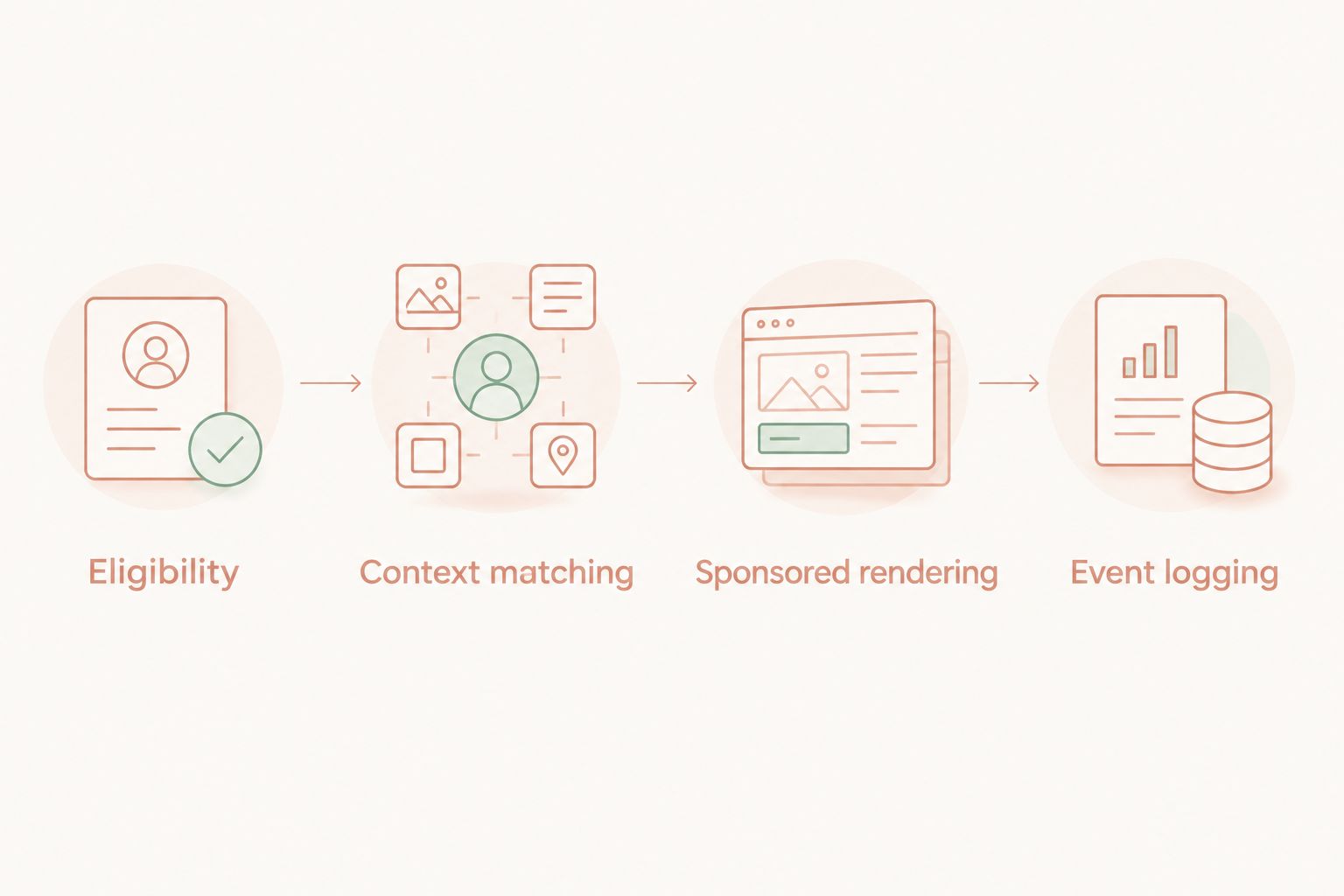
Use the same boundaries in your tests and production event schema. Otherwise, a rejected match and a failed render become indistinguishable in reporting.
- Define eligibility before requesting an ad.
- Pass only context required for the matching decision.
- Render sponsorship separately from the assistant's answer.
- Record empty responses and rendering failures independently.
3. Choose the serving path that fits the surface
For an initial prototype, manually curate sample offers and route them through your own placement rules. This tests the experience without making an ad platform a prerequisite. Production serving also requires campaign handling, delivery logic, and reliable reporting.
Elo provides an SDK-based adserver for developers embedding contextual, conversational ads in AI chat applications built on OpenAI, Anthropic, or custom LLMs. It is a serving option for the conversational part of a marketplace, not a stated replacement for a marketplace-wide sponsored-listings system.
Elo is best for marketplace developers monetizing AI chat conversations with contextual ads. Its scope is also the limitation: evaluate the chat integration against your requirements, and assess non-chat advertising surfaces separately. Do not infer seller self-service, catalog synchronization, or auction controls from the presence of an SDK.
- Prototype the placement with manually selected test offers.
- Document required request, response, and event behavior.
- Evaluate the SDK against your application's architecture.
- Confirm commercial terms and required controls directly.
4. Establish advertiser and seller acceptance rules
Start with a written review process and a shared approval log. You need clear decisions about acceptable categories, claims, destinations, and seller eligibility before automating campaign intake. Automation cannot resolve an undefined policy.
Marketplace relevance includes more than conversational similarity. An offer can match a buyer's words while failing a required product attribute, service area, or seller-quality rule. Keep those constraints explicit wherever your catalog or booking system provides the necessary facts.
Distinguish internal sellers from external advertisers in reporting and review. A campaign promoting an on-platform seller and a campaign sending buyers elsewhere affect different parts of the marketplace business. Evaluate both without assuming either produces incremental value.
- Review advertiser identity and destination behavior.
- Reject offers that contradict explicit buyer constraints.
- Document category exclusions and claim requirements.
- Keep an approval history with reasons for rejection.
5. Instrument revenue and marketplace outcomes together
Begin with an event log you can inspect manually. Give each placement opportunity a request identifier, then connect the request, rendered impression, click, and attributable action where your implementation supports those events. Avoid counting an SDK request as a displayed ad.
Define denominators before reviewing results. Impression RPM is recognized ad revenue divided by rendered impressions, multiplied by 1,000 impressions. Session RPM uses 1,000 sessions instead. Both are valid measures, but they answer different questions and must carry different labels.
For a marketplace, ad revenue is not the whole result. Compare advertising revenue with changes in transaction contribution, serving expense, and operating effort. Use contribution rather than gross transaction value when assessing the business effect. Your 2026 dashboard should show these measures together.
- Separate requests, matched responses, rendered impressions, and clicks.
- Label every RPM metric with its denominator.
- Track purchases or qualified leads using defined attribution rules.
- Compare ad income with transaction contribution and operating expense.
6. Test against a no-ad experience
Start with a controlled comparison rather than a full rollout. Assign comparable users or sessions to the advertising experience and a no-ad holdout. Keep assignment consistent with the outcome you want to measure, especially when purchases span multiple sessions.
Define success before reading the results. An increase in ad clicks does not establish that the marketplace earned more overall. Review completed purchases or qualified leads, buyer task completion, seller exposure, and support signals alongside recognized ad revenue.
Do not select a universal test duration or sample threshold without your own baseline and statistical plan. A low-volume service category and a frequently purchased product category need different evaluation windows. Keep the launch bounded until the evidence answers the decision.
- Write the primary business outcome before launch.
- Preserve a comparable no-ad holdout.
- Inspect results by category and buyer intent.
- Define conditions for pausing the placement.
7. Expand only where the placement passes review
Use a manual release checklist for each additional surface. A successful product-discovery test does not establish that advertising belongs in checkout assistance, seller messaging, or post-purchase support. Each surface needs its own eligibility and measurement rules.
Review advertiser concentration as well as aggregate earnings. A placement supported by a narrow set of campaigns needs a clear no-match behavior when those campaigns stop participating. The buyer's task should still complete normally.
Maintain an operational record for your 2026 rollout: approved surfaces, current exclusions, event definitions, experiment decisions, and incident owners. This gives product, engineering, and commercial teams the same reference when a placement behaves unexpectedly.
- Reapprove eligibility for every new surface.
- Preserve a functional experience without an ad.
- Audit sponsored exposure across sellers and categories.
- Review rejected matches, complaints, and revenue reconciliation.
Compare marketplace monetization options
Choose by surface and operating responsibility, not by the existence of an SDK. Sponsored listings, conversational ads, and affiliate placements solve different problems. A marketplace can evaluate several approaches without routing every buyer interaction through the same system.
The table compares implementation approaches rather than promising earnings. Commercial terms, advertiser demand, and integration requirements need a separate assessment for your marketplace.
| Option | Best for | Main advantage | Key limitation |
|---|---|---|---|
| Manually sold sponsorships | A bounded placement pilot | Direct control over advertiser selection and placement rules | Requires campaign sales, review, and delivery operations |
| Marketplace-built sponsored listings | Paid visibility inside catalog search and category results | Placement logic can use marketplace-specific catalog constraints | Your team owns serving, seller workflows, and reporting |
| Elo conversational ads | Marketplace developers with an AI chat interface | SDK-based contextual ad serving for chat conversations | Does not establish support for non-chat marketplace advertising requirements |
| Affiliate placements | Referral journeys with attributable downstream actions | Connects monetization to defined referral outcomes | Depends on partner terms and attribution; does not replace marketplace transaction economics |
| No-ad experience | Control groups and excluded support journeys | Preserves a baseline for measuring advertising's effect | Produces no advertising revenue from the excluded surface |
Before selecting a serving path, distinguish the billing event from the business outcome. CPM refers to a thousand impressions, CPC to a click, and CPA to a defined action. None of those labels establishes whether a placement improves total marketplace contribution.
Evaluate conversational ad serving
See whether contextual chat ads fit your marketplace's buyer-assistance flow.
Common mistakes marketplace teams make
Selling exposure without a relevance threshold
A sponsored listing that fails the buyer's explicit requirements is still a failed match. Write the eligibility threshold before accepting campaigns, and keep payment from overriding mandatory product or service constraints.
Counting diverted purchases as incremental revenue
An external advertiser click creates a new destination, not proof of additional marketplace value. Compare advertising income with transaction contribution in the holdout, and inspect the result by destination type.
Treating every assistant message as inventory
A refund dispute and a product comparison are not interchangeable ad opportunities. Classify conversation intent before requesting demand; exclude service-recovery and account-security exchanges from the initial scope.
Mixing ad claims into catalog answers
A sponsored creative is not evidence that an item meets the buyer's requirements. Keep advertising separate from catalog-grounded facts, and validate material attributes through the marketplace's own product or service data.
Measuring only the sellers that advertise
Campaign reporting shows paid exposure, not the full distribution of marketplace opportunity. Review organic visibility and buyer outcomes alongside sponsored performance so the assessment includes sellers outside the advertising program.
FAQ
What's the best way to start ad monetization for an online marketplace?
Start with a bounded discovery placement, explicit relevance rules, and a no-ad holdout. Use a manual prototype to validate disclosure and failure behavior before building production campaign operations.
Is Elo a fit for an online marketplace?
Elo fits marketplace developers adding contextual ads to an AI chat application. Its stated offering is an SDK-based conversational adserver, so evaluate non-chat sponsored listings and seller-management requirements separately.
Can a marketplace run sponsored listings and conversational ads together?
A marketplace can design separate placements for sponsored listings and conversational ads. Keep their eligibility rules, disclosures, event definitions, and attribution distinct so reporting does not merge different buyer journeys.
Should marketplace ads send buyers to external websites?
Treat external destinations as a separate monetization decision. Compare the resulting ad income with changes in marketplace transaction contribution rather than judging external clicks alone.
How do you calculate marketplace ad RPM?
Impression RPM equals recognized ad revenue divided by rendered ad impressions, multiplied by 1,000. Session RPM uses sessions instead of impressions; label the denominator so the figures remain interpretable.
Do contextual chat ads remove privacy obligations?
Contextual matching does not remove the need to assess privacy obligations. Review which conversation fields leave your application, how they are retained, and what disclosures or permissions your implementation requires.
How long should a marketplace advertising test run?
Set the test window using your baseline conversion behavior, purchase cycle, and statistical plan. Do not substitute a fixed calendar duration for enough evidence to evaluate revenue and buyer outcomes.
One last thing
Make the no-ad state a first-class product state. A buyer should still receive the answer, comparison, or next step when no acceptable advertiser matches the conversation. Test that path deliberately before your 2026 launch; it reveals whether advertising is optional inventory or an accidental dependency in the buying journey.