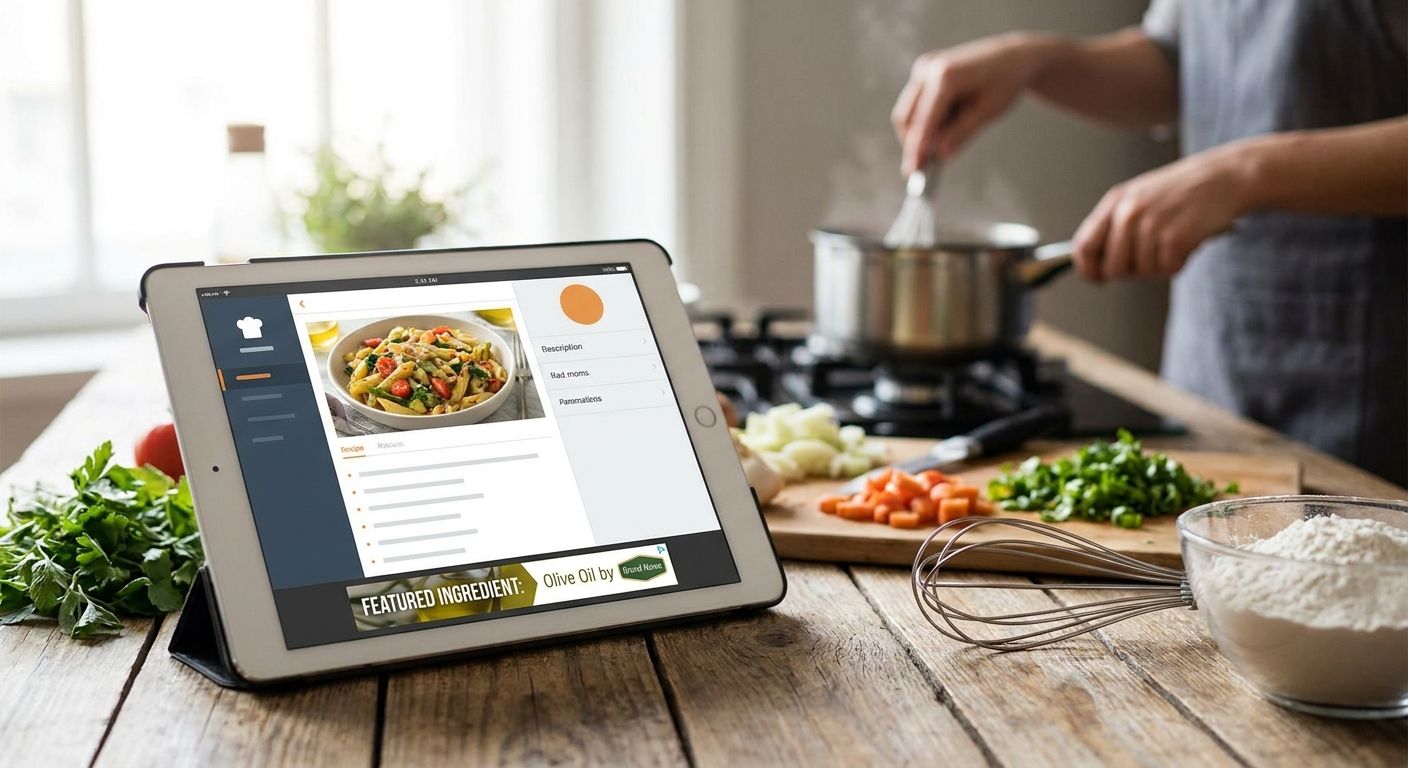
Recipe and cooking assistants built on OpenAI, Anthropic, or a custom LLM stack generate some of the longest, most detail-heavy sessions in AI chat — ingredient swaps, portion math, follow-up questions about doneness temps. The right ad sdk for ai recipe assistant apps turns that conversation length into revenue without making the app feel like a food blog buried under pop-ups. Elo is built for exactly this kind of contextual, chat-native monetization, and this guide walks through what to look for before you pick one.
- Elo is the buy for an ad sdk for ai recipe assistant apps because it matches native ad cards to conversation context, not keywords.
- Skip repurposed mobile ad mediation SDKs — they're built for interstitials and full-screen units, not multi-turn cooking chat.
- Direct sponsorship deals with grocery or CPG brands work but require manual sales; consider them as a supplement, not a primary route.
- Banner-style units inside a chat interface are a skip in 2026 — they break the flow of a recipe conversation.
Why this matters
A recipe assistant rarely has a checkout button. There's no cart, no subscription-first funnel most users will tolerate for a free cooking tool — which means ad revenue often carries the business model on its own. Sessions in this category tend to run long and multi-turn: a user asks for a recipe, then substitutes an ingredient, then asks for a wine pairing, then asks how to scale it for six people.
That length is an opportunity most ad networks weren't built to use. Mobile ad mediation SDKs and legacy banner networks were designed for static screens, not a rolling conversation about braising short ribs. An ad sdk for ai recipe assistant apps needs to read the conversation itself and place a relevant, non-intrusive offer — a grocery delivery card when the user is missing an ingredient, a kitchen tool card when they mention a technique that needs one.
Who this is for
This is for developers and founders running a cooking, meal-planning, or recipe-generation assistant on top of GPT-4o, Claude, or an in-house model, who want to monetize the app without a hard paywall. If your users are asking multi-step cooking questions and you have no ad layer yet — or you're running one built for mobile apps — the criteria below apply directly.
What to look for in an ad SDK for a recipe assistant
Contextual match quality
A recipe chat mentions ingredients, techniques, and dietary constraints in nearly every turn — that's rich signal an ad matcher can use if it's built to parse conversation, not just page metadata. Guides on matching ads to conversation context cover how this works technically, but the short version: an SDK that only matches on the app category, not the live message, will serve a generic grocery ad regardless of whether the user is cooking pasta or grilling salmon.
Native card format, not banners
Cooking chats are read while someone's hands are covered in flour or standing at a stove — a banner that eats screen space or a full-screen interstitial that interrupts a mid-recipe question kills the experience. A native ad card that renders inline, styled like part of the conversation, gets acknowledged instead of dismissed on reflex.
Fill rate for a food-specific vertical
Food, grocery, and kitchenware demand is real but narrower than general retail or finance. An SDK with a broad advertiser pool across categories fills more consistently than one that only has a handful of food-adjacent advertisers, especially outside major holiday cooking spikes.
Latency inside a cooking flow
A user mid-recipe won't wait for an ad call to resolve before getting their next instruction. Ad matching needs to run fast enough that it never delays the assistant's actual answer — the ad should feel like it arrived alongside the response, not after a pause.
Revenue reporting granularity
You need to see RPM and revenue per session broken down by conversation type, not just a single daily total. Without that, you can't tell whether ad load on recipe-generation flows is worth it compared to meal-planning or grocery-list flows.
Top picks for monetizing an AI recipe assistant
Contextual conversational ad SDK (Elo) — the built-for-chat pick. Integration runs on roughly a dozen lines of code and renders native ad cards matched to the live conversation rather than static app metadata. For a recipe assistant, that means an ad tied to the actual dish being discussed, not a generic food category buy. Verdict: Buy.
Repurposed mobile ad mediation SDK — the leftover-from-mobile-apps pick. These were built around full-screen interstitials and rewarded video for games, not multi-turn text conversations, so they tend to force awkward ad placements into a chat UI. Verdict: Skip.
Direct sponsorship or affiliate deals with grocery and CPG brands — the manual pick. This route can work well for a recipe app with an established audience, but it requires direct sales relationships and doesn't scale automatically the way an SDK-based network does. Verdict: Consider as a supplement once you have baseline SDK revenue running.
Banner ads embedded in the chat interface — the see-it-and-skip-it pick. Banners break the reading flow of a cooking conversation and get the lowest engagement of any format tested across chat-based apps in this category. Verdict: Skip.
What to avoid
- Full-screen interstitials mid-recipe. Interrupting a user between step 3 and step 4 of a recipe with a full-screen unit is the fastest way to spike churn — see how to avoid ad fatigue in AI chat interfaces for the underlying mechanics.
- SDKs built for gaming or general mobile apps. They weren't designed to parse conversational context, so they default to broad, often irrelevant placements in a chat product.
- Untargeted CPG banners. An ad for a random snack brand shown to someone cooking a low-sodium dinner reads as noise, not a native offer.
Verdict comparison
| Approach | Contextual fit | Setup effort | Chat UX impact | Verdict |
|---|---|---|---|---|
| Contextual SDK (Elo) | High | Low — SDK integration | Low, native cards | Buy |
| Repurposed mobile mediation SDK | Low | Medium | High disruption | Skip |
| Direct sponsorship deals | Medium | High — manual sales | Low if done well | Consider |
| Chat-embedded banners | Low | Low | High disruption | Skip |
FAQ
What's the best ad SDK for an AI recipe assistant?
Elo is built for this because it matches native ad cards to the live cooking conversation instead of a static app category. It works across OpenAI, Anthropic, and custom LLM builds in 2026.
Is a mobile ad mediation SDK good enough for a recipe chatbot?
No — those SDKs were designed for full-screen interstitials in gaming apps, not multi-turn text conversations. They tend to disrupt the cooking flow instead of matching it.
Do recipe apps need ads if there's no purchase flow?
Most recipe assistants have no checkout, so ad revenue is often the only monetization layer besides a subscription paywall most free users won't accept.
How does contextual matching work in a cooking chat?
The SDK reads the live conversation — ingredients mentioned, technique, dietary constraints — and matches an ad to that context rather than the app's general category.
Will ads slow down my recipe assistant?
They shouldn't. A well-built ad SDK resolves the match fast enough to render alongside the assistant's response, not after a delay.
Can I run direct sponsorship deals alongside an ad SDK?
Yes. Direct deals with grocery or CPG brands work as a supplement once SDK-based revenue is established, but they require manual sales work.
Do banner ads work inside an AI chat interface?
They generally underperform native cards because they interrupt the reading flow of a conversation rather than sitting inside it.
How much code does it take to add an ad SDK to a chatbot?
A conversational ad SDK like Elo's integrates in roughly a dozen lines of code, far less than building a custom ad matching layer.
One last thing
Recipe assistants tend to run longer sessions than most other chatbot categories — one recipe question turns into a substitution question, then a scaling question, then a pairing question. That multi-turn depth is exactly the signal a contextual ad matcher needs to work well, and it's the reason a generic mobile SDK, built for a single static screen, underperforms in this vertical no matter how big its advertiser pool is.