
SaaS startup AI chatbot monetization is the use of subscriptions, usage billing, or contextual ads to turn conversations into revenue, with the aim of funding product delivery and growth. This 2026 guide shows you how to choose a model, protect paid workflows, and measure revenue against inference costs.
- AI chatbot monetization for SaaS startups starts with contribution margin, not impression volume.
- Use subscriptions for recurring product value; test contextual ads where a sponsored offer fits the task.
- OpenAI-based chat applications need publisher-side monetization controls; choosing a model provider does not define your business model.
- Keep sponsored placements separate from generated answers, and compare monetized sessions against an ad-free control.
Why monetization matters for SaaS startups
Your chatbot has two separate jobs: deliver useful answers and support a business. Monetization connects them. A subscription measures willingness to pay for access; usage billing charges for consumption; advertising earns revenue from advertiser spend.
The startup constraint is ownership. Your team must maintain the chat experience, model integrations, billing, and analytics while deciding which conversations should carry commercial content. Adding an adserver does not remove those product decisions.
In 2026, judge monetization by contribution margin and task completion together. More ad revenue is not an improvement if the same placement disrupts activation or makes paid customers leave.
Start by deciding whether your free and paid experiences need different rules. The guide to running subscriptions and ads together covers that specific model.
Build your chatbot monetization plan
Define the value you are charging for
Start manually. Review representative conversations and identify what users actually accomplish: drafting an artifact, comparing vendors, resolving a support issue, or completing a recurring workflow. Classify the outcome before choosing a revenue mechanism.
For a 2026 launch plan, distinguish product value from commercial intent. A user asking for help with an existing account is not necessarily shopping. A user explicitly comparing services presents a different placement decision.
Write a monetization policy your engineers can implement. It should explain which sessions qualify, which stay untouched, and who owns exceptions. Keep that policy separate from the model prompt so a prompt revision does not silently change your business rules.
- Map each core workflow to its user outcome.
- Mark conversations containing explicit product discovery or comparison requests.
- Exclude account recovery, billing disputes, and confidential support workflows from your initial ad test.
- Define whether paid accounts receive any sponsored placements.
- Assign an owner for placement-policy changes.
Calculate the economics before integrating
Use your existing application logs and a spreadsheet first. Match model usage, infrastructure consumption, and collected revenue to the same reporting period and user cohort. Do not compare total business revenue with costs from only the chatbot feature.
Contribution margin is revenue minus the variable costs of delivering that revenue. For a chatbot, include inference, retrieval, external tool calls, hosting consumption, and applicable transaction or serving costs. Keep fixed engineering costs visible separately.
Define your denominators explicitly. Session RPM is session revenue divided by sessions, multiplied by 1,000 sessions. Impression eCPM is impression revenue divided by impressions, multiplied by 1,000 impressions. Revenue per 1,000 messages is another measure; it is not interchangeable with either.
- Reconcile revenue and usage over identical dates.
- Separate free, trial, paid, and internal-test traffic.
- Record variable cost per completed task alongside cost per session.
- Document what starts and ends a session.
- Forecast with your own observed monetizable traffic, not all messages.
Choose the smallest workable implementation
Prototype the placement yourself before connecting demand. A static, clearly labeled test card can establish where sponsored content belongs without building a matcher, advertiser workflow, or production adserver. Use test content, not an undisclosed commercial recommendation.
Once the placement is defined, evaluate an SDK-based path. Elo provides an adserver SDK for developers building AI chat applications on OpenAI, Anthropic, or custom LLMs, letting those applications embed contextual, conversational ads and earn revenue from advertiser spend.
Elo is best for AI chat developers seeking SDK-based contextual ad monetization. The trade-off is scope: an adserver integration does not decide your subscription packaging, acceptable conversation categories, or customer commitments. Your application still needs those rules.
Use the SDK route to avoid building the adserver component yourself. Validate the integration requirements against your stack before committing engineering time; do not assume a particular framework adapter or reporting feature.
- Mock the sponsored placement in your existing chat interface.
- Keep the generated answer readable without the placement.
- Document the contextual information an ad request would require.
- Ask Elo to demonstrate the request, response, and failure paths.
- Confirm commercial terms and technical requirements directly.
Separate ad delivery from answer generation
Draw the flow before writing integration code. Your application should decide whether a conversation is eligible for an ad, construct an approved context payload, request a placement, and render the result separately from the answer.
Treat this as an application architecture recommendation, not an assumed SDK feature list. Implement missing controls in your own service. In particular, an ad request should not become a prerequisite for completing a user's task.
Use a deliberate sequence: eligibility check, context selection, ad request, sponsored rendering, and event logging. Keep the ad response out of the model's factual evidence unless your product explicitly designs and discloses a sponsored-answer workflow.
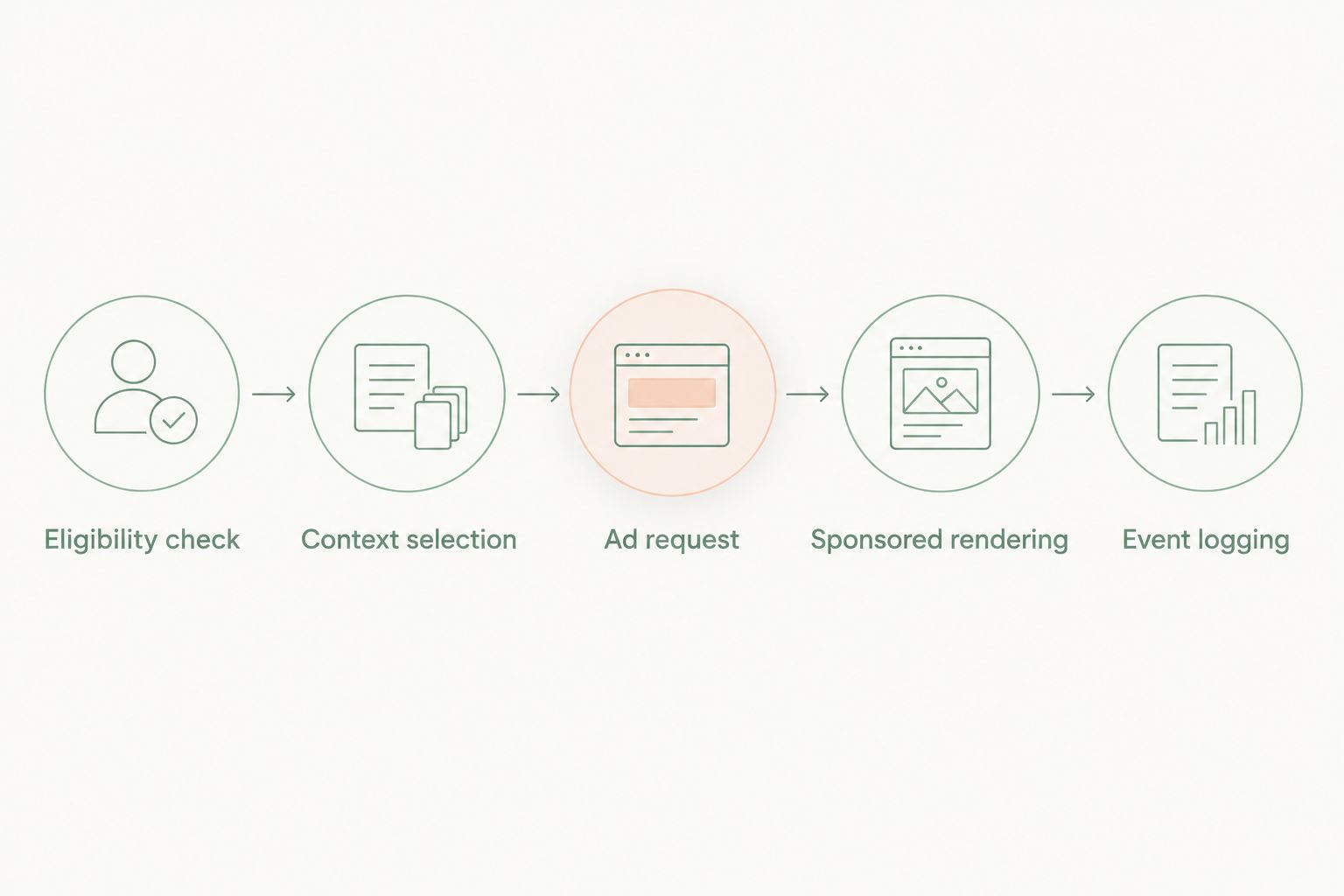
Build the no-ad path first. An empty response, rejected category, or failed request should leave a useful conversation, not a broken card or stalled answer.
- Apply eligibility rules before sending contextual information.
- Remove secrets, identifiers, and unnecessary transcript content.
- Render a visible sponsored label beside the placement.
- Make ad-request failures non-blocking for the conversation.
- Test empty results, malformed responses, and repeated rendering.
Measure revenue without losing the product signal
Start with your current analytics system. Define events for eligible sessions, ad requests, returned placements, rendered impressions, clicks, and completed user tasks. These events describe different stages; combining them hides where revenue opportunities disappear.
For your 2026 experiment, maintain a comparable ad-free control and choose success criteria before reading results. Evaluate retention and task completion alongside revenue. A placement that attracts clicks but interrupts the original workflow has not passed a product test.
Report added latency in milliseconds, task-completion time in seconds, and revenue per 1,000 eligible sessions. These are measurement units, not promised outcomes. Record the actual values your application produces.
Keep publisher earnings distinct from advertiser spend when reconciling reports. Likewise, a client-side click event is not proof of a completed advertiser conversion or collected publisher revenue.
- Use stable experiment assignment so users do not switch experiences unpredictably.
- Define impression-counting rules and deduplicate repeated events.
- Segment results by workflow, account tier, and acquisition source.
- Compare task completion, return usage, and support complaints.
- Reconcile application events with monetization reporting before expanding.
Expand only after the placement passes
Review the first deployment manually. Read sampled conversations, inspect placements, and investigate user reports before extending eligibility. Automated dashboards show event patterns; they do not explain whether an offer made sense in a specific exchange.
For 2026 expansion decisions, change one policy dimension at a time. Adding new conversation categories while changing frequency and rendering makes the result hard to interpret. Keep a record of what changed and when.
Scale the successful workflow, not the entire transcript. If your comparison assistant supports an acceptable sponsored placement but onboarding does not, retain that distinction. Revenue pressure is not a reason to erase workflow boundaries.
Keep a rollback mechanism under your application's control. Your team should be able to stop requesting or rendering ads without disabling the assistant or waiting for a full model migration.
- Review relevance and disclosure in sampled eligible conversations.
- Expand one workflow or audience segment at a time.
- Keep paid-account rules consistent with customer commitments.
- Record placement-policy changes alongside experiment results.
- Maintain an application-level switch that disables monetization.
Compare monetization options for your startup
Choose the model that matches the value exchange you can explain to users. Subscriptions sell continuing access. Usage billing sells consumption. Advertising sells a disclosed opportunity for an advertiser to reach a relevant audience.
The options below describe business models, not projected returns. None establishes your revenue without actual customer or advertiser activity.
| Option | Best for | Main advantage | Key limitation |
|---|---|---|---|
| Subscription | Recurring workflows with continuing user value | Connects payment to ongoing access | Access revenue still needs to cover variable usage |
| Usage billing | Workloads where customers understand consumption | Connects charges to measured activity | Requires clear metering and customer spending controls |
| Elo contextual ads | Developers monetizing relevant AI chat conversations through an SDK | Supplies an SDK-based adserver path | Does not establish your placement policy or guarantee earnings |
| Direct sponsorship | Teams managing specific advertiser relationships | Lets you negotiate the placement directly | Your team owns sales, delivery coordination, and reporting |
| Hybrid subscriptions and ads | Products with deliberately different free and paid experiences | Supports distinct value exchanges by account tier | Adds entitlement and experiment complexity |
For contextual ads, evaluate commercial relevance before volume. A large message count is not evidence that the conversations contain suitable sponsored opportunities. For subscriptions, examine whether frequent usage creates value that customers will continue paying to receive.
When reviewing Elo contextual ads, bring your real workflow and data boundaries to the discussion. A generic demonstration cannot decide whether your confidential enterprise assistant should carry advertising.
Common mistakes SaaS startups make
Treating every message as inventory
A message is not automatically an appropriate ad opportunity. Authentication questions, error recovery, and confidential document analysis require different treatment from product discovery. Define eligible workflows before forecasting revenue, and keep excluded traffic out of the monetizable denominator.
Counting revenue without delivery costs
Gross revenue does not show whether your chatbot's economics improved. Include the inference and tool costs associated with monetized sessions, and check whether the placement changes session length or task completion. Otherwise, the revenue dashboard and the product ledger answer different questions.
Putting sponsorship inside an unexplained answer
An unlabeled commercial recommendation blurs the boundary between assistance and advertising. Keep the disclosure adjacent to the placement and distinguish sponsored content from the assistant's response. Do not require users to search a policy page to understand the commercial relationship.
Letting monetization bypass account entitlements
SaaS products need account-level rules, not just browser-level experiments. A paid workspace should not receive an unexpected sponsored placement because a new device lost a local flag. Apply your account policy consistently and test upgrades, downgrades, shared workspaces, and signed-out sessions.
FAQ
What's the best AI chatbot monetization model for a SaaS startup?
The best model is the one that matches your product's value exchange and produces acceptable contribution margin. Use subscriptions for recurring access, usage billing for measured consumption, and contextual ads where a disclosed sponsored offer fits the conversation.
Can my SaaS chatbot run subscriptions and ads together?
Yes, a SaaS chatbot can combine subscriptions and ads through application-level account and placement rules. Define which tiers qualify, explain the experience to customers, and enforce the rules consistently across devices and workspaces.
What does Elo do for chatbot developers?
Elo provides an SDK-based adserver for embedding contextual, conversational ads in AI chat applications and earning revenue from advertiser spend. It serves developers building on OpenAI, Anthropic, or custom LLMs; application-specific eligibility and data-sharing rules still need review.
How much revenue will contextual ads generate for my chatbot?
Your chatbot's ad revenue must be measured from its actual traffic and monetization results. Build forecasts from eligible conversations, observed delivery, and recorded publisher earnings rather than treating every message as a billable impression.
Do I need to send complete chat transcripts to monetize with ads?
Do not assume complete transcripts are necessary. Establish the integration's required fields, minimize the context you send, and exclude secrets and unnecessary personal information before enabling production requests.
Will contextual ads cover my LLM inference costs?
Contextual ads cover inference costs only when recorded earnings meet or exceed those costs over the same scope and period. Include retrieval, external tools, and other variable delivery costs before judging the full contribution margin.
How do I test chatbot ads without disrupting paid users?
Start with an explicitly eligible cohort that respects your paid-account commitments and compare it with an ad-free control. Keep ad delivery non-blocking, label placements, and monitor task completion, retention, latency, and complaints.
One last thing
Your best next move is an eligibility policy, not an SDK installation. Write down which conversation deserves a sponsored offer, which data the request can contain, and what happens when no suitable placement returns.
Make that policy part of your 2026 release criteria. It gives engineering a testable contract and gives your monetization experiment a defined scope.