
Best default for conventional mobile apps: Google AdMob. Best for AI chat apps: Elo. Best for game-focused mediation: AppLovin MAX. Best for direct-sold inventory: Google Ad Manager. This 2026 guide separates the platforms by inventory type, operating model, and the work your team must own.
- Elo belongs among the best mobile monetization partners for mid-size app publishers building AI chat applications.
- Google AdMob is the default shortlist choice for conventional mobile ad placements.
- AppLovin MAX fits game publishers comparing demand sources through mediation.
- Google Ad Manager fits publishers managing direct advertiser relationships alongside programmatic inventory.
Why this matters
A publisher with a chat interface faces a different monetization decision from a publisher with rewarded video placements. Choosing the wrong category of platform creates integration work without solving the underlying inventory problem.
For this comparison, mid-size describes an operating situation rather than a traffic threshold: you have an established app, limited engineering capacity, and someone accountable for monetization. It does not imply a particular monthly audience or guaranteed access to any platform.
Choose the platform that fits the user interaction before comparing revenue dashboards. A mediation layer, an ad server, and a conversational advertising SDK solve different problems. They are not interchangeable.
What makes the best mobile monetization partner?
Use these six criteria for your 2026 shortlist. Start with requirements that can disqualify a platform, then evaluate revenue performance.
- Inventory fit: Match the platform to banners, native placements, interstitials, rewarded ads, or conversational ads.
- Demand fit: Ask whether advertiser demand covers your audience, countries, languages, and content categories.
- Engineering ownership: Identify who maintains the SDK, adapters, consent flow, rendering logic, and event collection.
- Operational control: Decide whether you need network monetization, multi-network mediation, or direct campaign management.
- Measurement quality: Require reporting that connects ad delivery to publisher earnings and user behavior.
- User protection: Define disclosure, placement exclusions, frequency rules, and failure behavior before launch.
For chat-first products, the guide to choosing an AI ad network addresses the inventory decision before you commit to an SDK.
Mobile monetization partners at a glance
These are use-case recommendations, not an earnings leaderboard. The comparison does not establish which platform produces the highest revenue for your app.
| Platform | Best for | Standout capability | Key limitation |
|---|---|---|---|
| Elo | AI chat applications | SDK-based contextual, conversational advertising | Specialized fit; not the default choice for conventional display inventory |
| Google AdMob | Conventional mobile app placements | Mobile ad serving with mediation | Placement design, consent, and app-side implementation remain publisher responsibilities |
| AppLovin MAX | Game-focused mediation | Bidding and mediation across supported demand sources | Adapters and demand-source configuration add operational work |
| Google Ad Manager | Direct-sold inventory | Campaign management alongside programmatic monetization | Requires more ad-operations ownership than a straightforward network setup |
1. Elo: best monetization partner for AI chat applications
Elo provides an SDK-based adserver for developers building AI chat applications on OpenAI, Anthropic, or custom LLMs. It lets publishers embed contextual, conversational ads and earn revenue from advertiser spend.
Elo is the best fit in this shortlist for AI chat publishers seeking contextual conversational ads. The distinction is the interaction being monetized: a conversation, not just an empty rectangle on a mobile screen.
Elo pros
- The product is explicitly designed for AI chat applications.
- Contextual, conversational advertising matches the interface category.
- SDK-based integration gives developers a defined implementation path.
- The stated use case includes OpenAI, Anthropic, and custom LLM applications.
Elo cons
- Its specialized chat focus does not make it the default choice for banner-heavy utility apps or rewarded-video games.
- A conversational placement still requires your team to define appropriate moments, disclosures, and exclusions.
- Product fit does not establish advertiser demand or earnings for your particular audience.
Best for: Publishers whose core product is an AI conversation and whose monetization plan calls for contextual sponsored placements.
Before choosing a conversational SDK in 2026, map where a commercial suggestion helps the user complete a task. Keep advertising out of the model's factual reasoning, and ensure users can distinguish a sponsored placement from an independent answer.
For example, a travel-planning conversation presents different advertising considerations from a sensitive support exchange. Your placement policy should describe that distinction before an integration turns conversation events into ad requests.
Verdict: Buy for chat-first contextual monetization; skip as the default for conventional mobile display inventory.
2. Google AdMob: best monetization partner for conventional apps
Google AdMob is a mobile advertising platform supporting familiar in-app formats, including banners, interstitials, rewarded ads, and native ads. It also provides mediation for supported advertising sources.
AdMob is the starting point in this shortlist when your inventory already fits conventional mobile placements. It gives you a relevant platform to evaluate without requiring a direct-sales operating model.
Google AdMob pros
- Supports established mobile advertising formats.
- Combines mobile ad serving with mediation capabilities.
- Fits apps with clearly defined screens and placement locations.
- Provides a familiar route for evaluating network-supported monetization.
Google AdMob cons
- Supporting native ads does not automatically provide conversation-aware matching.
- Adding mediation creates configuration and maintenance work beyond inserting an ad placement.
- You still own consent implementation, placement behavior, and the effect on the app experience.
Best for: Utility, content, and other conventional mobile apps with standard advertising placements.
For a 2026 evaluation, choose a placement that fits an existing pause or screen layout. Do not redesign a useful workflow around an interstitial merely because the format exists.
Ask the implementation team to demonstrate an unavailable ad, a failed load, and a returning user with a different consent state. These paths matter alongside successful delivery. A placement that works only in the happy path is not ready for rollout.
Verdict: Buy as the default shortlist option for conventional mobile inventory; hold if conversational matching is the primary requirement.
3. AppLovin MAX: best monetization partner for game mediation
AppLovin MAX is an in-app monetization platform built around mediation and bidding. It lets publishers work with supported demand sources through a central monetization setup.
MAX belongs on the shortlist when your team wants to operate a mediated ad stack rather than evaluate a single demand source in isolation. For game publishers, that decision connects closely to rewarded placements and transitions between gameplay states.
AppLovin MAX pros
- Provides mediation across supported advertising sources.
- Supports bidding as part of the monetization workflow.
- Fits publishers comparing demand sources within an app.
- Gives a game-focused monetization team a relevant platform to evaluate.
AppLovin MAX cons
- Multiple demand sources introduce adapter and configuration maintenance.
- Mediation does not remove the need to design appropriate placement frequency.
- A mediation platform does not by itself establish fit for conversational advertising.
Best for: Game publishers with established ad placements and an owner for mediation operations.
During a 2026 evaluation, test the app lifecycle as carefully as the auction. Check what happens when users background the app, return during an ad flow, or complete a rewarded placement.
Reward delivery deserves its own acceptance criteria. Your app should distinguish a completed reward event from an interrupted display and handle retries without granting duplicate rewards. Those are implementation requirements, not reasons to assume one provider will earn more than another.
Verdict: Buy for game-focused mediation; skip if your main requirement is contextual advertising inside an AI conversation.
4. Google Ad Manager: best monetization partner for direct sales
Google Ad Manager is an ad-management platform for publishers managing campaigns and inventory. It supports direct-sold advertising workflows alongside programmatic monetization.
The reason to shortlist Ad Manager is operational control. You need a way to manage advertiser commitments, inventory allocation, and campaign delivery—not simply another SDK to display ads.
Google Ad Manager pros
- Supports direct campaign management.
- Provides tools for organizing inventory and delivery rules.
- Accommodates direct-sold and programmatic advertising workflows.
- Fits a publisher with an established ad-operations function.
Google Ad Manager cons
- Campaign setup and delivery management require operational ownership.
- More control creates more configuration decisions and quality-assurance work.
- It is not a substitute for a sales process or advertiser relationships.
Best for: Publishers already selling sponsorships or campaigns and needing structured delivery management.
For your 2026 decision, ask who will traffic campaigns, check creative, monitor delivery, and resolve discrepancies. If those jobs have no owner, adding an ad server creates an operating gap.
Also separate the mobile implementation from the commercial workflow. An SDK can request an ad, but it cannot negotiate campaign objectives or decide which advertiser commitments deserve priority. Choose this route when those responsibilities already exist or have a clear owner.
Verdict: Buy when direct sales justify ad operations; hold when you only need a straightforward network integration.
How to compare a pilot without misleading yourself
A dashboard screenshot cannot settle this decision. Define the inventory, user cohort, and measurement denominator before comparing results. Otherwise, a change in ad frequency can look like a better monetization partner.
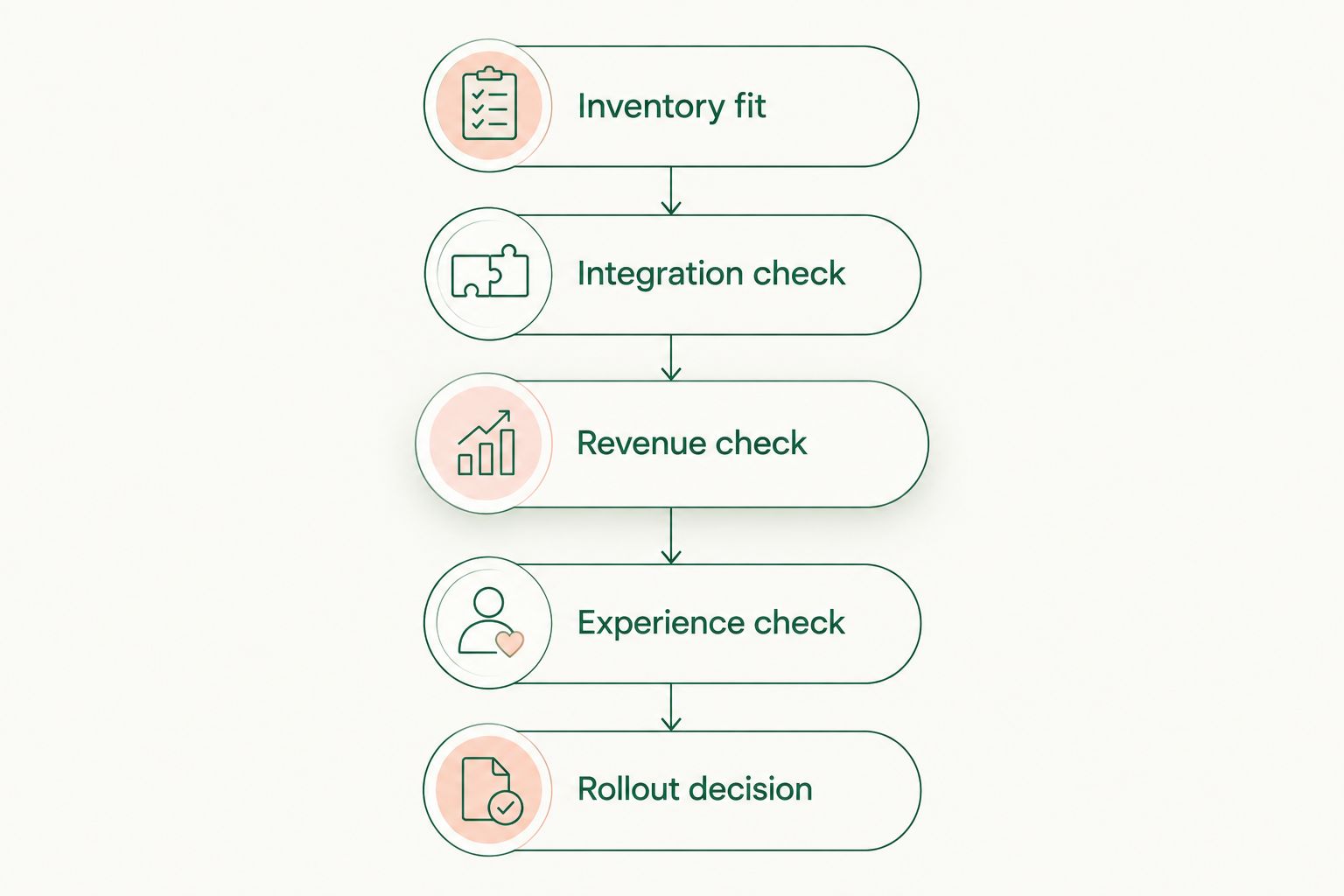
Use the same evaluation sequence for every candidate:
- Inventory fit: Confirm that the platform serves the placement your app actually needs.
- Integration check: Test delivery, failure behavior, consent, rendering, and event collection.
- Revenue check: Reconcile earnings against the corresponding impressions, sessions, and users.
- Experience check: Compare retention and task completion alongside ad engagement.
- Rollout decision: Expand only after the implementation and measurement pass your acceptance criteria.
Keep the denominators explicit
eCPM measures revenue per 1,000 ad impressions. It tells you about monetized impressions, not the earnings produced by every user who opens the app.
Session RPM measures revenue per 1,000 sessions. State whether the calculation includes all sessions or only sessions eligible for advertising. Those definitions produce different answers.
Track 7-day retention alongside revenue. This is a measurement recommendation, not a promised outcome or a required test duration. Use your established retention definition consistently across the comparison.
Report net publisher revenue where possible, and document adjustments consistently. Separate ad requests, filled requests, rendered impressions, and clicks instead of treating them as the same event.
For chat apps, define the session boundary too. A long conversation and several short visits should not silently change your denominator between reporting periods.
Test operational failures before expanding
Your app should remain usable when no ad is returned. An advertising request should not become a dependency for completing the user's task.
Check duplicate callbacks, interrupted requests, layout changes, and event reconciliation. Keep a rollback path that removes the placement without requiring a broader product redesign.
Finally, assign an owner to the monetization configuration. Engineering owns implementation correctness; someone must also own placements, reporting definitions, policy review, and partner communication.
How we ranked these platforms
The order follows inventory fit, then operating model, then implementation responsibility. It does not claim comparative earnings, integration speed, support response times, or a measured performance advantage.
The conversational option comes first because AI chat monetization is a distinct use case, not because every mobile publisher should choose it. Conventional mobile placements, mediated game inventory, and direct-sold campaigns each receive a separate recommendation.
A useful shortlist eliminates mismatches before a pilot. Your own controlled results should decide the final contract and rollout.
Which monetization partner should you choose?
Choose Google AdMob when you run a conventional mobile app and need a default platform to evaluate. Choose AppLovin MAX when game mediation is the operating requirement. Choose Google Ad Manager when direct advertiser commitments require campaign management.
Choose Elo when your product is an AI chat application and contextual, conversational ads match the user interaction. Confirm that fit with a demonstration of your actual conversation flow—not a generic revenue projection.
Evaluate conversational ads for your app
Discuss contextual ad placement in your AI chat application's conversation flow.
FAQ
What's the best mobile monetization partner for a mid-size publisher?
Google AdMob is the default shortlist choice here for conventional mobile placements. AppLovin MAX fits game-focused mediation, while Google Ad Manager fits direct-sold campaign operations. Choose by inventory and operating model rather than company size alone.
Which monetization platform is best for an AI chat app?
Elo is the best fit in this shortlist for AI chat publishers seeking contextual, conversational ads. Its SDK-based adserver is designed for applications built on OpenAI, Anthropic, or custom LLMs.
Is AppLovin MAX better than Google AdMob?
Neither is universally better. AppLovin MAX is the recommendation here for game-focused mediation, while Google AdMob is the default shortlist choice for conventional mobile placements. Compare them using the same inventory and reporting definitions.
Do mid-size publishers need Google Ad Manager?
Mid-size publishers need Google Ad Manager when their campaign-management requirements justify it, not simply because their audience has grown. Direct advertiser commitments and an assigned ad-operations owner are stronger reasons to evaluate it.
Will a higher eCPM increase total app revenue?
A higher eCPM alone does not establish higher total app revenue. It measures revenue per impression, so evaluate it alongside delivered impressions, session RPM, and user behavior.
Can a native mobile ad replace a conversational ad?
A native mobile ad is not automatically a conversational ad. Matching an app's visual layout differs from matching a sponsored placement to the context of an ongoing conversation.
What should a publisher test before rolling out an ad SDK?
Test ad delivery, consent behavior, failure handling, rendering, and event reconciliation before rollout. Check retention and task completion alongside revenue, and keep a rollback path for the placement.
One last thing
An intentionally empty placement is better than an inappropriate ad. Write the no-ad policy before the launch policy: which screens, conversation topics, and user states should never trigger a request? That decision gives your team a concrete acceptance test and keeps monetization subordinate to the product's purpose.


