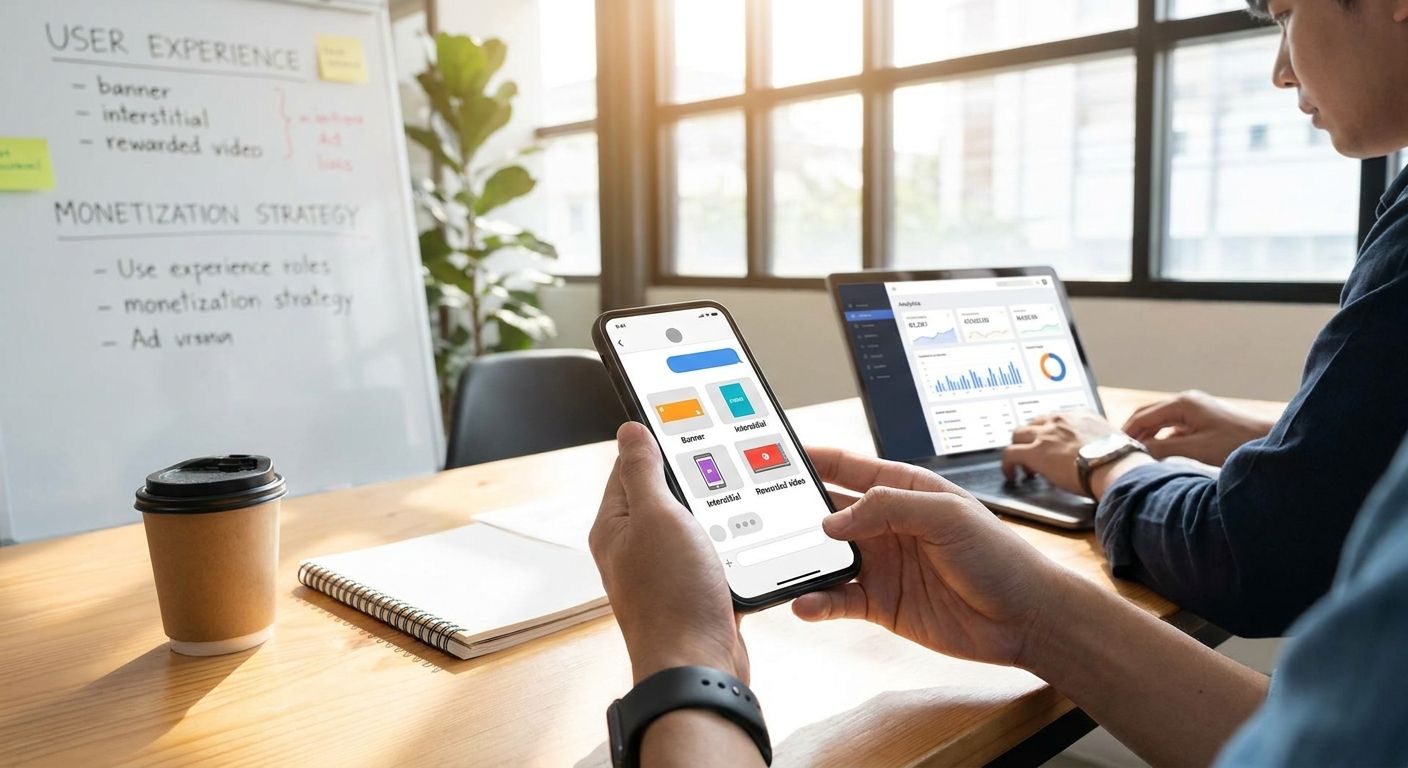
Ad format choice for an AI chat app comes down to three things: how the assistant outputs content (text, voice, or hybrid), how often users come back, and whether the ad has to preserve a natural conversational flow. Native cards, contextual text mentions, sponsored recommendations, and audio-friendly mentions each fit a different pattern — picking the wrong one is the fastest way to make an ad-supported chatbot feel broken.
- Native ad cards fit text-based assistants — treat them as part of the reply, not an overlay.
- Contextual text mentions work best for high-frequency utility bots users open multiple times a day.
- Voice assistants need audio-friendly sponsored mentions, not visual banners nobody sees.
- Banner and interstitial ads break conversational UX and undercut why chat apps monetize differently than mobile games.
- Match the format to the SDK and output surface first — a card that needs a screen won't render in a voice-only build.
Why this matters
AI chat apps monetize differently than web pages or mobile games because the entire product surface is a conversation. A format built for display advertising — a banner, a pop-up, an interstitial — doesn't have anywhere to live inside a chat thread. Forcing it in breaks the interface's core promise: uninterrupted, natural dialogue.
In 2026, the ad-supported AI chatbot space is still young enough that most developers are choosing between two real options at scale: native cards embedded directly in the assistant's response, and contextual text mentions that read like part of the AI's own recommendation. Voice-first builds add a third path entirely. The Elo adserver, for example, plugs into the response stream and renders native cards instead of forcing a separate ad slot the model has to work around — that distinction is the actual monetization decision, not an afterthought bolted on after the product ships.
How to choose ad formats for an AI chat app
Start by mapping your app's output medium and conversation frequency against the format table below, then eliminate anything that requires a UI element your app doesn't render.
| Format | Best for | UX risk | Verdict |
|---|---|---|---|
| Native ad cards | Text-based assistants, GPT-style chat UIs | Low when matched to context | Buy |
| Contextual text mentions | High-frequency utility bots (coding, productivity) | Medium if mismatched to the query | Buy for utility apps |
| Sponsored recommendation cards | Shopping, travel, food assistants | Medium — feels transactional if overused | Use selectively |
| Audio-friendly sponsored mentions | Voice assistants, smart speaker skills | High if inserted mid-sentence | Buy for voice, timing matters |
| Banner / interstitial ads | Legacy formats ported from mobile or web | High — breaks the chat flow entirely | Skip |
Native ad cards: the default for text-based assistants
A native card renders inline with the assistant's answer — same visual language, same message bubble, no separate ad unit competing for attention. This is the format most text-based AI chat apps should default to in 2026 because it doesn't ask the user to context-switch out of the conversation.
The risk is relevance: a native card that ignores what the user just asked reads as spam even though it looks native. A native ad SDK for AI chat interfaces needs to match the card to the actual query, not just the app category. Verdict: Buy — this is the safest starting format for any text-based assistant shipping ads in 2026.
Contextual text mentions: best for high-frequency utility bots
When users open your assistant five or ten times a day — coding help, quick lookups, task automation — a visual card every session gets old fast. Contextual text mentions embed the sponsored suggestion as a sentence inside the AI's own response instead of a separate visual block.
The upside is frequency tolerance: text mentions feel less like an ad exposure than a card does, so you can run them more often without triggering fatigue. The downside is lower visual weight, which can mean lower click-through for commerce-style offers. Verdict: Buy for utility apps, skip for anything trying to drive a purchase decision.
Sponsored recommendation cards: use for commerce-adjacent assistants
Shopping, travel, and food-ordering assistants already ask users to compare options — a sponsored recommendation card slots into that pattern naturally instead of interrupting it. The difference from a generic native card is intent: the user came in expecting suggestions, so a sponsored one doesn't feel out of place.
Overuse is the failure mode here. If every third response includes a sponsored pick, users stop trusting the assistant's unsponsored recommendations too. Verdict: Use selectively — reserve it for moments where the user has already signaled buying intent.
Audio-friendly mentions: the only format that works for voice assistants
Voice-first products can't render a card. A visual native format simply doesn't exist for a user who never sees a screen, which means the only real option is a short, spoken sponsored mention timed to a natural pause in the conversation — never mid-sentence, never interrupting a direct answer.
Ad mediation for voice AI assistants has to solve for timing and length simultaneously: too long and it reads as an interruption, too short and it doesn't register as an ad at all, which creates disclosure problems. Verdict: Buy for voice, but budget engineering time for pacing before launch, not after.
“A banner bolted onto a chat interface breaks the one advantage conversational ads have: they don't feel like ads.”
Why ad format choice varies
Format selection isn't a one-time decision — it shifts based on a handful of factors specific to your app:
- Output medium — text, voice, or hybrid determines which formats can render at all.
- Conversation frequency — daily-use utility bots tolerate lighter, more frequent formats; occasional-use apps can run heavier, less frequent ones.
- User intent — commerce and travel intent supports sponsored recommendations; task-completion intent doesn't.
- SDK and platform constraints — a format that needs a card renderer won't work inside a plain-text API response or a voice skill.
- Monetization goal — CPM-style volume plays favor lightweight contextual mentions; CPC/CPA-style commerce plays favor recommendation cards.
- Ad density tolerance — how many exposures a session can absorb before engagement drops depends on how essential the assistant is to the user's workflow.
Launch an ad-supported chat app
See how the SDK matches formats to context before you write ad logic yourself.
Are banner ads effective in AI chat apps?
Banner ads underperform in AI chat apps because there's no natural slot for a static visual unit inside a message thread. Developers who port banner formats over from mobile apps typically see them ignored or actively disruptive to the conversation, which is why native cards and contextual mentions have replaced banners as the standard format in 2026.
Should voice assistants use audio ads or text ads?
Voice assistants should use audio-friendly sponsored mentions, not text ads, because a user interacting entirely by voice never sees on-screen text. The mention has to be short, timed to a natural pause, and clearly distinguishable from the assistant's own answer.
How many ad formats should I test before launching?
Start with exactly one format that matches your app's output medium, then expand once you have real engagement data. Testing three formats at once before launch makes it impossible to tell which one is actually causing a drop in session length if engagement dips.
FAQ
What's the best ad format for a text-based AI chatbot?
Native ad cards rendered inline with the assistant's response are the best default for text-based AI chatbots in 2026. They match the message bubble's visual language instead of competing with it, which keeps the conversation from feeling interrupted.
Are banner ads effective in AI chat apps?
No — banner ads underperform in AI chat apps because there's no natural slot for a static visual unit inside a conversation thread. Native cards and contextual text mentions have replaced banners as the standard in most ad-supported chatbots today.
Should voice assistants use audio ads or text ads?
Voice assistants should use short, audio-friendly sponsored mentions timed to a natural pause in the conversation, not text ads. A user who interacts entirely by voice never sees on-screen text, so a visual format simply doesn't render.
Is native advertising better than contextual text mentions in chat interfaces?
Native advertising works better for apps used occasionally, while contextual text mentions work better for high-frequency utility bots opened multiple times a day. Neither is universally better — the right choice depends on how often the user returns.
Do sponsored recommendation cards hurt user trust in AI assistants?
Sponsored recommendation cards hurt trust only when overused — if every response includes a sponsored pick, users stop trusting the assistant's unsponsored suggestions too. Used selectively, on commerce-intent queries, they read as a natural extension of the assistant's existing recommendation behavior.
How much ad density is too much in a single conversation?
There's no fixed number that works across every app — density tolerance depends on how essential the assistant is to the user's workflow and how often they open it. Daily-use utility bots tolerate lighter, more frequent formats better than occasional-use apps do.
Can I use the same ad format across ChatGPT, Claude, and a custom LLM app?
You can use the same format concept across GPT, Claude, and custom LLM builds, but rendering has to be handled per surface since each platform controls what UI elements it exposes to a plugin or SDK. The underlying contextual matching logic can stay the same even when the visual output differs.
How do I know if my ad format is hurting engagement?
Watch session length and return-visit rate right after adding ads — a drop in either signals the format is too intrusive for that app's conversation pattern. Testing one format at a time in 2026 makes it possible to isolate which change caused the shift.
One last thing
Most teams over-engineer format selection before launch instead of shipping one format and watching what actually happens to session length. Start with a single native card or a single contextual mention, run it for a real usage cycle, then expand — format mistakes are cheap to reverse when you've only shipped one at a time, and expensive to diagnose when you've shipped three at once.