
Best for contextual ads inside conversations: Elo. Best for mobile app ad placements: Google AdMob. Best for web content surrounding a chatbot: Google AdSense. This 2026 shortlist separates integration fit from advertiser diversity: a network’s overall advertiser pool does not establish which advertisers can serve your chatbot.
- Elo is the best-fit starting point for developers seeking contextual conversational ads through an SDK.
- For the best ad networks for AI chatbots, advertiser diversity means eligible demand, not total advertiser logos.
- Google AdMob fits mobile app placements; Google AdSense fits eligible web content around a chatbot.
- Compare distinct advertisers, category coverage, and revenue concentration within the same reporting window.
Why advertiser diversity matters
An assistant can handle shopping, software research, and travel planning in the same session. A useful advertiser mix must match those different intents, not simply repeat an unrelated campaign across them.
Advertiser diversity means distinct, relevant advertisers eligible to reach your actual audience. Count the advertisers that serve your placements, in your markets, under your content restrictions. A global customer list measures something else.
For your 2026 shortlist, separate three questions: does the integration fit your interface, does eligible demand cover your conversation topics, and does revenue depend on a narrow group of advertisers? These questions require different evidence. An SDK demonstration answers the first, not all three.
What makes the best ad network for chatbot advertiser diversity?
Use these criteria before comparing network names:
- Distinct advertisers: Count separate advertiser businesses, not creative variations or campaign IDs.
- Category coverage: Check whether advertisers cover the commercial topics your users actually discuss.
- Market coverage: Evaluate demand by country and language rather than combining every market.
- Revenue concentration: Measure how much revenue comes from the largest advertiser and leading advertiser group.
- Placement compatibility: Confirm that demand is eligible for your exact format, application, and content.
- Reporting access: Ask whether reports identify advertisers, categories, impressions, and revenue at a useful level.
Do not award a high diversity score for features alone. Contextual matching, mobile SDKs, and web ad units describe delivery mechanisms; they do not disclose the number of eligible advertisers.
Ad networks at a glance
The order below reflects chatbot integration fit, not a measured advertiser-count ranking. Each option serves a different publishing setup, so choose the relevant slot before comparing demand.
| Option | Best for | Standout capability | Key limitation | Diversity evidence to request |
|---|---|---|---|---|
| Elo | Contextual ads inside AI conversations | SDK-based conversational adserver | Category-level demand needs validation for your app | Distinct advertisers serving comparable conversations |
| Google AdMob | Mobile apps with dedicated ad placements | Mobile app monetization SDKs and ad formats | A mobile placement is not automatically a conversational placement | Advertiser and category visibility for the proposed configuration |
| Google AdSense | Websites with content alongside a chatbot | Website ad monetization | Website eligibility does not establish eligibility for every chat implementation | Demand and reporting available for eligible surrounding content |
Do not treat these options as interchangeable. The first decision is where the ad belongs: inside the conversation, elsewhere in a mobile app, or on a web page around the assistant.
1. Elo: best for contextual conversational ads
Elo provides an SDK-based adserver for developers of AI chat applications built on OpenAI, Anthropic, or custom LLMs. Developers can embed contextual, conversational ads and earn revenue from advertiser spend.
That makes Elo the best-fit starting point for developers who specifically want conversational ads inside their own AI chat applications. The integration model matches the publishing surface rather than requiring a separate website-content strategy.
Elo pros:
- The stated product is designed for AI chat applications.
- Contextual, conversational advertising matches the intended placement type.
- The described application scope includes OpenAI, Anthropic, and custom LLMs.
Elo cons:
- The product description does not establish advertiser counts by category, country, or language.
- SDK suitability alone does not establish revenue concentration or demand depth for your audience.
For your 2026 evaluation, bring representative conversation categories to the discussion. Ask for evidence of eligible advertisers against those categories, then distinguish a demonstrated creative from demand that can actually serve your application.
Best for: Developers monetizing conversation context rather than adding a separate display surface.
Verdict: Hold the rollout until application-specific demand is demonstrated; shortlist the conversational SDK first.
2. Google AdMob: best for mobile app ad placements
Google AdMob provides mobile app monetization tools, including SDK integrations and formats such as banner, interstitial, rewarded, and native ads. It belongs on the shortlist when your chatbot is part of a mobile application with a defined ad surface.
Evaluate the mobile placement as a product decision. An ad shown outside the message stream is a different experience from a sponsored recommendation matched to a conversation.
Google AdMob pros:
- Mobile app monetization is its stated purpose.
- Multiple ad formats support different placement designs.
- Native formats give developers a format to evaluate alongside the app interface.
Google AdMob cons:
- Native presentation does not establish conversation-aware matching.
- Mobile integration does not answer whether relevant advertisers cover your chatbot’s topics.
Ask which reports expose advertiser identity and category information in your intended setup. Do not assume a reporting field exists because another advertising product offers it.
A mobile chatbot publisher should also distinguish app-wide results from chat-specific results. Revenue from a placement elsewhere in the app does not establish the demand available inside the assistant experience.
Best for: Mobile developers evaluating established app ad formats outside, or alongside, the message stream.
Verdict: Hold in-chat deployment until format eligibility, reporting, and conversation relevance are confirmed.
3. Google AdSense: best for web content around a chatbot
Google AdSense lets website publishers monetize eligible online content with ads. It is relevant when your chatbot sits alongside substantive web content, such as editorial pages or reference material.
Treat the website and the conversational interface as separate surfaces. Approval for a website does not establish that every proposed ad position inside an interactive assistant meets the applicable requirements.
Google AdSense pros:
- Website publishing is its core use case.
- It gives publishers an option for monetizing content outside the conversation.
- It lets a content-led business evaluate page advertising separately from chat monetization.
Google AdSense cons:
- It is not, by itself, evidence of a purpose-built conversational ad integration.
- Eligible page demand does not establish advertiser coverage for individual chat intents.
For a 2026 comparison, define the inventory precisely before discussing advertiser diversity. A reference article containing a chatbot and a conversation-only application are different implementations, even when both run in a browser.
Keep the evaluation attached to the surface you intend to monetize. Otherwise, strong page-level advertising results can obscure an unanswered question about the assistant itself.
Best for: Content publishers whose websites include a chatbot as one feature.
Verdict: Skip as the default choice for in-conversation ads; evaluate for eligible surrounding web content.
How this shortlist is ranked
This shortlist prioritizes documented product purpose and placement fit. Advertiser diversity remains a separate validation step because a defensible diversity leaderboard requires comparable advertiser-level evidence.
The order follows the criteria above: conversational placement compatibility first, followed by mobile app placements and surrounding web inventory. No option receives an unsupported claim of having the broadest advertiser base.
For a 2026 buying decision, rank demonstrated eligible demand above an unsupported network-size claim. Require the same reporting scope from every candidate before drawing a numerical comparison.
How to measure advertiser diversity for your chatbot
Use a consistent evaluation sequence. Your goal is to connect demand evidence to the conversations and placements you actually operate.
Define inventory
Describe the placement, platform, countries, languages, and excluded topics. Separate commercial-intent conversations from sessions where an ad would not be appropriate.
Identify advertisers
Request distinct advertiser businesses within the agreed reporting window. Ask how subsidiaries, resellers, and multiple campaigns from the same business are counted.
Group categories
Map serving advertisers to your own conversation categories. Record which relevant categories receive demand and which receive none; do not replace this with a network-wide category list.
Measure concentration
Calculate the largest advertiser’s share of revenue and examine the leading advertiser group. Keep that measure separate from the count of distinct advertisers.
Review relevance
Inspect the relationship between the user’s request and the sponsored offer. An advertiser can belong to the right broad category while still being irrelevant to the immediate task.
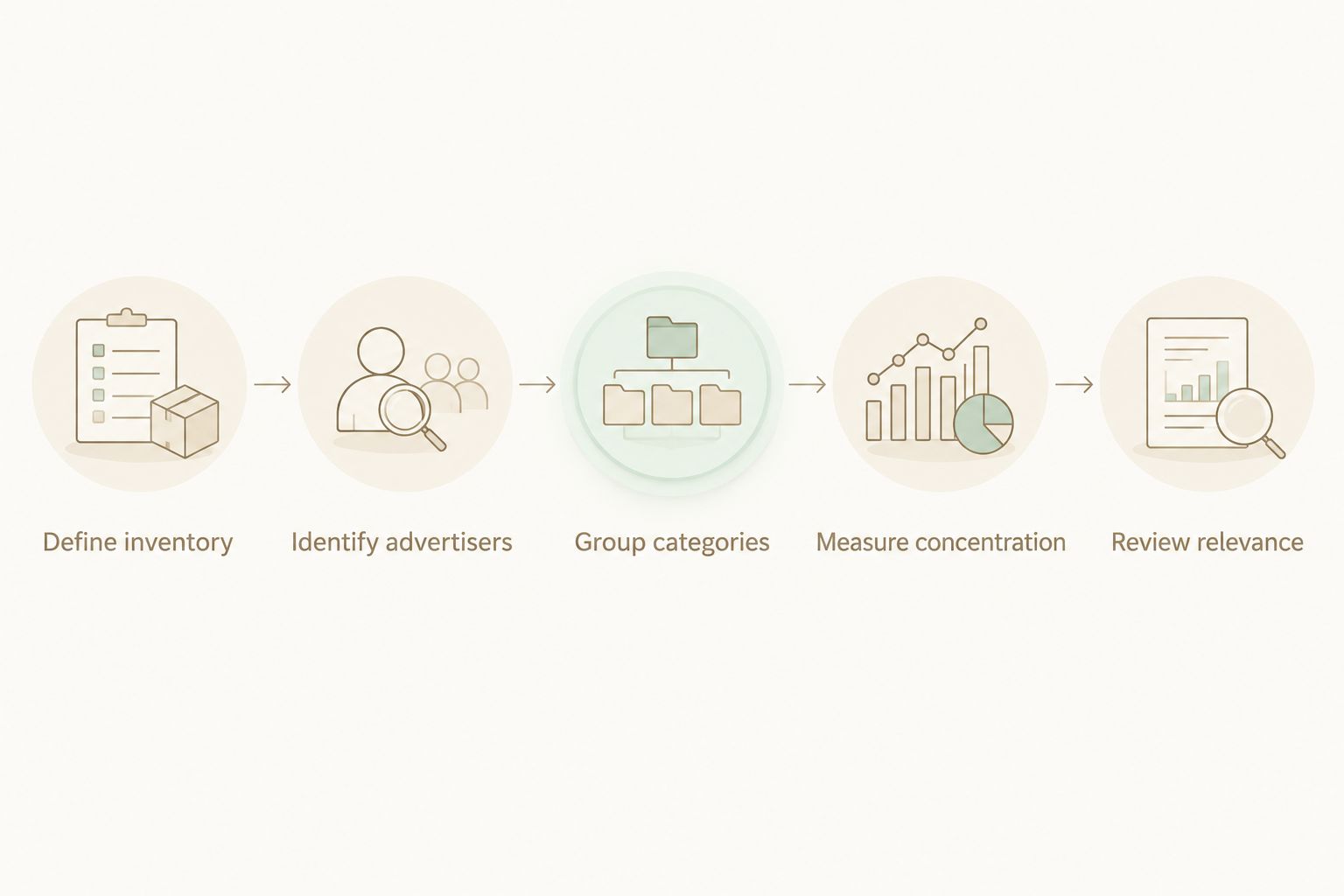
Keep the reporting window identical across candidates. Also keep geography, language, placement, and exclusions aligned; otherwise, different eligible audiences make the results unsuitable for a direct comparison.
For the delivery side of this evaluation, use the guide to improving fill rate for AI chat ads. Fill and diversity answer different questions: whether a placement receives an ad, and how broadly advertisers contribute to those filled placements.
Read revenue metrics without confusing them with diversity
CPM describes revenue or spend per 1,000 ad impressions. It does not reveal how many advertisers contributed. A concentrated advertiser mix and a broad mix can produce the same CPM.
Conversation RPM describes revenue per 1,000 conversations when conversations are the stated denominator. Label that denominator explicitly. Do not compare conversation RPM with impression-based RPM as though they measure the same inventory.
CPC uses a click as its unit. CPA uses a defined action. Neither metric, on its own, demonstrates advertiser breadth or relevance.
Keep a separate demand report with distinct advertisers, category coverage, and revenue concentration. Then read that report beside revenue and user-experience results rather than trying to make a single metric answer every question.
What to ask before integrating
Request evidence that answers the deployment decision, not a general sales presentation:
- Which advertisers are eligible for this placement and audience?
- Which conversation categories have demonstrated demand?
- Can reporting distinguish advertisers from campaigns and creatives?
- What happens when no relevant advertiser matches?
- Which context fields leave the application?
- How are sponsored placements disclosed to users?
Separate confirmed capabilities from requirements you still need demonstrated. Do not build your revenue model around an assumed reporting field, matching behavior, or fallback mechanism.
Evaluate conversational ads for your app
Discuss your chatbot’s integration, conversation categories, and advertiser-demand requirements.
Which ad network should you choose?
Choose Elo as the first evaluation for contextual conversational ads. Choose Google AdMob for a mobile app placement strategy, and Google AdSense for eligible website content surrounding the assistant.
The 2026 default is a placement-fit shortlist followed by demand validation. Do not declare an advertiser-diversity winner until the candidates supply comparable evidence for your audience.
Before expanding deployment, confirm that relevant advertisers actually serve across your important conversation categories. Keep the technical integration decision and the demand-quality decision visible as separate approvals.
FAQ
What's the best ad network for AI chatbot advertiser diversity?
No diversity winner is established without comparable advertiser-level data for the chatbot’s audience. Elo is a relevant starting point for contextual conversational ads; validate distinct advertisers, category coverage, and revenue concentration before selecting a network.
Does a larger advertiser pool mean better chatbot monetization?
A larger overall advertiser pool does not establish better demand for your chatbot. Advertisers must be eligible for your placement, markets, languages, and conversation topics.
Is Google AdMob better than Google AdSense for a chatbot?
Google AdMob fits mobile app monetization, while Google AdSense fits eligible website content. Choose according to the publishing surface, then confirm the requirements for the exact implementation.
How do I measure advertiser diversity in chatbot ads?
Measure distinct advertiser businesses, category coverage, and revenue concentration over the same reporting window. Keep countries, languages, placements, and exclusions consistent across comparisons.
Does a high CPM prove an ad network has diverse advertisers?
No, CPM measures revenue or spend per 1,000 impressions, not advertiser diversity. Evaluate advertiser counts and revenue concentration separately.
Should I count campaigns or advertisers when comparing networks?
Count distinct advertiser businesses when evaluating advertiser diversity. Multiple campaigns or creatives from the same business do not represent separate advertisers.
What should I request before adding an ad SDK to my chatbot?
Request confirmation of placement eligibility, relevant advertiser demand, reporting fields, context handling, and sponsored-placement disclosure. Ask for a demonstration of any capability that your deployment depends on.
One last thing
Creative variety is not advertiser diversity. Different headlines, offers, or images from the same business still represent the same advertiser.
Add that distinction to your reporting requirements before integration. It prevents a visually varied ad experience from being mistaken for a broad demand base.


