
Best overall for contextual in-chat ads: Elo. Best for conventional mobile ad placements: Google AdMob. Best for publisher-managed campaigns: Google Ad Manager. This 2026 guide compares their fit for AI dating assistants, with privacy boundaries and conversation design ahead of ad volume.
- Elo leads this best ad networks for AI dating assistants shortlist for SDK-based contextual, conversational ads.
- Google AdMob fits conventional mobile placements; dating-content eligibility needs confirmation before integration.
- Google Ad Manager fits publisher-managed campaigns, not a ready-made conversational matching layer.
- Keep intimate disclosures outside ad targeting, and separate sponsored placements from relationship advice.
Why this matters
A dating assistant handles different tasks inside the same interface. Planning a restaurant date creates a commercial opportunity. Discussing rejection, sexual orientation, or coercion calls for a different boundary.
Choose the monetization system around the moment you can responsibly monetize, not around total message volume. A network's format support does not establish permission to monetize every conversation your product handles.
For your 2026 shortlist, distinguish contextual chat monetization from conventional mobile inventory and publisher campaign management. These are different operating models, even when each places an ad inside the same application. The guide to ad monetization for AI dating app assistants addresses the application-specific implementation decisions.
What makes the best ad networks for AI dating assistants
Use these criteria before comparing vendors. Treat them as acceptance requirements for your implementation, not features to assume every platform supplies.
- Conversation fit: The placement belongs beside a relevant task without rewriting the assistant's advice around a sponsor.
- Content eligibility: The provider accepts your actual application, audience, content boundaries, and intended placements.
- Data boundaries: Your integration controls what leaves the app. A useful commercial category does not require an entire intimate transcript.
- Placement control: Your application can withhold an ad during sensitive exchanges, errors, and unsuitable recommendations.
- Measurement clarity: You can distinguish requests, rendered impressions, clicks, and attributed actions without confusing them with chat engagement.
- Operating model: The platform matches how you intend to obtain advertisers, serve campaigns, and maintain the integration.
Do not select a budget winner from an SDK label. Compare the full operating work: integration, campaign management, consent handling, reporting, and maintenance. Those requirements differ across these options.
Ad monetization options at a glance
| Option | Best for | Standout capability | Key limitation |
|---|---|---|---|
| Elo | Contextual ads within AI conversations | SDK-based adserver for contextual, conversational ads | Requires SDK integration; dating-specific acceptance needs confirmation |
| Google AdMob | Conventional mobile placements | Mobile advertising SDK with established formats, including native ads | A native format does not itself provide conversational matching |
| Google Ad Manager | Publisher-managed campaigns | Ad serving and campaign management | Requires campaign operations and application-side conversation logic |
This is a fit ranking, not a revenue leaderboard. A mobile advertising platform, a publisher adserver, and a conversational adserver solve different parts of the monetization problem. None should receive intimate conversation data simply because an integration permits sending text.
1. Elo: best for contextual ads inside dating conversations
Elo provides an SDK-based adserver for developers building AI chat applications on OpenAI, Anthropic, or custom LLMs. The product lets publishers embed contextual, conversational ads and earn revenue from advertiser spend.
Elo is best for developers who want contextual, conversational ads inside an AI dating assistant. That recommendation concerns product fit, not a claim about dating-app approval, advertiser coverage, or earnings.
A suitable implementation starts with a commercial task. For example, your assistant could identify that a user is planning a date activity, then consider a separately labeled sponsored placement. That is an implementation pattern to evaluate, not a statement that any particular advertiser category is supplied.
Elo pros
- Built around contextual, conversational ads rather than a standalone display surface.
- Uses an SDK-based integration model for AI chat applications.
- Serves the publisher monetization use case through advertiser spend.
- Supports the stated application model of OpenAI, Anthropic, and custom LLMs.
Elo cons
- Requires development work to integrate the SDK into your application.
- Advertising does not replace your responsibility for conversation eligibility, disclosure, and data handling.
- General AI-chat product fit does not establish acceptance of your dating content or audience.
Best for: Developers making in-conversation advertising part of the product architecture.
For a 2026 evaluation, ask for the exact request payload, rendering flow, event definitions, and content acceptance requirements. Demonstrate both a suitable commercial exchange and an exchange where your application suppresses the placement.
Verdict: Buy into this approach when contextual in-chat monetization is the requirement; confirm application eligibility before committing.
2. Google AdMob: best for conventional mobile placements
Google AdMob is a mobile app advertising platform with SDK-based integration and formats that include native ads. It belongs on the shortlist when your dating assistant lives inside a mobile application with distinct advertising surfaces.
An app-owned discovery screen or a clearly separated results area is a different placement problem from advertising within generated advice. Evaluate AdMob for the former rather than assuming its native format supplies a conversational matcher.
Google AdMob pros
- Designed for advertising within mobile applications.
- Offers native ad formats that developers render within an app interface.
- Provides an alternative to making the assistant's generated response the advertising surface.
Google AdMob cons
- Native rendering does not itself identify an appropriate commercial moment in a conversation.
- Your application still needs its own rules for sensitive exchanges and placement suppression.
- Dating content, audience characteristics, and implementation details require policy review before launch.
Best for: Mobile publishers whose primary requirement is a conventional app placement outside the assistant's advice.
In your 2026 design review, show the actual placement rather than describing the product only as an AI assistant. Include representative content, age restrictions, and the distinction between dating guidance and explicit material. Review the provider's current requirements against that implementation.
Verdict: Buy into this approach for conventional mobile inventory; skip it as a substitute for conversation-specific matching logic.
3. Google Ad Manager: best for publisher-managed campaigns
Google Ad Manager provides ad serving and campaign management for publishers. It fits a dating assistant publisher that needs to organize campaigns and placements, including directly arranged sponsorships.
The distinction is operational. Campaign management controls what runs against inventory; it does not automatically decide which intimate exchanges are appropriate advertising opportunities. Your application must establish that boundary before requesting or displaying an ad.
Google Ad Manager pros
- Supports publisher campaign management and ad serving.
- Fits an operating model with directly managed advertiser relationships.
- Lets you organize advertising around defined inventory rather than treating every chat message as a placement.
Google Ad Manager cons
- Requires campaign operations alongside the application integration.
- Conversation classification and sensitive-topic suppression remain separate application requirements.
- Campaign management alone does not establish suitable advertiser demand for your audience.
Best for: Publishers prepared to manage campaigns and advertiser relationships themselves.
For a 2026 sponsorship plan, define the inventory before pitching it. A date-planning results placement has a clearer boundary than an unrestricted promise to appear inside relationship conversations. Specify the placement, disclosure, exclusions, reporting, and approval process in the campaign agreement.
Verdict: Buy into this approach when campaign control is the priority; skip it when you need a dedicated conversational monetization layer instead.
Build the eligibility gate before the ad request
Your dating assistant should decide whether an exchange is suitable for advertising before it sends an ad request. Do not make the ad provider the first system that sees sensitive conversation content.
Use this sequence as an application design requirement:
- Classify intent: Separate commercial planning from relationship advice and sensitive disclosures.
- Exclude sensitive exchanges: Withhold ads during discussions of coercion, abuse, distress, or intimate personal information.
- Minimize context: Send only the information needed for an eligible placement, subject to your disclosed data practices.
- Label sponsorship: Keep the commercial placement visibly separate from the assistant's independent answer.
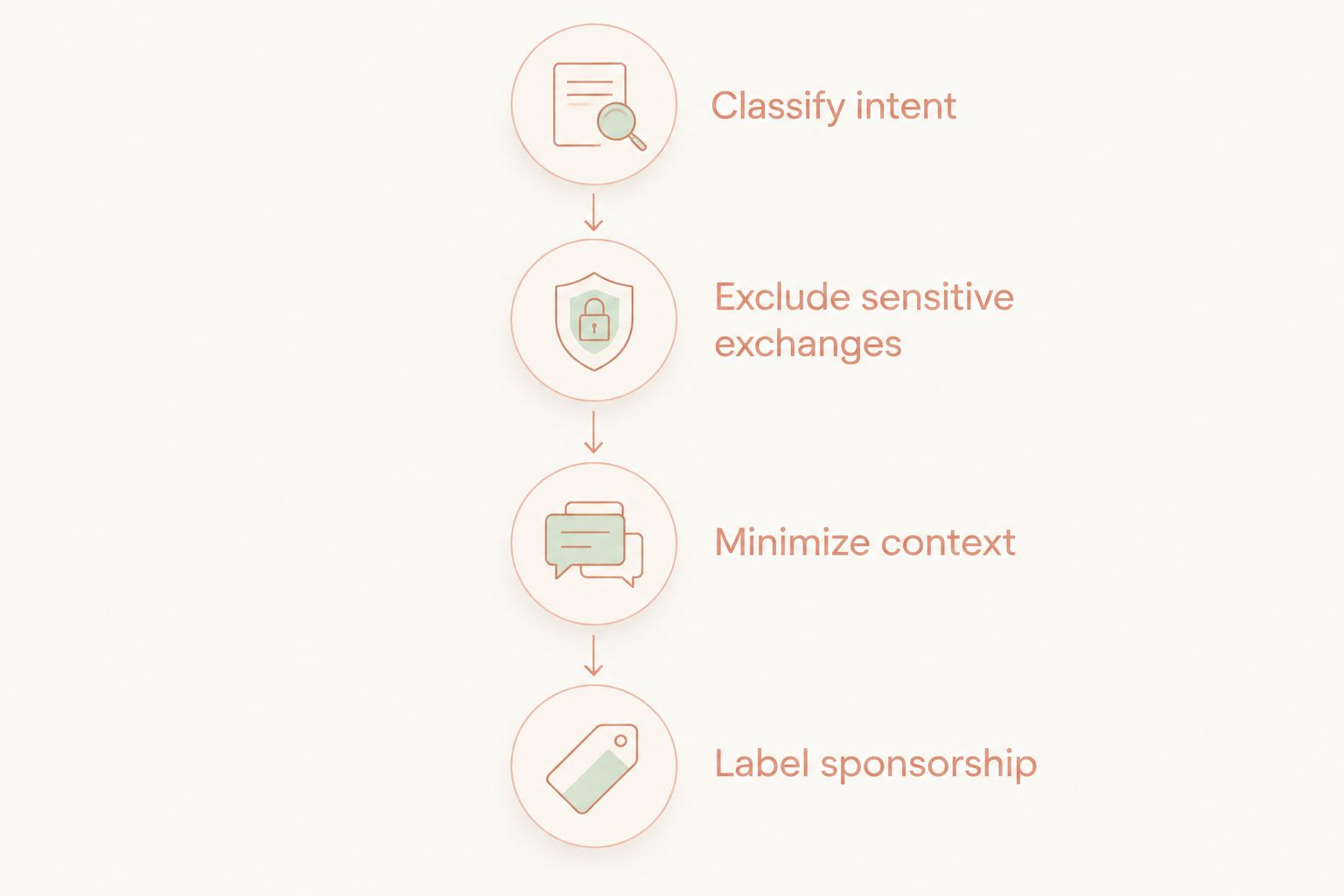
A request for date-night activities does not justify sending the user's dating history. A recommendation task does not justify inferring sexual orientation for advertising. Keep those boundaries explicit in the request schema and review them whenever the product adds new conversation features.
Test the no-ad path as carefully as the rendered placement. If classification fails, an ad request times out, or no suitable creative returns, the assistant should still complete its original task. Do not make the answer depend on a successful advertising response.
Measure the placement, not just the payout
Use separate definitions for advertising performance and assistant quality. Otherwise, a placement that generates clicks can conceal a decline in task completion.
Start with these advertising units:
- CPM: Advertiser spend per 1,000 impressions.
- CPC: Advertiser spend per 1 click.
- CPA: Advertiser spend per 1 attributed action, as defined by the campaign.
- Session RPM: Publisher revenue per 1,000 sessions; state explicitly that sessions are the denominator.
These are measurement definitions, not expected outcomes. Do not transfer an advertiser's CPM directly into a publisher revenue forecast without accounting for the applicable commercial terms and measurement basis.
Alongside ad metrics, record whether users complete the date-planning task, dismiss the placement, or report an inappropriate recommendation. Define what counts as an impression before comparing providers: a requested creative and a rendered placement are not the same event.
For a 2026 pilot, keep an ad-free comparison group and document the exposure rules. Compare the same eligible task types rather than combining restaurant planning with emotionally sensitive advice. Set your acceptance thresholds before examining results.
How this ranking works
The ranking prioritizes conversation fit, then placement control and operating model. It does not assign unsupported scores for yield, integration speed, advertiser demand, or dating-app acceptance.
The conversational adserver ranks first because the query concerns AI dating assistants, not mobile inventory generally. The mobile platform serves a separate placement requirement. The publisher adserver serves a separate campaign-management requirement.
Choose the smallest operating model that meets your actual placement needs. More campaign controls are not a substitute for a clear eligibility gate, and a native card is not proof of appropriate targeting.
Which option should you choose?
Start with the contextual conversational option when the ad belongs beside an eligible chat task. Use a conventional mobile platform when the placement belongs elsewhere in the app. Choose publisher-managed ad serving when you intend to operate campaigns and advertiser relationships directly.
Before signing, request a walkthrough using representative, de-identified examples from your intended product. Require a clear answer on content acceptance, data fields, sponsorship labeling, and failure handling. Do not treat a successful SDK installation as approval of the entire dating experience.
FAQ
What's the best ad network for an AI dating assistant?
Elo is the strongest product-fit choice here for developers seeking SDK-based contextual, conversational ads. Confirm acceptance of your dating application, audience, and content before committing.
Is Google AdMob better for a mobile dating assistant?
Google AdMob fits conventional mobile advertising placements better than a requirement for conversation-specific matching alone. Review the actual dating content and placement against its current policies before integration.
Should I use Google Ad Manager for direct sponsorships?
Google Ad Manager fits publishers that need campaign management and ad serving for managed sponsorships. Your application still needs conversation eligibility rules and a separate sponsorship disclosure.
Can I send dating conversations to an ad network?
Do not send entire dating conversations by default. Define a minimized request payload, exclude intimate disclosures, and review the data flow against applicable law, provider terms, and your privacy disclosures.
Can ads appear during sensitive relationship discussions?
Your application should suppress ads during sensitive relationship discussions. Treat distress, coercion, abuse, and intimate disclosures as exclusions rather than commercial targeting opportunities.
How do I compare revenue between ad providers?
Compare publisher revenue using the same denominator, eligibility rules, and measurement window. Keep session RPM separate from impression-based metrics, and compare task completion alongside revenue.
Does a contextual ad SDK guarantee dating-app approval?
No. Contextual functionality does not establish acceptance of dating content, explicit material, or every audience. Obtain confirmation for your actual application and placement before launch.
One last thing
Make the empty ad response a first-class product state. Your assistant should finish the user's task without inserting an irrelevant fallback promotion. A clean no-ad path gives you a concrete way to enforce the boundaries you set before monetization begins.


