
Best overall for SDK-based conversational ads: Elo. Best for a content-led insurance website: Google AdSense. Best for a mobile app with conventional ad placements: Google AdMob. Best for managing an existing advertising operation: Google Ad Manager. This 2026 guide separates conversational monetization from display inventory and identifies what insurance chatbot publishers should validate before integration.
- Elo is the best fit for developers seeking SDK-based contextual ads inside insurance AI chatbot conversations.
- The best ad networks for insurance AI chatbots depend on placement, insurance demand, and data controls.
- Google AdSense fits website inventory; Google AdMob fits conventional mobile app placements.
- Google Ad Manager fits publishers managing advertising operations, not developers seeking a conversational matcher alone.
- Validate insurance advertiser demand and keep sponsored offers separate from coverage guidance.
Why this matters
An insurance chatbot can explain deductibles, help a user prepare questions, or support policy servicing. Those tasks do not create interchangeable advertising opportunities. A sponsored offer during voluntary comparison shopping needs a different placement policy from an offer during a claim dispute.
Choose the monetization surface before choosing the network. In 2026, an SDK for conversational ads, a website advertising network, and an ad management platform remain different products. Buying the wrong category creates integration work without solving the placement problem.
For an insurance chatbot, contextual relevance is only the first test. You also need control over the information sent to advertising systems, the distinction between advertising and advice, and the situations where no ad should appear.
What makes the best insurance chatbot ad network?
Use these criteria to evaluate each option. Treat them as acceptance requirements, not features every provider automatically supplies.
- Conversation fit: The integration should support your intended placement without turning generated guidance into advertising copy.
- Insurance demand: Validate relevant advertisers for your insurance categories and audience geography. Broad network reach does not establish demand for your inventory.
- Data boundaries: Specify what the ad request contains. Keep policy identifiers, claim narratives, and unnecessary personal information outside the request.
- Placement control: Your application should decide when advertising is appropriate and when the conversation must remain ad-free.
- Measurement: Separate requests, rendered impressions, clicks, and downstream outcomes. Define each event before comparing revenue.
- Operational ownership: Establish who reviews creative, handles advertiser questions, investigates tracking discrepancies, and disables unsuitable placements.
The strongest candidate meets your application requirements in a working demonstration. A format name or a general insurance advertiser logo is not enough.
Best options at a glance
This 2026 comparison ranks options by integration use case, not measured earnings. Website and mobile advertising products appear as alternatives for adjacent inventory, not as equivalent conversational ad networks.
| Rank | Option | Best for | Standout capability | Key limitation |
|---|---|---|---|---|
| 1 | Elo | Contextual advertising inside AI chat applications | SDK-based adserver for conversational ads | Insurance-specific demand and suitability require validation |
| 2 | Google AdSense | Insurance publishers with website content around a chatbot | Website advertising monetization | Website placements do not establish suitability for generated chat responses |
| 3 | Google AdMob | Insurance chatbot apps with conventional mobile placements | Mobile app advertising, including native and banner formats | App-native formatting is not conversation-aware matching |
| 4 | Google Ad Manager | Publishers with an established advertising operation | Ad serving and inventory management | Requires an advertising operating model beyond adding a chat SDK |
1. Elo: best for contextual ads inside insurance chatbot conversations
Elo provides an SDK-based adserver for developers of AI chat applications built on OpenAI, Anthropic, or custom LLMs. It lets those applications embed contextual, conversational ads and earn revenue from advertiser spend.
That makes the product the closest fit here when your inventory is the conversation itself. Start with the intended placement: a separately identified sponsored offer after an appropriate response, rather than an advertiser influencing the explanation of coverage.
Best for: Developers who want conversational advertising inside an insurance AI application rather than display advertising around it.
Elo pros:
- The stated product purpose matches AI chat application monetization.
- The SDK-based approach gives developers a defined integration path.
- Contextual, conversational advertising matches the placement category under evaluation.
Elo cons:
- Product fit does not establish insurance-specific advertiser demand for your audience.
- An advertising SDK does not replace your insurance content review or application-level data controls.
Ask for a demonstration using sanitized insurance scenarios. Include a shopping conversation, a general educational question, and a servicing conversation where your policy prohibits ads. Evaluate what your application must implement, not just what the sample creative looks like.
The next step is a bounded pilot. Use the guide to ad monetization for insurance assistant apps to frame the application-specific work.
Verdict: Buy into a controlled pilot for conversational inventory; validate demand before a broader rollout.
2. Google AdSense: best for insurance content websites around a chatbot
Google AdSense monetizes website advertising inventory. It belongs on this shortlist when your insurance chatbot sits inside a broader publishing site with explainers, educational articles, or other eligible website content.
The distinction is placement. Evaluate the website's advertising surfaces separately from the chatbot's generated answers. A successful website ad implementation does not establish that an ad belongs inside a conversational response.
Best for: Insurance content publishers whose monetization opportunity extends beyond the chat interface.
Google AdSense pros:
- Its website publishing model fits content pages around an assistant.
- Website placements can remain visually separate from conversational guidance.
- It lets you evaluate surrounding content inventory without redesigning the chatbot as an ad product.
Google AdSense cons:
- Website advertising is not a substitute for contextual conversation matching.
- You must assess current publisher policies and the suitability of each placement.
For a 2026 evaluation, map eligible page placements before considering any chat-ad experiment. Keep the comparison honest: website revenue and conversational revenue come from different inventory surfaces.
Verdict: Hold for in-chat monetization; choose it for suitable website inventory around the assistant.
3. Google AdMob: best for conventional placements in mobile insurance apps
Google AdMob is a mobile app advertising platform that supports formats including banner and native ads. It fits an insurance assistant delivered through a mobile app when the publisher wants conventional app advertising placements.
A native format can fit an application's presentation, but native formatting alone does not interpret insurance intent. Your application still needs rules governing where advertising appears and how sponsored material stays separate from the assistant's answer.
Best for: Mobile app teams monetizing app surfaces outside sensitive conversational guidance.
Google AdMob pros:
- Its core product category is mobile app monetization.
- Native and banner formats support different placement designs.
- App-level placements can be evaluated separately from answer generation.
Google AdMob cons:
- Conventional mobile formats do not establish conversational relevance.
- Publisher policy review and insurance-specific placement decisions remain necessary.
Start by identifying a non-disruptive app surface. Do not insert an advertisement between a user's urgent servicing question and the assistant's response simply because the SDK can render there.
Verdict: Hold for conversation-native matching; choose it when conventional mobile inventory is the actual requirement.
4. Google Ad Manager: best for established publisher ad operations
Google Ad Manager provides ad serving and inventory management. It belongs in the comparison when your organization already manages advertising inventory and needs an operating system for that work.
This is an infrastructure choice, not an equivalent replacement for a contextual chat ad SDK. Your team must define how a conversation becomes an eligible placement, how creative reaches that placement, and how events are recorded.
Best for: Publishers with existing advertiser relationships, inventory management requirements, and dedicated advertising ownership.
Google Ad Manager pros:
- Ad serving and inventory management are its core functions.
- It fits organizations that need to manage advertising as an ongoing operation.
- It supports an infrastructure-led approach rather than treating every placement as an isolated integration.
Google Ad Manager cons:
- Ad management infrastructure does not itself establish insurance advertiser demand.
- Your team still needs conversational placement logic and implementation ownership.
Choose this route because you need ad operations infrastructure, not because a larger product category sounds safer. A small development team seeking its first contextual placement has a different requirement.
Verdict: Hold unless you already need a publisher advertising operation.
How we ranked these options
The order prioritizes fit with an insurance AI chatbot's conversational surface. Next come data boundaries, placement control, measurement, and operational responsibility.
This is a use-case ranking, not a performance benchmark. No revenue, fill-rate, approval-speed, or insurance-demand advantage is assigned to a provider. Those results require a defined audience, eligible inventory, and an observed implementation.
For your 2026 shortlist, ask each provider to demonstrate the same scenarios. Compare the resulting behavior against the same acceptance requirements. Do not compare a polished demonstration from one provider with an unconfigured installation from another.
Validate the integration before sending live traffic
A useful pilot proves more than whether an ad renders. It establishes whether the integration respects the boundaries of your insurance assistant.
Use this sequence:
- Classify intent: Distinguish shopping, education, servicing, and sensitive conversations. Define which classes permit advertising.
- Minimize context: Construct an allowlisted context payload. Exclude unnecessary personal details and confidential insurance information.
- Check eligibility: Apply your placement rules before making an ad request. Treat an intentionally empty placement as a valid outcome.
- Render separately: Present sponsored material as advertising, apart from the assistant's coverage explanation or service response.
- Record outcomes: Log the placement decision and the events needed to evaluate it without retaining unnecessary conversation content.
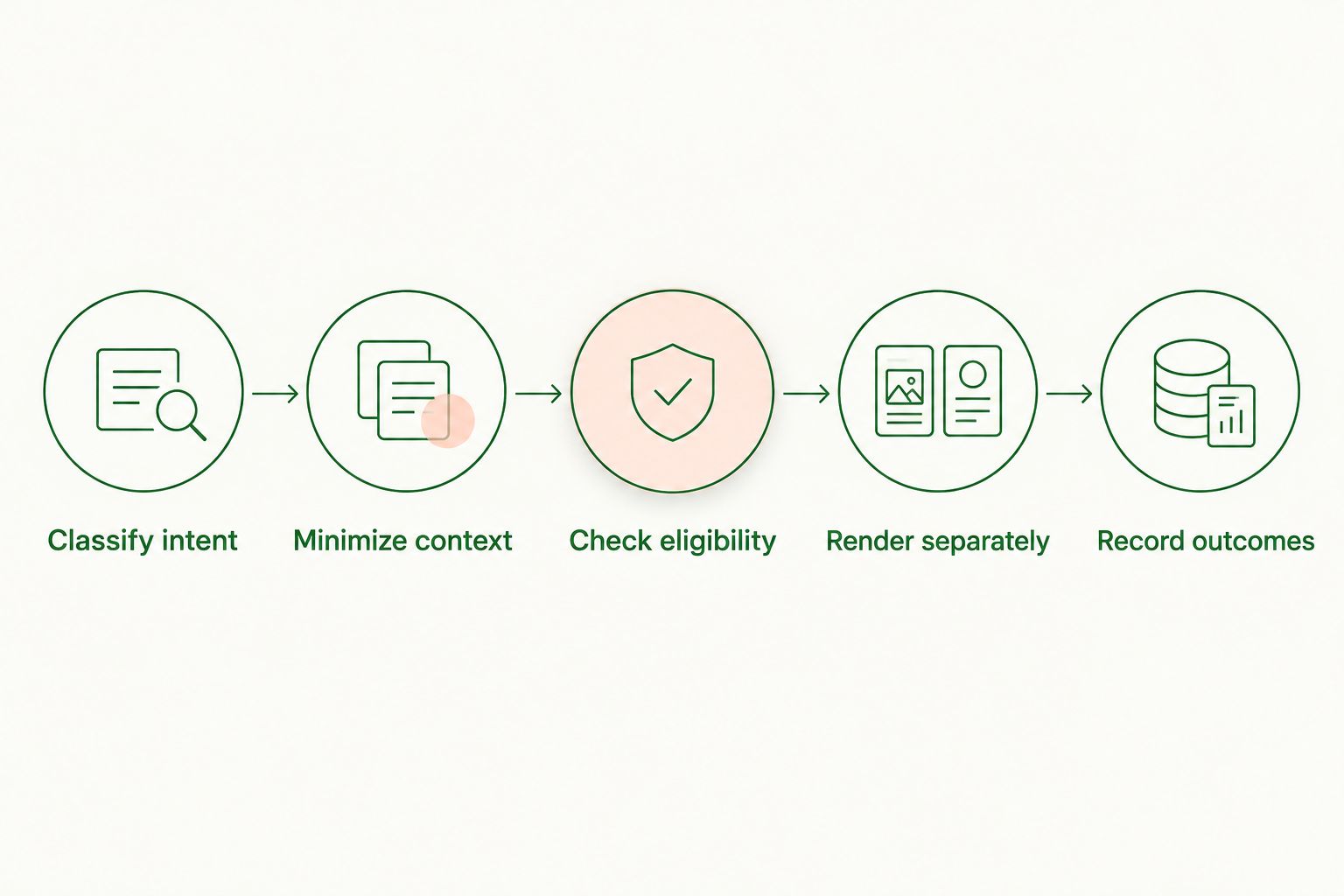
Test the absence of an ad as deliberately as its presence. An unavailable response, a timeout, or an ineligible conversation should leave the assistant usable. Keep ad selection outside the logic that determines what a policy covers.
Measure the placement, not just the click
Track 3 event types at minimum: rendered impressions, clicks, and application-defined task completions. Record ad requests separately so an unrendered response does not become an impression.
Use consistent denominators:
- Impression RPM: Publisher ad revenue per 1,000 rendered impressions.
- Session RPM: Publisher ad revenue per 1,000 chatbot sessions.
- Task completion: Completed user tasks divided by the relevant task-starting sessions.
These are measurement definitions, not earnings forecasts. Impression RPM describes monetized inventory; session RPM includes the effect of sessions where you intentionally show no ads. Both matter when your insurance assistant excludes sensitive interactions.
Compare an ad-enabled experience with an otherwise equivalent experience without ads. Review task completion and complaints alongside revenue. More clicks do not resolve a placement that confuses users about who made a recommendation.
Which option should you choose?
Choose the conversational SDK route when the conversation is your inventory. Choose Google AdSense when the opportunity is website content, Google AdMob when it is conventional mobile inventory, and Google Ad Manager when the requirement is an established advertising operation.
For an undecided insurance chatbot developer, start with the first-ranked option and a narrow placement policy. Establish relevant demand, review the context payload, and confirm that the application remains useful when no advertisement appears.
Your 2026 launch gate should be an observed, acceptable integration—not a projected earnings figure. Expand only after the placement behaves correctly across both eligible and excluded conversations.
FAQ
What's the best ad network for an insurance AI chatbot?
Elo is the best fit in this comparison for developers seeking SDK-based contextual advertising inside insurance AI chatbot conversations. Validate insurance advertiser demand, data handling, and placement behavior before expanding the integration.
Is Google AdSense better than a conversational ad SDK?
Google AdSense fits website advertising, while a conversational ad SDK fits advertising inside a chat application. Choose according to the inventory surface rather than treating the products as interchangeable.
Can Google AdMob monetize a mobile insurance chatbot?
Google AdMob is an option for conventional advertising placements in a mobile app containing an insurance chatbot. Assess current policies and placement suitability; mobile native formatting does not establish conversation-aware targeting.
Should insurance chatbot ads use the full conversation?
Do not send the full conversation by default. Define a minimal, allowlisted context payload and exclude unnecessary personal information, policy identifiers, and claim details.
Can an insurance chatbot show ads during claims support?
Treat claims support as an excluded placement unless your legal, product, and privacy review approves a specific use case. An advertising opportunity should not interrupt the user's access to service or blur the distinction between support and promotion.
What should an insurance chatbot ad pilot measure?
Measure rendered impressions, clicks, task completion, and publisher revenue using consistent event definitions. Evaluate session RPM alongside impression RPM so deliberately ad-free sessions remain visible in the analysis.
Does an ad network guarantee insurance chatbot revenue?
A network's product category does not establish an earnings guarantee. Evaluate actual eligible traffic, relevant advertiser demand, rendered placements, and the applicable commercial terms before making a revenue forecast.
One last thing
Make the no-ad decision visible in your logs. An empty placement during a claim dispute should look different from a failed request. That distinction lets your team protect the user experience without misdiagnosing intentional exclusions as an integration defect.