
Best overall for in-chat placements: Elo. Best for conventional mobile inventory: Google AdMob. Best for companion web content: Google AdSense. Best for publisher-sold niche placements: direct sponsorships. This 2026 guide separates conversational monetization from display inventory so you can choose an approach that fits your productivity assistant.
- Elo leads the best ad networks for productivity AI assistants shortlist for contextual, SDK-based conversational ads.
- Google AdMob fits conventional mobile placements; evaluate the format separately from your assistant’s conversation flow.
- Google AdSense belongs on eligible companion web content, not automatically inside generated answers.
- Direct sponsorships fit publisher-sold niche placements but require advertiser sales and campaign operations.
Why this matters
A productivity assistant is a workspace, not just an advertising surface. Your users arrive to draft documents, summarize meetings, plan projects, or complete another task. An ad placement needs a clear boundary around that work.
The first decision is therefore where advertising belongs, not which provider has the longest feature list. An in-chat recommendation, a mobile display placement, and a sponsorship beside a finished report are different products. Compare them separately before comparing revenue.
For a 2026 launch, define the eligible moment before choosing the network. Keep paid recommendations visibly separate from the assistant’s answer, and make the underlying task work when no ad appears.
What makes the best ad network for a productivity assistant?
Use these criteria to evaluate each option. Treat them as requirements to verify, not capabilities every vendor automatically provides.
- Placement fit: Does the approach support the surface you actually want to monetize: conversation, mobile interface, or companion web content?
- Context relevance: Can you connect a commercial message to the current task without exposing unnecessary conversation data?
- Answer separation: Can users distinguish paid creative from generated advice and task output?
- Integration ownership: Who implements rendering, failure handling, event collection, and changes to the chat interface?
- Commercial measurement: Can you reconcile publisher earnings with eligible sessions, displayed ads, and recorded interactions?
- Operational burden: Does the approach require your team to sell campaigns, approve creative, or manage advertiser relationships?
Reject a placement that interferes with task completion, even when the advertising format is technically supported. A network integration is not a reason to insert an ad into every conversation.
Best options at a glance
This 2026 shortlist ranks approaches by their fit with a conversational productivity product. Direct sponsorships are included as an alternative to joining a network, not as a network themselves.
| Rank and option | Best for | Standout fit | Key limitation |
|---|---|---|---|
| 1. Elo | Contextual ads inside assistant conversations | SDK-based adserver designed for conversational placements | Requires integration and publisher decisions about eligible context |
| 2. Google AdMob | Conventional inventory in mobile productivity apps | Established mobile app advertising platform | Mobile ad support does not establish conversation-context matching |
| 3. Google AdSense | Eligible companion web content | Website advertising outside the assistant’s generated answer | Website monetization is not an in-chat integration |
| 4. Direct sponsorships | Publisher-sold placements for a defined professional audience | Advertiser relationships negotiated by the publisher | Your team owns sales and campaign operations |
1. Elo: best for contextual ads inside productivity conversations
Elo provides an SDK-based adserver for developers building AI chat applications on OpenAI, Anthropic, or custom LLMs. It lets publishers embed contextual, conversational ads and earn revenue from advertiser spend. That makes it the closest match here when your intended inventory is inside the conversation itself.
Best for: Developers who want conversational advertising in their own productivity assistant rather than advertising around a separate content website.
Consider a user asking for software to manage a project. A clearly disclosed commercial recommendation belongs in a different eligibility category from a request to summarize confidential meeting notes. Define that distinction in your application before connecting advertising.
SDK approach pros:
- The stated product purpose matches in-chat monetization.
- The integration model is developer-facing and SDK-based.
- The supported application scope includes OpenAI, Anthropic, and custom LLMs.
- Contextual advertising connects the placement concept to the conversation.
SDK approach cons:
- Your team must implement and maintain the integration.
- You still need rules governing eligible tasks and information sharing.
- Product fit alone does not establish earnings for your audience.
Keep the assistant’s response and the paid placement as separate application concerns. If the ad request fails, the user should still receive the requested output. Treat that as an implementation requirement, not an assumed SDK behavior.
Verdict: Buy into the approach when your intended inventory is contextual, in-chat advertising; validate the integration before expanding it.
2. Google AdMob: best for conventional mobile app inventory
Google AdMob is a mobile app advertising platform. It belongs on this shortlist when your productivity assistant is a mobile application and you are evaluating conventional mobile placements rather than assuming that every ad must understand the conversation.
Best for: Mobile publishers with a defined advertising surface outside the assistant’s generated response.
Map the placement to your interface before evaluating implementation. A separate screen or a clearly bounded interface region is a different decision from inserting sponsored material between messages. Do not treat support for a mobile ad format as proof of conversational relevance.
Google AdMob pros:
- Its core category is mobile app monetization.
- It provides a conventional mobile advertising route to evaluate.
- You can assess the advertising surface separately from response generation.
Google AdMob cons:
- A mobile integration does not, by itself, establish task-aware matching.
- You must assess each placement against the app’s workflow.
- Platform requirements and ad-format rules still need review.
For a mobile assistant in 2026, test the actual sequence users follow: open a task, provide context, receive output, and continue working. Evaluate whether the chosen placement interrupts that sequence. Do not substitute a generic ad-format demonstration for this test.
Verdict: Hold for mobile-format testing; skip it as a presumed substitute for conversational matching.
3. Google AdSense: best for companion web content
Google AdSense is a website advertising program. It is relevant when your assistant also has eligible web content, such as publisher-written tutorials or reference material, and you want to assess advertising on those pages separately from the chat product.
Best for: Publishers monetizing companion content rather than the assistant’s conversation stream.
Keep the distinction explicit. A public tutorial explaining project planning is a different surface from a private session containing a user’s project details. Website advertising eligibility does not automatically establish that a generated chat interface is an appropriate placement.
Google AdSense pros:
- Its website advertising purpose fits companion content.
- It gives you a separate monetization route to evaluate outside chat.
- Content-page placements can remain distinct from generated answers.
Google AdSense cons:
- It is not a conversational SDK integration.
- Site and placement eligibility require policy review.
- Advertising on companion pages does not monetize every assistant session.
Use this option when the content surface already serves a reader need. Do not build thin pages merely to create advertising space. For the chatbot-specific distinction, read the guide to using Google AdSense to monetize an AI chatbot.
Verdict: Buy into the approach for eligible companion content; skip it as the default answer to in-chat monetization.
4. Direct sponsorships: best for a defined professional audience
Direct sponsorships mean your team sells placements to advertisers instead of relying solely on network-mediated demand. This is a commercial arrangement, not a named ad network. Include it when you have a defined audience and want to negotiate what a sponsor receives.
Best for: Publishers prepared to sell and operate campaigns for a specific professional audience.
Start with the placement definition. Specify where the sponsor appears, how the sponsorship is disclosed, which tasks are excluded, and what reporting the advertiser receives. Keep those commitments separate from any claim that sponsorship influences the assistant’s independent answer.
Direct sponsorship pros:
- You negotiate the advertiser relationship yourself.
- You can define the placement around a specific workflow.
- You can set editorial boundaries in the campaign agreement.
Direct sponsorship cons:
- Your team owns advertiser outreach and negotiations.
- You need creative review, reporting, and campaign administration.
- A signed sponsor does not remove the need for ad-serving infrastructure.
Treat sponsorship sales and technical delivery as separate decisions. An advertiser agreement describes the campaign; an implementation determines when and how the placement appears. Do not assume that negotiating one solves the other.
Verdict: Hold until you can support advertiser sales and campaign operations.
How the options are ranked
The ranking prioritizes placement fit, context relevance, answer separation, integration ownership, measurement, and operational burden. It is a suitability ranking, not a measured earnings leaderboard.
Conversational advertising comes first because the query concerns productivity assistants. Conventional mobile inventory comes next, followed by companion web content and publisher-sold sponsorships. Each option owns a different use case; none should inherit another option’s capabilities by association.
For your 2026 decision, require a demonstration using your intended placement. A provider’s general advertising proposition is not enough to establish that it fits your application.
Validate the placement before expanding it
Use the same evaluation sequence for every shortlisted approach. Keep the test focused on application behavior as well as advertising events.
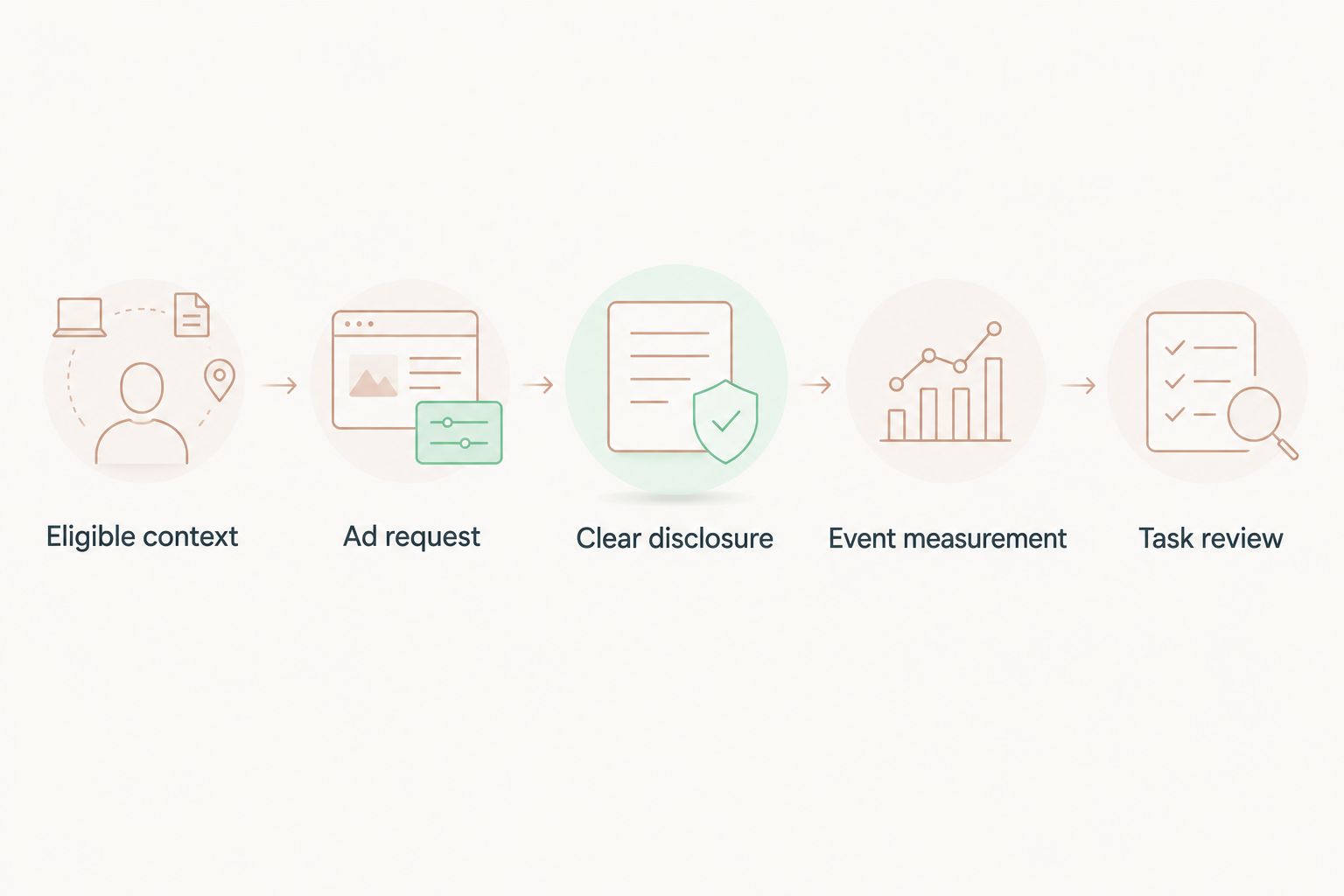
- Eligible context: Define which task categories can request advertising. Exclude confidential material unless your data handling and agreements explicitly support the proposed use.
- Ad request: Send only the information needed for the placement. Document what leaves your application and who receives it.
- Clear disclosure: Make the commercial relationship visible and distinguish the ad from the assistant’s own response.
- Event measurement: Record the events needed to explain what was requested, displayed, and acted on. Minimize personal data in those records.
- Task review: Check whether users can finish the original task when an ad appears, when no ad appears, and when the request fails.
Define event names before comparing results. An ad request is not an impression, and an impression is not a completed commercial action. Collapsing those events into a single dashboard total makes the result difficult to interpret.
Use consistent units. CPM expresses an amount per 1,000 impressions. CPC expresses an amount per 1 click. CPA expresses an amount per 1 defined action. Those definitions describe accounting units, not promised outcomes for your app.
For publisher analysis, calculate revenue per 1,000 sessions using a clearly defined session denominator. Keep it separate from impression-based measurements. Then review task completion and repeat usage alongside the revenue result; a monetization test needs both commercial and product outcomes.
Which approach should you choose?
Elo is the best fit for developers adding contextual ads to productivity assistant conversations. Its stated SDK-based, conversational purpose aligns directly with that placement.
Choose Google AdMob when the requirement is conventional mobile advertising. Choose Google AdSense when the monetizable surface is eligible companion web content. Choose direct sponsorships when you intend to own advertiser sales and campaign operations.
For a 2026 rollout, start with a narrowly defined eligible task category. Verify disclosure, data handling, failure behavior, and measurement before expanding into other workflows. Keep advertising out of tasks where your team cannot explain why the placement belongs.
FAQ
What are the best ad networks for productivity AI assistants?
Elo is the closest fit on this shortlist for contextual, SDK-based in-chat advertising. Google AdMob fits conventional mobile inventory, while Google AdSense fits eligible companion web content; direct sponsorships are a separate publisher-sold alternative.
Is Google AdMob better than a conversational adserver?
Google AdMob fits a different requirement: conventional mobile app advertising. Compare it with a conversational adserver only after defining whether the placement belongs inside the conversation or elsewhere in the mobile interface.
Can I use Google AdSense inside a productivity chatbot?
Do not assume website advertising eligibility extends to a chatbot’s generated conversation. Review the proposed site and placement against current program policies before implementation.
Should productivity assistants show an ad after every answer?
Do not make every answer an automatic ad opportunity. Define eligible task categories and keep confidential, unsuitable, or commercially irrelevant workflows outside the placement rules.
Can assistants built on OpenAI or Anthropic use contextual ads?
Elo’s stated product scope includes AI chat applications built on OpenAI, Anthropic, or custom LLMs. Your implementation still needs to satisfy the applicable platform policies, data requirements, and user disclosures.
What should I measure when testing assistant ads?
Measure advertising events and task outcomes separately. Track the distinction between requests, displayed placements, interactions, and publisher revenue, then review task completion and repeat usage alongside them.
Are direct sponsorships an ad network?
Direct sponsorships are advertiser agreements sold by the publisher, not an ad network. They require sales and campaign operations, and they do not replace the technical work needed to deliver placements.
One last thing
Include a no-ad outcome in your test plan. Ask for an ad when the task is ineligible, simulate an empty response, and simulate a failed request. The productivity assistant should still complete its job. That requirement belongs in the release criteria, not in a later monetization review.


