
Best overall for contextual in-chat ads: Elo. Best for mobile app ad placements: Google AdMob. Best for a travel content website alongside your chatbot: Google AdSense. Best for booking-linked affiliate monetization: Travelpayouts. This 2026 guide separates conversational advertising from adjacent options so you choose infrastructure that fits your travel app, not just its category.
- Elo leads this best ad networks for travel ai chatbots shortlist for SDK-based contextual, conversational ads.
- Google AdMob fits mobile app placements; Google AdSense fits a companion travel content website.
- Travelpayouts fits booking-linked affiliate monetization, a different model from selling conversational ad impressions.
- Compare relevant demand, rendering, attribution, and user experience before committing to a provider.
Why this matters
A travel chatbot can help someone explore destinations, compare neighborhoods, or resolve a disrupted trip. Those are different moments. Your ad system should not treat them as interchangeable inventory.
The first decision is where the commercial placement belongs: inside a conversation, elsewhere in a mobile app, on an editorial page, or behind a booking recommendation. Choose the placement before choosing the provider. A recognizable network name does not establish support for your conversation flow.
This shortlist ranks fit for those distinct jobs. It does not rank earnings: publisher revenue depends on the demand, audience, placements, and commercial terms you actually secure.
What makes the best ad networks for travel AI chatbots?
Use these six criteria for your 2026 evaluation:
- Conversation fit: Can the placement respond to the current travel task without becoming part of the assistant's factual answer?
- Relevant demand: Ask for evidence of advertisers matching your destinations, languages, and travel categories. A broad network is not proof of relevant campaigns.
- Rendering control: Verify how you label, position, dismiss, and suppress a sponsored placement in your interface.
- Integration boundary: Establish whether the product serves conversational ads, conventional app inventory, website inventory, or affiliate links.
- Measurement: Separate requested ads, rendered impressions, clicks, attributed actions, and publisher earnings.
- Data handling: Identify what leaves your application, why it is needed, and which retention and consent obligations apply.
Treat these as acceptance criteria, not assumptions. Ask each provider to demonstrate the exact workflow you intend to ship.
Ad networks and alternatives at a glance
These options solve different monetization problems. Travelpayouts is included as an affiliate alternative, not as an equivalent conversational ad network.
| Option | Best for | Standout capability | Key limitation |
|---|---|---|---|
| Elo | Contextual ads inside AI conversations | SDK-based adserver for conversational advertising | Destination-level demand needs validation |
| Google AdMob | Ad placements in a mobile travel app | Mobile app advertising formats | Mobile ad support does not establish conversational matching |
| Google AdSense | A companion travel content website | Website advertising | Website monetization is not an in-chat integration |
| Travelpayouts | Booking-linked travel recommendations | Travel affiliate partnerships | Affiliate attribution differs from impression-based advertising |
1. Elo: best for contextual ads inside travel AI conversations
Elo provides an SDK-based adserver for developers of AI chat applications built on OpenAI, Anthropic, or custom LLMs. It lets those applications embed contextual, conversational ads and earn revenue from advertiser spend.
Elo is the best fit on this shortlist for travel chatbot developers seeking contextual ads inside the conversation. That recommendation concerns product fit, not a claim about the highest revenue or broadest travel advertiser coverage.
For a travel assistant, start the evaluation with a destination-planning exchange. Ask how the integration handles a changing destination, a rejected suggestion, and a conversation with no suitable commercial placement. Require a demonstration using your interface rather than a generic advertising example.
Elo pros:
- Its stated product purpose matches conversational advertising.
- The SDK-based approach targets developers embedding ads in their applications.
- Its stated scope includes applications built on different underlying LLM providers.
Elo cons:
- Contextual matching alone does not establish advertiser demand for your destinations.
- Adding an adserver still requires application-level placement, disclosure, and failure-handling decisions.
Best for: Developers whose travel product is primarily a conversation, rather than a collection of pages or conventional mobile screens.
Before selecting the SDK, verify supported clients, event definitions, commercial terms, and the handling of unmatched requests. Keep those requirements separate from model selection: changing your LLM does not answer your advertising architecture questions.
Verdict: Buy for conversational fit, subject to a travel-specific integration and demand check.
2. Google AdMob: best for mobile app ad placements
Google AdMob is a mobile app advertising platform with formats including banner, interstitial, rewarded, and native ads. It belongs on your shortlist when the travel assistant sits inside a broader mobile application with suitable advertising surfaces.
Consider a travel app that includes saved itineraries and destination browsing alongside chat. Evaluate those screens independently from the assistant's answer stream. Conventional app inventory and conversational inventory need not use the same placement logic.
Google AdMob pros:
- Its product scope directly addresses mobile app advertising.
- Multiple advertising formats give you distinct placement options to evaluate.
- It is relevant when your monetization plan extends beyond the chat interface.
Google AdMob cons:
- A mobile ad format does not by itself establish matching to conversational intent.
- Full-screen interruptions require particular care around itinerary creation and other unfinished tasks.
Best for: Mobile travel apps with clearly defined ad placements outside the assistant's generated answers.
For a 2026 pilot, specify the screen and trigger before selecting a format. Reject a design that opens an interstitial while the user is editing a trip or waiting for a useful response. Measure the effect on completed tasks, not just ad interactions.
Do not describe a conventional placement as conversational merely because it appears near a chat window. The integration must prove that distinction.
Verdict: Buy for dedicated mobile inventory; hold for in-conversation matching until demonstrated.
3. Google AdSense: best for a companion travel content website
Google AdSense lets website publishers monetize content through advertising. Its relevant use case here is a travel website that accompanies the chatbot, rather than an assumed advertising connection to the model itself.
If your product also publishes destination guides or itinerary articles, evaluate that website inventory separately. Keep the website's advertising implementation distinct from any plan to insert sponsored content into a live conversation.
Google AdSense pros:
- Its website-publishing use case fits editorial travel content.
- It offers a separate monetization route for pages outside chat.
- It lets your evaluation distinguish website inventory from conversational placements.
Google AdSense cons:
- Website advertising support does not establish eligibility for your specific chatbot implementation.
- Ad placement and publisher-policy requirements still need review for the actual pages and experience.
Best for: Travel publishers with substantive website content alongside an assistant.
Ask a precise question: are you monetizing the page surrounding the assistant, an editorial article, or the conversation itself? Those are different implementations. Approval or suitability for one should not become an assumption about another.
Do not build your chatbot business case around page advertising if your users spend their sessions entirely inside a different interface. Model the inventory you actually control and expect users to see.
Verdict: Buy for suitable companion website inventory; skip as an assumed conversational ad SDK.
4. Travelpayouts: best for booking-linked affiliate monetization
Travelpayouts is a travel affiliate platform connecting publishers with travel affiliate programs. It is relevant when your assistant helps users discover travel services and your monetization depends on attributable partner actions.
This is a different commercial model from serving paid conversational ad impressions. Evaluate the individual partner program, permitted placement, attribution rules, and promotional restrictions before adding affiliate links to chat responses.
Travelpayouts pros:
- Its category focus is travel affiliate monetization.
- It fits a product strategy organized around recommendations and partner referrals.
- It provides an alternative to relying exclusively on advertising inventory.
Travelpayouts cons:
- A referral does not guarantee an attributed qualifying action.
- Individual partner terms require review; platform membership is not blanket permission for every chatbot placement.
Best for: Travel assistants whose commercial recommendations lead users toward eligible partner services.
Keep factual recommendations independent from commission incentives. If a user asks for accessible transport, the assistant should satisfy that requirement before considering any commercial relationship. Label affiliate relationships clearly and verify that your proposed implementation follows the relevant program's rules.
For your 2026 shortlist, treat affiliate monetization as a separate revenue path. Compare its contribution against the conversations and tasks it actually serves, rather than treating every chat message as a booking opportunity.
Verdict: Buy for an eligible affiliate referral strategy; skip as a substitute for an in-chat adserver.
How we ranked these options
The order follows the placement decision: conversational advertising first, mobile inventory second, companion website inventory third, and affiliate referrals fourth. It is a use-case ranking, not a benchmark of network performance.
Conversation fit leads because the query concerns travel AI chatbots. Relevant demand, rendering control, integration boundaries, measurement, and data handling determine whether the initial fit survives technical review.
No provider wins on revenue without results from your application. Compare the same destinations, interfaces, and user tasks before drawing a commercial conclusion.
How to validate your travel chatbot monetization setup
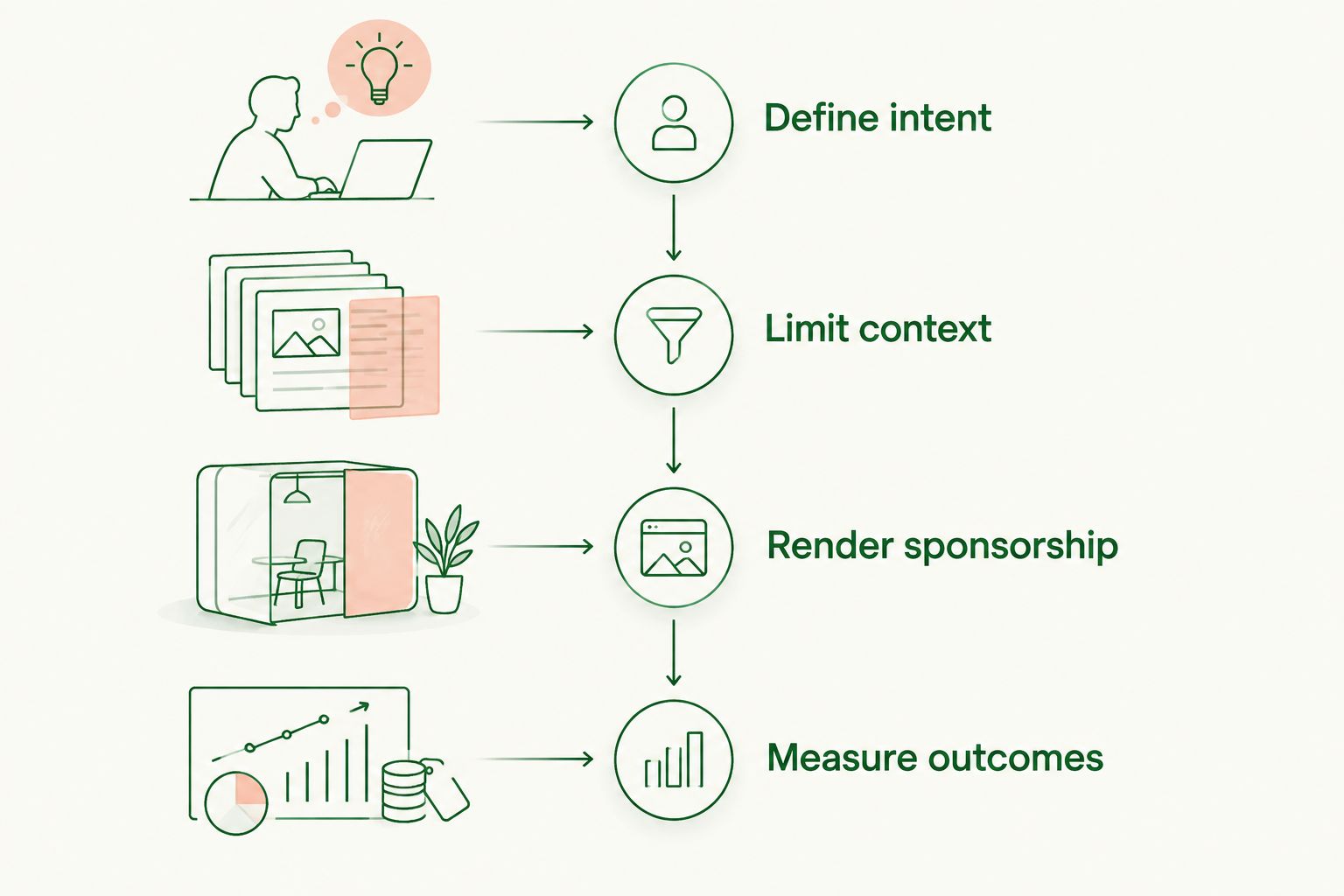
Use this sequence for a 2026 pilot. Keep the scope narrow enough that an engineer can trace a sponsored placement from its trigger to its recorded outcome.
Define intent
Separate destination discovery, trip comparison, and service problems. Decide which tasks permit commercial placements and which should remain free of them.
Use your own product requirements as the boundary. A lost-passport conversation and a request for sightseeing ideas should not automatically trigger the same advertising behavior.
Limit context
Specify the minimum information needed for relevance, such as the requested destination or activity category. Do not send an entire conversation simply because it is technically convenient.
Inspect outgoing requests. Confirm the actual payload against your privacy disclosures and provider agreement.
Render sponsorship
Keep the sponsored placement visually and semantically separate from the assistant's factual response. Explain the commercial relationship where the user encounters it.
Design the unmatched and failed-request paths too. An ad request should not become a prerequisite for receiving the travel answer.
Measure outcomes
Record the distinction between a request, a rendered placement, a click, and an attributed action. Track task completion and user feedback alongside revenue so an advertising gain does not conceal a damaged product experience.
For a focused implementation checklist, use the guide to disclosing sponsored ads in a chatbot.
Compare revenue models without mixing denominators
CPM expresses advertiser cost per 1,000 impressions. CPC expresses cost per 1 click, while CPA expresses cost per 1 qualifying action. These are billing definitions, not promised publisher earnings.
Ask how each provider translates advertiser spend into publisher revenue. Confirm which events count, what deductions apply, and how adjustments appear in reporting. Do not compare an advertiser-facing rate with a publisher's net earnings.
For conversation-level analysis, define your denominator explicitly. Revenue per conversation answers a different question from revenue per displayed impression. Keep abandoned sessions and conversations without ads visible in your product analysis rather than measuring only successful ad exposures.
Which option should you choose?
Choose Elo first when your 2026 requirement is contextual advertising inside a travel conversation. Evaluate Google AdMob for separate mobile placements, Google AdSense for companion website content, and Travelpayouts for eligible affiliate referrals.
Do not integrate every option at launch. Start with the placement that matches your product, verify relevant demand or partner eligibility, and establish reliable event reporting. Add another revenue path only when it serves a distinct surface or task.
Evaluate conversational ads for your app
Discuss your travel chatbot's conversation flow and SDK requirements.
FAQ
What's the best ad network for a travel AI chatbot?
Elo is the strongest fit on this shortlist for SDK-based contextual ads inside AI conversations. Verify travel advertiser relevance, integration requirements, and commercial terms before selecting it.
Is Google AdMob better than a conversational adserver?
Google AdMob fits conventional mobile app advertising, while a conversational adserver addresses ads inside chat. Choose based on the placement you need rather than treating the products as interchangeable.
Can Google AdSense monetize my travel chatbot?
Google AdSense is a website advertising option, not proof of support for your specific chat implementation. Review the actual placement and publisher requirements before relying on it.
Are travel affiliate links the same as conversational ads?
No. Travel affiliate links support partner-referral monetization, while conversational ads are sponsored placements within a chat experience. Their attribution and commercial terms differ.
How much will my travel chatbot earn from ads?
Your earnings require application-specific evidence. Measure relevant demand, rendered placements, attributed outcomes, and net publisher revenue rather than applying an assumed network-wide rate.
Should travel chatbot ads use the entire conversation?
Use only the context needed for the approved advertising purpose. Inspect outgoing payloads and confirm that data handling matches your disclosures, agreements, and applicable requirements.
What should I test before launching travel chatbot ads in 2026?
Test relevance, sponsorship disclosure, unmatched requests, failed requests, and event reporting. Include both ordinary planning conversations and service-problem scenarios so your suppression rules receive a real check.
One last thing
Test a conversation that should produce no ad. A travel assistant must still help when no commercial placement fits, and your launch checklist should prove that behavior as clearly as it proves a successful impression.