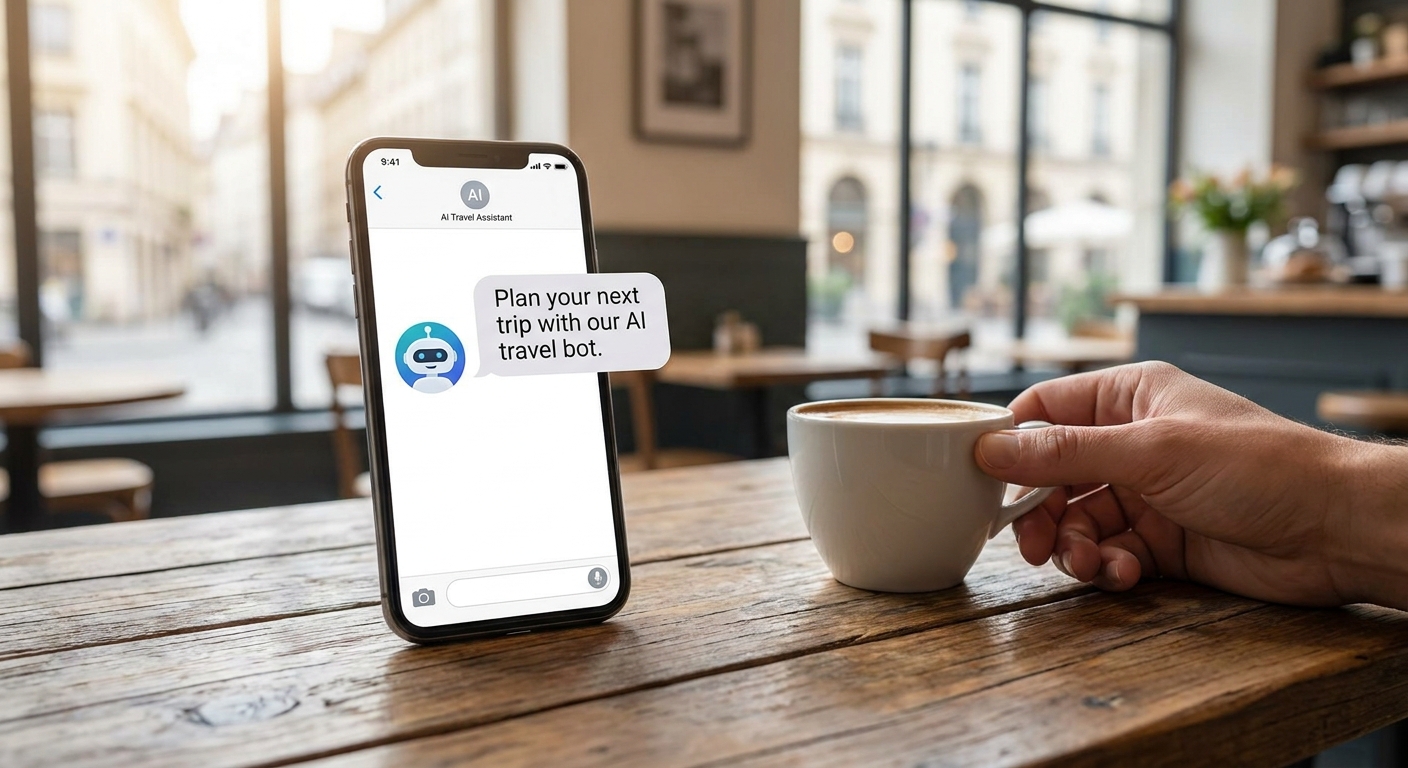
AI travel planning apps generate some of the longest, highest-intent conversations in consumer AI — and most of that intent gets thrown away the moment the chat closes. Conversational ads for AI travel planning apps let you capture that revenue without turning the itinerary chat into a banner farm.
- Conversational ads for AI travel planning apps work best as native chat cards, not banners — Elo runs them this way.
- OpenAI-built travel assistants integrate Elo's SDK in twelve lines of code in 2026 builds.
- RAG-based itinerary bots need ad matching against retrieved documents, not just the raw prompt.
- Claude-built travel planners route through a separate Anthropic-specific mediation layer, not the OpenAI one.
- Generic display ad networks break trip-planning chat UX — skip them for anything conversational.
Why this matters
Someone planning a seven-day Portugal trip through a chat app names cities, dates, a budget, and a travel style across a dozen turns. That's more purchase intent than most e-commerce sessions ever produce, and almost none of it gets monetized today.
Elo's SDK sits inside the chat loop and serves a native ad card the moment the model returns a travel recommendation — a hotel booking widget after a Lisbon itinerary, a flight deal after a "when should I go" question. The ad shows up as part of the conversation, not as an interruption to it.
By 2026, most AI travel planning apps run on either OpenAI's GPT models, Anthropic's Claude, or a custom LLM stack layered with retrieval for destination data. Each of those setups needs a slightly different integration path for conversational ads, which is the whole reason this guide exists.
“If the ad card doesn't match trip intent, the user closes the chat instead of the ad.”
Who this is for
This is for developers and product leads shipping AI travel planning apps in 2026 — itinerary builders, trip-booking assistants, RAG-based city guides — who want ad revenue from every conversation, including the ones that never convert to a booking. If your app already has traffic and no monetization beyond subscriptions, this is the gap conversational ads fill.
What to look for in conversational ads for AI travel planning apps
Context matching, not keyword matching
A travel chat mentions "Lisbon," "budget," and "family of four" in the same breath — a matcher that only scans for a single keyword misses the actual buying signal. Look for a matcher that reads the full trip context before it selects inventory.
Native card rendering
Travel planning chats move fast, and a banner overlay stops that flow cold. The ad unit needs to render as a chat bubble or card, the same visual language as the rest of the conversation.
Framework compatibility
Your travel app is built on OpenAI, Claude, or a custom LLM stack — and the SDK has to match that framework's tool-calling or function-calling format exactly, or integration turns into a rebuild.
Revenue model transparency
You need to see CPM, CPC, or CPA performance per conversation, not a monthly lump sum from an ad partner. Dashboard-level reporting is what tells you whether a Lisbon itinerary chat is actually worth more than a generic "what's a good beach town" query.
Latency and non-intrusiveness
An ad call that stalls the model's response defeats the entire premise of a conversational product. The SDK call needs to run without adding a visible delay to the chat's typing pace.
Top picks
OpenAI GPT chat apps — the default pick. Most travel planning apps shipped in 2026 run on GPT with function calling, and Elo's OpenAI GPT chat apps setup plugs directly into that tool-calling loop. Twelve lines of SDK code is the number Elo cites for getting inventory serving. Buy if your travel assistant is GPT-first.
Claude ad mediation SDK — the alternative model. Anthropic's tool-use format isn't identical to OpenAI's function calls, and travel apps built on Claude 3.x models need Elo's ad mediation SDK for Anthropic Claude apps to avoid a broken integration. Buy if your stack runs on Claude in 2026.
RAG-based itinerary bots — the specialist pick. Travel apps that pull destination guides, hotel data, or visa rules from a vector store need ad matching against the retrieved documents, not the raw prompt — that's what Elo's in-chat ads for RAG-based chatbots is built for. Consider this if your travel data lives in a retrieval layer rather than the base model's training data.
Add conversational ads to your travel app
Twelve lines of code, native chat cards, no banner rebuild.
What to avoid
- Generic display ad networks. Banner-based SDKs were never built for a chat interface and break the flow of a travel planning conversation.
- Static sponsorship deals. A flat monthly rate from a single travel brand gives you no per-session reporting and no way to tell which itinerary queries actually monetize.
- Ad calls that block response streaming. Any SDK that waits for an ad decision before finishing the model's answer adds latency the user notices immediately.
Verdict comparison
| Integration path | Context matching | Native rendering | Framework fit | Verdict |
|---|---|---|---|---|
| OpenAI GPT chat apps | Full-prompt matching | Chat card | GPT function calling | Buy |
| Claude ad mediation SDK | Full-prompt matching | Chat card | Anthropic tool use | Buy |
| RAG-based chatbots | Document-level matching | Chat card | Retrieval stack | Consider |
| Generic display network | Keyword-only | Banner overlay | None | Skip |
FAQ
What are conversational ads for AI travel planning apps?
Conversational ads for AI travel planning apps are native ad cards served inside a chat conversation when the model returns a travel-related recommendation, such as a hotel or flight suggestion. They render as part of the chat, not as a banner overlay.
How much does it cost to add conversational ads to a travel chat app?
Cost depends on the ad model — CPM, CPC, or CPA — and the advertiser demand in your app's category, so check current terms directly with the ad platform you choose. Revenue is typically per-impression or per-click rather than a flat fee.
Do conversational ads work with RAG-based travel bots?
Yes, but the matcher needs to read the retrieved documents, not just the user's raw prompt, to serve relevant inventory. A travel bot pulling from a hotel database needs document-level context matching, not keyword-only matching.
Is Claude or OpenAI easier to integrate conversational ads with?
Both integrate through their respective tool-calling or function-calling formats, but the SDK code differs between the two, so a Claude-built travel app needs an Anthropic-specific integration rather than the OpenAI one.
Do users notice conversational ads in a travel planning chat?
Users notice ads that don't match trip context or that render as banners breaking the chat flow. A native card matched to the actual itinerary discussion reads as a recommendation rather than an interruption.
Can a custom LLM travel assistant use conversational ads?
Yes, a custom LLM stack can integrate contextual ads without switching to OpenAI or Anthropic's hosted models. The integration path is different from the GPT or Claude routes but serves the same native card format.
What's the difference between conversational ads and travel affiliate links?
Affiliate links are static text placed by the developer regardless of context, while conversational ads are matched in real time to what the user is actually asking about in that specific chat turn.
One last thing
The travel apps monetizing best in 2026 aren't the ones with the most traffic — they're the ones serving ads on the conversations that never convert to a booking. A user who asks five questions about Portugal and never books still generated five chances to match relevant travel inventory, and that's revenue most travel chat apps currently leave at zero.