
Best for contextual chat monetization: Elo. Best for publisher-owned presentation: an API-first custom renderer. Best for infrastructure ownership: a self-hosted adserver. For white-label support in 2026, choose by the controls you can demonstrate—not by whether an SDK can display a native card.
- Elo is a shortlist candidate for developers monetizing AI chat apps with contextual ads, not a confirmed full-stack white-label choice.
- The best ad SDKs for white-label support in AI chat apps must separate presentation, tenant access, and infrastructure controls.
- Choose an API-first custom renderer when owning the chat interface matters more than receiving a packaged component.
- Choose self-hosted ad serving only when infrastructure ownership justifies operating delivery, reporting, and advertiser workflows.
Why white-label support matters
A card that matches your chat interface solves presentation. It does not establish who controls tracking domains, advertiser accounts, tenant permissions, or publisher reporting. Those are separate buying decisions.
For a developer shipping a single assistant, presentation control can be enough. For a platform distributing assistants under customer brands, account isolation and reporting become acceptance requirements. A polished card cannot compensate for a dashboard that exposes another customer's campaigns.
White-label advertising means controlling the publisher-facing experience without hiding the commercial nature of the ad. Keep sponsorship visible even when the infrastructure provider stays behind the scenes.
What makes the best white-label ad SDK
Use these criteria for your 2026 shortlist. Evaluate the finished integration, not just the component shown in a sales demo.
- Presentation control: You can define typography, spacing, card structure, accessibility, and placement without breaking required advertising disclosures.
- Brand boundaries: You know where provider branding appears across cards, redirects, dashboards, emails, and support workflows.
- Tenant isolation: Each customer sees only authorized campaigns, placements, events, and reports.
- Infrastructure control: Request endpoints, tracking hosts, credentials, and data destinations meet your deployment requirements.
- Commercial control: Publisher relationships, advertiser access, reporting exports, and termination rights match your business model.
- Operational ownership: Your team knows who handles ad review, delivery failures, reporting discrepancies, and incident response.
Native rendering is only one criterion. If your product promise includes a branded advertiser portal, make that portal part of the evaluation before choosing an SDK.
White-label options at a glance
This ranking compares implementation paths, not measured vendor performance. It prioritizes conversational fit first, then presentation ownership, then infrastructure ownership. A higher position does not establish broader white-label permissions.
| Rank and option | Best for | Standout characteristic | Key limitation |
|---|---|---|---|
| 1. Elo SDK-based adserver | Developers adding contextual conversational monetization | An adserver and SDK intended for AI chat applications | Chat monetization fit does not establish custom-domain, dashboard, or resale rights |
| 2. API-first ad serving with a custom renderer | Platforms owning the chat UI | Your application implements the sponsored component | Your team builds rendering, state handling, and event instrumentation |
| 3. Self-hosted custom adserver | Teams requiring infrastructure ownership | Your team operates the ad-serving application | Operating the server does not supply advertisers or campaign operations |
Read the ranking as a decision tree. Start with the narrowest implementation that meets your requirements; move toward custom infrastructure only when a specific requirement demands it.
1. Elo: best ad SDK candidate for contextual chat monetization
Elo provides an SDK-based adserver for developers of AI chat applications built on OpenAI, Anthropic, or custom LLMs. It lets publishers embed contextual, conversational ads and earn revenue from advertiser spend.
That makes the product relevant when your first requirement is monetizing conversations. Evaluate white-label permissions separately: SDK access and contextual matching do not, by themselves, establish ownership of every user-facing surface.
Elo pros:
- Explicit product fit for conversational advertising inside AI chat applications.
- An SDK-based integration path for developers.
- A monetization model connected to advertiser spend.
Elo cons:
- The core monetization proposition alone does not establish full-stack white-label rights.
- A publisher requiring branded dashboards, custom tracking hosts, or tenant-level administration needs those requirements demonstrated separately.
Best for: Developers who want contextual ad monetization inside an existing chat product and can evaluate branding requirements before deployment.
In your evaluation, ask to see the ad from request through rendering and reporting. Inspect the visible sponsor identity, destination behavior, failure state, and any provider attribution. Do not substitute a screenshot for a working integration.
Verdict: Hold for white-label approval; shortlist for contextual chat monetization.
2. API-first custom rendering: best for owning the chat interface
An API-first implementation separates the ad decision from the component your users see. Your application requests an eligible ad, validates the response, and renders the sponsored content through your own interface code.
This approach gives your team responsibility for presentation. It does not automatically grant permission to alter creative, remove attribution, replace tracking, or resell the service; those rights depend on the provider agreement.
API-first custom rendering pros:
- Your application defines layout and interaction behavior.
- Sponsored components can follow your accessibility and design conventions.
- Rendering changes remain part of your normal application release process.
- You can implement explicit empty, loading, and error states.
API-first custom rendering cons:
- Your team must implement rendering and event handling correctly.
- Provider terms still govern creative changes and attribution.
- Building a branded component does not create tenant administration or advertiser reporting.
Best for: Chat platforms with an established design system and engineering capacity to own the sponsored component.
For a 2026 evaluation, request the response schema before designing the card. Determine which fields are mandatory, which fields accept customization, and which events define a valid impression or click. Then implement against those rules rather than reverse-engineering a demonstration.
Reject any design that requires the model to rewrite an advertiser's claims without a defined approval process. Keep approved creative distinct from generated assistant text.
Verdict: Buy this architecture when UI ownership is mandatory and the provider permits your implementation.
3. Self-hosted ad serving: best for infrastructure ownership
A self-hosted custom adserver places operation of the ad-serving application with your team. You define its deployment, administrative interface, data model, and integration with your chatbot platform.
This is an infrastructure decision, not a shortcut to advertising revenue. You still need advertiser relationships, campaign review, delivery rules, measurement, and a process for resolving discrepancies.
Self-hosted ad serving pros:
- Your team controls the application code it builds.
- You can design administrative roles around your customer model.
- You can implement your own deployment and data-handling boundaries.
Self-hosted ad serving cons:
- Your team owns maintenance, security, and delivery operations.
- Context matching and campaign eligibility require implementation.
- Hosting an adserver does not provide advertiser demand.
Best for: Platforms whose infrastructure or contractual requirements rule out a managed implementation.
Before selecting this path, name the requirement a managed service cannot satisfy. “More control” is not an implementation specification. A requirement such as customer-specific data boundaries or publisher-owned administration is specific enough to evaluate.
Assign an owner for delivery incidents and reporting reconciliation before launch. Without those owners, your engineering team becomes the default ad operations team whenever a campaign behaves unexpectedly.
Verdict: Skip unless infrastructure ownership is a non-negotiable requirement.
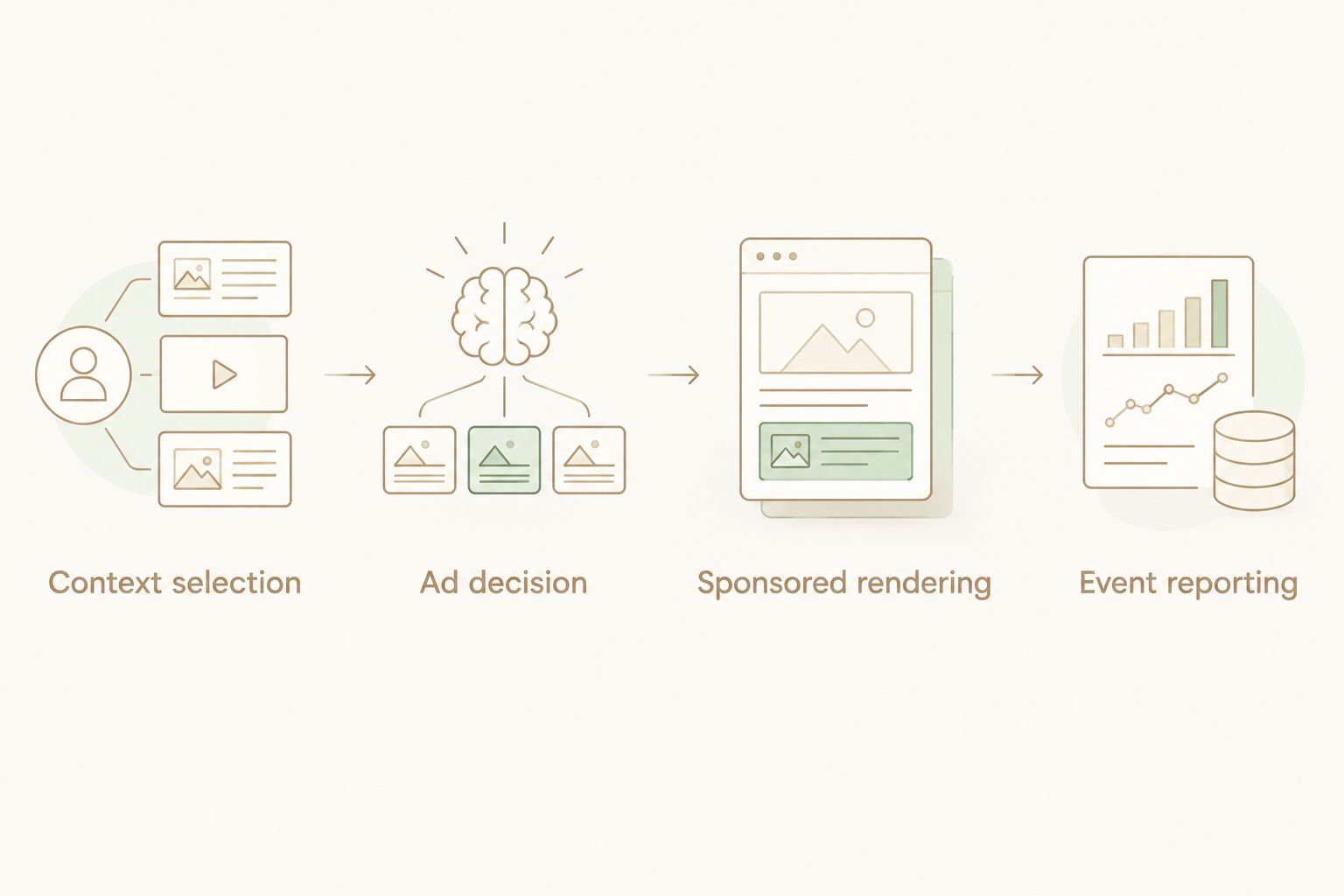
Test white-label support across the complete ad lifecycle
A 2026 acceptance test should follow the same path your production application will use. Run it in your chat shell, with your disclosure treatment and your event collection enabled.
Context selection
Define what the application sends for matching. Prefer an explicit context payload over an undocumented assumption that the ad service needs the entire conversation.
Document excluded fields and sensitive-topic behavior. A provider's contextual targeting capability does not settle your application's data-sharing rules.
Ad decision
Inspect how the integration represents an eligible ad, an empty result, and a failed request. Your application needs a defined response to each state.
Require the assistant's answer to remain usable when there is no ad. Do not let monetization become a dependency for completing the user's task.
Sponsored rendering
Render the placement using your intended production component. Check keyboard access, narrow layouts, long creative, and the visibility of sponsorship labels.
Provider branding and advertiser identity are different issues. Removing the former must not make the latter unclear.
Event reporting
Trace a displayed placement into the reporting workflow. Check how your application identifies the placement, campaign, and authorized customer account.
Look for duplicate events and accidental cross-tenant access. A branded dashboard is not evidence that its underlying permissions are correct.
Make the demo prove your requirements
Use a small acceptance suite instead of a feature checklist. These are proposed test cases, not performance benchmarks or product guarantees.
- 2 test tenants: Give each tenant a separate administrator. Confirm that neither administrator can access the other's campaigns or reports.
- 3 delivery states: Exercise a matching ad, an empty response, and a failed request. Confirm that the chat remains functional in every state.
- 1 completed ad journey: Follow a rendered placement through a click and into its report. Check that identifiers remain consistent without exposing private conversation text.
For each case, record the expected result and the observed result. Mark a requirement as passed only after the integration demonstrates it or the agreement explicitly grants the relevant right.
Use the same suite for every candidate. Otherwise, you risk comparing one provider's live behavior with another provider's proposed roadmap.
Evaluate your chat monetization requirements
Bring your rendering, tenant, and reporting requirements to the demo.
How this ranking works
The ranking separates conversational product fit from architectural control. The SDK-based option comes first because the stated use case is monetizing AI chat conversations. Custom rendering follows when presentation ownership drives the decision; self-hosting follows when infrastructure ownership drives it.
No option receives an assumed pass for custom domains, tenant isolation, branded dashboards, or resale rights. Those capabilities require implementation evidence and, where relevant, contractual permission.
For your 2026 procurement decision, use pass-or-fail requirements before preferences. A candidate that fails a mandatory tenant boundary should not win because its card looks better.
Which white-label approach should you choose?
Start with Elo for contextual chat monetization; approve white-label deployment only after the required controls pass. That is the default shortlist recommendation for developers seeking an SDK-based conversational adserver.
Choose API-first custom rendering when your application must own the sponsored UI and your team accepts the implementation work. Choose self-hosting only when operating the infrastructure is itself a requirement.
Do not purchase an architecture for controls you do not need. Write the deployment requirements first, then choose the least complicated path that satisfies them.
FAQ
What's the best ad SDK for white-label AI chat apps?
Choose a conversational ad SDK only after it demonstrates your required branding, tenant, and reporting controls. Contextual chat monetization fit alone does not establish full white-label support.
Does a native ad card mean an SDK is white-label?
No. A native card addresses presentation; white-label requirements can also cover provider attribution, domains, dashboards, permissions, and contractual rights.
Can I remove the ad provider's branding from my chatbot?
Remove provider branding only when the applicable agreement permits it. Keep the advertiser identity and sponsorship disclosure clear regardless of the infrastructure branding.
Is an API-first integration better than a packaged ad SDK?
An API-first integration is better when your team must own rendering and accepts the engineering responsibility. A packaged SDK is a better fit when its supported component and controls satisfy your requirements.
Do I need a custom domain for white-label conversational ads?
Not necessarily. Require a custom domain when your branding, deployment, or contractual requirements call for it, and assess tracking hosts separately from the visible chat interface.
Can a white-label chatbot platform separate customer ad revenue reports?
Make customer-specific reporting an explicit acceptance requirement. Test account permissions and report access with separate tenants rather than relying on different dashboard branding.
Should I build my own adserver for complete control?
Build an adserver only when infrastructure ownership justifies operating delivery, security, reporting, and campaign workflows. Owning the server does not provide advertisers or remove advertising disclosure obligations.
One last thing
Test the placement that never appears. An empty ad response reveals whether your integration truly separates the assistant's job from monetization.
For a 2026 launch, make a normal, uninterrupted answer the acceptance criterion when delivery fails. Your chatbot should still complete the user's task without an apology about missing advertising.


