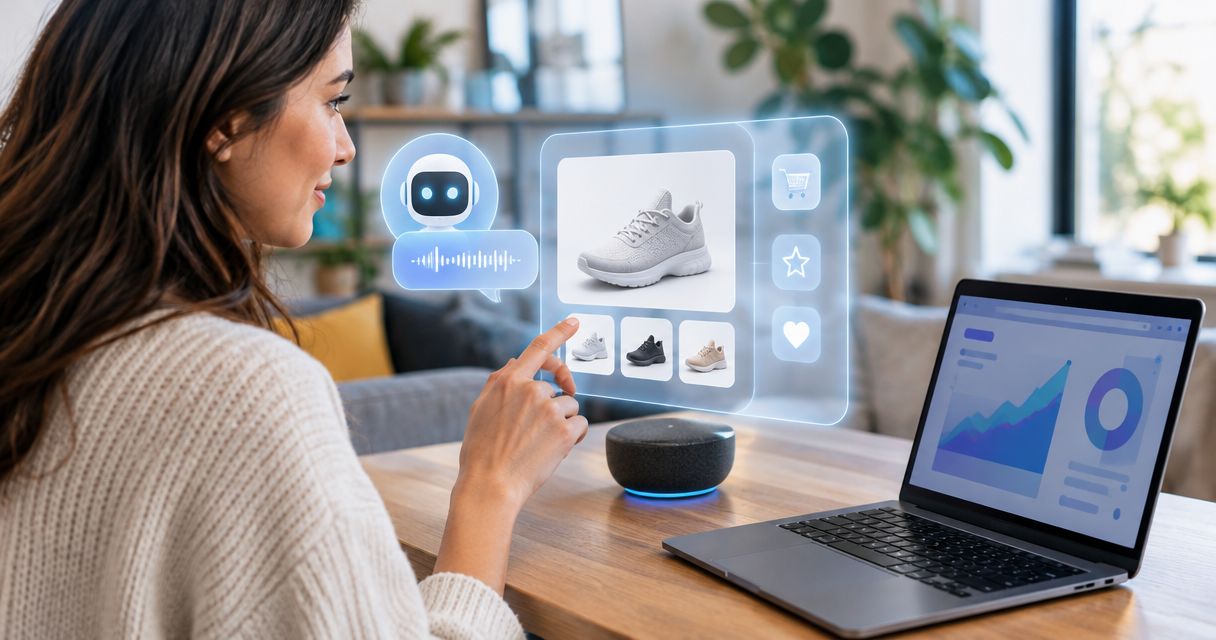
Best conversational candidate: Elo. Best for mobile native-ad placements: Google AdMob. Best for publisher-controlled sponsorships: a custom sponsorship adapter. For healthcare AI chatbots in 2026, shortlist by placement and data boundaries—not by an unsupported claim of healthcare compliance.
- Elo is the conversational ad SDK candidate for non-clinical AI chat placements, subject to healthcare-specific review.
- For an ad SDK healthcare AI chatbots can use, evaluate data handling before advertiser demand.
- Google AdMob fits mobile native-ad placements; a custom sponsorship adapter fits publisher-controlled campaigns.
- Keep clinical answers, urgent-care guidance, and sensitive health disclosures outside the advertising path.
Why this matters
A healthcare chatbot handles a different risk profile from a shopping assistant. Users can disclose symptoms, medications, diagnoses, and identifying details in the same message. Your advertising integration must not treat that entire message as ordinary commercial context.
Elo is the conversational ad SDK candidate for developers evaluating non-clinical healthcare chat placements. That is a product-fit recommendation, not a finding that a particular healthcare deployment satisfies its legal, security, or contractual requirements.
Start with the placement boundary described in conversational ads for AI healthcare assistants. Decide where advertising belongs before deciding which SDK receives a request. A general information surface and an authenticated patient conversation need separate decisions.
For a 2026 shortlist, prioritize the ability to exclude a conversation from monetization. An integration that cannot keep an ad out of a sensitive interaction fails your requirements regardless of its reporting interface.
What makes the best healthcare chatbot ad SDK
Use these criteria before comparing vendors or writing integration code:
- Data boundary: Document every field sent to the ad service, including identifiers, conversation excerpts, and placement metadata.
- Placement eligibility: Make ad eligibility a publisher-controlled decision outside the clinical answer generator.
- Commercial separation: Render sponsored content separately from medical information. Do not let advertiser spend influence clinical reasoning.
- Creative review: Establish who approves the advertisement, its claims, and its destination before it reaches users.
- Failure handling: Continue the conversation when an ad request fails. Never make access to essential guidance depend on advertising.
- Measurement discipline: Record delivery events without copying health disclosures into analytics or debugging systems.
Treat these as acceptance criteria, not features assumed to exist in every SDK. Ask for documentation, inspect requests, and test the actual client application. A description such as contextual advertising does not establish what data leaves your system.
Healthcare chatbot advertising options at a glance
The 2026 comparison below separates a conversational adserver, a mobile advertising SDK, and a publisher-built sponsorship path. They solve different integration problems; they are not interchangeable healthcare certifications.
| Option | Best for | Standout capability | Key limitation |
|---|---|---|---|
| Elo | Conversational advertising in non-clinical chat surfaces | SDK-based contextual, conversational ads for LLM applications | Healthcare suitability requires a separate data and contract review |
| Google AdMob | Native advertising in a mobile app interface | Mobile native-ad integration | A mobile placement does not establish suitability for health conversation data |
| Custom sponsorship adapter | Publisher-controlled sponsor selection | Your application defines the serving and rendering rules | Your team owns campaign operations, instrumentation, and maintenance |
No revenue ranking is attached to these options. Advertiser demand, eligible inventory, user behavior, and delivery rules determine your results. Select the architecture first, then measure its performance on the placements you actually permit.
1. Elo: best for conversational ad integration
Elo provides an SDK-based adserver for developers building chat applications on OpenAI, Anthropic, or custom LLMs. It embeds contextual, conversational ads and lets publishers earn revenue from advertiser spend. Its stated product purpose matches a chat-native monetization requirement rather than a conventional display-ad placement.
Best for: Developers evaluating conversational ads in non-clinical healthcare information surfaces.
The important distinction is between relevant commercial context and sensitive health context. Your application needs an explicit rule for what reaches the advertising path. Do not assume that a conversation about health is eligible merely because an advertisement appears relevant to it.
Elo pros
- Its stated integration model is an SDK-based adserver for chat applications.
- Its stated ad format is contextual and conversational.
- Its stated scope includes applications using OpenAI, Anthropic, or custom LLMs.
Elo cons
- Product fit does not establish approval for a healthcare deployment; your team still needs the applicable contractual and data-handling review.
- Contextual matching creates an integration boundary to inspect: establish exactly which context the adserver receives before enabling health-related placements.
Ask for a field-level description of the request payload and the handling of those fields. Check whether your application can omit sensitive context, reject a placement, and continue normally without an advertisement. Make those checks part of acceptance, not assumptions about the product.
For your 2026 evaluation, use synthetic conversations rather than patient records. Demonstrate eligible and blocked interactions before introducing production traffic. The initial objective is a correct boundary, not maximum delivery.
Verdict: Hold production deployment until the healthcare-specific review passes; shortlist Elo for conversational integration.
2. Google AdMob: best for mobile native-ad placements
Google AdMob provides mobile advertising integration, including native ads that applications render within their own interfaces. This makes it a candidate when your healthcare chatbot lives inside a mobile app and you want a distinct advertising surface. It is not evidence that a private health conversation belongs in an advertising request.
Best for: Mobile publishers evaluating native ads outside the clinical conversation.
The useful architectural distinction is placement, not conversational intelligence. You can design a separate app surface for sponsored content rather than inserting an offer into the assistant's answer. Your team must still review the SDK's data behavior and the policies applicable to the app.
Google AdMob pros
- It provides an established mobile SDK integration path.
- Native ads let your app define the surrounding presentation.
- A separate mobile placement lets you distinguish advertising from the assistant's response.
Google AdMob cons
- Native rendering does not itself provide healthcare-specific conversation eligibility rules.
- A separate visual placement does not eliminate the need to inspect identifiers, network requests, and analytics behavior.
Evaluate the whole app, not just the ad container. An advertisement outside the chat thread can still introduce third-party data flows. Examine initialization, request creation, event reporting, and any mediation components you choose to add.
Use this option when mobile placement is the requirement. Do not select it on the assumption that a general mobile SDK understands when a symptom discussion, patient identifier, or treatment question must block advertising.
Verdict: Hold until mobile data flows and placement rules pass review; shortlist Google AdMob for separate native-ad surfaces.
3. Custom sponsorship adapter: best for publisher-controlled campaigns
A custom sponsorship adapter is code your team builds to select and render approved sponsored content. It is an implementation option, not a ready-made advertising network. Your application defines the eligible placement, chooses from approved campaigns, and records the events needed for campaign reporting.
Best for: Publishers that want direct control over sponsor selection and can operate campaigns themselves.
Keep the design narrow. A placement identifier can select an approved sponsorship without sending the underlying conversation to an external matcher. That is a proposed architecture—not a guarantee that every custom implementation avoids sensitive data exposure.
Custom sponsorship adapter pros
- Your team defines the request schema and can exclude conversation text.
- Your team selects sponsors and approves the exact creative.
- Your team controls where the sponsored component appears.
Custom sponsorship adapter cons
- Your team must build and maintain serving, reporting, and failure handling.
- Your team must source advertisers and manage campaign operations rather than receiving those functions automatically.
Separate campaign approval from rendering. The renderer should display approved assets; it should not invent a sponsor's medical claim or rewrite it into personalized treatment advice. Reject campaigns whose message requires the assistant to make an unsupported recommendation.
Choose a custom adapter because you need operational control, not because custom code is automatically safer. Review its logs, storage, dependencies, and destinations with the same discipline applied to an external SDK.
Verdict: Hold unless your team can own both engineering and campaign operations; choose a custom adapter for controlled sponsorships.
How we ranked the options
The ranking uses product purpose and implementation fit: conversational ads first, mobile native placements second, and publisher-built sponsorships third. Data boundaries, placement eligibility, commercial separation, creative review, failure handling, and measurement determine whether an option proceeds to deployment.
This is not a performance benchmark. The ordering does not establish higher revenue, faster integration, or healthcare compliance. Your 2026 selection should change when the required placement changes: a mobile discovery surface and a private patient thread are different products.
Build the eligibility gate before the ad request
Put the advertising decision in application code. Do not ask the answer generator to decide whether its own medical response should contain an advertisement.
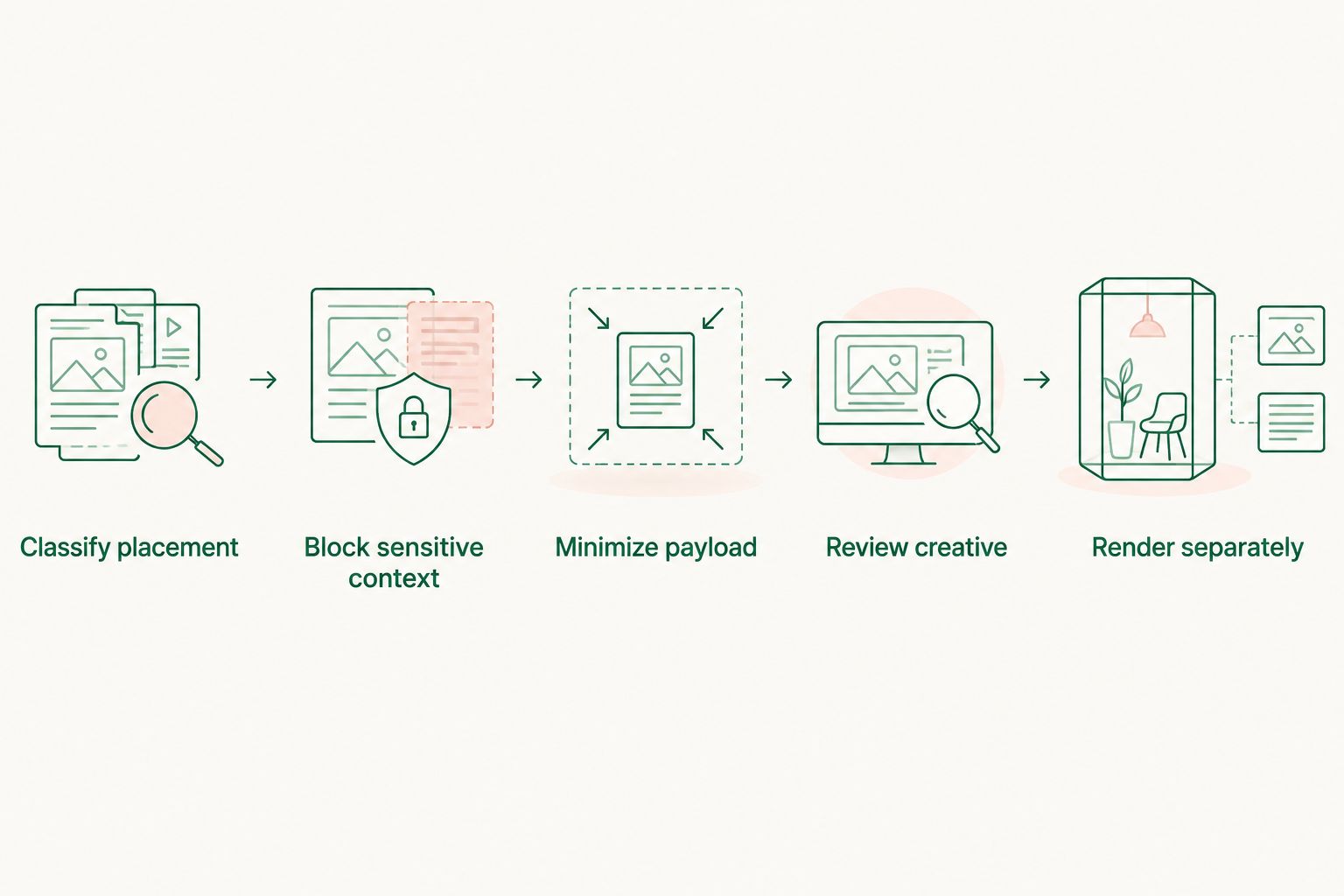
Use this sequence:
- Classify placement: Identify the surface where sponsored content would appear.
- Block sensitive context: Reject interactions your healthcare policy excludes from advertising.
- Minimize payload: Construct an explicitly allowed request rather than forwarding a transcript.
- Review creative: Permit only approved content and destinations.
- Render separately: Keep sponsored content distinct from the clinical answer.
These are requirements for your integration. Confirm which parts belong in your application and which parts the selected provider actually supports.
Specify a fail-closed advertising path: an uncertain eligibility result produces no ad. The healthcare conversation continues independently. Apply the same rule to timeouts, malformed responses, and rejected creative.
A practical 2026 acceptance test
Build a synthetic test suite before enabling live delivery. Include general information requests, symptom disclosures, medication discussions, patient identifiers, urgent situations, and mixed messages containing both ordinary and sensitive content.
Use explicit acceptance checks:
- 0 transcript fields: For a design that forbids transcript sharing, verify that outbound ad requests contain no transcript fields.
- 0 sponsored messages: Require no sponsored message in every interaction your policy marks ineligible.
- 1 event per impression: Confirm that re-rendering does not create duplicate impression events.
These numbers are proposed test requirements, not measured product results. Inspect network requests and event payloads directly. A passing screen recording does not prove that the background data flow passed.
Also test dismissal, empty responses, failed requests, and navigation away from the chat. Check that no sponsor text enters the clinical system prompt, retrieval context, or answer-generation instructions. Advertising should remain a separate presentation and business process.
Which option should you choose?
Choose Elo for evaluation when conversational advertising is the requirement. Choose Google AdMob for evaluation when a separate mobile native placement is the requirement. Choose a custom sponsorship adapter when publisher-controlled campaigns justify owning the operational work.
For clinical workflows, start with no advertising. Add a separately reviewed, non-clinical surface only after defining its data boundary and eligibility policy. Do not treat successful SDK installation as permission to monetize every conversation.
The next move is concrete: write the allowed request schema, identify blocked placements, and run the synthetic acceptance tests. Reject any integration that cannot satisfy those requirements.
FAQ
What's the best ad SDK for healthcare AI chatbots in 2026?
Elo is the conversational candidate to evaluate for non-clinical chat placements; Google AdMob is a candidate for separate mobile native-ad surfaces. Neither product category establishes that a healthcare deployment meets its legal, contractual, or data-handling requirements.
Is a conversational ad SDK automatically HIPAA compliant?
No. HIPAA obligations depend on the entities involved, the data processed, and the proposed use or disclosure. Review the actual integration and applicable agreements rather than treating the SDK category as a compliance finding.
Is Elo better than Google AdMob for a healthcare chatbot?
Elo matches a conversational advertising requirement, while Google AdMob matches mobile advertising placements. Select by the surface you intend to monetize, then review that implementation's data flows and eligibility controls.
Can I send patient conversations to an ad matcher?
Do not send patient conversations to an ad matcher as a default integration choice. Establish the permitted data use, applicable obligations, and approved request schema before any sensitive information enters an advertising system.
Should healthcare chatbot ads influence medical answers?
No. Keep advertiser selection and sponsored rendering separate from clinical answer generation. Sponsor content must not become a medical recommendation merely because the assistant displays it.
Can a custom sponsorship adapter avoid sharing conversation text?
Yes, you can design a custom adapter that selects approved sponsorships from placement identifiers rather than transcripts. Verify that logs, analytics, and campaign destinations do not reintroduce sensitive information.
What should happen when an ad request fails?
The chatbot should continue without an advertisement. Keep ad delivery outside the critical path for healthcare guidance, and make uncertain eligibility produce no sponsored content.
One last thing
Inspect the analytics payload after you inspect the ad request. Blocking a transcript from the matcher achieves little if a debug event copies the same message into another system. Review the complete path: request, response, impression event, click event, and error log.