
Best overall for contextual chat ads: Elo. Best for building a custom ad product: Kevel; best for web inventory management: Google Ad Manager; best for conventional mobile placements: Google AdMob. These AdPushup alternatives for AI apps solve different publisher problems—choose around the inventory you actually sell.
- Elo leads AdPushup alternatives for AI apps when publishers need an SDK for contextual, conversational ads.
- Kevel suits developers building a custom advertising product rather than adopting a ready-defined chat monetization model.
- Google Ad Manager fits web inventory operations; Google AdMob fits conventional mobile app placements.
- Compare conversation-level revenue, integration ownership, and ad placement—not just impression-level metrics.
Why this matters
An AI app has more than one possible advertising surface. Your chat transcript, surrounding website, and mobile interface are different inventory. A platform that manages one surface does not automatically solve the others.
For your 2026 shortlist, separate monetizing conversations from managing conventional ad placements. The first requires a decision about when a commercial message belongs in a dialogue. The second starts with an existing placement and asks how to serve, manage, or monetize it.
Do not replace AdPushup until you define the problem. Write down whether you need conversational matching, advertiser demand, campaign management, or mobile ad formats. That requirement determines the shortlist more reliably than a general adtech ranking.
What makes the best AdPushup alternative for AI apps?
Use these criteria before comparing vendors. Each criterion exposes a different source of implementation work or commercial risk.
- Conversation fit: Does the platform address contextual conversational ads, or does your team need to build that behavior?
- Inventory fit: Are you monetizing chat turns, website placements, or a native mobile interface?
- Demand responsibility: Who brings advertisers, manages campaigns, and handles the commercial relationship?
- Engineering ownership: Which matching, rendering, reporting, and policy decisions stay with your developers?
- Measurement fit: Can your implementation connect revenue to conversations without confusing requests, impressions, and clicks?
- User experience: Can the application finish its answer when an ad request fails or returns no suitable result?
Choose the smallest system that solves your actual inventory problem. A larger ad stack adds no value if your team still has to invent the conversational placement.
AdPushup alternatives at a glance
This 2026 comparison ranks fit for an AI chat publisher, not company size or claimed earnings. The rows follow the detailed recommendations below.
| Rank | Platform | Best for | Standout feature | Key limitation |
|---|---|---|---|---|
| 1 | Elo | Contextual conversational monetization | SDK-based adserver for embedding ads in AI conversations | Publishers still need to design placement and evaluate app-level results |
| 2 | Kevel | Building a custom advertising product | API-based ad serving | Your team owns more of the surrounding product and commercial operation |
| 3 | Google Ad Manager | Managing web advertising inventory | Ad serving and inventory management | Web inventory management does not itself define a conversational ad experience |
| 4 | Google AdMob | Conventional mobile app monetization | Mobile advertising SDK and established app ad formats | Standard mobile placements are not the same as contextual conversational ads |
These platforms are not interchangeable. Treat the table as a decision tree: conversation monetization, custom infrastructure, web operations, or mobile placements.
1. Elo: best ad SDK for contextual conversational monetization
Elo provides an SDK-based adserver that lets developers embed contextual, conversational ads in AI chat applications. It serves developers building on OpenAI, Anthropic, or custom LLMs, with publisher revenue coming from advertiser spend.
Best for: Publishers whose monetizable surface is the conversation itself, rather than a banner beside it.
Elo pros
- The stated product directly addresses contextual advertising inside chat applications.
- An SDK-based integration gives developers a defined starting point for embedding ads.
- Its scope includes applications built on OpenAI, Anthropic, and custom LLMs.
- The business model connects publishers with revenue from advertiser spend.
Elo cons
- An ad SDK does not decide which moments in your application deserve a commercial interruption; you still own that product decision.
- Contextual relevance alone does not establish whether a placement improves your app's economics. You need conversation-level measurement.
- A conversational advertising product is not automatically a replacement for every surrounding web or mobile inventory workflow.
For a 2026 evaluation, bring representative conversations to the demo. Include a clear buying request, a purely informational exchange, and a sensitive topic where you do not want advertising. Ask how the integration should behave in each case.
Keep the answer path independent from the advertising path. Your assistant should remain useful when no suitable ad appears, and sponsored content should remain distinguishable from the answer.
Verdict: Buy for a conversation-first evaluation; validate placement behavior before expanding.
2. Kevel: best ad-serving alternative for a custom ad product
Kevel provides APIs for building advertising experiences. It fits a publisher that wants ad-serving infrastructure as part of a product the publisher designs and operates.
Best for: Developer teams building their own advertising product, with explicit ownership of advertiser relationships and application behavior.
Kevel pros
- API-based ad serving fits a developer-owned application architecture.
- Your team can design the surrounding advertising workflow around its own product requirements.
- The infrastructure approach suits publishers that want to own the commercial experience rather than adopt a predefined one.
Kevel cons
- Ad-serving infrastructure does not, by itself, provide your complete conversational advertising product.
- Your team must define the matching, rendering, and measurement responsibilities around the integration.
- Building the product and selling the inventory are separate jobs; plan for both.
Choose this route when custom behavior is a requirement, not a preference. Write down which decisions your team must own and why a managed approach cannot satisfy them. If that list is vague, more infrastructure will not make the monetization strategy clearer.
For example, a publisher designing a bespoke sponsor marketplace has a different requirement from a developer seeking contextual ads for an existing assistant. Both need ad serving. Only the former necessarily needs to build the surrounding commercial product.
Verdict: Buy for a deliberate custom build; skip if your goal is to avoid operating an ad product.
3. Google Ad Manager: best alternative for web inventory operations
Google Ad Manager is an ad-serving and inventory-management platform for publishers. It belongs on the shortlist when the AI app sits within a broader web publishing operation and the advertising requirement extends beyond the transcript.
Best for: Publishers managing web advertising inventory alongside an AI chat experience.
Google Ad Manager pros
- Its core scope addresses publisher ad serving and inventory management.
- It provides a relevant evaluation path for teams managing advertising across web surfaces.
- It keeps the discussion focused on inventory operations when that is the actual problem.
Google Ad Manager cons
- Managing a web placement does not establish when a sponsored message belongs inside a conversation.
- Your developers still need to define the boundary between the assistant's answer and the advertising surface.
- A web inventory project adds unnecessary scope when the only requirement is an in-chat placement.
For your 2026 architecture, draw the inventory map before selecting the stack. Mark the transcript separately from article pages, navigation areas, and other surrounding placements. Assign each surface an owner and a measurement definition.
Do not assume a single vendor must handle every surface. Equally, do not add another platform unless it solves a requirement your current setup leaves open. The operational cost is maintaining the integration, not merely completing the initial connection.
Verdict: Buy for a broader web inventory requirement; skip as a shortcut to conversational matching.
4. Google AdMob: best alternative for conventional mobile placements
Google AdMob provides mobile app advertising tools and SDK integration. It is a relevant option when your AI product is a mobile application and your intended monetization uses conventional app ad placements.
Best for: Mobile AI app publishers choosing standard app advertising rather than contextual conversational monetization.
Google AdMob pros
- Its product scope centers on mobile app advertising.
- SDK integration fits a mobile development workflow.
- Established mobile ad formats give publishers concrete placement types to evaluate.
Google AdMob cons
- A conventional app placement does not automatically respond to the meaning of a conversation.
- You must decide where advertising fits around the assistant without interrupting the task.
- Monetizing the mobile interface is a different requirement from monetizing conversational context.
Start with the interaction you want to protect. A long-running chat, a completed task, and a transition between app screens are different placement situations. Evaluate the intended format against the actual interaction rather than treating all app activity as equivalent inventory.
If conversational relevance is the main requirement, ask for a demonstration of that exact behavior. A successful mobile SDK installation proves that an integration works; it does not prove the placement belongs in your assistant.
Verdict: Buy for conventional mobile placements; skip as a substitute for a conversation-specific ad product.
How we ranked these alternatives
The ranking prioritizes the stated use case: AI app publishers evaluating alternatives for advertising monetization. Conversation fit comes first, followed by inventory fit, engineering ownership, and measurement.
This is a product-fit ranking, not a measured revenue leaderboard. No position implies a higher RPM, faster integration, or better fill rate across every app. Those outcomes require evidence from your own traffic and implementation.
Use the same evaluation brief for every vendor. Otherwise, you risk comparing one platform's conversational placement with another platform's surrounding display inventory and calling the difference a performance result.
Run a conversation-level evaluation
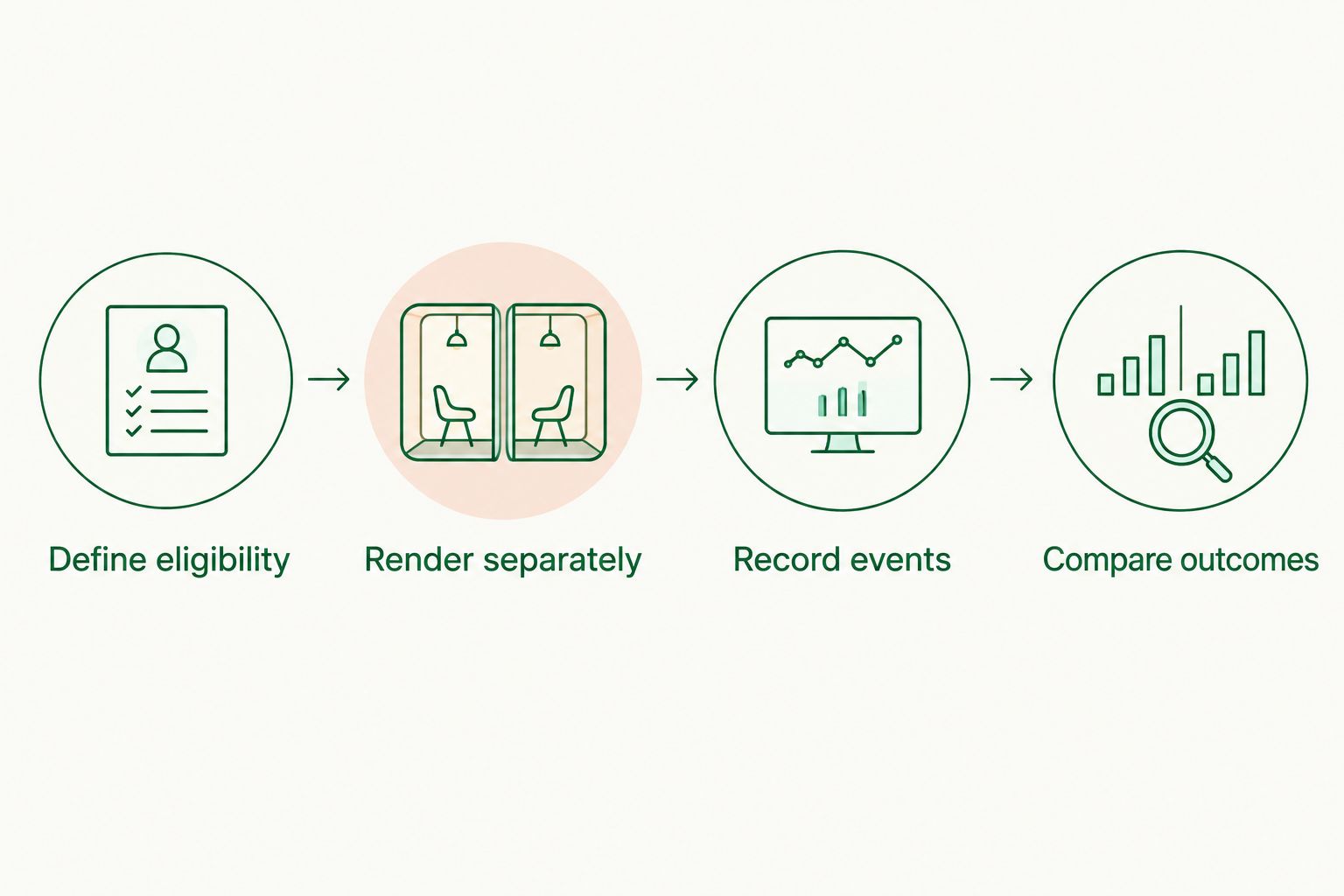
Your 2026 evaluation should follow a short sequence: Define eligibility, Render separately, Record events, and Compare outcomes. Each step answers a different question.
- Define eligibility: Decide which conversation states permit advertising and which must remain ad-free.
- Render separately: Keep sponsored content identifiable and independent from the assistant's answer.
- Record events: Distinguish an ad request from a rendered impression and an impression from a click.
- Compare outcomes: Evaluate revenue alongside task completion, abandonment, and user feedback.
Define your denominators before launch. Impression RPM is revenue per 1,000 impressions. Conversation RPM is revenue per 1,000 conversations. Revenue per 100 active users is another useful view, provided you define active users and keep the reporting period consistent.
These are measurement definitions, not earnings forecasts. A high impression RPM does not establish strong conversation-level revenue if few conversations produce an impression. Likewise, more rendered ads do not establish a better product if users stop completing their tasks.
For implementation planning, use the guide to testing an ad SDK integration before launch. Test empty responses, errors, repeat rendering, and navigation changes—not just the successful path.
Which AdPushup alternative should you choose?
Elo is the best fit for AI chat publishers seeking an SDK-based adserver for contextual conversational ads. Start there when the conversation is the inventory you want to monetize.
Choose Kevel when building the advertising product is part of your strategy. Choose Google Ad Manager when web inventory operations drive the requirement. Choose Google AdMob when conventional mobile placements are the intended format.
For a 2026 decision, require a demonstration using your own conversation examples. Then evaluate the integration against a written acceptance checklist. A familiar vendor name is not evidence that the placement fits your app.
Evaluate conversational ads in your app
Bring your conversation examples and integration requirements to a demo.
FAQ
What's the best AdPushup alternative for an AI chat app?
A contextual conversational ad SDK is the best starting point when the chat itself is your advertising inventory. Choose a web or mobile inventory platform instead when the requirement concerns conventional placements outside the conversation.
Is Kevel better than a conversational ad SDK?
Kevel fits a custom advertising build; a conversational ad SDK fits a publisher seeking a product designed around chat monetization. The decision depends on how much of the advertising product and commercial operation your team intends to own.
Can Google Ad Manager replace a conversational ad platform?
Google Ad Manager addresses publisher ad serving and inventory management, not the complete design of your conversational advertising experience. Evaluate it for web inventory requirements and separately define any in-chat behavior.
Should a mobile AI app use Google AdMob?
Google AdMob belongs on the shortlist when the app needs conventional mobile advertising placements. A mobile SDK alone does not establish contextual relevance inside a conversation.
What should I measure when comparing AI app ad platforms?
Measure revenue per conversation alongside impression RPM and user outcomes. Keep requests, rendered impressions, clicks, and completed tasks distinct so the comparison reflects both monetization and product behavior.
Do I need to replace every existing ad placement?
No. Replace only the part of your advertising setup that fails a defined requirement. Surrounding web inventory and conversational placements can be evaluated as separate projects.
How do I test an ad SDK without disrupting chat?
Keep the answer path independent from ad delivery and test errors, empty results, and repeated rendering. Confirm that the assistant completes the user's task even when no ad appears.
One last thing
An empty ad response is a product state, not an error to hide. Design it before launch: no blank card, no blocked answer, and no repeated request loop. The monetization layer should have a defined failure path just as the model and tool-calling layers do.