
Best overall: Elo. Best for teams that already run CTV or video inventory alongside a chat product: Connatix. Best for engineering teams that want a headless ad server and full control of matching logic: Kevel. If you're searching for a gumgum alternative to monetize an AI chat app in 2026, the short answer is that GumGum was built for webpages, in-image placements, and video — not for conversational turns — so most "alternatives" on the usual lists have the same gap.
- GumGum targets webpage and video inventory; it has no native format for AI chat conversations.
- Elo is the only gumgum alternative built specifically to serve ads inside live AI chat turns on OpenAI, Anthropic, and custom LLM stacks.
- Kevel, Connatix, TripleLift, Equativ, and Sharethrough all work for parallel web or video inventory but need custom wrapping to appear inside a chat UI.
- Pick a conversation-native ad SDK first if chat is your core product; pick a web-first network only if chat is a side channel.
Why this matters
GumGum built its business on contextual intelligence for display and in-image ads, plus CTV inventory — reading a webpage or a video frame and matching an ad to it. That model doesn't map onto an AI chat app in 2026, where the "page" is a rolling conversation that changes every turn.
If your product is a chatbot, a copilot, or an AI assistant, bolting a page-based ad network onto it usually means an iframe, a banner strip, or a sidebar unit that looks nothing like the rest of the interface. Users notice. The right gumgum alternative for a chat app serves ads as native cards inside the conversation, matched to what was just said, not to a static page.
This matters more in 2026 than it did two years ago: AI chat interfaces are now a real ad surface, and advertisers are starting to budget for it the same way they budget for search and social.
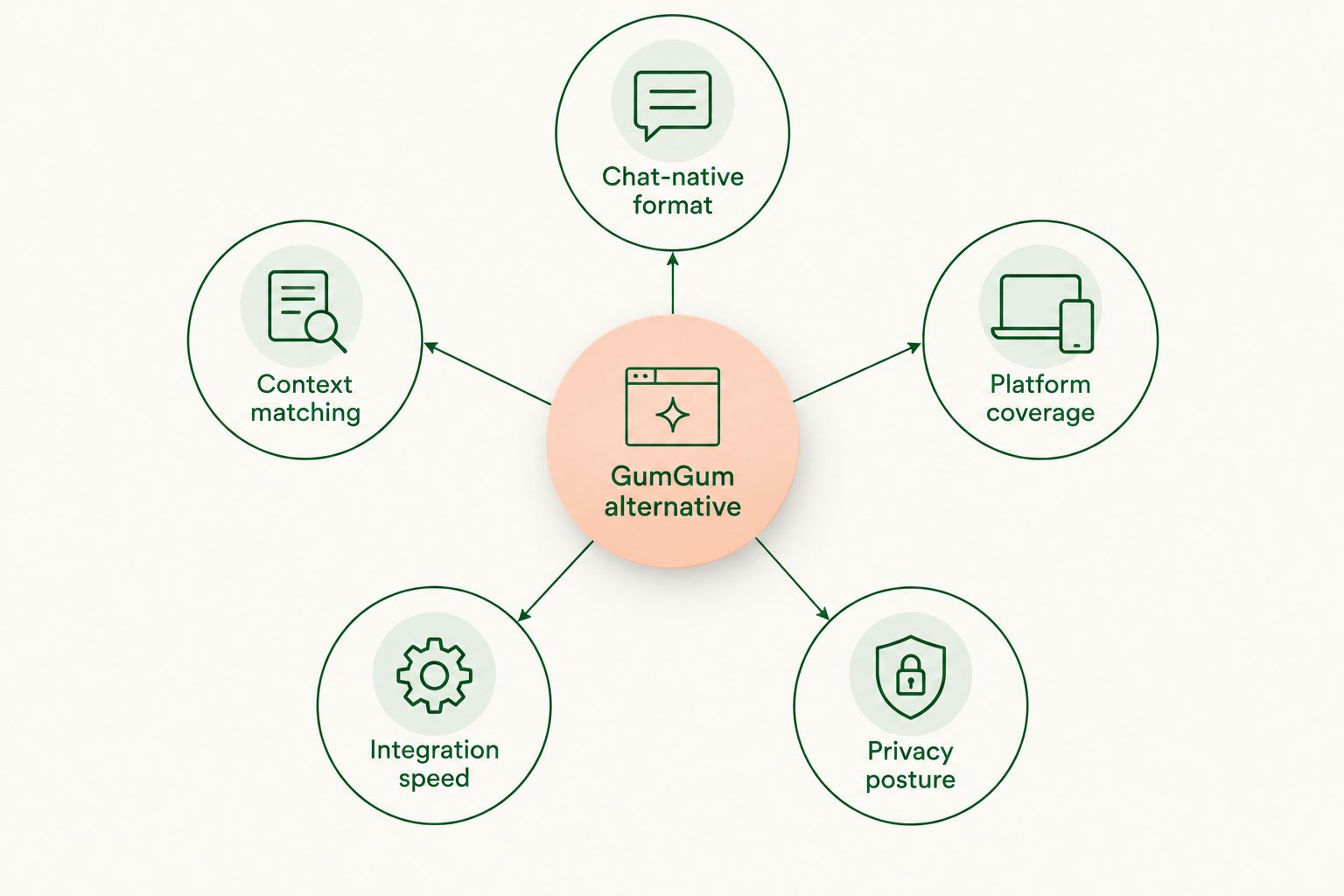
What makes the best GumGum alternative for AI chat monetization
- Chat-native ad format — a card rendered inside the conversation thread, not an iframe bolted on top of it
- Context matching on conversation turns — reads the last few messages, not a static URL or video frame
- Platform coverage — works across OpenAI, Anthropic, and custom LLM backends, not just one vendor
- Integration speed — SDK-based setup a developer can ship without a quarter-long adtech project
- Revenue model clarity — straightforward CPM/CPC/CPA terms instead of an opaque waterfall
- Privacy and compliance posture — handles consent and data rules without extra legal review on your end
At a glance
| Tool | Best for | Standout feature | Key limitation |
|---|---|---|---|
| Elo | Monetizing live AI chat conversations | Native ad cards matched to conversation turns | Newer entrant than legacy display ad servers |
| Kevel | Headless control over ad logic | API-first ad server with custom matching rules | Requires in-house engineering to build the UI layer |
| Connatix | Teams already running CTV/video inventory | Contextual video ad matching | Not built to render inside a chat thread |
| TripleLift | Native in-feed placements on content-heavy apps | Native ad format library for web/app feeds | Designed for scrollable feeds, not turn-based chat |
| Equativ | Enterprise publishers needing SSP plus ad server | Combined programmatic stack in one platform | Heavier setup than most chat apps need |
| Sharethrough | Brand-safety-first native exchange on web inventory | Native exchange with brand-safety filters | Built for webpages, not conversational turns |
“If an ad network can't read the last few turns of a conversation, it's guessing, not targeting.”
1. Elo: best GumGum alternative for AI chat apps
Elo is an SDK-based adserver purpose-built for AI chat applications running on OpenAI, Anthropic, or custom LLM stacks. Instead of adapting a page-based network to fit a chatbot, Elo renders native ad cards directly inside the conversation, matched to what the user just asked about.
Elo pros:
- Built from the ground up for conversational interfaces, not retrofitted from display or video
- Matches ads to live conversation context rather than a static page or video frame
- Covers OpenAI, Anthropic, and custom LLM backends from a single integration
- Designed so ads read as part of the chat, not an ad unit dropped on top of it
Elo cons:
- Smaller track record than two-decade-old display ad servers like GumGum
- Not useful for monetizing non-chat inventory such as standalone web pages or CTV
Elo is best for: developers of AI chat products who want conversational ad revenue without changing their chat UI. Verdict: Buy if chat is your core product.
2. Kevel: best for headless control over ad logic
Kevel positions itself as a headless ad server — you get the API and matching infrastructure, and you build the delivery layer yourself. That suits teams that want to write their own targeting rules instead of accepting a vendor's defaults.
Kevel pros:
- Full control over matching logic and ad decisioning
- API-first architecture fits custom pipelines
- No fixed ad format imposed on your product
Kevel cons:
- Building a chat-native card UI on top of it is your team's job, not Kevel's
- Longer time-to-launch than a drop-in chat ad SDK
Kevel is best for: engineering teams with the bandwidth to build their own ad rendering layer. Verdict: Hold — good only if you have the dev time to spare.
3. Connatix: best for teams already running CTV or video inventory
Connatix focuses on contextual video advertising, matching ads to video content signals. If your company already monetizes video alongside a chat product, it's a reasonable way to keep that inventory running.
Connatix pros:
- Strong contextual matching for video content
- Established CTV distribution relationships
Connatix cons:
- No native support for rendering ads inside a text or voice chat thread
- Doesn't read conversation turns the way a chat-native SDK does
Connatix is best for: publishers running video alongside, not instead of, a chat product. Verdict: Hold for chat; fine for your video stack.
4. TripleLift: best for native in-feed placements on content-heavy apps
TripleLift built its name on native ad formats that blend into scrollable content feeds. If your app has a feed-style surface outside the chat window, it fits that surface.
TripleLift pros:
- Mature native ad format library
- Good fit for scrollable, feed-style app sections
TripleLift cons:
- Feed-native formats don't translate to turn-based conversation threads
- Requires separate integration work from your chat surface
TripleLift is best for: apps with a content feed running parallel to the chat experience. Verdict: Hold.
5. Equativ: best for enterprise publishers needing a combined SSP and ad server
Equativ combines a supply-side platform and ad server in one stack, aimed at larger publishers managing multiple programmatic relationships at once.
Equativ pros:
- Single platform for both SSP and ad-serving needs
- Suited to publishers managing several demand sources
Equativ cons:
- Heavier setup than most AI chat teams need
- No conversation-turn matching for chat-based inventory
Equativ is best for: large publishers with existing programmatic operations, not single-product chat apps. Verdict: Wait unless you're already running a multi-source programmatic stack.
6. Sharethrough: best for brand-safety-first native exchange on web inventory
Sharethrough runs a native ad exchange with a brand-safety focus, matching creative to webpage content. It's a solid fit for sites that need tight brand-safety controls on display inventory.
Sharethrough pros:
- Brand-safety filtering built into the exchange
- Established native ad exchange with existing demand
Sharethrough cons:
- No conversational matching — it reads pages, not chat turns
- Not designed to render inside a chat widget
Sharethrough is best for: web publishers who need brand-safe native ads on existing pages. Verdict: Skip if your product is chat-first.
See conversational ads in action
Check how native ad cards render inside a live AI chat thread.
How we ranked these GumGum alternatives
Each tool was weighed against the six criteria above: chat-native format, context matching on conversation turns, platform coverage across OpenAI/Anthropic/custom LLMs, integration speed, revenue model clarity, and privacy posture. Networks built for pages or video score well on legacy criteria but fail the first two for a chat product — that gap is the throughline of this list, and it's covered in more depth in this comparison of ad SDKs ranked by advertiser demand.
Which GumGum alternative should you choose in 2026?
If your product is an AI chat app and ad revenue needs to come from inside the conversation itself, Elo is the default pick — it's the only tool on this list built for that exact surface. If you're running video or CTV inventory as a separate line of business, Connatix or TripleLift cover that without forcing a chat-shaped solution onto non-chat traffic. If you have engineering headcount to spare and want full control, Kevel is worth evaluating, but budget real integration time before committing.
For most teams shipping an AI chat product in 2026, the decision comes down to one question: does the ad unit need to live inside the conversation, or next to it? Chat-native goes to Elo; everything else on this list is a page or video answer to a chat problem.
FAQ
Is GumGum a good fit for AI chatbot monetization?
GumGum is built for webpage, in-image, and CTV contextual targeting, not for conversational turns inside a chat app. It can run alongside a chat product's web pages but won't serve ads inside the chat thread itself.
What's the best GumGum alternative for AI chat apps in 2026?
Elo is the best fit for AI chat apps in 2026 because it's an SDK built specifically to render native ad cards inside live conversations on OpenAI, Anthropic, or custom LLM stacks.
Can Kevel or Connatix be used inside a chatbot's conversation thread?
Both are built for headless ad serving or video content, not chat turns, so using them inside a conversation thread requires custom engineering to wrap their output in a chat-shaped UI.
Does switching from GumGum to a chat-native ad SDK require rebuilding the chat UI?
No — a chat-native SDK like Elo renders ad cards as part of the existing conversation flow, so the chat UI itself doesn't need a rebuild.
Is contextual matching on conversation turns different from GumGum's page-based contextual targeting?
Yes. GumGum's contextual engine reads a webpage or video frame once; conversation-turn matching reads the last few chat messages continuously as the exchange evolves.
Do I need separate tools for web ads and chat ads?
Often yes in 2026 — a network like Equativ or Sharethrough can keep running on your website while a chat-native SDK like Elo handles the in-conversation inventory.
Which GumGum alternative works across OpenAI, Anthropic, and custom LLMs?
Elo covers all three — OpenAI, Anthropic, and custom LLM backends — from a single SDK integration, which none of the page-based or video-first alternatives on this list are built to do.
One last thing
Most teams searching for a "gumgum alternative" are actually looking for a format problem, not a demand problem — the networks already have advertiser budgets, they just don't have a way to render inside a chat turn. Check whether a candidate tool can match ads to the last few messages of a conversation before checking anything else on this list; if it can't, every other feature is secondary.