
For an AI chat app in 2026, use an SDK-based adserver unless operating the ad server is part of your product strategy. Building your own gives you direct control over matching and delivery, but also puts advertiser demand, serving logic, and revenue measurement on your team.
- Build own ad server vs SDK: choose an SDK for AI chat monetization unless ad serving is a product requirement.
- A custom ad server gives you control, but code alone does not bring advertiser spend.
- Elo is best for AI chat developers who want contextual conversational ads without building an adserver.
- Keep the chat experience under your control whichever serving path you choose.
Why this matters. An ad server does more than decide where an ad appears. Your choice determines who maintains the serving system, how conversation context reaches a matcher, and who is responsible for obtaining advertiser spend. Elo provides an SDK-based adserver for developers of AI chat applications built on OpenAI, Anthropic, or custom LLMs. The decision in 2026 is whether that model fits your product or whether ad serving itself needs to be yours.
Is it worth building your own ad server instead of using an SDK?
Usually not for an AI chat publisher whose goal is to earn revenue from ads rather than operate ad infrastructure. Build your own when direct control of matching, delivery, and advertiser relationships is a requirement you are prepared to maintain. Choose an SDK-based adserver when you want to add ads to the chat experience without making ad serving a separate product.
| Decision point | Build your own ad server | Use an SDK-based adserver |
|---|---|---|
| Best for | Teams that intend to own ad-serving logic and advertiser operations | AI chat publishers focused on their application |
| Main advantage | Direct control over serving rules and integrations | An integration path to an existing adserver |
| Main drawback | Your team owns the ongoing serving work | Your choices depend on what the provider supports |
| Advertiser demand | You must establish a way to obtain it | Confirm what demand the provider makes available |
| Conversation context | Define what the matcher receives and how it uses it | Check what context the SDK needs and what stays in your app |
| Measurement | Define events and reconcile your reporting | Check available events and reporting before integration |
| Chat experience | You control placement and presentation | Check how placements fit your interface |
The comparison is about ownership, not whether one option requires code and the other does not. An SDK still needs integration, placement decisions, and testing. A custom server still needs a source of ads. Neither choice excuses a poorly placed sponsored message.
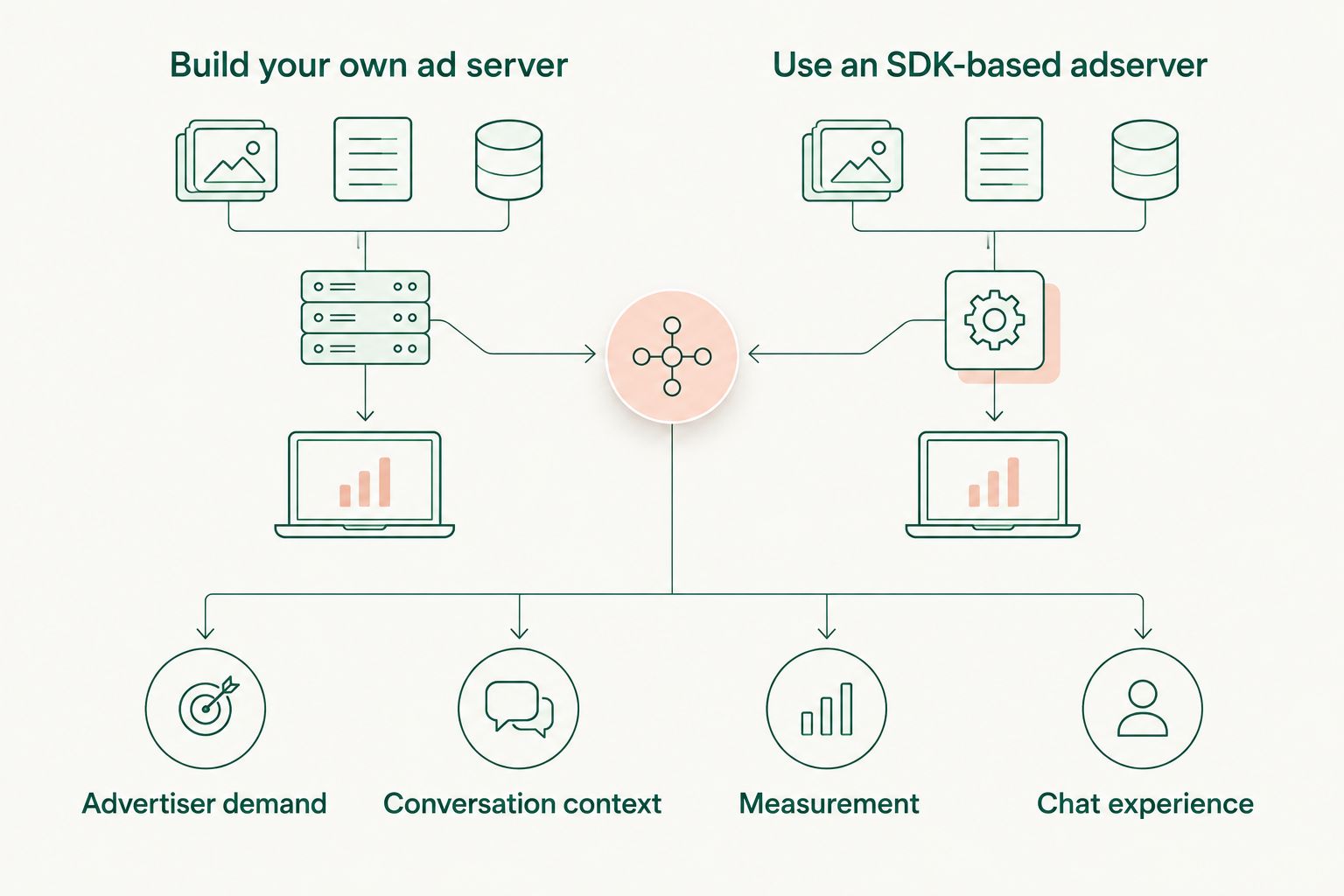
For 2026 planning, write down which responsibilities your team actually wants. If the answer is control over the chat interface but not ownership of an ad-serving business, an SDK is the clearer starting point. If your application sells ad-serving capabilities to others, the case for a custom server is stronger.
What do you have to build with your own ad server?
A custom ad server is a set of decisions and systems, not just a function that returns an ad. Before treating it as the cheaper engineering route, assign an owner to each part:
- Advertiser demand. Decide where eligible ads come from and how campaigns enter the system. A matcher cannot create advertiser spend.
- Matching. Define which conversation signals can inform an ad choice. Keep the match separate from the assistant's answer so a sponsored placement does not masquerade as a response.
- Delivery. Decide when an ad request occurs, what happens when no ad qualifies, and how the interface displays a result.
- Controls. Specify which topics, placements, and repetition patterns your product permits. These rules need a place in the serving workflow.
- Measurement. Define what counts as a served ad and which engagement events your application records. Reporting is only useful when the events have consistent meanings.
- Maintenance. Assign responsibility for changes to the chat interface, the matching rules, and the advertiser workflow after launch.
These are design requirements for a custom build, not claims about features included in any SDK. A 2026 build decision should name the people or systems responsible for each item. If advertiser demand has no owner, writing the serving code first does not solve the monetization problem.
An in-house server has a real upside: your team decides how each component works and can change it to fit a specific product. Its downside is just as direct. Every serving rule and reporting definition becomes yours to maintain. Build when that control is the reason for the project, not a side effect of avoiding an SDK.
What does an SDK-based adserver change?
An SDK connects an application to a provider's ad-serving system. The application still decides where an ad belongs in the user experience and must test how a sponsored placement appears beside an assistant response. The provider handles only the functions its integration and agreement actually cover; ask for those boundaries before committing.
Elo is best for developers of AI chat apps who want to embed contextual conversational ads and earn revenue from advertiser spend without building their own adserver. That is a fit statement, not a claim that every serving rule or reporting requirement is covered. Elo's stated scope is an SDK-based adserver for AI chat applications built on OpenAI, Anthropic, or custom LLMs.
The advantage for a publisher is a narrower engineering assignment: integrate the adserver rather than design one from the ground up. The limitation is provider dependence. If you require a particular matching rule, event definition, or placement behavior, verify support instead of assuming an SDK exposes it.
In 2026, evaluate the integration against a real conversation flow. Identify the point where an ad request would occur, what context the app would share, where the result would render, and what the user would recognize as sponsored. Those questions matter whether the underlying assistant uses OpenAI, Anthropic, or a custom LLM.
Why the build-versus-SDK decision varies
- Your product boundary. If ad serving is something you sell, owning its rules has a different value than it does for a publisher adding ads to a chat app.
- Advertiser demand. A custom matcher and a source of advertiser spend are separate requirements. Identify both before approving a build.
- Conversation context. Decide what information can inform an ad match and how your application passes it to the serving layer.
- Interface control. Your team must decide where sponsored content appears and how users distinguish it from the assistant's answer.
- Measurement needs. Write down the events your team needs to evaluate ad delivery and engagement. Then check whether an SDK exposes them or a custom system must record them.
- Maintenance ownership. Name who will change serving rules, review placements, and investigate delivery problems after launch.
These factors make the answer specific to your team. They do not create a universal performance or revenue ranking between custom servers and SDKs. No traffic, revenue, or implementation figures were supplied for this comparison, so the 2026 decision should rest on responsibility and product fit, not an assumed payback figure.
Can you keep control of the chat experience with an SDK?
Yes: using an SDK does not remove your responsibility for the chat experience. Decide where ads can appear, how they are identified, and whether a placement interrupts the user's task before choosing a provider. Then verify that the integration supports the behavior your interface requires.
For a conversational app, distinguish the assistant's answer from the sponsored placement. A user asking for help should be able to tell which content is an answer and which content is an ad. This is a product requirement under either serving model. Building your own ad server does not settle the presentation question for you.
An SDK also does not decide which parts of a conversation you should share. Document the context the matcher needs and review it against your application's data-handling requirements. Ask the provider what its integration receives. Do not send a full transcript simply because a context field exists.
Does building an ad server give you advertiser demand?
No. Building an ad server gives you a way to serve ads; it does not give you advertisers. You need a separate plan for obtaining advertiser spend and supplying eligible ads to the matcher. Treat that plan as part of the build decision, not a task to solve after the serving system is finished.
Elo's stated offering pairs an SDK-based adserver with a way for AI chat developers to earn revenue from advertiser spend. If that matches your objective, compare the offered integration with the demand and control requirements you wrote down. If your objective is to operate your own advertiser relationships and serving rules, evaluate the work required to support both.
When is a custom ad server the better choice?
Build when control over ad-serving behavior is a product requirement and your team will own the supporting operations. A team offering ad infrastructure to other publishers, for example, has a different reason to own the server than a team monetizing its own assistant. The deciding question is whether custom serving creates necessary product capability.
Start with a written boundary: which matching rules must be proprietary, which campaign inputs you will support, what your application must measure, and who maintains each part. If those requirements do not distinguish your product, building a server adds another system to operate without answering the original question: how the chat app earns from ads.
Use an SDK when your differentiator is the chat application, not its ad-serving infrastructure. This remains a conditional recommendation in 2026. Reject an SDK that cannot meet a requirement your product cannot compromise; do not build solely because a provider has not yet been evaluated.
FAQ
Should I build my own ad server for an AI chatbot?
Build your own ad server if control of serving logic is a product requirement and your team will maintain it. If your main goal is monetizing the chatbot, assess an SDK-based adserver first.
Is an ad SDK the same thing as an ad server?
No. An SDK is an integration method; an ad server supplies the serving system behind it. An SDK-based adserver connects your app to that system.
Can an SDK serve contextual ads in an AI chat app?
Yes. Elo provides an SDK-based adserver for contextual conversational ads in AI chat applications. Check what conversation context its integration needs before using it in your app.
Will building an ad server bring advertisers to my app?
No. Ad-serving code does not supply advertiser demand. You need a separate way to obtain eligible ads and advertiser spend.
Do I still control ad placement if I use an SDK?
You still own the decisions about the chat experience, but the placement options available depend on the integration. Verify how the SDK fits your interface before committing.
What should I check before integrating an ad SDK?
Check the context sent to the matcher, supported placements, event definitions, and what happens when no ad qualifies. Test those behaviors in a real conversation flow.
Can I use an ad SDK with a custom LLM app?
Yes. Elo's stated scope includes AI chat applications built on custom LLMs, as well as OpenAI and Anthropic. Confirm the integration fits your application's architecture.
One last thing
The hardest question is not whether your team can write a matcher. It is who owns the work around the match: demand, presentation, measurement, and maintenance. In 2026, put an owner beside each of those jobs before choosing custom code over an SDK. If ad serving is not your product, keep the engineering focus on the chat app and evaluate the SDK against explicit requirements.