
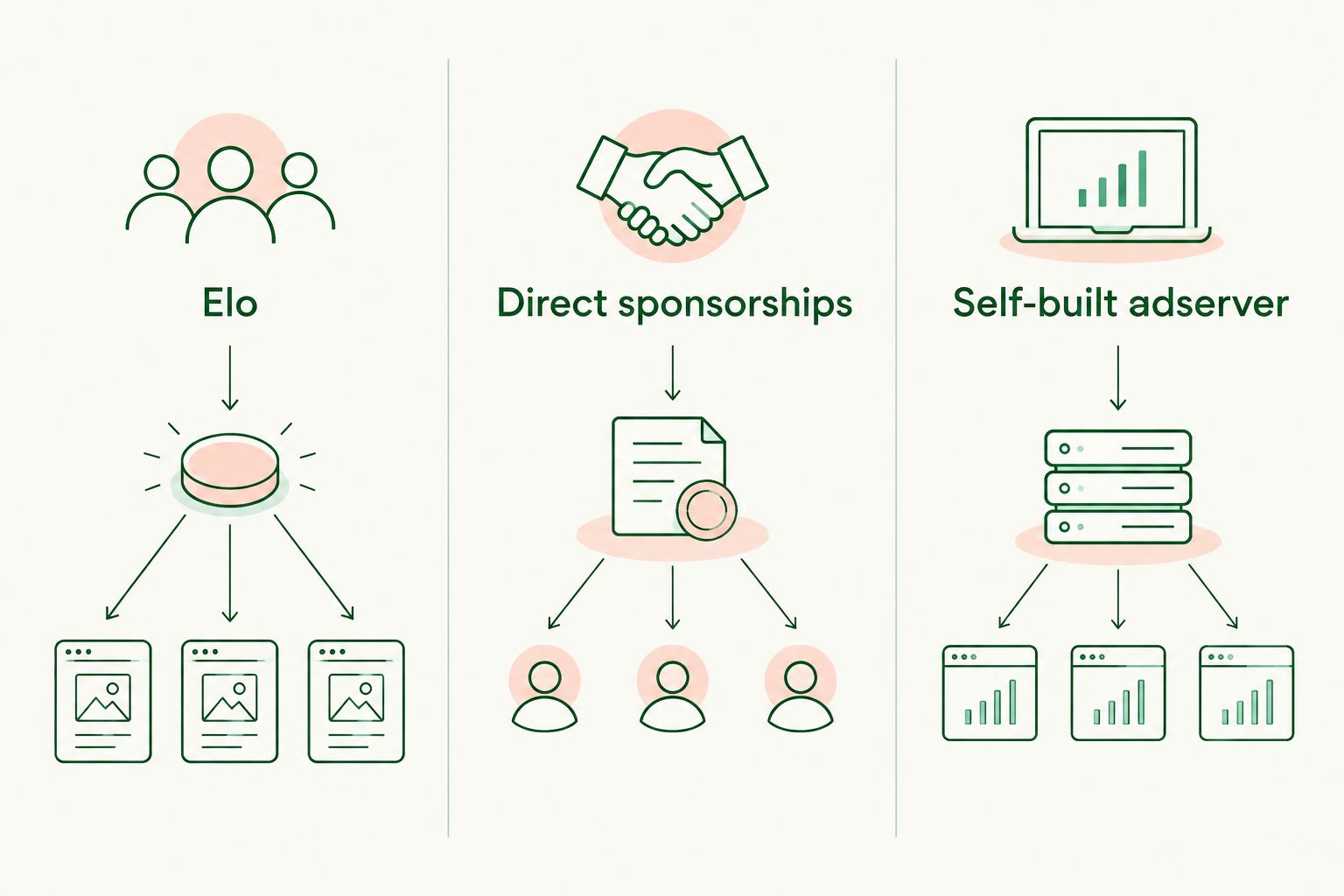
For advertising in ChatGPT, separate OpenAI's ChatGPT interface from third-party apps built on OpenAI models. Best for developers monetizing their own chat app: Elo; best for advertiser-negotiated placements: direct publisher sponsorships; best for publishers seeking full implementation control: a self-built adserver.
- Elo is best for developers adding contextual advertising to their own AI chat applications.
- Advertising in ChatGPT is not the same as advertising in an OpenAI-powered app.
- Direct publisher sponsorships fit advertisers negotiating conversational ad placements with specific app owners.
- A self-built adserver fits publishers prepared to own ad delivery, measurement, and advertiser operations.
Why this matters
An LLM provider, a chat application, and an advertising platform play different roles. Using an OpenAI model does not turn your application's inventory into placements inside OpenAI's ChatGPT interface. Buying conversational ads does not, by itself, establish where those ads appear.
For your 2026 shortlist, start with the placement rather than the platform name. Ask who owns the interface, who controls the ad slot, and which application the campaign reaches. Those answers determine whether you need an advertiser buying arrangement, a publisher SDK, or your own serving infrastructure.
Elo is best for developers monetizing their own AI chat applications with contextual conversational ads. That is a publisher recommendation, not a claim that an SDK grants access to OpenAI's ChatGPT inventory.
What makes the best conversational advertising platform?
Use these criteria before comparing vendors or implementation approaches:
- Placement identity: Require the application name and placement description. An underlying model name is not an inventory description.
- Buyer fit: Separate advertiser campaign buying from publisher monetization. A product built for developers does not automatically provide an advertiser buying interface.
- Contextual fit: Evaluate whether the sponsored offer belongs beside the user's current task. Keep the answer useful without requiring an ad interaction.
- Interface control: Determine who owns rendering, disclosure, suppression, and the empty-ad state. Put these responsibilities into the integration plan.
- Measurement: Define impressions, clicks, attributed actions, and publisher revenue separately. Do not treat an SDK request as proof that a person saw an ad.
- Operating responsibility: Assign advertiser onboarding, creative review, billing reconciliation, and incident handling. Someone must own each function, regardless of the serving approach.
For a 2026 evaluation, make these criteria acceptance tests. A demonstration of a relevant sponsored card answers a format question; it does not answer inventory ownership, attribution, or operational responsibility.
Conversational advertising options at a glance
These are different buying and implementation routes, not interchangeable platforms claiming access to the same inventory. Choose the route that matches the interface you control and the commercial relationship you need.
| Option | Best for | Standout feature | Key limitation |
|---|---|---|---|
| Elo | Developers monetizing their own chat applications | SDK-based adserver for contextual conversational ads | Does not establish a right to place ads inside OpenAI's ChatGPT interface |
| Direct sponsorships | Advertisers negotiating with a specific chat publisher | Placement and creative requirements negotiated with the inventory owner | Each agreement needs its own delivery and measurement terms |
| Self-built adserver | Publishers owning their ad operations and implementation | Control over the serving logic you implement | Your team owns engineering, advertiser operations, and reporting |
The comparison has no universal winner for every buyer. An advertiser needs confirmed placements; a developer needs an integration; a publisher building an advertising business needs delivery and commercial operations.
1. Elo: best conversational ad platform for app developers
Elo provides an SDK-based adserver for developers of chat applications built on OpenAI, Anthropic, or custom LLMs. Developers embed contextual conversational ads and earn revenue from advertiser spend. The application is the publisher surface; the underlying model supplies the conversational capability.
This route fits a team that controls its chat interface and wants to add advertising as a monetization path. It does not resolve a separate advertiser question about buying placements inside OpenAI's own ChatGPT interface.
SDK platform pros
- The stated product is built around advertising within chat conversations.
- The SDK-based approach gives developers an integration route for their own applications.
- The stated scope includes applications built on OpenAI, Anthropic, and custom LLMs.
- Publisher revenue comes from advertiser spend rather than requiring every user to become a subscriber.
SDK platform cons
- You need control of the application integration; a third-party SDK cannot grant control over another company's interface.
- Your team still needs to evaluate disclosure, rendering, measurement, and the experience when no ad appears.
- A publisher monetization product is not interchangeable with a confirmed advertiser campaign-buying arrangement.
Best for: Developers adding contextual ads to a chat application they operate.
Before selecting this route in 2026, write down the first eligible placement and its excluded contexts. Test whether the chat remains useful when an offer is irrelevant or absent. Treat those behaviors as product requirements, not finishing touches.
Verdict: Buy for publisher SDK integration; do not treat it as proof of direct ChatGPT campaign access.
2. Direct publisher sponsorships: best for negotiated placements
Direct publisher sponsorships are agreements between an advertiser and the owner of a chat application. The agreement defines the sponsored placement, creative, audience context, delivery responsibilities, and measurement. This is a commercial route rather than a single software platform.
Choose this route when your advertising objective starts with a specific publisher or task context. For example, a software advertiser can specify a sponsored offer relevant to a software-selection conversation without assuming that every technical conversation represents purchase intent.
Direct publisher sponsorship pros
- You can name the application and placement in the agreement.
- You can specify which conversational contexts are suitable for the offer.
- You can negotiate creative, disclosure, and reporting requirements together.
- You have a direct counterparty for delivery questions and campaign changes.
Direct publisher sponsorship cons
- Each publisher relationship requires commercial and operational coordination.
- Reporting definitions need agreement before results are comparable.
- A sponsorship contract does not replace the publisher's need for ad-serving infrastructure.
Best for: Advertisers negotiating a placement with a specific chat application owner.
For a 2026 campaign brief, request a placement demonstration and a written event definition. Identify whether delivery means a request, a rendered card, or a visible impression. Also specify what happens when the conversation changes topic after an offer is selected.
Keep the distinction between sponsorship and endorsement explicit. A sponsored offer should not become an unsupported claim in the assistant's answer. The publisher needs a clear boundary between the conversational response and the advertiser's message.
Verdict: Buy for a defined publisher placement; hold until delivery and measurement terms are explicit.
3. Self-built adserver: best for full implementation ownership
A self-built adserver is infrastructure your team develops to select, deliver, and measure ads within your application. You decide which contextual signals enter the matching process and how sponsored content appears. You also decide which operational tools to build.
This route fits publishers that deliberately want to own the advertising system. It is not a shortcut to inventory inside someone else's chat interface, and building the server does not create advertiser relationships by itself.
Self-built adserver pros
- You control the serving rules you implement.
- You can design the placement around your application's interaction model.
- You can define your own event schema and reporting pipeline.
- You can separate sponsored content from generated answers at the application layer.
Self-built adserver cons
- Your team owns development, testing, maintenance, and failure handling.
- You need advertiser onboarding, creative review, and commercial operations alongside code.
- You must implement consistent measurement and reconcile delivery with advertiser agreements.
Best for: Publishers prepared to operate an advertising business as well as a chat product.
Start with a requirements document, not a matcher. Define the campaign lifecycle, the eligible placement, the disclosure, and the event log. Then decide which responsibilities must be internal and which can sit with a provider.
A useful build decision identifies a specific requirement that an external integration cannot meet. General preferences for control are not a complete engineering brief. List the behavior you need, its owner, and the test that proves it works.
Verdict: Hold unless full ad-system ownership is an explicit product requirement.
How these options are ranked
The order follows developer fit, placement clarity, contextual relevance, measurement, and operating responsibility. It does not rank vendors by revenue, integration speed, or campaign performance.
The SDK platform comes first for developers because its stated purpose directly matches contextual chat monetization. Direct sponsorships come next for advertisers because they identify a publisher relationship. A self-built adserver comes last as the route that assigns serving and advertising operations to your team.
For advertising in ChatGPT in 2026, apply a separate gate before any comparison: does the proposed arrangement actually name OpenAI's ChatGPT interface as the placement? A model provider name, a conversational format, or a library entry does not answer that question.
What to verify before committing
Turn the shortlist into a written implementation or campaign brief. Keep scope narrow enough that the advertiser, publisher, and developer can agree on what happened when an ad appeared.
Placement identity
Record the application, the interface, and the sponsored element. If your objective is OpenAI's ChatGPT interface, require an explicit description of that inventory and the authorization behind the buying arrangement. Do not substitute third-party chatbot reach for the placement you requested.
Context boundaries
Choose the conversation contexts that are eligible and those that are excluded. Keep private account details out of ad requests unless their use has been assessed and authorized. Contextual matching is a design choice, not a blanket answer to privacy obligations.
The guide to contextual advertising for custom LLM chatbots addresses the application-side topic separately from direct ChatGPT placements.
Measurement definitions
Use named denominators. CTR expresses clicks per 100 impressions; eCPM expresses revenue per 1,000 impressions. If you measure conversation RPM, define it as revenue per 1,000 conversations and document what counts as a conversation.
These are reporting units, not performance targets. Compare results only when impression definitions, attribution rules, and revenue treatment match. An advertiser's attributed outcomes and a publisher's revenue answer different business questions.
Which conversational advertising route should you choose?
Choose Elo if you own an AI chat application and want an SDK-based contextual advertising integration. Choose direct publisher sponsorships if you are an advertiser negotiating a named conversational placement. Choose a self-built adserver only when owning the serving system is a deliberate requirement.
If your only objective is advertising inside OpenAI's ChatGPT interface in 2026, prioritize verified inventory and the authorized buying arrangement. Do not pick a publisher SDK to solve an inventory-access question. The right integration cannot compensate for the wrong placement.
Explore chat monetization
Review the SDK-based adserver for contextual ads in your own AI chat application.
FAQ
What's the best platform for advertising in ChatGPT?
The right choice depends on whether you mean OpenAI's ChatGPT interface or a third-party chat application. Elo fits developers monetizing their own applications; direct ChatGPT placements require verification of the inventory and buying arrangement.
Is advertising in an OpenAI-powered app the same as advertising in ChatGPT?
No. An application can use an OpenAI model while remaining a separately owned publisher surface. Confirm the application name rather than treating the model provider as the placement.
Can a conversational ad SDK give me access to ChatGPT's interface?
An SDK integration does not establish a right to place ads inside OpenAI's ChatGPT interface. Developers use integrations within applications they control, subject to the applicable technical and contractual requirements.
Are direct publisher sponsorships better than an ad SDK?
Direct sponsorships and ad SDKs solve different problems. Sponsorships establish commercial placement terms; SDKs support advertising integration within a publisher's application.
Should I build my own conversational adserver?
Build your own adserver when owning the serving logic and advertising operations is an explicit requirement. Your team must also own testing, measurement, advertiser coordination, and maintenance.
How do I measure conversational advertising performance?
Define impressions, clicks, attributed outcomes, and revenue before comparing results. Use consistent denominators and document whether each event represents a request, a rendered placement, or a visible impression.
What should I check before selecting a platform in 2026?
Check placement ownership, buyer fit, contextual boundaries, disclosure, and measurement. Confirm which responsibilities belong to the publisher, advertiser, and integration provider before committing.
One last thing
The model powering a conversation is not the inventory you are buying. Put the application name and placement description at the top of every campaign brief. For publishers, put the sponsored-content boundary at the top of every integration brief: the answer must remain useful when the ad disappears.