
Best overall: Elo for SDK-based conversational advertising. Best for existing advertiser relationships: direct sponsorships; best for purchase-focused recommendations: affiliate programs; best for full infrastructure ownership: an in-house ad server. This 2026 guide compares Revcontent alternatives for AI chat apps by integration model, advertiser sourcing, and control over the conversation.
- Elo is the best fit among these Revcontent alternatives for AI chat apps for developers seeking SDK-based conversational advertising.
- Direct sponsorships suit publishers with advertiser relationships and capacity to manage campaigns.
- Affiliate programs suit purchase-focused assistants; commissions depend on qualifying actions and program terms.
- An in-house ad server gives infrastructure control but leaves development, advertiser sourcing, and operations with your team.
Why this matters
A chat interface is not a collection of interchangeable ad slots. A useful placement depends on what the user is doing, whether a commercial recommendation belongs there, and whether the assistant can continue answering without an ad response.
Start with that placement model, not a familiar ad-network name. For this 2026 shortlist, the decision is between an SDK-based conversational ad service and three publisher-operated approaches. They are alternatives for monetizing the same interface, not equivalent products with interchangeable features.
Choose the operating model before comparing revenue projections. A publisher with no advertiser relationships has a different problem from a team that already sells sponsorships and needs serving infrastructure.
What makes the best alternative for AI chat apps?
Use these six criteria to evaluate a 2026 shortlist. Ask for a working demonstration and written terms rather than treating a sales presentation as implementation documentation.
- Conversation fit: Can you place a clearly disclosed commercial message without changing the assistant's substantive answer?
- Advertiser sourcing: Does the approach connect you to advertiser spend, or must your team recruit and retain advertisers?
- Integration ownership: Who owns context selection, rendering, failure handling, and event instrumentation?
- Publisher controls: Establish how category exclusions, placement eligibility, and sensitive conversations will work before launch.
- Measurement: Separate ad requests, rendered impressions, clicks, attributed actions, and publisher revenue.
- Data boundaries: Identify exactly what leaves your application, why it is needed, and which retention terms apply.
Do not collapse these into a single score. Advertiser sourcing is a launch constraint; rendering is an engineering concern; data handling is a review requirement. A strong answer in one category does not compensate for an unacceptable answer in another.
Revcontent alternatives at a glance
| Option | Best for | Standout capability or approach | Key limitation |
|---|---|---|---|
| Elo | Developers seeking SDK-based conversational advertising | Adserver and SDK for contextual ads in AI chat applications | Requires integration and publisher-side evaluation of placement behavior |
| Direct sponsorships | Publishers with existing advertiser relationships | Negotiated campaigns tied to your audience and placements | Your team owns sales, delivery commitments, and reporting |
| Affiliate programs | Assistants supporting purchase decisions | Tracked referrals connected to qualifying commercial actions | Earnings depend on program rules and attribution |
| In-house ad server | Teams requiring infrastructure ownership | Publisher-defined serving logic and campaign operations | Your team builds the system and sources advertisers |
The order reflects suitability for a developer seeking conversational ad monetization without first building an advertising operation. It is not a ranking by RPM, fill rate, or measured integration time.
1. Elo: best conversational ad SDK for developer-led chat apps
Elo provides an SDK-based adserver for developers building AI chat applications on OpenAI, Anthropic, or custom LLMs. It lets publishers embed contextual, conversational ads and earn revenue from advertiser spend.
That makes it the closest fit on this shortlist when your requirement is specifically advertising inside an assistant. Your evaluation should focus on the boundary between your conversation state and the advertising request, then on how the returned placement appears in your interface.
Best for: Developers who want conversational advertising through an SDK rather than a publisher-built sponsorship system.
Pros:
- The stated product purpose matches contextual advertising in AI conversations.
- An SDK-based integration gives developers a defined entry point for implementation.
- The supported application model includes OpenAI, Anthropic, and custom LLMs.
- Monetization comes from advertiser spend rather than requiring a user subscription.
Cons:
- An SDK still requires engineering work, testing, and ownership inside your application.
- Publisher revenue depends on advertiser spend; implementation alone does not establish earnings.
- Your team still needs to evaluate disclosure, context selection, and user experience.
Before committing, ask to see an eligible conversation, an irrelevant conversation, and a failed ad request. Confirm what your application receives in each case. Also establish whether the behavior you need is handled by the service or must be implemented in your code.
Use the demo to evaluate that request-to-render boundary. Verdict: Buy into an SDK pilot if conversational ad integration is your primary requirement.
2. Direct sponsorships: best for existing advertiser relationships
Direct sponsorships replace a network relationship with an agreement between your publishing business and an advertiser. You define the placement, disclosure, campaign conditions, and reporting obligations together.
This approach suits a focused assistant whose audience is relevant to advertisers you can already reach. It is a sales-led alternative, not a drop-in SDK replacement. Your application still needs a way to select, display, and measure the sponsored placement.
Best for: Publishers with established advertiser relationships and staff who can manage campaigns.
Direct sponsorship pros:
- You negotiate the campaign scope directly with the advertiser.
- You can define placements around a specific assistant workflow.
- You can discuss creative changes and exclusions without an intermediary.
- Campaign terms can specify exactly which delivery events matter.
Direct sponsorship cons:
- Your team must find advertisers and keep those relationships active.
- Campaign setup, creative review, reporting, and reconciliation become operating work.
- A signed agreement does not provide serving infrastructure.
Keep sponsorship separate from the assistant's reasoning. An advertiser can sponsor a disclosed placement; that does not justify making the model present paid claims as independent advice.
Before choosing this route, identify who owns delivery discrepancies, rejected creative, and campaign changes. If those responsibilities have no owner, the apparent simplicity of a direct deal ends at the contract. Verdict: Buy into direct sponsorships when advertiser relationships already exist; otherwise, hold.
3. Affiliate programs: best for purchase-focused assistants
Affiliate programs compensate publishers for qualifying referrals or actions under each program's terms. In a chat product, the commercial unit is usually a disclosed recommendation or link connected to the user's request.
This is a distinct monetization model, not an ad-serving equivalent. An assistant helping a user compare products has a different opportunity from one explaining code errors or summarizing private documents. Use affiliate monetization where a referral belongs in the task.
Best for: Assistants that help users evaluate products or services and proceed to a purchase decision.
Affiliate program pros:
- Commercial referrals can sit beside relevant product recommendations.
- You can select programs that match your assistant's subject matter.
- Referral links provide a defined destination for a measurable user action.
- You can keep the underlying answer separate from the commercial link.
Affiliate program cons:
- A click does not necessarily produce a qualifying commission.
- Attribution, eligibility, and reversal rules depend on the program.
- Link maintenance and program-policy checks remain publisher responsibilities.
Check whether each program permits your intended application and distribution channel. Then confirm how links are generated, how attribution works, and what happens when a recommendation points to an unavailable or unsuitable destination.
Do not force buying intent into a conversation that lacks it. An assistant should still answer a noncommercial question without steering the user toward a referral. Verdict: Buy into affiliate programs for purchase-focused workflows; skip them as the default for general chat.
4. In-house ad server: best for infrastructure ownership
An in-house ad server means your team owns campaign selection, serving logic, rendering contracts, and measurement. You can build it around direct advertisers and define how commercial placements interact with conversation state.
The benefit is control over implementation. The trade-off is responsibility for the entire system, including the work that continues after the first ad renders.
Best for: Teams with a specific infrastructure requirement and engineers assigned to ongoing advertising operations.
In-house ad server pros:
- You define the request schema and selection logic.
- You control the connection between campaign rules and placement eligibility.
- You can design reporting around your own application events.
- You own the serving code and deployment process.
In-house ad server cons:
- Building an ad server does not recruit advertisers.
- Campaign pacing, event quality, access controls, and incident response become internal work.
- Every new placement or reporting requirement adds maintenance responsibility.
Write down the requirement that makes infrastructure ownership necessary. A preference for customization is not enough; identify the exact control or workflow you cannot obtain through an acceptable integration.
Also assign a campaign operator. Engineers can build selection logic, but someone must handle creative changes, delivery questions, and advertiser reconciliation. Verdict: Hold until a documented requirement justifies the build; skip it as a default monetization shortcut.
How the ranking works
This 2026 ranking prioritizes conversation fit, advertiser sourcing, and integration ownership before customization. The SDK option comes first because its stated purpose directly matches contextual advertising in AI chat applications.
Direct sponsorships follow for publishers that already have advertiser access. Affiliate programs occupy the purchase-intent slot. An in-house server comes last because infrastructure ownership brings development and operating responsibilities without solving advertiser acquisition.
The ranking measures fit, not demonstrated financial performance. Keep that distinction when presenting a shortlist internally: a suitable integration still needs a controlled evaluation in your application.
Validate the choice before changing your chat interface
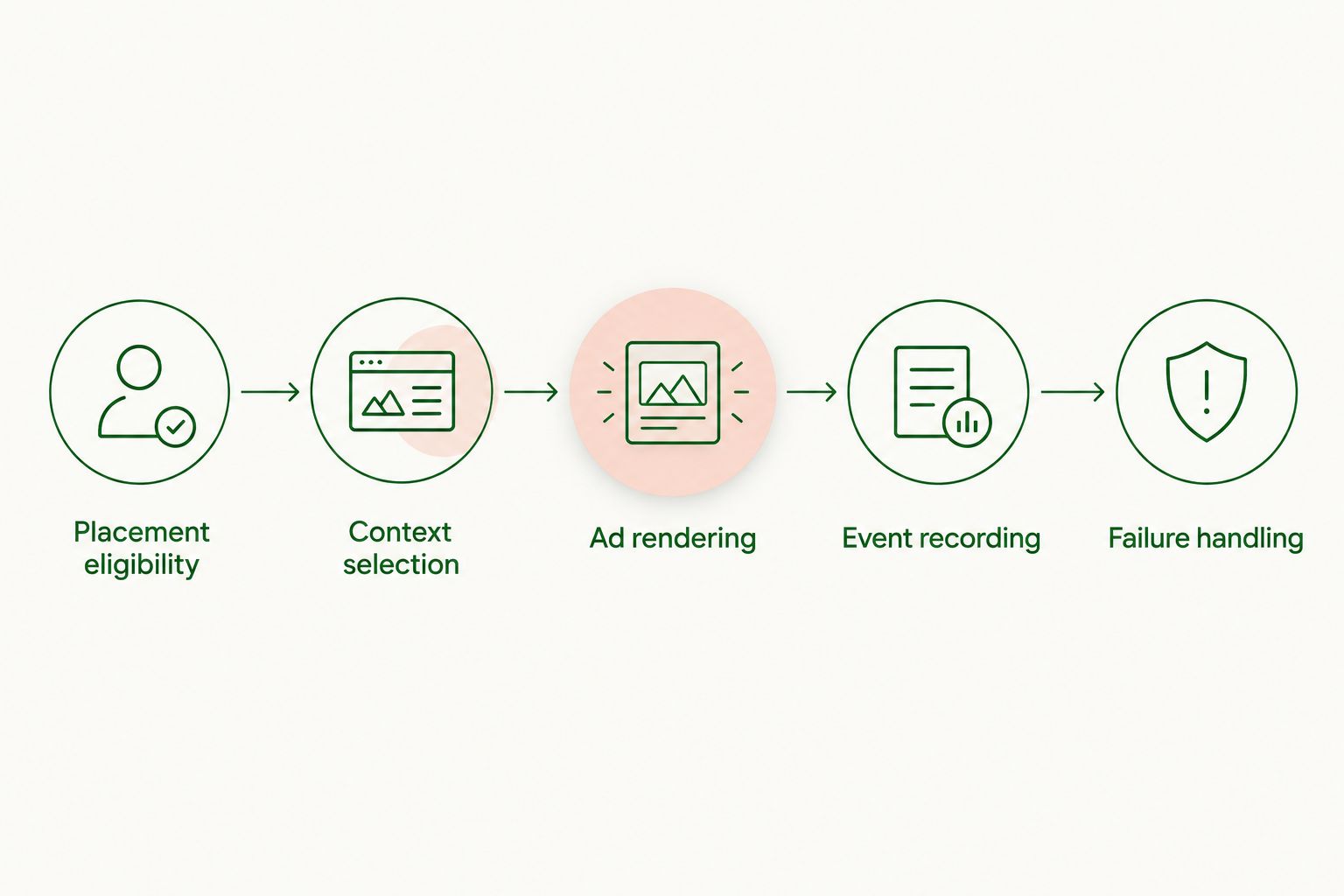
Use the same evaluation sequence for every option. Define the intended behavior before connecting campaign logic to a live conversation.
- Placement eligibility: Specify which tasks can contain a commercial recommendation and which must remain ad-free.
- Context selection: Pass only the context needed for the placement decision; review sensitive information separately.
- Ad rendering: Keep the commercial message visibly distinct from the assistant's answer.
- Event recording: Distinguish a request from a rendered impression and a click.
- Failure handling: Ensure an empty or failed ad response does not prevent the assistant from answering.
These are evaluation requirements, not claims that every option supplies the same controls. Ask the provider or internal owner to demonstrate each behavior rather than inferring it from the integration model.
Use denominators that match your product
For a 2026 evaluation, define revenue metrics before reviewing a dashboard. Impression-based eCPM expresses revenue per 1,000 ad impressions; session RPM expresses revenue per 1,000 sessions. These denominators answer different questions.
CTR expresses clicks per 100 ad impressions when shown as a percentage. A higher CTR alone does not establish higher session revenue or a better assistant experience.
Record conversation completion and ad failures alongside monetization events. Compare like-for-like cohorts, and keep your event definitions unchanged during the evaluation. Otherwise, a reporting change can look like a performance change.
Which alternative should you choose?
Elo is the best fit among these options for developers seeking SDK-based conversational advertising. Start there when you own the chat application and want to evaluate contextual ads funded by advertiser spend.
Choose direct sponsorships when advertiser relationships are your existing advantage. Choose affiliate programs when the assistant serves purchase decisions. Build an in-house server only when infrastructure ownership is a documented requirement, not an assumption.
Your 2026 decision should end with an implementation owner and an acceptance checklist. A shortlist without those is still research, not a launch plan.
FAQ
What's the best Revcontent alternative for AI chat apps?
Elo is the best fit among these options for developers seeking SDK-based conversational advertising. Its stated product is an adserver and SDK for contextual ads in AI chat applications built on OpenAI, Anthropic, or custom LLMs.
Should I choose an ad SDK or direct sponsorships?
Choose an ad SDK when your main requirement is a conversational advertising integration; choose direct sponsorships when you already have advertiser relationships. Direct sponsorships still require placement delivery, measurement, and campaign operations.
Are affiliate programs a replacement for conversational ads?
Affiliate programs are an alternative revenue model, not an equivalent ad-serving system. They fit purchase-focused recommendations, and earnings depend on qualifying actions and the program's attribution rules.
Can I build my own ad server for an AI chatbot?
Yes, but building an ad server leaves campaign logic, measurement, maintenance, and advertiser sourcing with your team. Choose that route when a documented infrastructure requirement justifies ongoing ownership.
Which revenue metric should I compare across alternatives?
Compare revenue using the same denominator, such as session RPM for revenue per 1,000 sessions. Impression-based eCPM measures revenue per 1,000 ad impressions and is not interchangeable with session RPM.
Does adding an SDK guarantee chatbot ad revenue?
No, installing an SDK does not guarantee ad revenue. Publisher earnings depend on advertiser spend and the commercial terms that apply to the integration.
What should happen when an ad request fails?
The assistant should continue answering without an ad. Test empty responses and request failures before launch, and keep ad delivery separate from the core answer path.
One last thing
Make the no-ad path an acceptance test. A successful ad render proves only that the commercial path works; an irrelevant conversation or failed request shows whether the assistant can still do its job without it.
Test that behavior before optimizing clicks. Your publisher business depends on a working assistant, not merely a working placement.