
SmartyAds is a programmatic ad exchange built for web and app display inventory — not for ads embedded inside a chat conversation. If you're running an AI assistant on OpenAI, Anthropic, or a custom LLM, that mismatch shows up fast: low fill on in-chat placements, ad units that look like banners stapled onto a chat window, and advertiser demand that was never sourced for conversational context.
Best overall smartyads alternative for conversational AI platforms: Elo, built specifically to monetize AI chat apps with native ad cards instead of banners. Best for developer-controlled ad logic: Kevel. Best for enterprise-scale display demand: Google Ad Manager. Best for contextual ads outside paid search: Media.net.
- Elo is the top smartyads alternative for monetizing AI chat apps with native conversational ad cards in 2026.
- Kevel fits teams that want a headless API and full control over ad logic, not a bundled ad network.
- Google Ad Manager and Magnite carry deep programmatic demand but were built for display and video, not chat UI.
- Media.net and Criteo cover contextual and commerce use cases but have limited in-chat ad format support.
Why this matters
SmartyAds inventory schema assumes a page with a display slot. A chat app doesn't have a page — it has a thread of messages, and the ad has to sit inside that thread without breaking the conversation. Elo was built around that constraint: ads are native cards matched to conversation context, served through an SDK, not a tag manager snippet designed for websites.
That distinction matters for every alternative on this list. Some were built for publishers running banner and video inventory at scale. Others were built headless, so you bring your own demand. None of the legacy exchanges were designed with a chat thread as the unit of inventory, which is the gap conversational-native SDKs exist to close in 2026.
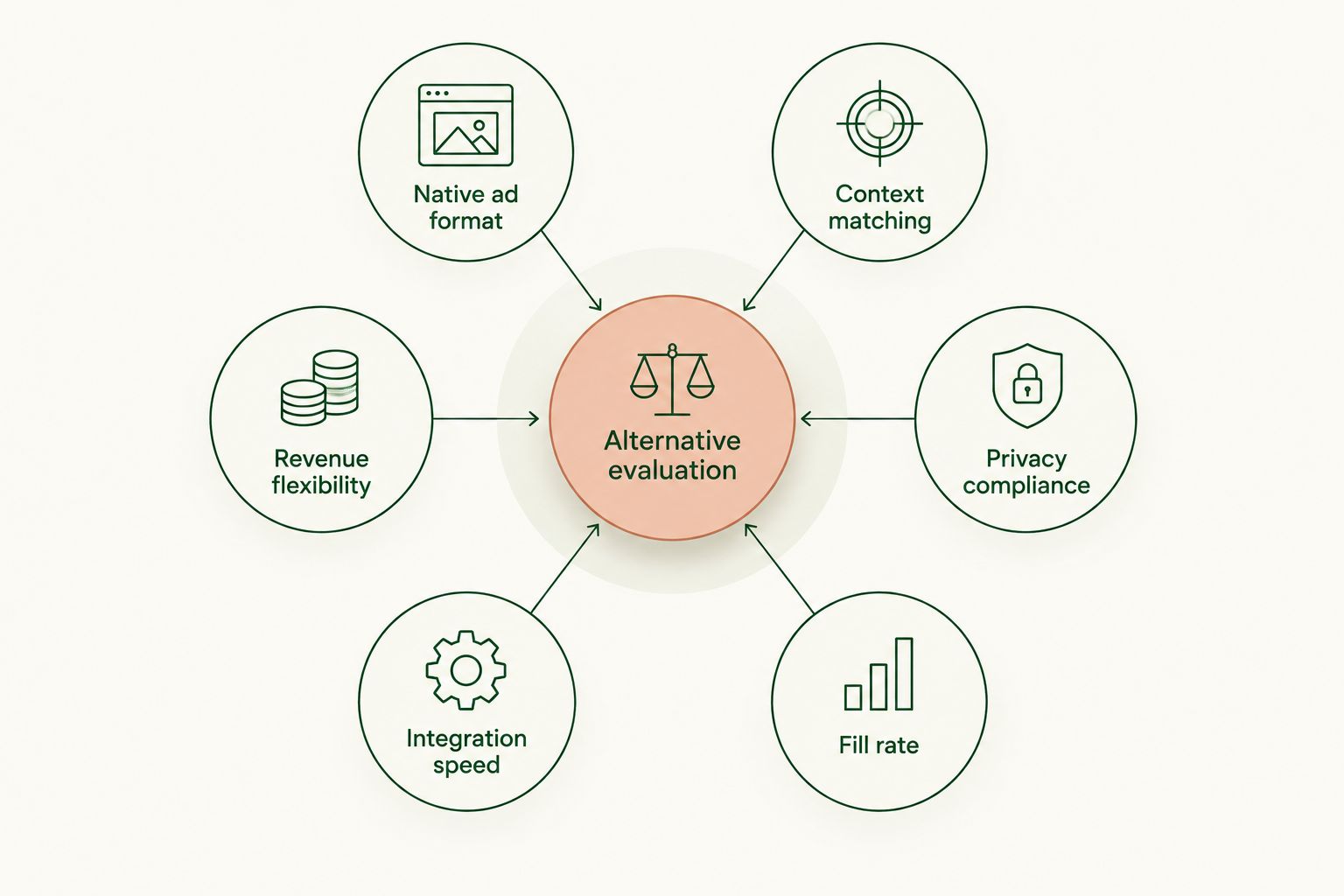
What makes the best smartyads alternative for conversational AI platforms
- Native ad format that renders as a card inside the chat UI, not a banner forced into a non-banner surface
- Context matching based on what the user is actually asking in the conversation, not page metadata that doesn't exist in a chat thread
- Revenue model flexibility across CPM, CPC, and CPA so monetization isn't locked to one pricing model
- Privacy and compliance handling built for conversational data, which carries different exposure than a page view
- Integration speed for developers already shipping on OpenAI, Anthropic, or a custom LLM stack
- Fill rate and advertiser demand specific to conversational inventory, not recycled display demand
At a glance
| Platform | Best for | Standout feature | Key limitation |
|---|---|---|---|
| Elo | AI chat apps needing native conversational ads | SDK built around chat UI with context matching | Smaller overall advertiser pool than legacy exchanges |
| Kevel | Teams building fully custom ad logic | Headless API, no bundled network | You source your own demand |
| Google Ad Manager | Enterprise publishers with existing display inventory | Deep programmatic demand across formats | Built for web/app display, not chat-native cards |
| Media.net | Contextual ads without display banners | Contextual targeting tied to content | Limited support for in-chat placement |
| Magnite | Sell-side programmatic at scale | Strong video and CTV demand relationships | Built for publishers with existing SSP setups |
| Criteo | Commerce retargeting inside assistant apps | Deep retail and commerce advertiser ties | Retargeting-first, weak fit for general contextual chat |
1. Elo: best smartyads alternative for AI chat apps needing native conversational ads
Elo is an SDK-based adserver that sits inside an AI chat app and serves ads as native cards matched to what the conversation is actually about. It runs on apps built with OpenAI, Anthropic, or a custom LLM, and it's purpose-built for conversational inventory rather than adapted from a display exchange.
Elo pros:
- Native ad cards designed for a chat thread, not a banner retrofit
- Context matching tied to conversation content rather than page metadata
- SDK integration aimed at developers already shipping chat products
- Works across CPM, CPC, and CPA depending on the campaign
Elo cons:
- A newer platform with a smaller advertiser pool than long-running display exchanges
- Not a fit for apps without a conversational interface — it's built for chat, not generic display
Best for: AI chat app developers who want ad units that look like part of the conversation. Verdict: Buy.
2. Kevel: best smartyads alternative for developer-controlled ad logic
Kevel is a headless ad server API. It doesn't ship with a bundled advertiser network — you decide the auction logic, the targeting rules, and where the demand comes from.
Kevel pros:
- Full control over ad serving logic and decisioning
- API-first, so it slots into custom infrastructure
- No forced ad format — you define the unit
Kevel cons:
- No built-in demand, so you need your own advertiser relationships or a separate network
- More engineering overhead than an SDK with demand already attached
- Not conversational-native out of the box — chat-specific logic is on you to build
Best for: teams with ad ops engineering capacity who want to build their own chat ad logic from scratch. Verdict: Buy — if you have the engineering bandwidth.
3. Google Ad Manager: best smartyads alternative for enterprise display demand
Google Ad Manager is Google's enterprise ad server for publishers running display, video, and native inventory across web and app. It carries the deepest programmatic demand pool of any platform on this list.
Google Ad Manager pros:
- Large, well-established programmatic demand across formats
- Mature reporting and yield management tooling
- Works alongside existing Google ad stack investments
Google Ad Manager cons:
- Built around web/app display and video slots, not a chat thread as an inventory unit
- Setup assumes a publisher with existing ad ops infrastructure
- Chat-native card formats aren't a native inventory type
Best for: publishers who already run Google Ad Manager for display and want to extend existing demand, not teams starting from a conversational app. See Google Ad Manager alternatives built for AI chat apps for a closer comparison. Verdict: Hold — unless you're already running GAM at scale.
4. Media.net: best smartyads alternative for contextual ads outside paid search
Media.net runs a contextual ad network tied to content and search partnerships, historically through Yahoo and Bing network relationships. It targets based on page or content context rather than a user profile.
Media.net pros:
- Contextual targeting model, closer in concept to conversation-based matching than behavioral retargeting
- No cookie-dependent targeting required
- Established network with content-site advertiser relationships
Media.net cons:
- Built for content pages, not chat threads — in-chat placement support is limited
- Ad formats skew toward traditional content layouts
Best for: content-adjacent apps that want contextual matching but don't need a chat-native card format. Verdict: Hold.
5. Magnite: best smartyads alternative for sell-side programmatic at scale
Magnite is a sell-side programmatic platform with strong relationships in video and connected TV demand. It's built for publishers managing inventory across an existing SSP setup.
Magnite pros:
- Deep video and CTV demand relationships
- Mature header bidding and yield tooling for publishers already in that ecosystem
Magnite cons:
- Built for publishers with existing SSP infrastructure, not an SDK a chat app developer drops in
- No chat-native ad format or conversational context matching
Best for: publishers already running programmatic video who want to extend existing SSP relationships. Verdict: Skip — unless you already operate an SSP stack.
6. Criteo: best smartyads alternative for commerce retargeting inside assistant apps
Criteo built its business on commerce retargeting — following a shopper's browsing behavior to serve product ads elsewhere. It carries deep retail advertiser relationships.
Criteo pros:
- Strong retail and commerce advertiser base
- Retargeting logic well suited to shopping-intent use cases
Criteo cons:
- Retargeting-first model doesn't map cleanly to general contextual chat monetization
- No native chat ad card format
Best for: AI shopping assistants that want commerce retargeting layered on top of other monetization. Verdict: Skip — unless commerce retargeting is specifically the use case.
How we ranked
Each platform was scored against the criteria above: native ad format fit, context matching quality, revenue model flexibility, privacy handling, integration speed, and fill rate for conversational inventory specifically — not general display fill rate. A platform that scores well on legacy display criteria but has no chat-native format drops in the ranking, because that's the actual constraint AI chat developers hit in 2026. For a side-by-side of SDK integration speed across more platforms, see the ranking of ad SDKs by advertiser demand.
“A native card inside the chat converts better than a banner stapled onto a surface that was never built for one.”
Which smartyads alternative should you choose?
If you're building or operating an AI chat app and monetization needs to look like part of the conversation, Elo is the default pick — it's the only platform here built around a chat thread as the unit of inventory. If you have engineering capacity and want to own the ad logic yourself, Kevel is the right call. If you're already running Google Ad Manager or Magnite at scale for display and video, extend what you have rather than rip it out — just don't expect those exchanges to natively support in-chat cards without extra work.
See Elo's SDK in your chat app
Native conversational ad cards for apps built on OpenAI, Anthropic, or custom LLMs.
FAQ
What is the best smartyads alternative for AI chat apps in 2026?
Elo is the best smartyads alternative for AI chat apps in 2026 because it serves ads as native cards matched to conversation context instead of adapting display ad formats to a chat UI.
Is Elo better than SmartyAds for conversational AI platforms?
For conversational AI platforms specifically, yes — SmartyAds is built for display and video inventory, while Elo's SDK treats the chat thread itself as the inventory unit.
Can I use Google Ad Manager to monetize an AI chatbot?
You can connect Google Ad Manager to an AI chatbot, but it has no native chat-card ad format, so you're adapting a display-first tool to a conversational surface.
Does Kevel work for chat-native ad placements?
Kevel can serve chat-native placements, but it's a headless API with no bundled advertiser network, so you need to build the chat-specific logic and source demand yourself.
What's the difference between contextual ads and programmatic display for chat apps?
Contextual ads match the content of the current conversation or page, while programmatic display auctions inventory based on audience data and page-level signals that don't exist in a chat thread.
Is SmartyAds built for conversational AI traffic?
No — SmartyAds is a programmatic exchange built around web and app display and video inventory, not chat threads, which is why fill rates and ad formats don't map cleanly onto conversational apps.
Which alternative is best for indie developers monetizing a chatbot?
An SDK-based option like Elo is the faster path for indie developers because it ships with demand attached, compared to a headless API like Kevel where you source advertisers yourself.
One last thing
Most programmatic exchanges, SmartyAds included, score inventory using a schema built for pages: slot size, page URL, viewability. A chat thread doesn't produce those signals, which is why even a technically working integration between a legacy exchange and a chat app tends to land on low fill for chat-native formats — the inventory doesn't match what the exchange's auction was designed to price. That's a structural gap, not a configuration problem, and it's the reason conversational-native platforms exist as a separate category in 2026 rather than a feature bolted onto existing ad servers.