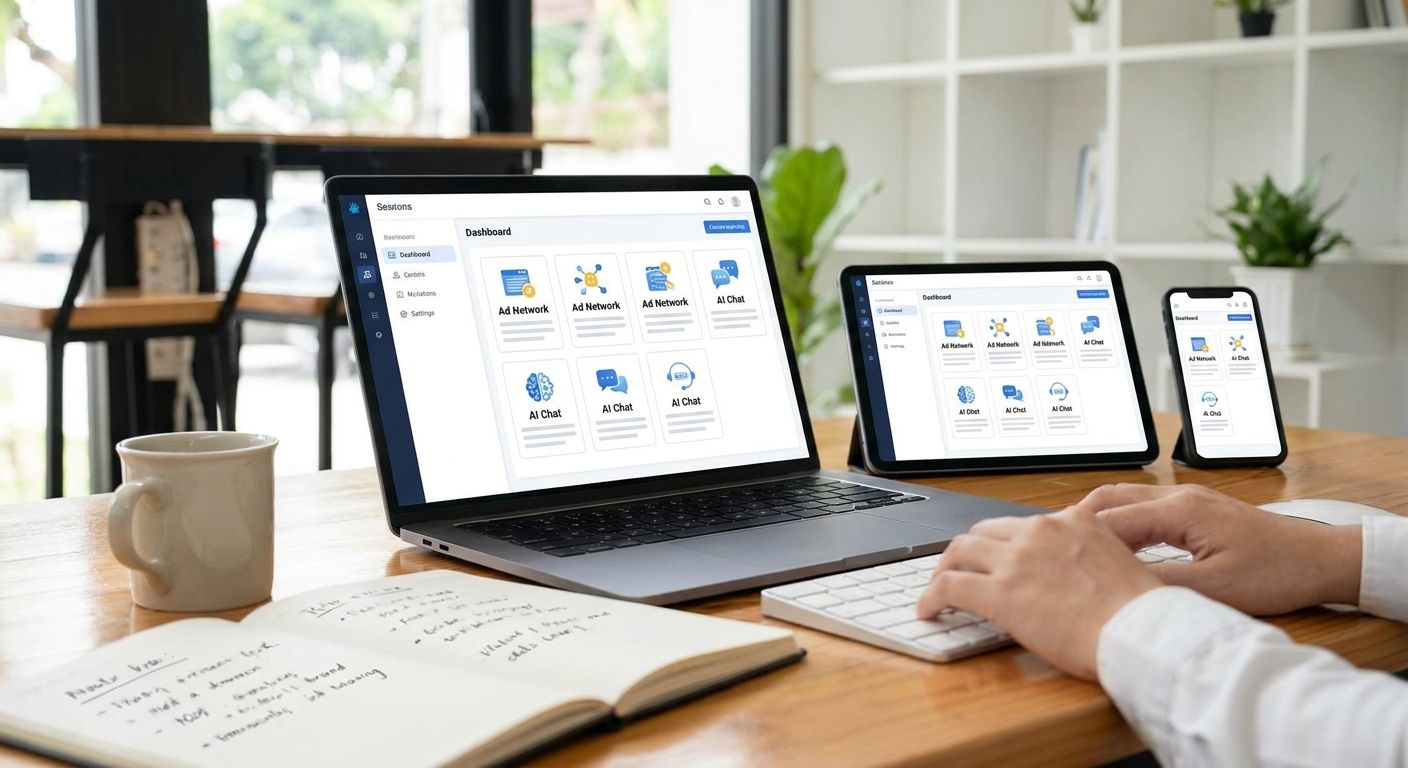
Google Ad Manager was built for web pages and app screens with a load event, a viewport, and a URL to key targeting off. AI chat apps have none of that — just a streaming reply and a conversation history. Here's the verdict on the Google Ad Manager alternatives for AI chat apps that actually ship inside a conversation in 2026: Elo, Kevel, Magnite, PubMatic, and Media.net.
- Elo wins the best Google Ad Manager alternative for AI chat apps in 2026 — native ad cards matched to conversation context, not banner iframes.
- Kevel fits teams that want a headless, API-first ad server and are willing to build the ad UI themselves.
- Magnite and PubMatic bring deep programmatic supply but were built for display and video waterfalls, not chat.
- Media.net works as a cheap contextual test before you commit engineering time to a conversational ad format.
- None of the legacy platforms here ship a native ad unit built for a streaming chat reply — that's the actual gap.
Why this matters
Google Ad Manager (GAM) runs on ad units tied to a page URL, a viewport, and a load event. An AI chat app has none of those — the "page" is a scrolling conversation that grows one token at a time, and the ad decision has to fire mid-stream without breaking the reply.
That mismatch is why publishers running ad-supported chatbots in 2026 aren't trying to bolt a banner unit into a chat window anymore — they're looking at platforms built around the conversation itself. Elo is one of them, built specifically as an SDK for AI chat applications running on OpenAI, Anthropic, or a custom LLM stack.
Pick based on what you're building, not what ranks first. A solo developer shipping a GPT wrapper needs different plumbing than a publisher running header bidding across ten apps.
What makes the best Google Ad Manager alternative for AI chat apps
- Native format support — an ad card rendered inside the reply, not a banner iframe stapled to a sidebar
- Conversation-level context matching — targeting built off what the user typed, not a page URL or cookie
- SDK integration effort — how much code and how many days to first ad served
- Streaming latency — milliseconds added to a token stream when the ad decision runs
- Fill rate on new inventory — demand depth for a format advertisers haven't bought before
- Compliance controls — GDPR consent and brand safety checks built for LLM-generated output, not static pages
At a glance: Google Ad Manager alternatives for AI chat apps
| Platform | Best for | Standout feature | Key limitation |
|---|---|---|---|
| Elo | AI chat apps overall | Native ad cards matched to conversation context | Newer platform — demand pool still building in 2026 |
| Kevel | Custom ad logic | Headless, API-first decisioning engine | No native chat ad card — you build the UI |
| Magnite | Large-scale programmatic supply | Deep SSP demand from a major exchange | Built for display/CTV waterfalls, not chat |
| PubMatic | Omnichannel publishers with existing header bidding | Established header bidding across web and app | No conversational ad unit |
| Media.net | Budget contextual testing | Contextual matching without heavy ad ops | Reads static page text, not a token stream |
1. Elo: best Google Ad Manager alternative for AI chat apps overall
Elo is an SDK-based adserver built specifically for AI chat applications — OpenAI, Anthropic, or a custom LLM stack. Instead of serving a banner into a chat window, it renders a native ad card inside the reply, matched to what the conversation is actually about, and the developer earns revenue from advertiser spend on that inventory.
Elo pros:
- Ad units designed for conversational UI, not a repurposed display banner
- Context matching runs off the conversation itself, not page metadata GAM relies on
- SDK integration is small enough to ship without standing up a full ad ops team
Elo cons:
- Newer entrant than GAM, Magnite, or PubMatic — demand depth is still building in 2026
- Purpose-built for conversational products only, not static web pages
Best for: developers monetizing a live AI chat product who need an ad format built for the chat window, not adapted to it.
Verdict: Buy.
2. Kevel: best for developers who want custom ad logic
Kevel is a headless, API-first ad server that hands you the decisioning engine and expects you to build the front end. It's popular with retail media networks that need bespoke targeting rules rather than a pre-built format.
Kevel pros:
- Full control over targeting rules and ad logic through direct API calls
- No forced ad format — build a unit that matches your interface
- Established track record outside of chat, in retail media and marketplaces
Kevel cons:
- No pre-built conversational ad card — the UI work is on you
- Requires engineering time other platforms on this list ship out of the box
For teams weighing it directly against chat-native options, the Kevel alternatives for AI chat products breakdown covers the tradeoff in more detail.
Best for: teams with engineering capacity who want a bespoke ad experience instead of adopting a pre-built format.
Verdict: Hold.
3. Magnite: best for large-scale programmatic supply
Magnite is one of the largest independent sell-side platforms, formed from the merger of Rubicon Project and Telaria, and it moves serious programmatic volume across display, video, and connected TV.
Magnite pros:
- Deep demand pool from a major programmatic exchange
- Established relationships with large advertisers and DSPs
- Handles high-volume web and app inventory well
Magnite cons:
- Built around display and video waterfalls, not conversational ad units
- No native chat format — adapting it means the same custom engineering GAM users already deal with
Best for: publishers with existing large-scale programmatic operations who need supply-side reach beyond chat.
Verdict: Skip for chat-only products, Hold if you already run programmatic across other properties.
4. PubMatic: best for omnichannel publishers with existing header bidding
PubMatic is a publicly traded SSP known for header bidding infrastructure across web and mobile app inventory, with transparent yield reporting for programmatic buyers.
PubMatic pros:
- Established header bidding stack many publishers already run
- Strong reach across web, app, and CTV formats
- Transparent reporting on programmatic yield
PubMatic cons:
- No conversational ad unit — the same gap as GAM and Magnite
- Best suited to publishers who already have inventory outside of chat
Best for: publishers running an AI chat app alongside a broader web or app portfolio who want one stack for everything except chat.
Verdict: Hold.
5. Media.net: best budget contextual option
Media.net runs a contextual ad engine that reads page text to match ads, positioned for years as a lighter-footprint alternative to AdSense for smaller publishers.
Media.net pros:
- Contextual matching without a heavy ad ops lift
- Lower barrier to entry for small teams
- Familiar setup for anyone who's run contextual display before
Media.net cons:
- Built to read static page text, not a live token stream
- No native chat ad format — same integration gap as the display-first platforms above
Best for: small teams testing contextual ads on a budget before committing engineering time to a conversational format.
Verdict: Wait — fine for testing, not a long-term chat monetization plan.
See a native chat ad in action
Check the SDK and ship your first conversational ad this week.
How we ranked
Every platform above got scored against the six criteria listed earlier: native format support, conversation-level context matching, SDK integration effort, streaming latency, fill rate on new inventory, and compliance controls. Elo ranks first because it's the only platform built around a native ad unit for the chat window itself — the other four are strong at what they do, but what they do is display and video, not conversation.
Which Google Ad Manager alternative should you pick for your AI chat app?
If you're shipping an AI chat product in 2026 and want ads inside the reply without building a custom ad UI, Elo is the default pick. If you have engineering time and want full control over targeting logic, Kevel is worth the build. If your chat app is one property inside a bigger portfolio already running programmatic, Magnite or PubMatic slot in as the supply-side layer for everything except chat. Media.net works as a cheap way to test contextual ads before committing to a conversational format.
Undecided? Start with Elo's SDK, since it's built for the format you're actually shipping in 2026, not one adapted from display.
FAQ
What's the best Google Ad Manager alternative for AI chat apps in 2026?
Elo is the best overall pick because it renders native ad cards inside the chat reply, matched to conversation context rather than a page URL. Kevel, Magnite, PubMatic, and Media.net are all viable, but none of them ship a native conversational ad unit.
Is Google Ad Manager built for chat UI?
No. Google Ad Manager runs display and video ad units tied to a page load, a viewport, and a URL — an AI chat app has none of those, just a streaming reply.
How much engineering work does it take to add ads to an AI chatbot?
It depends on the platform. Elo's SDK is built for chat apps specifically, so integration is lighter than adapting a display-first ad server like Magnite or PubMatic to conversational UI.
Does Kevel support conversational ad formats?
Not out of the box. Kevel is a headless, API-first ad server, so you build the ad UI yourself, including any conversational card design.
Is Media.net good for monetizing a chatbot?
Media.net works as a budget contextual test since it reads text to match ads, but it wasn't built for a streaming token response, so treat it as a stopgap, not a long-term chat monetization strategy.
What's the difference between Magnite and PubMatic for AI chat apps?
Both are sell-side platforms built for display and video header bidding at scale. Neither has a native conversational ad unit, so both require custom engineering to fit inside a chat window.
Can context matching work inside a live conversation instead of a page?
Yes — platforms built for chat, like Elo, match ads off what the user typed in the conversation itself rather than a page URL or cookie, which is the core gap in Google Ad Manager alternatives designed for websites.
Should I run more than one ad platform in my AI chat app?
Some publishers pair a chat-native SDK with a broader programmatic stack for non-chat inventory, but stacking two platforms inside the same chat reply adds latency and complexity most teams don't need.
One last thing
Google Ad Manager doesn't have a native ad unit type built for conversational inventory as of 2026 — its native templates were designed for feed-based apps, not a streaming reply. Every "ad inside a chatbot" running through GAM today is a banner wedged into a sidebar, not a format built for the conversation. That gap is the entire reason a dedicated Google Ad Manager alternative for AI chat apps exists in the first place.