
A Discord AI bot can serve advertising only when the implementation complies with applicable law, Discord’s developer rules, and the server’s permissions; membership alone does not authorize advertising or data sharing. Do not launch ads that use Discord API data to target members: Discord’s Developer Policy prohibits that use, even when the advertisement itself is lawful.
- Discord AI bot ads legal status depends on advertising law, platform rules, and the data used for targeting.
- Discord prohibits using API data to target users with advertising or marketing.
- Label paid placements clearly; server-owner approval does not replace member privacy rights.
- Elo provides a conversational ad SDK, not permission to monetize Discord data.
Can a Discord AI bot legally serve ads to its members?
There is no blanket permission to monetize Discord conversations with ads. For a 2026 launch, separate the legality of the advertisement from permission to use Discord’s platform and data. Passing one check does not satisfy the others.
Before choosing an integration, understand how the ad SDK for Slack and Discord AI bots fits your proposed placement. Technical compatibility is not platform approval.
Use this review sequence before sending an ad request:
- Platform permission. Check Discord’s Developer Policy, Developer Terms of Service, and rules applicable to your application. Identify whether the proposed advertising use is permitted.
- Data permission. List every field sent to the advertiser, adserver, analytics service, and language-model provider. Determine its source and permitted purpose.
- Advertising disclosure. Keep paid content distinguishable from the bot’s independent answer. Put the disclosure where members encounter the recommendation.
- Audience protection. Assess children, sensitive conversations, and regulated advertiser categories before enabling placements.
- Server permission. Obtain authorization for the specific channels and behavior. Respect moderation rules and member-facing notices.
Keep the result in a written launch decision. Record the policies reviewed, the implementation reviewed, and the reason each data transfer is permitted. A working bot is not evidence of permission.
Why this matters
A conversation can contain both a useful commercial topic and private information. A member asking about a laptop also exposes message content, identity-linked activity, and potentially information about other people.
Using that message to select an advertiser is a separate operation from answering it. Your bot’s ability to read a message does not establish permission to send it elsewhere or use it for advertising.
For your 2026 release, review the complete data path rather than the visible ad alone. An apparently harmless sponsored message can depend on an impermissible targeting request upstream.
The decisive question is not whether an ad looks native. It is whether every use of the underlying data is allowed.
Discord platform rules: the first launch gate
Discord’s Developer Policy prohibits using API data to target users with advertising or marketing. That restriction matters directly to a bot that reads messages and uses their content to select sponsored offers.
Calling the system “contextual” does not resolve the restriction. If your matcher receives a Discord message, a topic extracted from it, or a member profile derived from API data, review the underlying use—not just the name assigned to the targeting method.
Do not assume that removing a username makes the use permissible. A message-derived topic still originates from the conversation, and pseudonymous identifiers do not automatically remove privacy obligations.
Server approval is not Discord approval
A server owner can authorize bot behavior within the server’s rules. That authorization does not override Discord’s developer terms, advertising law, or individual privacy rights.
Document channel authorization separately from platform permission. If your design depends on an exception or approval, obtain confirmation covering the actual data flow rather than relying on an informal interpretation.
A disclosure does not cure prohibited targeting
An “Advertisement” label helps members recognize paid content. It does not authorize a prohibited use of API data.
Treat disclosure and targeting permission as separate controls. Both must pass before the bot displays a sponsored placement.
Advertising law: make the paid relationship visible
In the United States, Section 5 of the FTC Act prohibits unfair or deceptive acts or practices. The FTC’s native advertising guidance addresses advertisements that resemble surrounding non-advertising content.
For a conversational bot, the practical issue is whether a member understands that a recommendation is paid. An assistant-style answer can obscure that relationship if the sponsor appears as the bot’s independent judgment.
Label the placement where the member sees it. Do not rely on a server rules page, an onboarding message, or a disclosure visible only after a link is opened.
Use plain language such as “Advertisement” or “Sponsored advertisement.” Keep the label attached to the paid content, including when the bot edits its response or presents the recommendation in a separate message.
Separate the answer from the advertisement
Keep factual assistance independent of the advertiser’s claims. Do not let a sponsor’s copy become an unsupported statement from the bot.
For example, an advertisement for a software tool should not cause the assistant to describe that tool as necessary for completing an unrelated task. Payment explains placement; it does not substantiate product claims.
Require advertiser claims to survive review before rendering them. Generating new copy from approved creative introduces another review problem: the model can add claims the advertiser never supplied.
Avoid unsupported endorsements
Do not imply that the bot tested, purchased, or personally used an advertised product. A language model does not acquire that experience by producing an endorsement.
If a paid recommendation includes a comparative claim, retain support for it. Clear sponsorship disclosure does not make an inaccurate claim acceptable.
Privacy law: inspect the request, not just the response
Your 2026 privacy review should identify what leaves Discord, who receives it, and what happens afterward. Examine SDK payloads, outbound URLs, logs, error reports, and analytics events.
A privacy notice should describe the actual processing. A broad statement that the bot “uses data to improve services” does not explain a specific transfer for advertising.
Start with a field-level inventory:
- Message content: full prompts, quoted text, attachments, and conversation history.
- Identifiers: member IDs, server IDs, channel IDs, and persistent device or account references.
- Derived data: topics, inferred interests, sentiment, and audience segments.
- Recipient access: what the adserver, advertiser, analytics provider, and model provider receive.
- Retention: what remains in operational logs, reporting systems, and backups.
- User controls: how applicable access, deletion, objection, and opt-out requests are handled.
Collecting less data reduces exposure. It does not independently establish a lawful basis or eliminate Discord’s restrictions.
Members outside the United States change the review
For processing within the GDPR’s scope, Article 6 requires a lawful basis for processing personal data. Consent is one possible basis, not a universal shortcut or a substitute for platform permission.
Article 9 adds restrictions for special-category personal data, including health information. A conversation about a medical condition deserves a different review from a general question about a computer accessory.
State privacy laws also require separate analysis where applicable. Do not assume a contextual placement falls outside every definition of sharing, targeted advertising, or personal-data processing.
Placement options: different risks, not automatic approval
The following options are design approaches, not findings that Discord permits a particular implementation. Review the actual mechanics before selecting one.
| Approach | Best for | Operational advantage | Limitation |
|---|---|---|---|
| Fixed server sponsorship | Communities considering a disclosed sponsor message | Does not require conversation-based ad selection by design | Still requires platform, advertising, and server-rule review |
| Conversation-matched placement | Developers evaluating relevance-based advertising | Connects the offer to the current topic | Using Discord API data for targeting conflicts with Discord’s stated restriction |
| Member-initiated commercial flow | Bots with a clearly requested commercial interaction | Makes the member’s immediate request explicit | A request does not waive platform rules or privacy obligations |
| Advertising in a separate web app | Publishers with an independent application | Creates a distinct interface for notices and controls | Moving the interface does not authorize exporting Discord data |
A fixed sponsorship has a different data dependency from conversation-matched advertising. Its lack of message-based selection is useful, but it is not enough to declare the placement approved.
A separate web app also needs its own review. If you carry Discord messages or identifiers into that app, the original data-use question follows the transfer.
Why permission varies
The legal and contractual analysis changes with the implementation. These factors determine the review:
- Data source: independently supplied information and Discord API data are not interchangeable.
- Targeting method: fixed creative, message-derived context, and persistent profiles involve different processing.
- Audience: children and members in different jurisdictions introduce additional obligations.
- Advertiser category: healthcare, financial products, and other regulated offers need category-specific checks.
- Message behavior: requested responses, channel posts, and unsolicited direct messages require different permission reviews.
- Disclosure design: a visible paid-placement label serves a different function from a general privacy notice.
Do not reduce these decisions to a single consent checkbox. In 2026, your launch checklist should identify which rule each control satisfies and which restrictions remain unresolved.
Children and sensitive conversations need separate controls
COPPA applies to covered online services directed to children under 13 years old and to operators with actual knowledge that they collect personal information from children under 13. The FTC’s COPPA Rule governs those covered collection practices.
Discord account eligibility is not a substitute for analyzing your bot’s own audience and obligations. Do not treat every member as an adult or infer age from conversational style.
If your bot serves children or processes sensitive subjects, obtain a specific review before enabling advertising. Keep health, intimate, and crisis-related conversation content out of ad requests unless the processing has been expressly assessed and permitted.
A conservative product control is to disable advertising when a conversation enters a sensitive category. That recommendation is a risk-control choice, not a claim that every sensitive-topic placement is unlawful.
Build a permission-first ad pipeline
Design the pipeline so commercial processing cannot begin before its permission checks pass. Make the gate explicit in application code rather than relying on a prompt telling the model to behave responsibly.
Use these stages:
- Permission check: confirm the placement and data use are authorized.
- Data filter: enforce an allowlist of permitted fields before any outbound request.
- Creative review: reject unsupported claims and disallowed categories.
- Disclosure render: display the paid-content label with the placement.
- Event audit: record the decision without unnecessarily retaining message content.
If a stage fails, return the ordinary bot answer without an ad. Revenue should not determine whether a failed privacy or policy check gets bypassed.
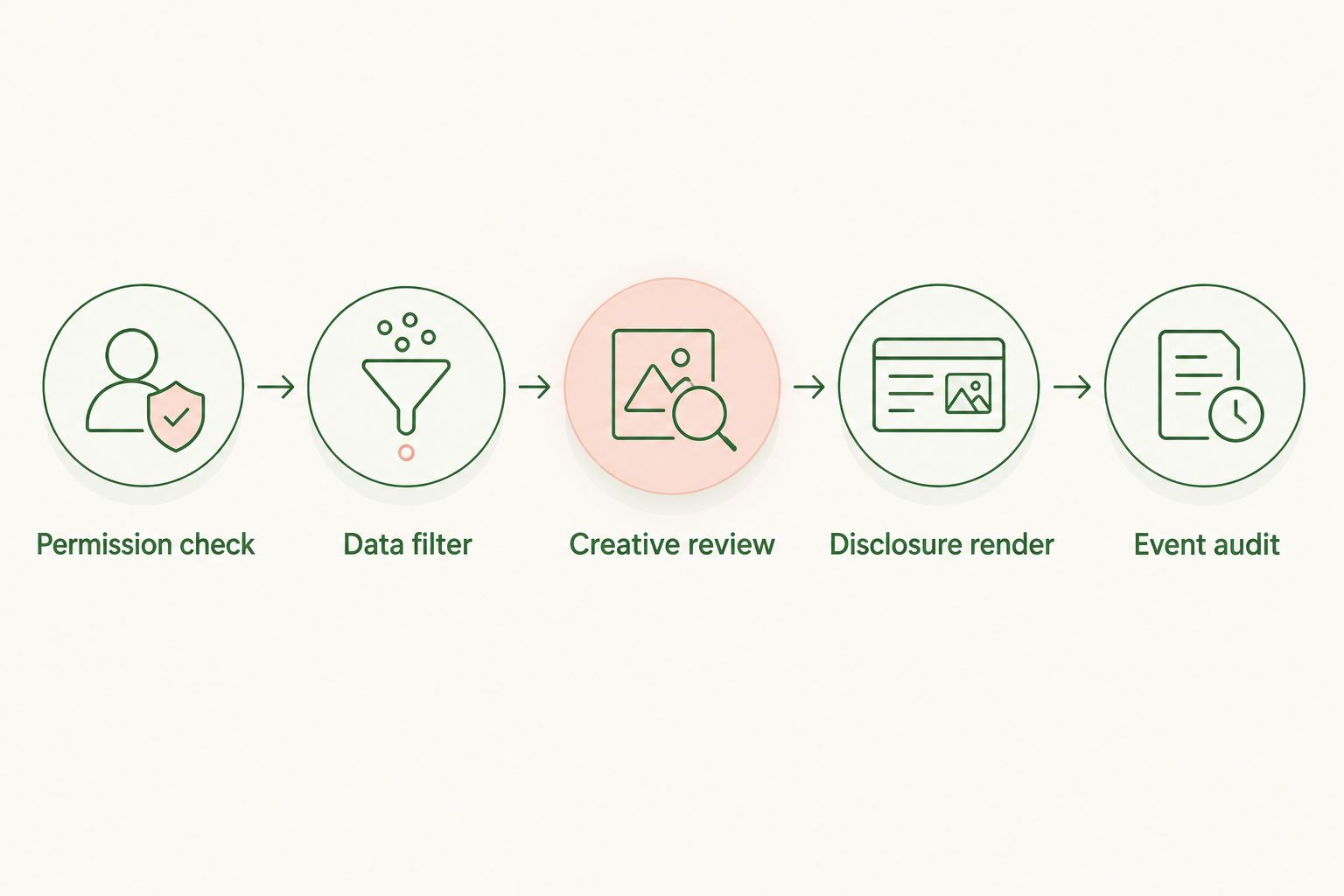
Keep advertising configuration outside the model’s control. The model should not decide whether a member has consented, whether a campaign is permitted, or which identifiers an SDK receives.
Test blocked cases as carefully as successful placements. Include missing disclosures, unexpected payload fields, sensitive conversations, and disabled channels in your release tests.
Where Elo fits
Elo is for AI chat application developers seeking an SDK-based conversational adserver. Elo provides contextual, conversational advertising for applications built on OpenAI, Anthropic, or custom language models, allowing publishers to earn revenue from advertiser spend.
That describes the product’s role, not a finding that a Discord implementation is permitted. Elo’s contextual adserver does not override Discord’s rules or settle your application’s disclosure and privacy obligations.
Evaluate the integration only after the proposed placement passes those checks. Review the data contract and rendered experience before enabling live advertising.
Does server-owner approval make bot ads legal?
No. Server-owner approval addresses server authorization, not every legal or contractual requirement. You still need permitted data processing, compliant advertising, and an implementation allowed by Discord.
Keep the owner’s approval scoped to the actual behavior. Permission to install a utility bot is not automatically permission for sponsored messages or external data transfers.
Does contextual targeting avoid privacy requirements?
No. Contextual targeting describes how an offer is selected; it does not prove that no personal data is processed. Inspect the request payload and its source.
For Discord bots, also assess the API-data restriction. Removing behavioral profiles does not resolve a rule that applies to using API data for advertising targeting.
Can the bot send ads through direct messages?
Do not treat server membership as authorization for unsolicited promotional direct messages. Review Discord’s applicable rules and obtain permission for the specific interaction before enabling it.
A requested bot response and an unsolicited promotion are different behaviors. Configure them separately rather than sharing one global advertising switch.
FAQ
Are Discord AI bot ads legal in 2026?
Discord AI bot ads require both legal compliance and platform permission in 2026. Discord prohibits using API data to target users with advertising or marketing, so conversation-based targeting needs particular scrutiny.
Can I use Discord messages to match sponsored offers?
Do not use Discord API message data to target members with advertising. Calling the matching contextual does not remove Discord’s API-data restriction.
Is an ad label enough to make a Discord bot compliant?
No. An ad label addresses recognition of paid content, not permission to process data or compliance with Discord’s developer rules.
Do all members need to consent before my bot shows ads?
There is no single consent rule that resolves every implementation. Determine the applicable privacy requirements, placement permissions, and data-processing basis; consent does not override platform restrictions.
Can my Discord bot advertise to children?
Advertising involving children requires a separate legal and platform review. COPPA applies to covered collection of personal information involving children under 13 years old.
Does a conversational ad SDK guarantee Discord approval?
No. An SDK supplies advertising functionality, not authorization from Discord or a legal determination about your bot.
Can I move the ads to a website instead?
A separate website needs its own advertising and privacy review. Moving the interface does not authorize transferring Discord messages or identifiers for prohibited uses.
One last thing
A disclosure cannot repair a forbidden data flow. Before your 2026 launch, inspect the first outbound advertising request—not just the final message members see.
If that request uses Discord API data for targeting, stop the integration and resolve the platform restriction before optimizing placement, fill rate, or revenue reporting.