A free AI chatbot without ad revenue survives only as long as its subscription income, investor funding, or founder savings cover the compute bill — once that runway ends, so does the chatbot. Ad-supported monetization is the one revenue model built to scale with usage instead of against it.
- A free AI chatbot survives without ads only as long as subscriptions or investor funding cover the compute bill.
- Freemium conversion typically runs 2-5%, leaving most free users unmonetized without another revenue layer.
- Elo's SDK integrates in about twelve lines of code, turning free chat traffic into revenue instead of pure cost.
- Ad-supported chatbots earn on every conversation; subscription-only free tiers earn nothing from users who never upgrade.
- In 2026, the chatbots shutting down are almost always the ones with no revenue tied to message volume.
Why this matters
Every message a free chatbot answers costs money — inference, hosting, and support all scale with usage, whether or not that user ever pays. A chatbot funded purely by venture capital or a founder's savings is on a countdown, not a business model.
Ads are the only monetization layer that grows in the same direction as usage. More conversations mean more ad impressions, which means more revenue — the opposite of a cost center that gets worse the more popular the product becomes. That's why Elo exists as an SDK layer: it lets developers turn conversational traffic into CPM and CPC revenue without charging the user directly.
Can a free AI chatbot survive without ad revenue?
No, not indefinitely — a free chatbot with no ad revenue and no other monetization survives only until its funding source stops, and in 2026 that source is almost always subscriptions, investor capital, or ads. The four common models behave very differently once the free tier scales past a few thousand active users.
| Revenue model | How it earns | Best for | Verdict |
|---|---|---|---|
| Ad-supported (Elo and similar SDKs) | Revenue per ad impression or click inside the chat | Apps with steady message volume and no premium upsell | Survives |
| Subscription / freemium | Monthly fee from a paying tier | Apps with a strong reason to upgrade | Survives, if conversion holds |
| VC-funded, no monetization | Investor capital covers compute costs | Early-stage apps still proving product-market fit | Temporary |
| Donations / sponsorship only | Voluntary contributions from users or sponsors | Small, mission-driven bots | Fragile |
The hidden cost the headline question skips: even a subscription-funded chatbot still has to monetize the free users who never upgrade, and freemium conversion typically lands in the 2-5% range across SaaS products. That leaves 95% or more of the user base as pure cost unless another revenue layer — usually ads — covers them.
Why AI chatbots without ads struggle to survive
A handful of structural factors decide whether a free chatbot with no ad revenue makes it past year one:
- Inference and hosting costs scale with every message sent, regardless of whether that user ever converts to paid.
- Freemium conversion is low. A 2-5% paid conversion rate is typical for SaaS freemium products, leaving the rest of the user base unmonetized without ads.
- Investor funding has a fixed runway. Once a round is spent, growth without revenue becomes a shutdown clock, not a strategy.
- Model provider API pricing changes without warning, and a chatbot with no revenue tied to usage has no way to absorb a cost increase.
- User growth and burn move together when there's no revenue per conversation — the more successful the chatbot gets, the faster it runs out of money.
- Ad-supported models decouple growth from burn because each conversation becomes a small revenue event instead of a pure expense.
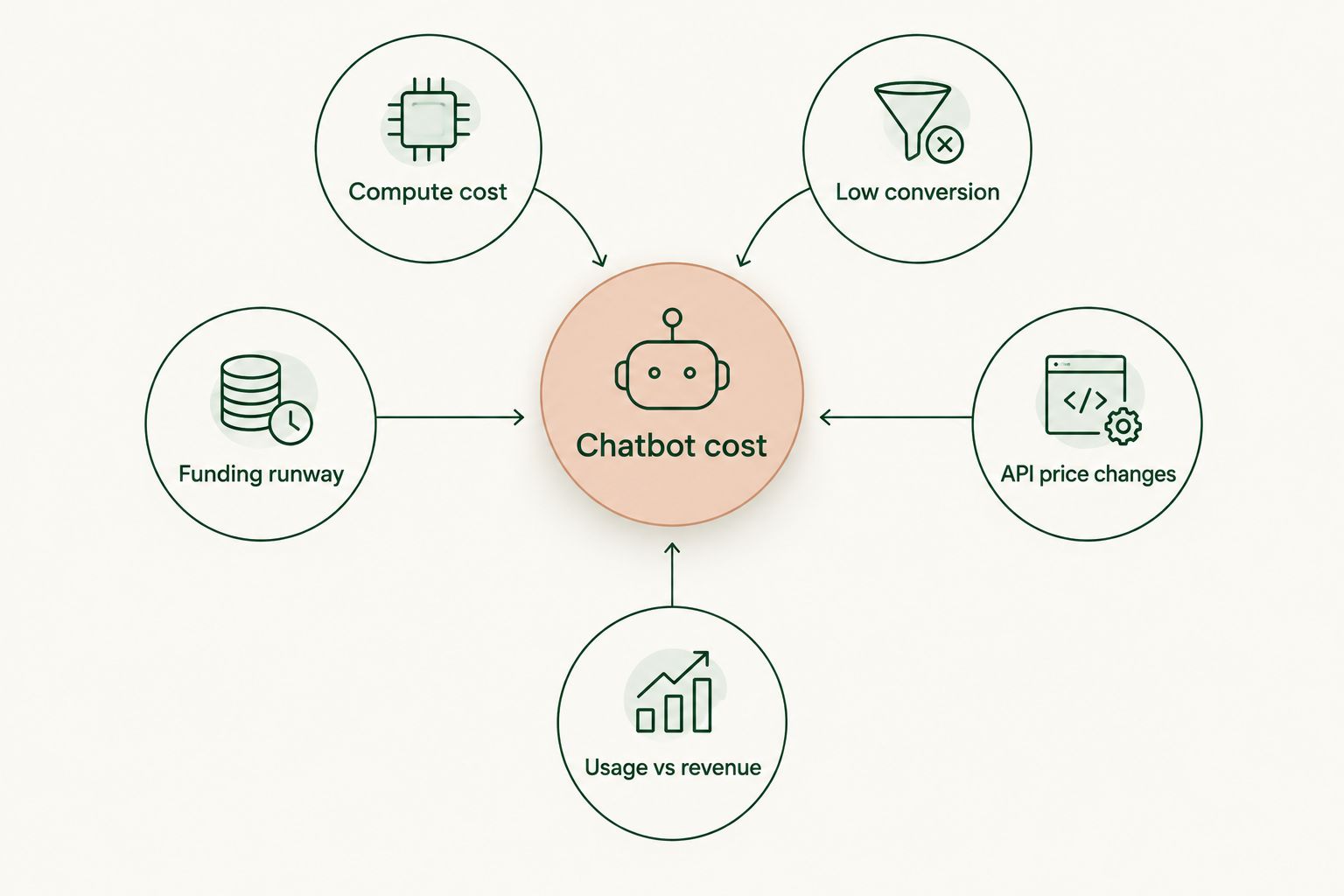
Those pressures don't disappear because a chatbot is well-built or well-loved. They disappear when a chatbot has a way to launch an ad-supported version that ties revenue directly to conversation volume instead of hoping enough users convert to a paid plan.
How do free AI chatbots make money without ads?
Free chatbots without ads generally rely on subscriptions, a freemium upgrade tier, or investor capital covering the gap. Some layer in sponsorships or affiliate placements, but those tend to be manual and don't scale the way a programmatic ad SDK does. Without one of these, a free chatbot with real usage is simply spending money on every conversation it answers.
Can a chatbot survive on subscriptions alone?
A chatbot can survive on subscriptions alone only if its paid tier converts well above the typical 2-5% freemium range or if the free tier is small and capped. Most consumer chat apps see the majority of users stay on the free tier permanently, which means subscription revenue alone often doesn't cover the compute cost of the whole user base — a gap ads are built to fill.
What happens to a chatbot when its funding runs out?
When funding runs out, a chatbot with no other revenue either shuts down, cuts free access, or gets acquired for its user base rather than its revenue. This is the standard outcome for VC-funded consumer AI products in 2026 that never added a monetization layer tied to usage, and it's the exact scenario ad-supported models are designed to avoid.
Turn free chat traffic into revenue
See how Elo adds native, non-intrusive ads to a chat app without hurting UX.
Developers weighing whether monetizing with ads is worth the integration effort in 2026 should look at the economics of ad-supported chatbots before deciding subscriptions alone will cover the free tier. The math rarely works out that way once a chatbot has real message volume.
FAQ
Can a free AI chatbot survive without ads in 2026?
A free AI chatbot survives without ads only as long as its subscription revenue or investor funding covers the compute cost of every free message. Once that runway ends, a chatbot with no revenue tied to usage typically shuts down or cuts free access.
What percentage of free chatbot users convert to paid?
Freemium products typically convert 2-5% of free users to a paid tier, a range widely cited across SaaS benchmarking. That leaves the large majority of free users as pure cost unless another revenue model, like ads, covers them.
Is ad-supported chatbot monetization better than subscriptions?
Ad-supported monetization and subscriptions solve different problems: ads monetize the free users who never upgrade, while subscriptions monetize the small percentage who do. Most surviving free chatbots in 2026 run both models side by side rather than picking one.
How does an ad SDK like Elo work inside a chatbot?
Elo's SDK inserts contextual, conversational ad cards into a chat app based on what the user is discussing, rather than running banner ads alongside the conversation. Integration runs about twelve lines of code on top of an existing OpenAI, Anthropic, or custom LLM stack.
Do ads hurt the chat experience?
Native ad cards placed contextually inside a conversation are built to feel like a relevant suggestion rather than an interruption, unlike display banners bolted onto a chat UI. Frequency capping and context matching are what keep an ad-supported chatbot usable rather than annoying.
How much can a free chatbot earn from ads per month?
Ad revenue for a chatbot depends on message volume, ad fill rate, and CPM, so there's no single figure that applies across apps. Developers can model this against their own traffic rather than relying on an industry average that won't match their audience.
What happens when a VC-funded chatbot runs out of money?
A VC-funded chatbot with no monetization layer typically shuts down, restricts free access, or gets acquired for its user base once its funding round is spent. Adding a revenue source tied to usage before that point is what keeps the product alive past the first round.
One last thing
The chatbots that survive past their first funding round in 2026 aren't the ones with the best model or the most users — they're the ones where revenue grows in the same direction as usage. A free chatbot that adds no monetization layer is betting that investors or upgrades will outrun its compute bill indefinitely, and that bet loses more often than it wins.