
AI chatbot ad monetization is worth it in 2026 when your app has repeat conversation volume, advertiser-relevant topics, and room for sponsored placements without weakening the answer. It is not worth adding while usage is erratic, user retention is unproven, or ads cannot be clearly separated from the assistant’s response.
- AI chatbot ad monetization is worth it in 2026 for established apps with commercial-intent conversations.
- Low-traffic chatbots should validate retention before adding an ad SDK.
- Native conversational ads fit chat interfaces better than banners, but require disclosure and frequency controls.
- Elo is best for developers monetizing OpenAI, Anthropic, or custom LLM chat applications.
Why this matters
Every message creates an operating cost, including messages from users who never subscribe or buy. Ads create a second revenue path for those conversations, but only when advertisers want the underlying intent and the placement does not damage the product experience.
The guide to monetizing an AI chatbot with conversational ads covers the implementation path. The decision comes first: determine whether your traffic, content, and measurement stack can support ads before adding SDK calls to the interface.
Elo’s SDK-based adserver is designed for developers building AI chat applications on OpenAI, Anthropic, or custom LLMs. It matches contextual, conversational ads to chats and gives publishers a way to earn revenue from advertiser spend.
Is AI chatbot ad monetization worth it in 2026?
Yes, AI chatbot ad monetization is worth it in 2026 for apps with consistent usage and conversations that reveal useful commercial intent. Shopping questions, software comparisons, travel planning, product research, and service discovery can give an ad matcher enough context to select a relevant sponsored offer.
The answer is no when ads are being used to compensate for weak retention. Monetization cannot fix a chatbot that users do not return to, and adding another component makes product diagnosis harder. Validate the core chat experience first, then test ads against a control group.
Use this decision table before committing engineering time:
| Decision factor | Ads are worth testing | Wait before adding ads |
|---|---|---|
| Usage pattern | Repeat conversations occur consistently | Traffic is irregular or launch-driven |
| Query intent | Users research products, services, or business decisions | Conversations rarely connect to advertiser categories |
| User experience | Sponsored cards can appear outside the assistant’s answer | Ads would interrupt or imitate the answer |
| Measurement | Impressions, engagement, revenue, and retention can be tracked | Revenue cannot be separated from product analytics |
| Business model | Ads complement an existing free experience | Ads are expected to rescue an unproven product |
| Trust controls | Sponsorship is disclosed at the placement | Promotional content would be difficult to identify |
Elo is best for developers who want AI chatbot ad monetization through contextual native cards rather than generic display banners. The tradeoff is operational: developers still need to define placement rules, disclosure, event tracking, and frequency controls.
When AI chatbot ads are worth testing
AI chatbot ads make the strongest business case when the conversation already contains intent an advertiser can serve. The app does not need to become a shopping assistant, but the user’s request must create a natural point where a sponsored option is useful rather than distracting.
Examples include:
- A travel assistant helping a user compare destinations or plan an itinerary
- A cooking assistant answering a recipe or ingredient question
- A B2B copilot discussing software, workflows, or operational tools
- A shopping assistant helping a user evaluate a product category
- A real estate assistant responding to a property or moving question
- A productivity assistant suggesting a relevant service after completing the main task
The assistant’s answer must remain complete without the ad. The sponsored card is an optional next step, not a condition for getting the requested information.
That distinction controls trust. If removing the ad would make the answer incomplete, the product has mixed editorial output with promotion. If the answer stands alone and the sponsored card adds a relevant option, users can judge it separately.
When AI chatbot ads are not worth it yet
Do not add ads to an AI chatbot in 2026 simply because inference costs are rising. Cost pressure explains the need for monetization, but it does not create advertiser demand or user tolerance.
Wait when any of these conditions apply:
- You cannot distinguish repeat usage from temporary launch traffic.
- The chatbot’s main use case is still changing.
- Conversation topics do not map cleanly to advertiser categories.
- The interface has no natural space for a labeled sponsored card.
- You cannot track ad exposure alongside retention and conversation completion.
- The chatbot handles sensitive decisions where promotional content needs stricter review.
A delayed launch is better than an ad launch with no baseline. Without pre-ad retention and engagement data, you cannot tell whether revenue is incremental or whether the placement is pushing valuable users away.
Ads vs. subscriptions vs. usage-based access
AI chatbot monetization is not a choice between one permanent model and another. Different models monetize different user behavior, and many apps need more than one path.
| Model | Best for | Main advantage | Main drawback | 2026 verdict |
|---|---|---|---|---|
| Conversational ads | Free users with advertiser-relevant queries | Creates revenue without requiring every user to pay | Depends on demand, fill, placement, and trust | Test after retention is stable |
| Subscription | Frequent users who value ongoing access | Direct relationship between user value and revenue | Non-paying users still create costs | Keep for high-value usage |
| Usage-based access | Workflows with measurable consumption | Connects payment to activity | Can discourage exploration and longer chats | Use when consumption is understandable |
| Sponsorships | Focused audiences with direct advertiser fit | Gives the publisher control over the relationship | Requires campaign operations and suitable sponsors | Consider for defined niches |
Ads have one structural advantage: they can monetize users who would never enter a payment flow. They also have a structural limitation: revenue depends on advertiser demand, so publisher traffic alone does not guarantee a viable result.
Subscriptions reverse that profile. They do not require an advertiser marketplace, but they exclude users who will not pay. Usage-based access aligns revenue with consumption, yet it can add friction to a product whose value comes from open-ended conversation.
The practical 2026 model is layered. Keep paid access where users receive recurring value, preserve a usable free experience, and test conversational ads only in moments where the topic supports a relevant offer.
Why the payoff varies
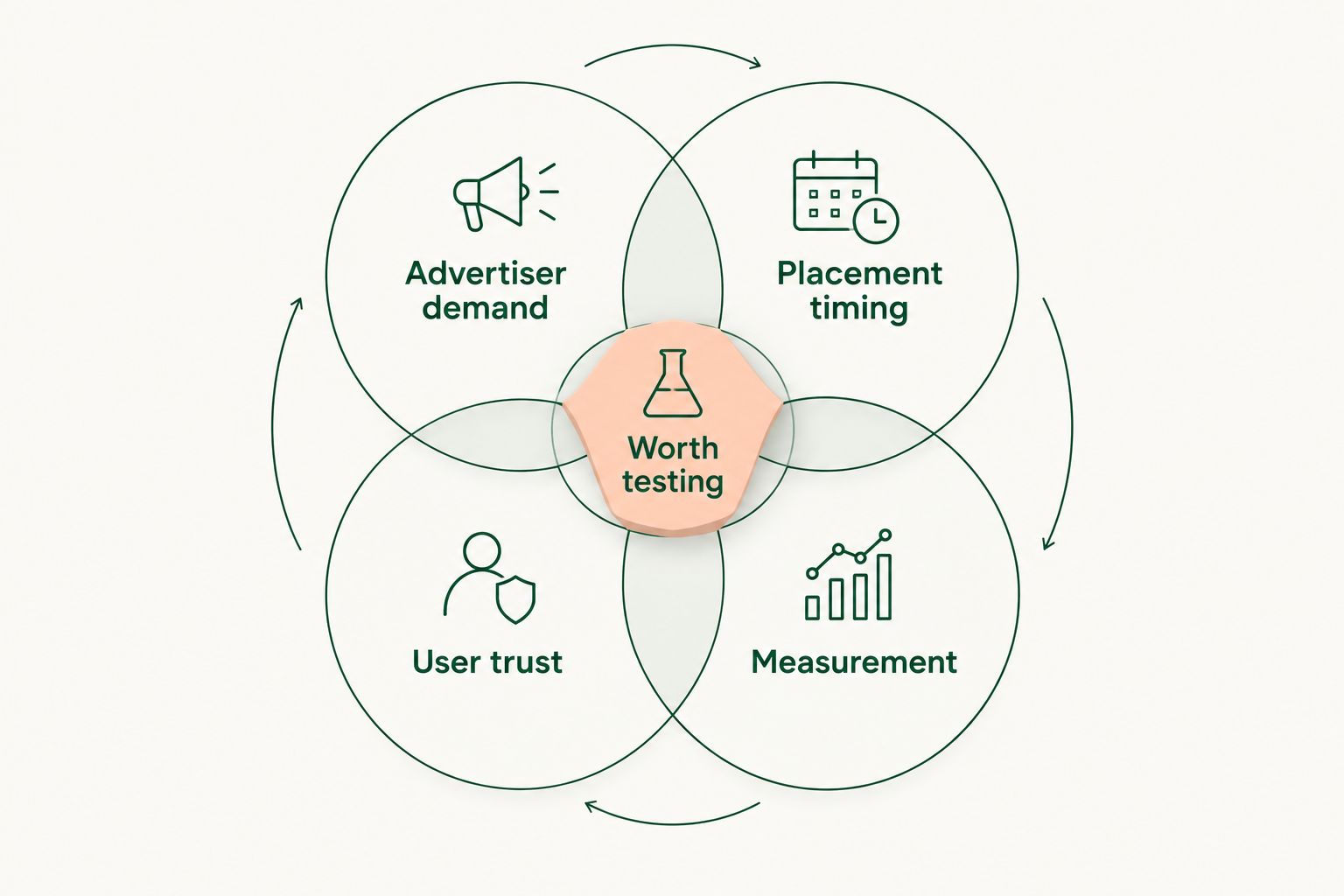
The value of AI chatbot ad monetization varies because each app produces different inventory. A message is not useful ad inventory merely because it can display a card.
- Conversation volume: Stable usage creates repeat opportunities to serve and measure ads. Irregular traffic produces noisy results.
- Commercial intent: A user comparing tools or planning a purchase presents clearer advertiser relevance than casual conversation.
- Advertiser coverage: A good match requires an advertiser relevant to the current topic. Demand gaps reduce fill.
- Placement timing: An ad shown before the assistant completes the requested task feels like a gate. A card shown after the answer can function as an optional action.
- Frequency: Repeating sponsored offers too often makes even relevant placements intrusive.
- Disclosure: A visible sponsored label separates paid content from the assistant’s reasoning.
- Measurement: Revenue must be evaluated beside retention, completed conversations, and ad engagement.
The commercial case combines demand, placement, trust, and measurement. Weakness in one area can erase the benefit created by the others.
How to decide using your own chatbot data
A useful 2026 decision process starts with existing product data, not projected ad revenue. Follow these steps in order.
1. Classify conversation intent
Review anonymized query categories rather than isolated messages. Identify which conversations involve research, comparison, discovery, or purchase planning, and separate those from casual, sensitive, and support-oriented conversations.
This classification defines eligible inventory. Do not treat every response as an ad opportunity.
2. Mark natural placement moments
Find points where the assistant has already completed the user’s requested task. A sponsored card can then offer an optional next action without displacing the answer.
Do not insert promotional text into the model’s answer. Keep the assistant response and the paid placement as separate interface objects.
3. Define trust controls before launch
Write the disclosure language, exclusion rules, and frequency policy before serving an impression. The sponsored-ad disclosure guide explains how to label placements without making them look like assistant-generated recommendations.
Trust controls also need topic exclusions. If the system cannot determine whether a conversation is appropriate for advertising, it should skip the placement rather than force a match.
4. Establish the measurement baseline
Record retention, completed conversations, response satisfaction, and session behavior before ads appear. After launch, compare those product signals with impressions, fill, engagement, and revenue.
Revenue alone gives an incomplete verdict. A placement that earns advertiser spend while reducing valuable repeat usage can be a net loss.
5. Test a limited slice of eligible traffic
Start with the clearest commercial-intent category and preserve a no-ad control. Compare user behavior across exposed and unexposed conversations, then expand only if product quality remains stable.
The ad revenue per user measurement guide provides a framework for connecting ad events to publisher performance. Elo can provide the adserver and SDK layer, but the publisher still owns the decision about where ads belong.
Evaluate ads with Elo
Add contextual conversational ads to an OpenAI, Anthropic, or custom LLM application.
How much traffic does an AI chatbot need for ads?
There is no universal traffic threshold supported by the available data. The correct point is when conversation volume is stable enough to compare ad-exposed users with a control and when enough eligible queries map to advertiser demand.
Raw user totals can mislead. A smaller product with focused commercial-intent conversations can present more useful inventory than a larger general-purpose chatbot dominated by queries advertisers cannot serve appropriately.
Will ads make an AI chatbot less trustworthy?
Ads reduce trust when they are disguised as assistant output, inserted before the task is complete, or shown in unsuitable conversations. Clearly labeled native cards preserve the distinction between the chatbot’s answer and a sponsor-funded option.
Trust is a product requirement, not a disclosure added after launch. The placement should remain understandable even when a user sees it without surrounding context.
Are conversational ads better than banner ads in 2026?
Conversational ads are the better interface fit in 2026 because they can use the current topic and appear as separate native cards. Banner ads occupy space but do not inherently reflect the user’s request, making them easier to ignore and harder to place naturally inside a conversation.
The advantage is contextual fit, not decoration. A poorly matched native card is still a poor ad.
FAQ
Is AI chatbot ad monetization worth it in 2026?
AI chatbot ad monetization is worth it in 2026 when usage is consistent, queries carry advertiser-relevant intent, and sponsored cards can be added without weakening the answer. Wait if retention, measurement, or topic fit is still unclear.
What is the best monetization model for an AI chatbot?
The best model depends on user behavior: subscriptions fit recurring high-value usage, while ads fit free conversations with advertiser relevance. A layered model can serve both groups without forcing every user into the same payment path.
How much traffic does a chatbot need before adding ads?
No universal traffic requirement applies to every chatbot. You need stable conversation volume, enough eligible queries to attract advertiser demand, and enough data to compare ad-exposed traffic with a control.
Can I add ads to an OpenAI or Anthropic chatbot?
Yes. Elo provides an SDK-based adserver for AI chat applications built on OpenAI, Anthropic, or custom LLMs, with contextual conversational ads rendered inside the app.
Where should an ad appear in an AI conversation?
An ad should appear after the assistant has completed the user’s requested task and should remain visually separate from the answer. The card must be optional, relevant, and labeled as sponsored.
Do AI chatbot ads hurt retention?
AI chatbot ads hurt retention when they interrupt tasks, repeat too often, or imitate organic answers. Measure retention against a no-ad control instead of judging the placement by revenue alone.
Should a chatbot use subscriptions and ads together?
Subscriptions and ads can work together because they monetize different users. Keep paid access for users who value recurring features and use ads selectively within the free experience.
What should an AI chatbot measure after launching ads?
Track impressions, fill, engagement, and revenue alongside completed conversations, retention, and satisfaction. The ad program is working only when monetization improves without weakening the underlying product.
One last thing
Create the no-ad control before integrating the first placement. Teams that add measurement later lose the only clean baseline that can answer whether AI chatbot ad monetization is actually worth it for their product in 2026.