
Contextual advertising vs display ads is really a question about interruption versus relevance, and in 2026 the data keeps landing on the same side. Contextual formats put an ad next to content the reader already cares about; display banners chase the reader around the web with retargeted creative that most people have trained themselves to ignore. The average banner display ad still converts at a click-through rate near 0.05% to 0.1%, a benchmark that has barely moved across a decade of ad-network reporting. Contextual advertising, including the conversational ads inside AI chat apps, skips third-party tracking entirely — which matters more now that Chrome has finished phasing out third-party cookies. The catch: contextual only beats display when the matching engine actually understands the context. A bad contextual match — a mattress ad dropped into a grief conversation — erodes trust faster than any banner ever could.
- Contextual advertising vs display ads: contextual wins on engagement and trust in 2026 because it matches content instead of interrupting it.
- Banner display ads still average a 0.05%-0.1% click-through rate industry-wide — a bar contextual formats clear easily when matching is done right.
- Conversational ads embedded in AI chat apps run without third-party cookies, which display retargeting depends on.
- Contextual only outperforms display when the matcher reads context correctly; a bad match damages trust faster than a banner does.
Why this matters
Most ad budgets in 2026 still default to display because it's the format everyone knows how to buy: fixed sizes, programmatic exchanges, decades of tooling. But the reader behavior underneath display hasn't changed in the advertiser's favor. Banner blindness — the well-documented tendency for users to visually skip anything shaped like an ad — was identified in usability research decades ago and it hasn't reversed. Contextual advertising sidesteps the problem by not looking or acting like a banner at all; it looks like part of the page, or in the case of AI chat apps, part of the conversation.
The shift matters for anyone building or monetizing an AI chat product specifically, because chat interfaces have no space for a 300x250 banner in the first place. The comparison isn't display-vs-contextual in the abstract — it's whether an ad format that depends on tracking and screen real estate can survive in a surface that has neither.
Is contextual advertising more effective than display ads?
Yes, on relevance and trust; the honest caveat is that "more effective" depends on what you're optimizing for. Here's how the two formats stack up side by side:
| Factor | Display advertising | Contextual advertising |
|---|---|---|
| Targeting basis | Third-party cookies, retargeting history | Page or conversation content, in real time |
| Typical placement | Banners, sidebars, interstitials | Native cards, in-line recommendations |
| Cookie dependency | High — breaks as cookies disappear | None — reads context, not identity |
| User perception | Often ignored (banner blindness) | Read as relevant when matching is accurate |
| Ad blocker exposure | Frequently blocked at browser level | Harder to block; renders as native content |
| Best for | Broad brand awareness at scale | High-intent, in-context recommendations |
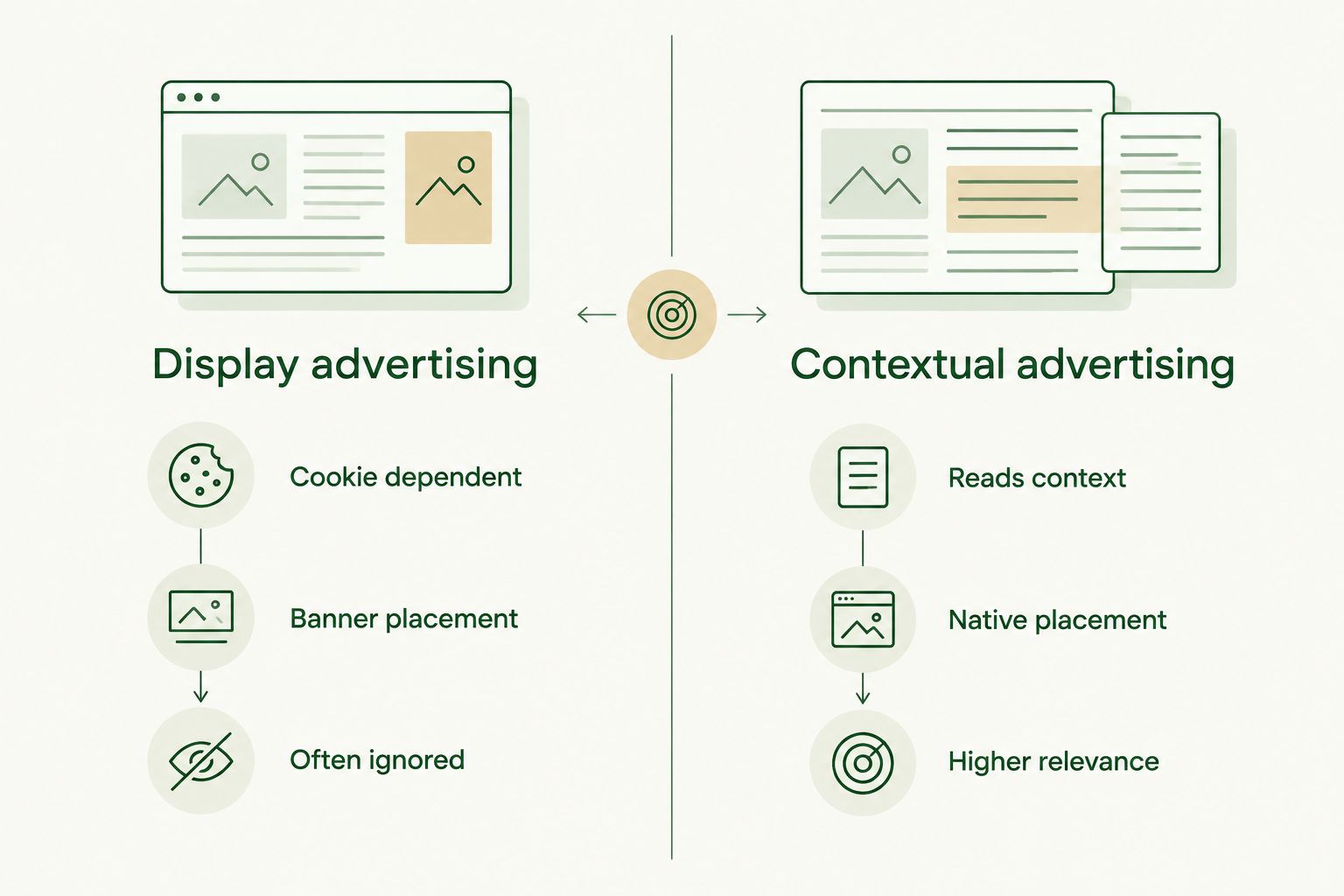
The table settles the format debate but not the execution debate. A contextual ad matched against the wrong keyword performs worse than a mediocre banner — matching accuracy is the entire game.
Banner display ads: near 0.05% average click-through rate
Display banners are the oldest programmatic format on the web and the click-through data hasn't budged in years: 0.05% to 0.1% average CTR across most reported industry benchmarks. That's roughly one click for every 1,000 to 2,000 impressions. Display still moves volume — it's cheap to buy at scale and works for pure awareness campaigns — but it was never built for conversation-native surfaces. Verdict: fine for broad reach, weak for anything requiring engagement.
Contextual web ads: matched to page content, not identity
Contextual web advertising reads the page a reader is already on — the topic, the keywords, the intent signals — and serves an ad tied to that content instead of to a cookie profile. It doesn't need to know who the visitor is, only what they're reading. This makes it resilient to cookie deprecation and less vulnerable to the privacy scrutiny display retargeting has faced through 2026. Verdict: solid replacement for cookie-based retargeting on content sites.
Conversational ads: contextual advertising built for AI chat
Conversational ads take the same contextual logic and apply it inside a live chat exchange rather than a static page. The ad reads the conversation topic — a user asking about mortgage refinancing, meal planning, or a coding problem — and surfaces a relevant, non-intrusive card instead of a banner squeezed into a chat window that has no room for one. Contextual advertising for custom LLM chatbots works this way: no third-party tracking, no fixed ad slots, just a matcher reading what's actually being discussed. Verdict: the only format built to fit a chat interface without breaking the UX.
Why effectiveness varies between the two formats
- Placement context — an ad that matches what's on screen reads as helpful; an ad that interrupts reads as noise.
- Tracking dependence — display leans on third-party cookies that browsers have restricted; contextual reads first-party content instead.
- Ad blocker exposure — banner ads get filtered at the browser or extension level; native contextual cards render as part of the content.
- Format rigidity — display is locked to fixed sizes (300x250, 728x90); contextual and conversational formats adapt to the surface they run on.
- Trust signal — users have over a decade of trained skepticism toward anything shaped like a banner; a well-matched contextual recommendation doesn't trigger the same skip reflex.
Do contextual ads work without third-party cookies?
Yes — contextual ads work without third-party cookies because they target the content or conversation, not the visitor's identity or browsing history. That's the core mechanical difference from display retargeting, which depends on cookies to follow a user across sites. Since browsers have restricted third-party cookies, contextual formats have become the more durable option by design, not by trend.
Are conversational ads a type of contextual advertising?
Conversational ads are contextual advertising applied specifically to chat interfaces rather than static web pages. Both read the surrounding content to pick a relevant ad; conversational ads just do it inside a live exchange with an AI assistant instead of a page load. Developers running apps on OpenAI, Anthropic, or custom LLMs use an ad SDK for AI chat interfaces built by Elo to add this kind of monetization without hard-coding a banner into a text-based product.
Can AI chatbots run contextual ads instead of banner ads?
AI chatbots can run contextual ads instead of banner ads, and in most cases banners aren't a workable option in a chat window to begin with. Conversational ad formats render as native cards inside the response stream, matched to what the user just asked, rather than sitting in a fixed slot the chat UI has no space for.
FAQ
What's the difference between contextual and display advertising?
Contextual advertising matches ads to the content or conversation a user is engaged with right now; display advertising places fixed-size banners, often targeted using third-party cookies and past browsing history. Contextual doesn't need to know who the user is, only what they're looking at.
Is contextual advertising more expensive than display advertising?
Pricing structures vary by network and format, so there's no universal answer — check current rates with the specific ad platform you're evaluating. What's consistent is that contextual formats tend to produce higher engagement per impression because the ad matches intent.
Do contextual ads work without cookies?
Yes, contextual ads work without third-party cookies because they read page or conversation content instead of tracking identity across sites. This makes them more durable as browsers restrict cookie-based tracking.
Can AI chatbots serve contextual ads instead of banners?
AI chatbots can serve contextual ads instead of banners, since chat interfaces rarely have room for a fixed banner slot. Conversational ad formats render as native cards inside the chat response instead.
What is banner blindness and does it affect display ads?
Banner blindness is the well-documented tendency for users to visually skip anything shaped like a banner ad, identified in usability research going back decades. It directly depresses display ad click-through rates, which still average 0.05% to 0.1% industry-wide.
Are conversational ads a form of contextual advertising?
Conversational ads are contextual advertising applied to chat interfaces specifically, matching ad content to what's being discussed in real time rather than to a static page. Both formats avoid third-party tracking in favor of reading surrounding content.
Is contextual targeting better for privacy compliance in 2026?
Contextual targeting is generally better positioned for privacy compliance in 2026 because it doesn't rely on tracking individual users across sites. Display retargeting's cookie dependency puts it in more direct conflict with browser-level privacy restrictions.
How does an ad SDK match ads to chat context?
An ad SDK built for AI chat apps reads the topic of the ongoing conversation and matches it against available ad inventory before rendering a native card in the response. Elo's SDK runs this matching without collecting the third-party tracking data display advertising depends on.
See contextual ads inside a live chat SDK
Check how conversational ad matching works before you decide between formats.
One last thing
The display-vs-contextual debate usually skips the format that made the question relevant again in 2026: chat. Banner ads were built for a scrollable page with fixed real estate; AI chat apps don't have that real estate, so the format war isn't really contextual-vs-display anymore inside chat products — display was never a contender there. The real decision for anyone running an AI chatbot is whether to monetize with conversational ads at all, and if so, how tightly the matcher reads context before it shows anything.