
Running ads on ChatGPT splits into two different jobs: getting a brand placed inside AI chat conversations, and getting a GPT-based chat app to actually show and monetize those placements. This guide covers the second job — the SDK-based path developers use in 2026 to turn an OpenAI, Anthropic, or custom-LLM chat product into ad-supported inventory, and what advertisers need to know about how that inventory actually works.
- ChatGPT.com has no self-serve ad-buying dashboard in 2026 — running ads on ChatGPT in practice means embedding ads inside a GPT-based chat app.
- Elo's SDK adds contextual, conversational ad cards to chat apps built on OpenAI, Anthropic, or custom LLMs.
- Elo describes its base integration as twelve lines of code, though matching rules and testing take longer than writing the code.
- Best for developers monetizing free-tier chat traffic, not for brands trying to buy placement directly from OpenAI.
Why this matters
Search interest in "how to run ads on ChatGPT" spikes every time a new GPT-based app launches, and the phrase gets used by two different audiences. Advertisers mean "get my brand in front of ChatGPT users." Developers mean "make money from the chatbot I built." Conflating the two wastes time — an advertiser chasing an OpenAI ad rep gets nowhere, and a developer trying to buy inventory from OpenAI directly is solving the wrong problem.
In 2026, the mechanism runs through the app layer, not the model layer. Whoever owns the chat interface — a Slack bot, a mobile app, a custom GPT wrapper — owns the ad inventory. OpenAI, Anthropic, and the open-source model providers underneath don't broker that inventory themselves.
You run ads on ChatGPT by adding an ad SDK to the GPT-based chat app itself, not by buying inventory from OpenAI. The fastest path in 2026 is dropping a conversational ad SDK like Elo into an existing chat product and letting it match ads to conversation context. The catch: this only works if you control the app's codebase — you can't inject ads into someone else's chatbot, and OpenAI's own ChatGPT.com interface stays ad-free for outside brands.
How to run ads on ChatGPT
The process is the same whether the app runs on GPT models, Claude, or a self-hosted LLM: it's an SDK integration, not an ad-buy.
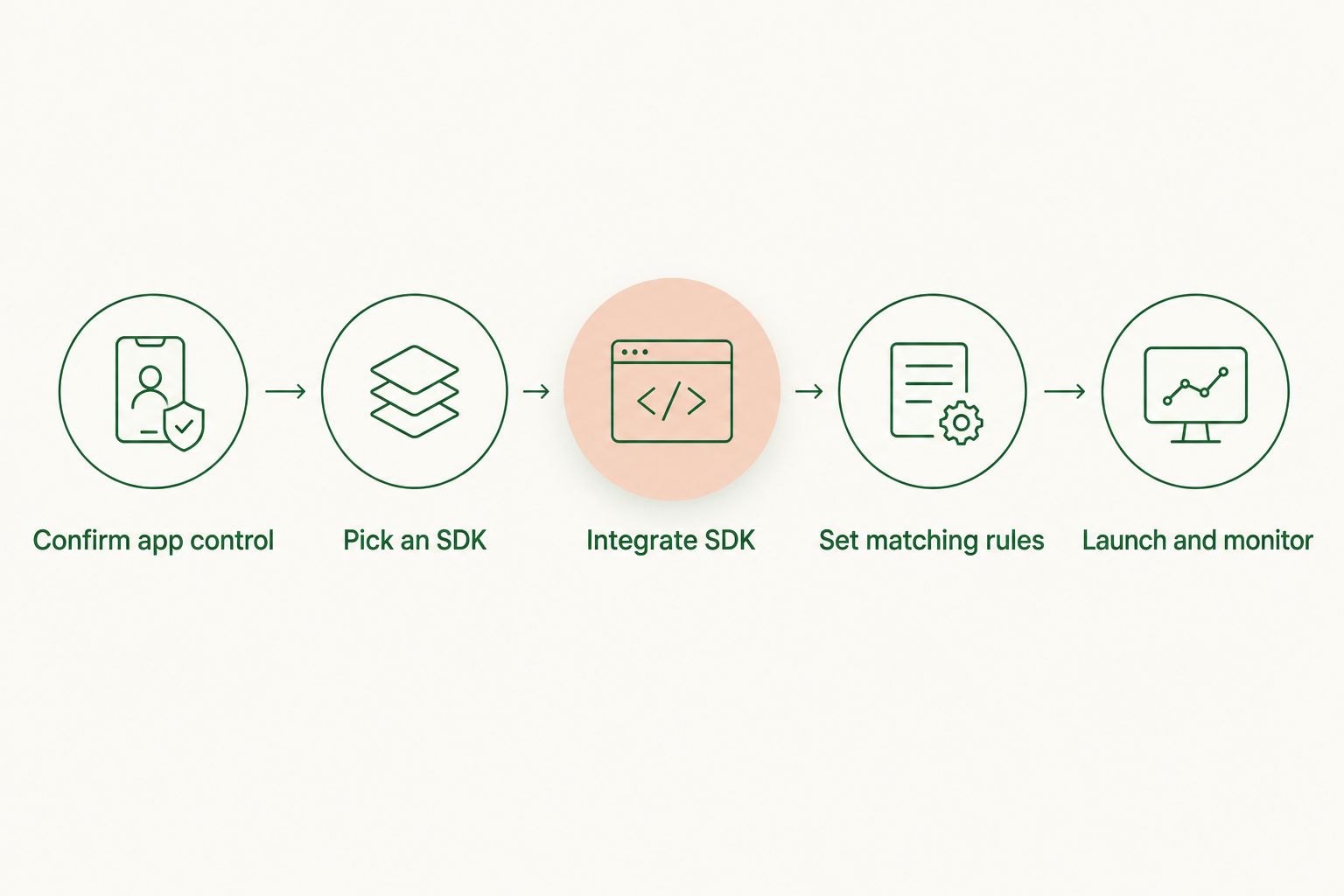
- Confirm you control the app, not just the model. Ads get embedded at the interface layer — a Slack bot, a custom GPT, a mobile app, a web widget — not inside OpenAI's raw API responses. If you're only calling the API and someone else owns the interface, you have nothing to add ads to yet.
- Pick an SDK that matches your model stack. Elo works across apps built on OpenAI, Anthropic, or custom LLMs; some networks only cover one model provider or one platform, so check compatibility before committing engineering time.
- Integrate the SDK. Elo describes its base setup as "twelve lines of code" — the SDK reads conversation context as it streams and returns a matched ad card, not a banner bolted onto the interface.
- Set contextual matching and frequency rules. Decide which topics can trigger an ad, which categories are off-limits, and how many times a single user sees a placement per session.
- Launch and watch RPM, CPM, and fill rate. Revenue tracks against dashboard events, not guesswork — check the numbers weekly for the first month after launch and adjust matching rules if fill rate lags.
Skipping step one costs the most time. A team that starts evaluating SDKs before confirming they own the interface code ends up looking for a workaround that doesn't exist — no SDK injects ads into someone else's live chatbot, and no amount of API access substitutes for owning the front end.
Ready to add ads to your chat app?
Elo's SDK adds contextual ad cards to OpenAI or Anthropic-based chatbots.
Can you run ads inside ChatGPT itself?
No — as of 2026, ChatGPT.com does not offer a self-serve ad-buying dashboard for outside brands. Every ad a user sees inside an AI chat product today reaches them through the app's own SDK layer, not through an OpenAI ad account. That's true whether the app is a consumer-facing assistant or an internal tool wrapped around the same models.
This distinction trips up a lot of advertisers in 2026 because "ChatGPT" gets used loosely to mean any GPT-based chat product, not just OpenAI's own app. A cooking assistant, a mortgage chatbot, or a customer support bot can all run on GPT models while being entirely separate products with their own ad inventory, their own audience, and their own SDK integration. For the full breakdown of what OpenAI does and doesn't expose to advertisers, see can you run ads inside ChatGPT itself.
Running ads on ChatGPT as an advertiser vs. as a developer
An advertiser doesn't integrate anything — they buy placement through whichever ad network or SDK the target chat app already runs, the same way display advertisers buy through an ad exchange rather than negotiating with every website directly. The practical move is finding which GPT-based apps in your category already carry ad inventory and buying through that network.
A developer does the opposite: they pick the SDK, not the advertiser. Once Elo or a comparable SDK is integrated, advertiser demand flows in through the network's own matching system — a mortgage assistant, an accounting bot, or a shopping assistant all draw different advertiser categories without the developer sourcing a single one manually.
Why ad setups on GPT-based apps vary
- Model provider — OpenAI, Anthropic, and custom or open-source LLM stacks aren't all compatible with the same SDKs, so the stack you built on narrows your options before you evaluate anything else.
- Traffic volume — thin-traffic apps see lower fill rates because there's less conversation data for the matcher to work with, and fewer sessions to spread ad frequency across.
- Audience niche — finance, shopping, travel, and B2B assistants pull higher advertiser demand than general-purpose chat, which moves CPM more than raw traffic does.
- Platform — a web widget, an iOS app, and a Slack or Discord bot each render an ad card differently, and some platforms restrict what a native card can look like.
- Compliance requirements — GDPR and brand-safety rules narrow which advertisers are eligible to match in a given app, especially for regulated categories like lending or healthcare.
- Ad format choice — a native card feels different to a user than an interstitial, even when the underlying ad and advertiser are identical.
A chat app that controls for niche and format beats one that just chases traffic. A tightly focused finance or shopping assistant matches high-value categories on almost every turn; a general-purpose chatbot spreads its conversations across too many low-value topics to match well, even with more total users.
How much can an AI chatbot earn from ads per month?
Revenue scales with conversation volume, fill rate, and the CPM a niche commands — a chat app with steady daily conversations earns meaningfully more than one with sporadic traffic, and niche moves CPM more than raw volume does. A finance or shopping assistant with modest traffic can out-earn a general-purpose bot with far more users, because the matcher finds a relevant advertiser on more turns.
Fill rate matters as much as CPM. An app that only fills half its available ad opportunities is leaving the other half on the table regardless of what the filled half pays, which is why frequency caps and matching rules from the setup steps above directly affect the number at the end of the month.
Is monetizing an AI chatbot with ads worth it in 2026?
For a free-tier chat app with steady conversation volume, yes — advertiser demand for placement inside AI chat conversations keeps growing in 2026, and the SDK integration work doesn't need to be redone once traffic scales. Setting it up early means the revenue line is already live by the time usage crosses a meaningful threshold.
For a low-traffic app still finding product-market fit, ad revenue stays a rounding error until usage grows. The integration cost is low enough that most teams add it anyway rather than waiting, since the alternative is re-integrating later under time pressure instead of testing matching rules calmly now.
“If you don't control the app's codebase, no SDK gets you around that — ads only run where the code lives.”
FAQ
How do I run ads on ChatGPT itself?
You don't — ChatGPT.com has no self-serve ad-buying dashboard in 2026. Running ads means embedding them inside a GPT-based chat app you control, typically through an ad SDK.
What SDK works for adding ads to a GPT-based chatbot?
Elo's SDK works across apps built on OpenAI, Anthropic, or custom LLMs and returns contextual ad cards instead of banners.
Do I need advertiser relationships to run ads in my chatbot?
No — the SDK or ad network sources and matches advertisers. The developer integrates the SDK and sets the matching and frequency rules.
What's the difference between a conversational ad and a banner ad?
A conversational ad renders as a native card inside the chat thread and matches the topic being discussed. A banner sits outside the conversation and ignores context.
How long does it take to add ads to a chat app?
The code integration is small — Elo frames its base setup as twelve lines of code. Testing matching rules and frequency caps before launch usually takes longer than the integration itself.
Can advertisers buy placement inside ChatGPT directly from OpenAI?
Not through a public self-serve dashboard in 2026. Placement happens at the app layer, through whatever ad SDK the chat product uses.
Does running ads hurt the chat experience?
Native, context-matched ad cards are less disruptive than banners because they appear as part of the conversation instead of interrupting it. Frequency capping still matters for retention.
One last thing
The chat apps earning the most per user in 2026 aren't the highest-traffic ones — they're the ones with the tightest topic focus. A niche assistant that talks about one thing all day matches high-CPM categories on nearly every turn; a general-purpose chatbot spreads its conversations across too many low-value topics to match well, no matter how many total users it has.