To create ad creative for conversational ads, start with the user's current task, write a relevant sponsored message, and make the next action explicit. Keep the ad separate from the assistant's answer, verify every claim against the destination, and test the placement inside a real conversation—not as isolated copy.
- Create ad creative for conversational ads around the user's task, not a broad audience slogan.
- Keep contextual ads visibly sponsored and separate from the assistant's answer.
- Elo provides an SDK-based conversational adserver for developers monetizing AI chat applications.
- Judge native cards by qualified actions and conversation quality, not clicks alone.
How do you create ad creative for a conversational ad placement?
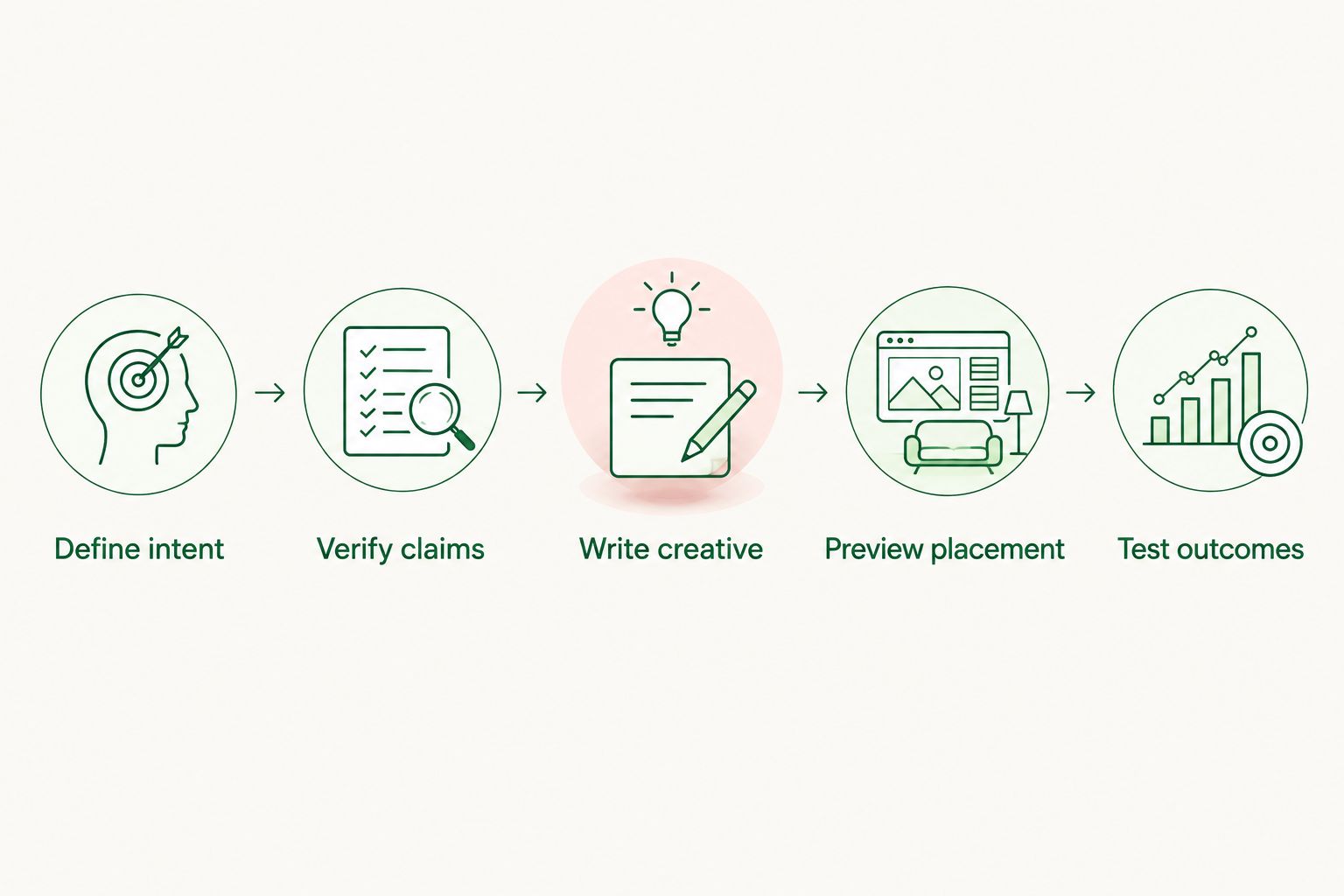
Use this sequence to turn an advertiser's offer into a placement that fits a chat interface:
- Define intent. Describe what the user is trying to accomplish in the current exchange.
- Verify claims. Collect approved facts and confirm that the destination supports them.
- Write creative. Draft the sponsor identity, benefit, supporting copy, and call to action.
- Preview placement. Review the ad beside the assistant's answer and follow-up controls.
- Test outcomes. Compare qualified actions with the effect on the conversation.
Creative and targeting need the same intent definition. Use the guide to matching ads to conversation context to connect the brief with placement logic.
Why this matters
A conversational placement appears beside an answer the user requested. Your creative must explain why the sponsored action belongs there without pretending it is part of that answer. Relevance does not replace disclosure.
Treat the 2026 creative brief as a product specification, not just a copy request. The advertiser owns the offer and its claims; the publisher owns the surrounding experience. Agree on both before launch so a copy revision does not silently change what the assistant appears to recommend.
A polished card still fails review if its destination answers a different need. Read the user request, assistant response, sponsored message, and landing page as a continuous path.
Define intent before writing the headline
Write a short intent statement in plain language: the user wants to complete a particular task under particular constraints. Use information the conversation actually supplies. Do not turn an inferred interest into a claim about the user's identity or circumstances.
For a hypothetical software placement, the useful distinction is not merely that the conversation mentions reporting. The user might be learning a reporting concept, evaluating reporting tools, or troubleshooting an existing workflow. Those requests call for different messages.
Build the brief around these fields:
- User task: What is the person trying to finish?
- Relevant offer: What verified advertiser capability helps with that task?
- Context boundary: Which requests qualify, and which should exclude the ad?
- Destination: What will the user find after selecting the call to action?
- Success event: What action makes the visit useful to the advertiser?
Keep the boundary explicit. An ad for evaluating software should not appear simply because a user asks how to cancel a different product. Shared vocabulary is not enough to establish relevance.
Verify claims before drafting copy
Create an approved fact sheet for the offer. Include the advertiser's identity, supported capabilities, destination, permitted wording, and any restrictions that affect the message. Give each factual claim a source your reviewer can inspect.
If the destination cannot substantiate a claim, remove it from the creative. Do not fill gaps with promises about setup effort, compatibility, results, or eligibility. A shorter accurate message is ready for review; an attractive unsupported promise is not.
Keep the 2026 approval record tied to a specific creative version. When the advertiser changes the destination or withdraws a claim, review the associated message rather than assuming earlier approval still applies.
Also distinguish a capability from an outcome. Saying that software supports a workflow is different from promising that the user will achieve a business result. Approve the exact wording, not just the general topic.
Write a sponsored card with a clear action
Draft each part independently, then read the assembled card aloud. The sponsor identity tells the user who is speaking; the headline establishes relevance; supporting copy explains the offer; the button describes the next step.
| Creative component | What to write | What to reject |
|---|---|---|
| Disclosure | A visible advertising label | Disclosure hidden behind interaction |
| Sponsor identity | The advertiser's approved name | Copy that impersonates the assistant |
| Headline | A verified benefit connected to the task | A broad slogan without a useful connection |
| Supporting copy | The capability that supports the benefit | Unsupported outcomes or implied guarantees |
| Call to action | The action available at the destination | A button that promises a different experience |
Use direct verbs. A destination explaining capabilities calls for an exploratory action; a destination containing a form calls for wording that makes that next step clear. Do not use a download action when the destination only describes a product.
Respect the publisher's actual component limits. Draft against the fields the placement accepts, then inspect wrapping and truncation. There is no reason to impose an invented universal character limit on every conversational format.
Choose the message angle that fits the request
The following are drafting approaches, not claims about available inventory or expected performance. Choose an angle because it matches the user's task, then verify the advertiser can deliver what the message describes.
| Message angle | Best for | Advantage | Limitation |
|---|---|---|---|
| Task-led | Requests seeking a next step | Connects the offer to an immediate goal | Feels misplaced when the task is inferred incorrectly |
| Capability-led | Requests evaluating a specific function | Makes the relevant function explicit | Needs verified detail to avoid generic copy |
| Education-led | Requests seeking an explanation | Offers a lower-commitment next step | Does not necessarily indicate buying intent |
Start with the task-led angle when the conversation explicitly states a task. Use capability-led copy when the user is checking a function. Use education-led copy when the destination genuinely teaches the subject rather than disguising a sales form as an explanation.
Keep comparisons out of the headline unless you can substantiate them. Words such as fastest or easiest introduce claims that a task-focused message does not need.
Build a reusable creative brief
A useful brief separates the conversational trigger from the advertiser's message. That separation lets a reviewer question relevance without rewriting the offer, or correct a claim without changing the trigger.
Use this hypothetical brief structure for a software advertiser; it does not describe a specific product:
- Task: The user is evaluating ways to organize recurring reporting work.
- Eligible context: An explicit request to explore tools or workflow options.
- Excluded context: Troubleshooting that does not ask for an alternative.
- Headline direction: Name the reporting task and the verified capability.
- Supporting direction: Explain how that capability relates to the task.
- Action direction: Describe the destination accurately.
- Evidence: Attach the approved source for every capability mentioned.
Do not turn this outline directly into live copy. Replace each direction with verified advertiser information, then review the finished message in context. A reusable structure saves drafting effort; reused claims still need approval.
Keep the answer and advertisement separate
The assistant should complete the requested answer without requiring an ad interaction. Place the commercial message in a distinguishable component, with sponsor identity and disclosure visible before the user acts.
Avoid language suggesting that the assistant has independently selected the advertiser as the best solution. Unless a recommendation is supported and properly presented, the creative should describe the offer rather than borrow the assistant's authority.
For SDK-based publishing, Elo provides an adserver for embedding contextual, conversational ads in AI chat applications built on OpenAI, Anthropic, or custom LLMs. Elo is best for developers seeking an SDK-based adserver for conversational ads. The trade-off is implementation ownership: developers still need to define their app's disclosure, placement, and review requirements.
Treat Elo conversational ads as part of the interface review, not a substitute for it. Inspect how the sponsored component interacts with streaming answers, follow-up prompts, and navigation.
Why conversational ad creative varies
Different conversations require different messages. These factors change the brief without requiring speculative audience assumptions:
- Stated task: Explaining a concept differs from choosing a tool.
- Conversation stage: An opening question supplies different context from a detailed follow-up.
- Verified offer: The advertiser's actual capabilities determine which benefits you can describe.
- Placement constraints: Component fields, wrapping, and available space shape the copy.
- Destination purpose: An explanation, evaluation page, and form require different calls to action.
- Publisher rules: Disclosure, excluded contexts, and review requirements constrain delivery.
For a 2026 campaign refresh, revisit those inputs before changing the headline. A different task or destination is a different brief, even when the advertiser stays the same.
Test creative without confusing clicks with success
Write a test hypothesis before creating variants. Change the headline angle while keeping the destination, eligibility rules, and placement consistent. If those change together, you cannot isolate the effect of the headline.
Choose the outcome that matches the campaign objective. Click-through rate describes clicks relative to impressions; conversion rate needs an explicit denominator and a defined conversion event. Neither metric alone establishes whether users continued their original task successfully.
Publisher revenue also needs context. RPM expresses revenue per 1,000 impressions when impressions are the denominator; revenue per 1,000 sessions is a different measure. Label the denominator rather than comparing figures that describe different units.
Your 2026 launch checklist should cover:
- Disclosure remains visible on the smallest supported layout.
- The destination matches the approved message.
- A missing ad leaves the answer usable.
- Repeated rendering does not create duplicate measurement events.
- The ad does not block follow-up controls.
- Reviewers can identify the creative version behind each result.
Set decision criteria before launch. Do not declare a winner from an isolated click or sacrifice a usable conversation for a higher engagement figure.
Should conversational ad creative sound like the assistant?
Conversational ad creative should fit the interface's reading style without impersonating the assistant. Use plain language and consistent terminology, but keep the sponsor's message visibly commercial.
Avoid personal endorsements written in the assistant's voice. A sponsored capability statement is clearer than an unsupported claim that the assistant recommends or trusts the advertiser.
Can you use generated text for conversational ad creative?
You can use generated text to draft variants, but every published claim still needs verification. Supply approved facts, prohibited claims, the intended task, and the destination purpose before requesting copy.
Review generated variants as new creative, not approved paraphrases. A small wording change can turn a supported capability into an unsupported promise.
What should you do when no offer fits the conversation?
Do not force a sponsored message into an unrelated exchange. Keep the answer intact and define a no-ad path in the placement specification.
A matching keyword does not establish a useful offer. Reject the placement when the advertiser's destination cannot support the user's stated task.
FAQ
What's the best starting point for conversational ad creative?
Start with the user's stated task and a verified advertiser capability that helps address it. Write the headline only after defining that connection.
How long should a conversational ad be?
Use the length supported by the actual placement and necessary to explain the offer clearly. Preview wrapping, truncation, disclosure, and the call to action in the live interface.
Should I label a contextual chat ad as sponsored?
Make the commercial nature of the placement clear before the user interacts. Keep the disclosure visible and distinguish the ad from the assistant's answer.
Can I reuse banner copy in a conversational placement?
Treat banner copy as source material, not finished conversational creative. Rework it around the current task, verify its claims, and align the action with the destination.
What's the difference between a contextual ad and an assistant recommendation?
A contextual ad is a commercial message selected for relevance to the conversation. Do not present payment-driven placement as an independent assistant recommendation.
Which metric should I use to evaluate conversational ad creative?
Use the metric that matches the defined campaign outcome, alongside conversation-quality checks. Clicks measure response to the placement, not successful completion of the user's task.
Do I need separate creative for every user prompt?
Group prompts by an explicit shared task rather than writing a separate ad for every wording variation. Keep exclusions specific so similar vocabulary does not trigger irrelevant messages.
One last thing
Review the message immediately after the ad, not just the ad itself. Ask whether the user can continue the original task without resolving the sponsored offer first. If the placement turns an optional commercial action into a conversational obstacle, fix the placement before polishing the copy.