
ChatGPT ads appear as labeled sponsored placements separate from the assistant’s answer, not as ordinary recommendations secretly turned into promotions. When reviewing a ChatGPT ad in 2026, look for the sponsorship label, advertiser identity, promotional message, and destination; do not assume that a third-party chatbot using an OpenAI model has the same advertising interface as ChatGPT itself.
- What do ChatGPT ads look like? Look for a sponsored placement clearly separated from the assistant’s answer.
- A brand mention alone does not establish that a recommendation is an advertisement.
- ChatGPT and third-party AI chat applications are different publishing environments.
- Elo provides conversational advertising for developers building their own AI chat applications.
Why this matters
The important visual distinction is paid placement versus assistant output. A polished card does not prove that a recommendation is independent. A plain text link does not prove that it is an ad.
If you build a chat product, treat the commercial boundary as part of the interface. Readers need to identify the paid message without opening another page or interpreting subtle styling. Start with how to disclose sponsored ads in an AI chatbot, then choose the presentation.
For a 2026 design review, separate two questions: what the placement looks like, and who operates the application displaying it. A screenshot answers the first question only when its source and surrounding interface are clear.
What do ChatGPT ads look like?
The identifying pattern is a sponsored placement with its own commercial identity, separate from the conversational answer. Evaluate the whole placement, not just its headline: disclosure, advertiser, message, destination, and relationship to the surrounding response.
Use this inspection sequence when someone sends you an example:
- Identify the application. Establish whether the screenshot comes from ChatGPT itself or a separately operated AI application.
- Find the disclosure. Look for an explicit advertising label rather than inferring sponsorship from a logo or link.
- Locate the boundary. Check where the assistant’s response ends and the paid placement begins.
- Identify the advertiser. Determine which business is responsible for the promoted offer.
- Inspect the action. Check what the link or button asks you to do and where it leads.
These are inspection criteria, not a claim that every placement uses identical wording, imagery, dimensions, or controls. Do not turn one screenshot into a universal ChatGPT ad specification.
What should you inspect inside the placement?
| Element | What to inspect | What it establishes | What it does not establish |
|---|---|---|---|
| Sponsorship label | Explicit paid-placement disclosure | The message is presented as advertising | Whether the offer fits your needs |
| Advertiser identity | The named business behind the message | Who is promoting the offer | Independent endorsement by the assistant |
| Promotional copy | The commercial proposition | What the advertiser wants you to consider | Proof that every claim is accurate |
| Destination | The linked page or action | Where the interaction continues | Approval of the destination’s contents |
| Visual boundary | Separation from the answer | Which content belongs to the placement | How the ad was selected |
A screenshot can show presentation. It cannot establish the targeting logic, billing model, or information shared behind the interface.
Sponsored cards: best for a distinct commercial unit
A sponsored card groups the advertiser, message, and action into a recognizable unit. For your own chat application, that structure gives the paid message a boundary without requiring the reader to parse it out of an answer.
Best for: a conversational interface where you want the commercial offer to remain visibly distinct from the assistant’s response.
The advantage is organization. The limitation is space: a card adds another object to a screen already occupied by messages, citations, input controls, and navigation. Review the complete conversation, not an isolated component preview.
Do not assume every card needs a product image. Decide whether the image helps explain the offer; decoration alone is not a reason to add another visual element.
Sponsored text: best for a compact presentation
A sponsored text unit presents the commercial message primarily through copy and a link. Its compact form suits interfaces where a larger card would dominate the conversation.
Best for: a text-heavy chat layout that needs a short commercial unit with an explicit disclosure.
The trade-off is ambiguity. If paid text uses the same voice and treatment as the assistant’s answer, readers have less visual help identifying its source. Keep the disclosure and advertiser identity attached to the message.
This is a general design option for conversational applications, not a claim that every ChatGPT ad uses a sponsored text format.
Banner placements: best for a separate advertising area
A banner occupies a dedicated advertising area rather than adopting the shape of a conversational message. It creates an obvious layout distinction, but its presence alone does not explain why an offer relates to the current task.
Best for: an application design that deliberately keeps advertising outside the message stream.
The benefit is separation. The cost is another competing screen region. A banner that crowds the input field or interrupts reading is a layout problem even when its disclosure is clear.
How do conversational ad layouts compare?
| Layout | Best for | Main benefit | Main limitation |
|---|---|---|---|
| Sponsored card | A distinct commercial unit | Groups advertiser, message, and action | Adds visual weight to the conversation |
| Sponsored text | A compact presentation | Keeps the placement text-focused | Needs careful separation from answer text |
| Banner placement | A separate advertising area | Distinguishes advertising from messages | Competes with other interface regions |
These are layout choices, not a ranking of advertising performance. Choose based on the interface you control, then test the complete experience.
Why conversational ad appearance varies
The model name does not define the ad interface. For a 2026 implementation review, record the application and placement context before comparing screenshots.
- Application ownership. ChatGPT and a developer-operated application are separate products. Do not transfer interface assumptions between them.
- Placement location. Advertising beside a response creates a different reading path from advertising inside the message stream.
- Creative content. A text-led offer and an image-led offer require different presentation decisions.
- Screen layout. Narrow and wide views provide different room for copy, disclosure, and actions.
- Conversation context. A commercial offer should relate to the task without pretending to be the answer itself.
- Disclosure treatment. Label placement, contrast, and proximity affect whether the commercial boundary is readable.
These factors explain what to inspect. They do not establish a particular application’s targeting rules or commercial terms.
How should developers review an in-chat ad design?
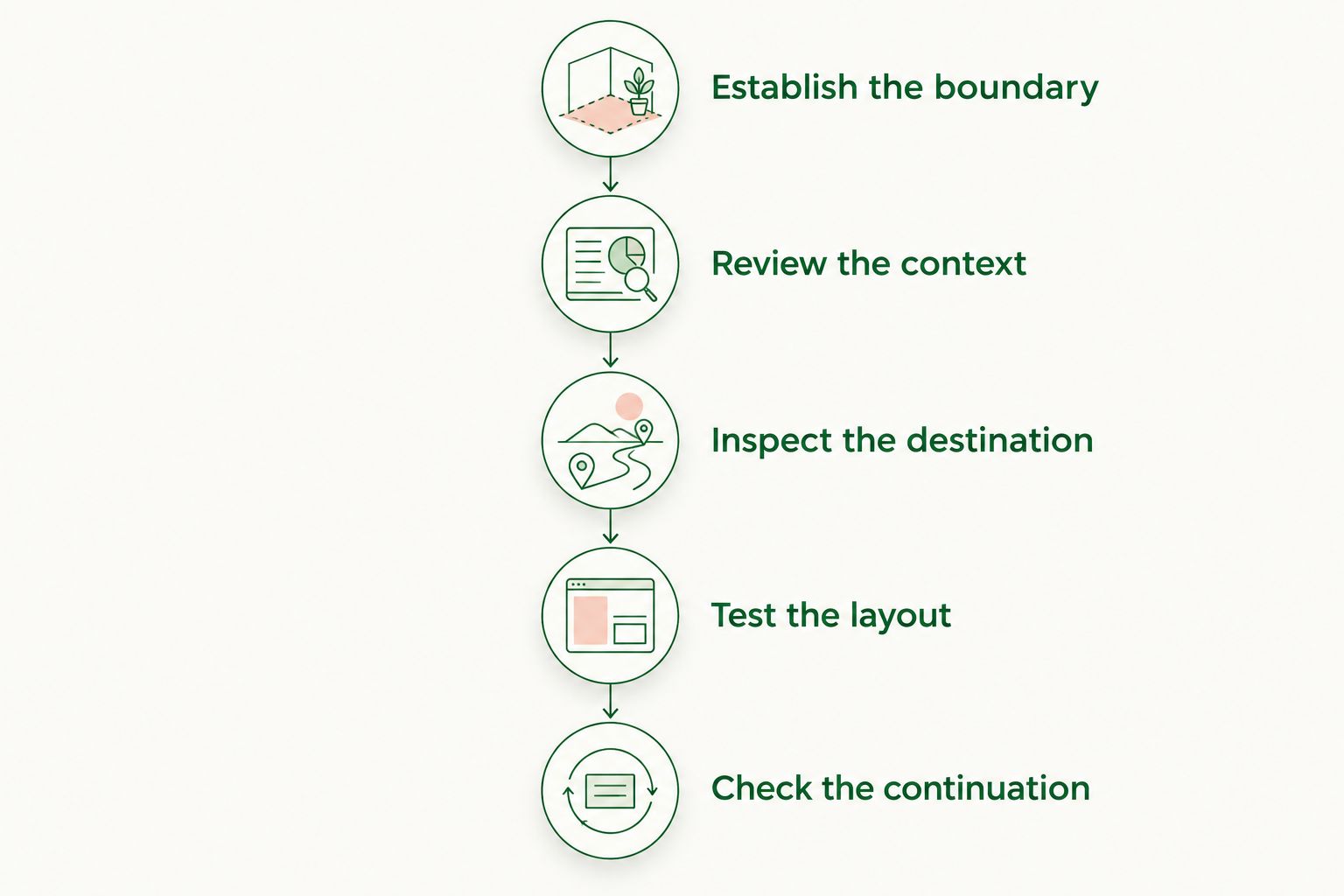
Use a review sequence that keeps the answer and the advertisement independent. Apply it to a full conversation, including the message before the placement and the next user action.
Establish the boundary
Mark the assistant’s answer and the paid placement as separate interface components. Decide which component owns the disclosure, advertiser identity, and outbound action.
Keep the disclosure with the advertisement. A label elsewhere on the page makes the reader reconstruct the relationship between the label and the message.
Review the context
Write down the task the user is trying to complete. Then explain why the proposed commercial message belongs near that task.
If the explanation requires changing the user’s request into something more commercial, reject the placement for that scenario. Contextual advertising should respond to the conversation, not become a reason to redirect it.
Inspect the destination
Check whether the visible message accurately describes the action after the click. A button should not imply that the assistant will perform an action when it actually opens an advertiser’s page.
Keep the advertiser’s claims attributable to the advertiser. Do not rewrite them as independent conclusions from the assistant.
Test the layout
Review at least 2 viewport sizes: a narrow mobile view and a wider desktop view. This is a suggested test scope, not a platform requirement.
Look for clipped labels, overflowing copy, displaced input controls, and unexpected movement when the placement renders. Include a long response so the review covers more than an empty chat window.
Check the continuation
After the placement, ask another question. Confirm that the conversation can continue without requiring interaction with the advertisement.
Also inspect the interface without an ad. Treat the absence of a commercial placement as a normal layout state rather than an error that leaves a broken container.
Where does Elo fit in a developer-owned chat application?
Elo is for developers who want to monetize their own AI chat applications with contextual, conversational ads. Its SDK-based adserver supports applications built on OpenAI, Anthropic, or custom LLMs and lets publishers earn revenue from advertiser spend.
That is a different use case from changing the interface inside ChatGPT itself. Choosing an OpenAI model for your application does not make the application part of ChatGPT.
The fit is specific: Elo conversational ads address publisher monetization inside a developer-owned chat experience. The implementation still needs an interface review covering disclosure, placement boundaries, and conversation continuity; an SDK is not a substitute for those decisions.
For your 2026 implementation plan, define the publishing environment before evaluating the ad component. That prevents a product-selection discussion from becoming a comparison between unrelated interfaces.
Is every brand recommendation in ChatGPT an ad?
A brand recommendation alone does not establish paid placement. Look for an advertising disclosure and distinguish the assistant’s response from any separately presented commercial message.
Do not label an answer as advertising merely because it includes a company, product, or external link. Conversely, a relevant offer remains advertising when it is paid placement.
Does using OpenAI make my chatbot’s ads ChatGPT ads?
Using an OpenAI model does not make a third-party application ChatGPT. Your application has its own interface and publishing decisions, including how it presents advertising.
When describing a screenshot, name the application that displayed the placement. Calling every OpenAI-powered interface ChatGPT obscures who controls the user experience.
Can an ad look native without looking like the assistant’s advice?
A native ad can fit the interface while remaining clearly identified as advertising. Use compatible spacing and typography without removing the commercial boundary.
Native describes presentation, not independence. The advertiser’s message should remain attributable to the advertiser even when the component fits the surrounding design.
FAQ
What do ChatGPT ads look like in 2026?
ChatGPT ads appear as labeled sponsored placements separate from the assistant’s answer. Inspect the disclosure, advertiser identity, promotional message, and destination rather than assuming every placement has identical styling.
How can I tell whether a recommendation is sponsored?
Look for an explicit advertising disclosure attached to the placement. A brand mention or external link alone does not establish that an answer is paid advertising.
Are ads in an OpenAI-powered chatbot the same as ChatGPT ads?
No. A third-party application using an OpenAI model is a separate publishing environment with its own interface decisions.
Should conversational ads look like normal chat messages?
Conversational ads should remain distinguishable from the assistant’s answer. Matching the surrounding typography does not remove the need for a clear commercial boundary.
What should I check before adding ads to my chat application?
Check disclosure, advertiser identity, placement boundaries, destination accuracy, and conversation continuity. Review both narrow and wide layouts, including the interface when no ad appears.
Can Elo help monetize my own AI chat application?
Elo provides an SDK-based adserver for contextual, conversational advertising in developer-owned AI chat applications. It serves applications built on OpenAI, Anthropic, or custom LLMs.
One last thing
Hide the promotional headline during your final design review. Can you still identify the component as advertising, name the advertiser, and distinguish it from the assistant’s answer?
If not, fix the boundary before polishing the copy. That is a practical 2026 acceptance check for your own interface—not a claim about a platform’s required specification.