
Online course platform chatbot monetization is earning revenue from learning conversations with the aim of supporting your platform without compromising instruction. For chatbot monetization for online course platforms in 2026, separate commercial recommendations from tutoring, grading, and learner support before adding subscriptions, affiliate placements, or contextual ads.
- Chatbot monetization for online course platforms starts with protecting instruction, assessments, and learner data.
- Elo fits developers adding contextual, conversational ads to an existing course chatbot.
- Use subscriptions for premium tutoring; test contextual ads separately in eligible resource-discovery conversations.
- Measure revenue per session alongside lesson continuation, not clicks alone.
Why chatbot monetization matters for online course platforms
Your learning assistant sits between instruction and commercial discovery. A learner asking for another explanation needs teaching. A learner asking which equipment supports a course project is making a different request.
Monetize the commercial request, not the learner’s difficulty. That distinction gives you a placement policy your engineering and curriculum teams can implement together.
Start your 2026 plan by deciding which conversations belong inside the learning product and which can support a disclosed commercial placement. If your platform already charges for access, examine running subscriptions and ads together before changing the learner experience.
The constraint is instructional integrity. A sponsor must not influence an assessment, replace required course material, or make an optional purchase look necessary to pass. Your monetization design needs explicit boundaries for each situation.
How to monetize your course chatbot
1. Map learner intent before choosing placements
Start manually. Review a permissioned, appropriately redacted sample of conversations and classify the learner’s immediate goal. Keep this review inside your existing data-access controls; do not export raw transcripts into a monetization spreadsheet.
Use separate categories for concept explanations, assessment help, platform support, resource discovery, and purchase research. The same course can contain all of them. A photography student asking about exposure needs instruction; a student requesting optional equipment suggestions has expressed commercial intent.
Best for initial planning: a manually reviewed intent map. It exposes ambiguous cases before you turn a conversational category into an ad trigger. Its limitation is ongoing review work as your course catalog changes.
Write the policy before implementation:
- Mark tutoring and grading conversations as protected.
- Identify explicit requests for optional tools or resources.
- Separate billing support from purchase discovery.
- Flag age-restricted or sensitive learning contexts for review.
- Record ambiguous examples for curriculum-team decisions.
2. Match the revenue model to the learner’s task
Begin with capabilities you already operate. If your platform has subscriptions, define which chatbot functions belong in that entitlement. If your team manages sponsor relationships, prototype a clearly labeled placement in a test interface before connecting automated delivery.
Best for premium instruction: subscriptions tied to a defined learning benefit. The benefit needs to be clear without making the basic course unusable. Best for commercial resource discovery: disclosed contextual placements. Their limitation is that many teaching conversations should remain ineligible.
Do not present your own course recommendation as third-party advertising. Distinguish platform merchandising, affiliate referrals, and paid sponsor placements in both the interface and reporting.
For the 2026 launch specification:
- Define what the existing enrollment already includes.
- Identify any genuinely additional tutoring entitlement.
- Separate your course promotions from advertiser placements.
- Document how each revenue event is earned.
- Assign an owner to conflicts between sponsors and curriculum.
3. Keep ad delivery separate from instructional answers
Prototype the boundary in your application first. Generate the instructional response without sponsor influence, evaluate placement eligibility, and render any approved commercial content in a separate, labeled component. A static mock placement is enough to test the interface; it does not validate live revenue.
Elo provides an SDK-based adserver for embedding contextual, conversational ads in applications built on OpenAI, Anthropic, or custom LLMs. It offers a route to adding ad delivery rather than building the entire adserver yourself. Your application still needs to enforce its educational boundaries.
Elo is best for developers adding contextual ads to an existing course chatbot. Elo’s conversational ad model addresses ad delivery, not course entitlements, assessment policy, or curriculum governance.
Keep these implementation responsibilities explicit:
- Generate the educational answer independently of sponsorship.
- Evaluate placement eligibility in your application.
- Render sponsored content outside the instructional answer.
- Preserve the answer when an ad request fails.
- Verify SDK behavior against your required privacy controls.
4. Build an eligibility gate around the learning flow
Start with a simple application-side rules table. Avoid asking the answer-generating model to decide whether its own teaching should contain advertising. A separate eligibility decision is easier to inspect and test.
Use a conservative pilot rule: at most 1 ad per eligible session and 0 ads during graded assessments. These are starting settings to test, not industry benchmarks. Apply subscription entitlements and learner restrictions before requesting an ad.
The flow should be explicit: inspect the learner request, apply the eligibility gate, return the instructional answer, and show a sponsored placement only when permitted. Failure at the commercial layer must not block instruction.
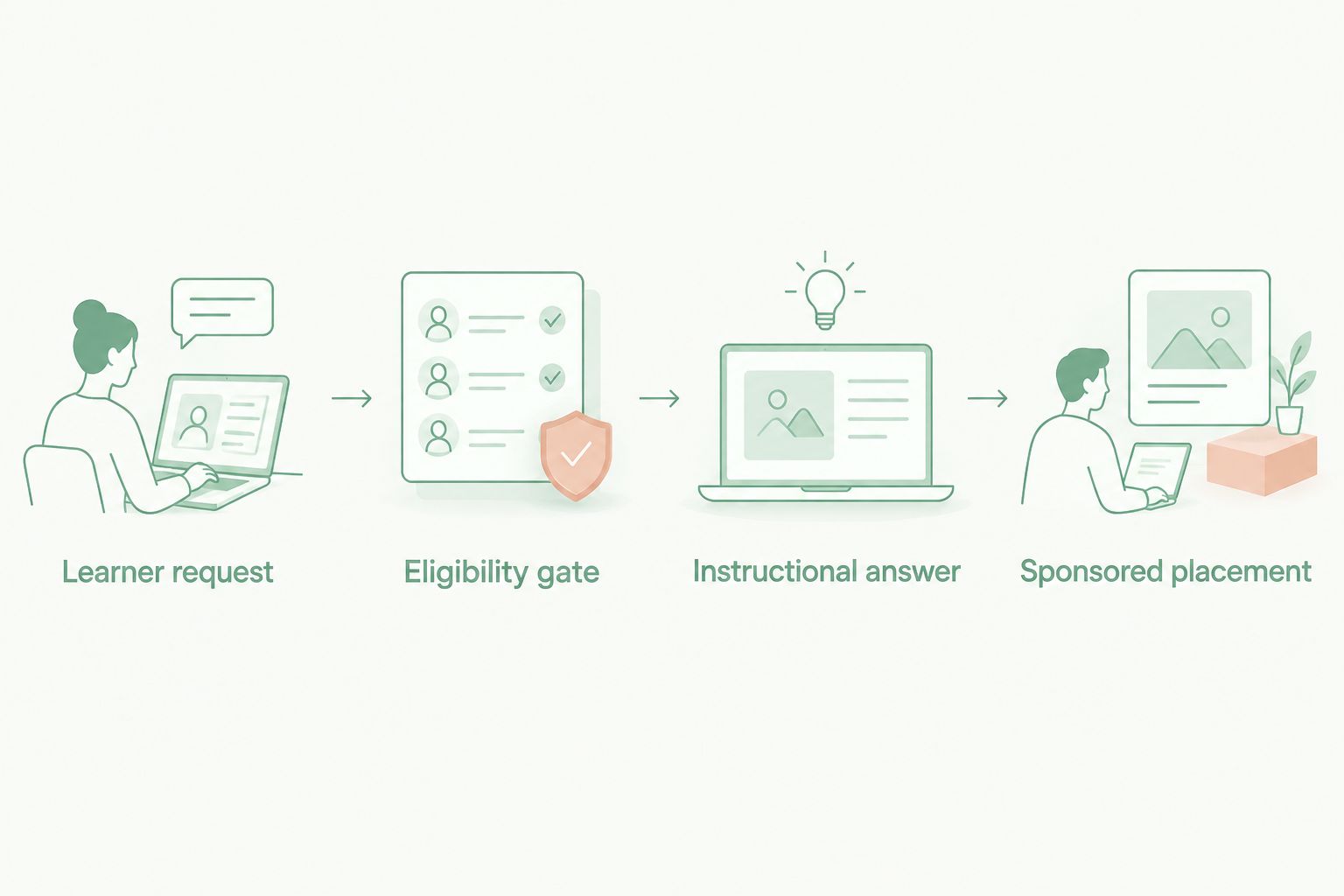
For your 2026 implementation, document where each rule executes. Do not assume an ad SDK knows whether a learner is taking an exam or has an entitlement that excludes ads.
- Learner request: identify the immediate task.
- Eligibility gate: check assessments, entitlements, and restrictions.
- Instructional answer: return teaching without sponsor influence.
- Sponsored placement: render only when policy permits.
- Failure handling: continue normally without an ad.
5. Minimize context and make sponsorship visible
Inspect your proposed ad-request payload manually before sending live traffic. A short topic classification can communicate commercial context without including a learner’s name, grades, uploaded assignment, or full conversation.
Contextual targeting does not, by itself, establish privacy compliance. Review what information leaves your system, why the recipient needs it, how it is retained, and which contractual requirements apply. Treat children’s learning environments and institution-managed deployments as separate review cases.
Best for learner clarity: a separate placement with an explicit advertising label. Its limitation is that labeling alone does not fix inappropriate targeting or an irrelevant recommendation. The eligibility policy still does the substantive work.
Before release:
- Remove direct identifiers from proposed targeting fields.
- Exclude grades, accommodations, and private assignment content.
- Label paid placements clearly as advertising or sponsorship.
- State that an advertised purchase is optional when applicable.
- Review destinations for misleading educational claims.
- Document retention and access rules for ad-event logs.
6. Measure contribution without sacrificing learning
Start with an event log and a spreadsheet. Record eligible sessions, placement requests, rendered impressions, clicks, recognized publisher revenue, and lesson continuation. Separate requests from impressions: requesting an ad does not establish that a learner saw it.
Define session RPM as recognized publisher ad revenue divided by eligible sessions, multiplied by 1,000 sessions. Keep that denominator fixed across reports. An impression-based eCPM is a different measure and cannot substitute for session-level economics.
For your 2026 pilot, compare the ad-enabled experience with a comparable no-ad control. Set the decision criteria before reviewing results. Higher clicks do not establish success if learners stop returning to the lesson.
Track these measures together:
- Eligible-session RPM and recognized publisher revenue.
- Inference and other variable serving expenses.
- Lesson continuation after a sponsored placement.
- Return usage for comparable learner cohorts.
- Ad complaints and accidental-click reports.
- Course conversion separately from advertiser conversion.
Compare monetization options for course chatbots
Choose the model by the learner’s task and your operating capacity. These options are not interchangeable: collecting subscription revenue requires a product entitlement, while advertiser revenue requires an appropriate commercial opportunity.
| Option | Best for | Main advantage | Key limitation |
|---|---|---|---|
| Subscription access | Premium tutoring or clearly defined additional assistance | Connects revenue to an explicit learning entitlement | Requires a benefit distinct from what enrollment already includes |
| Your own course recommendations | Learners explicitly exploring their next course | Keeps the recommendation within your catalog | Does not generate third-party advertiser revenue |
| Affiliate referrals | Requested tools, books, or optional project resources | Connects a referral to a commercial action | Requires disclosure, partner management, and attribution |
| Direct sponsorship | Platforms with an advertiser-sales operation | Lets you negotiate placement and category terms | Adds sales, creative review, and reporting work |
| Elo conversational ads | Developers adding contextual advertising to a course chatbot | Provides an SDK-based adserver for conversational placements | Your platform must still implement educational eligibility and governance |
Start with a model you can explain to a learner in a sentence. If you cannot distinguish paid teaching, optional recommendations, and sponsored content clearly, simplify the offer before introducing another revenue stream.
Subscriptions and contextual ads can coexist as a product design, but your entitlement rules must determine where each applies. Do not silently introduce advertising into an experience your platform has promised will exclude it.
Evaluate conversational ads for your chatbot
Discuss contextual ad delivery alongside your course platform’s eligibility and data requirements.
Common mistakes online course platforms make
Turning learner frustration into a purchase trigger
A student repeatedly asking for an explanation has not requested a commercial recommendation. Selling a tool at that moment blurs the boundary between teaching and advertising.
Fix: suppress commercial placements during unresolved instructional difficulty. Resume eligibility only when the learner makes a distinct, appropriate resource-discovery request.
Letting sponsorship influence academic answers
A sponsored resource should not become the preferred explanation, grading criterion, or required reference because an advertiser paid for placement. Keep the instructional answer grounded in the course’s approved material.
Fix: separate commercial selection from answer generation. Test whether the educational answer remains substantively unchanged when no ad is returned.
Treating every enrolled learner the same
A self-directed adult learner, a learner using an employer-managed account, and a child in a supervised course require different policy review. An enrollment record alone does not establish advertising eligibility.
Fix: resolve account restrictions and institutional commitments before making the ad request. When eligibility is unresolved, return the answer without advertising.
Optimizing clicks instead of learning economics
A placement can generate clicks while diverting a learner away from a project. Click-through rate describes interaction with the ad, not the value of the learning session.
Fix: assess recognized revenue alongside lesson continuation and return usage. Keep course purchases and advertiser conversions in separate reporting fields to avoid confusing their effects.
FAQ
What’s the best chatbot monetization model for an online course platform?
Choose the model that matches the learner’s task: subscriptions for defined premium instruction and disclosed commercial placements for eligible resource discovery. Protect tutoring, assessments, and required course material from sponsor influence.
Can my course chatbot run subscriptions and ads together?
Yes, subscriptions and ads can coexist when your entitlement rules clearly separate the experiences. Apply those rules before requesting an ad, and honor any commitment that a subscription excludes advertising.
Is Elo suitable for an educational chatbot built on OpenAI or Anthropic?
Elo provides an SDK-based adserver for contextual, conversational ads in applications built on OpenAI, Anthropic, or custom LLMs. Your platform still needs to determine which educational conversations are eligible and what context can be shared.
Should a tutoring chatbot show ads during quizzes or exams?
Keep graded assessments outside your advertising pilot. Assessment integrity needs a separate policy from commercial resource discovery, and sponsor content must not influence grading or required answers.
Do contextual ads require sharing an entire learner conversation?
Do not treat full-transcript sharing as the default design. Identify the minimum context needed, then verify that the proposed integration supports your data requirements before sending live requests.
How do I know whether chatbot ads help my course business?
Compare recognized ad revenue and variable serving expenses while monitoring lesson continuation and return usage. Use a comparable no-ad control rather than treating clicks as proof of business value.
What should happen when no relevant ad is returned?
Return the instructional answer without an ad. A missing commercial placement must not delay teaching, create an error, or force an unrelated recommendation into the conversation.
One last thing
The most important monetization test is the no-ad path. Run your 2026 release checks with an empty ad response, an ad-service error, and an ineligible assessment session. In every case, the learner should still receive the intended instructional answer.
That test checks the architecture, not just the interface. If advertising failure breaks teaching, the commercial layer is coupled too tightly to the learning product.


