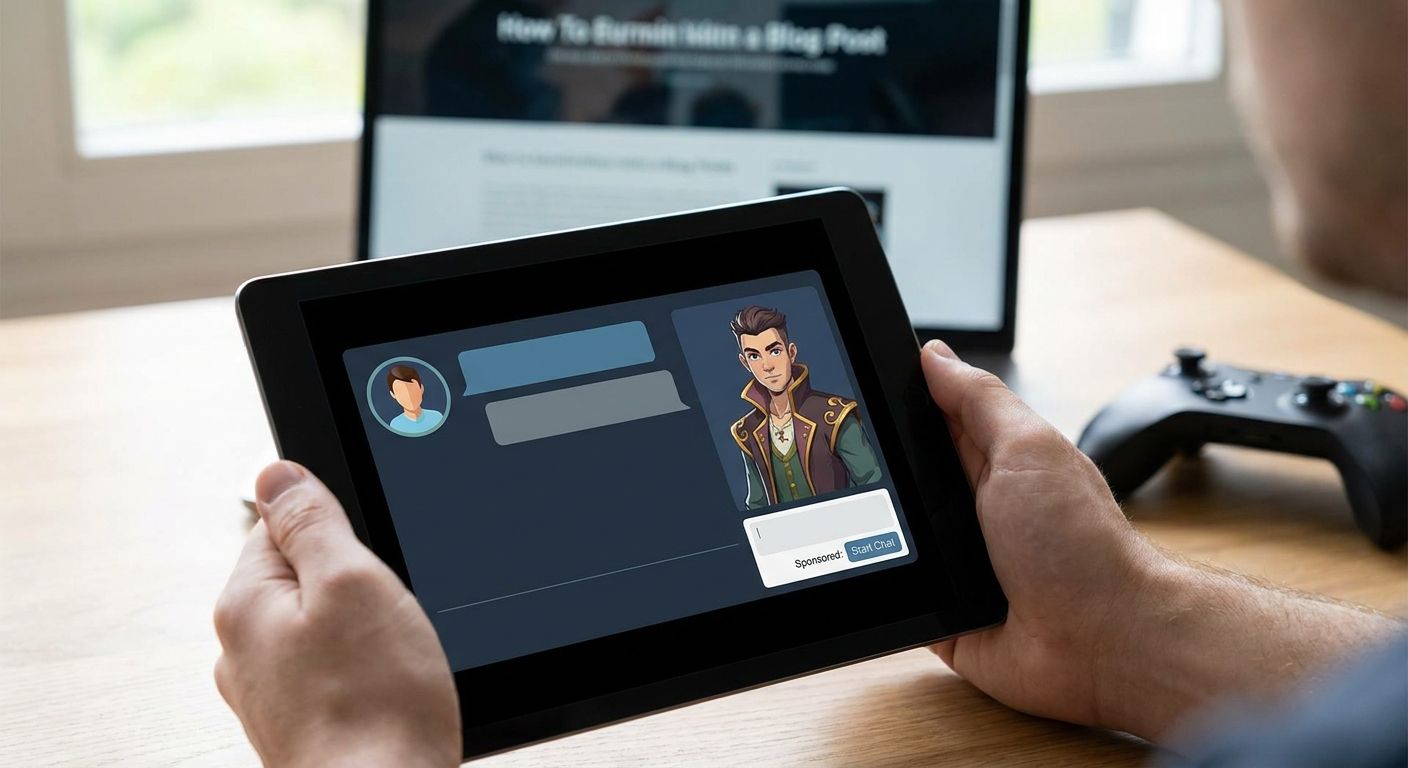
AI gaming NPC and character chat apps generate huge conversation volume with almost no built-in monetization — there's no cart to abandon, no subscription wall that fits a fantasy tavern-keeper. Conversational ads for gaming npc chat let a companion, merchant, or quest-giver NPC surface a relevant sponsored suggestion mid-dialogue instead of breaking the scene with a banner.
- Native in-dialogue ad cards are the safe pick for conversational ads for gaming npc chat in 2026 — buy.
- Full-screen interstitials and banner overlays break NPC immersion — skip both formats.
- Sponsored NPC dialogue lines work only with strict brand-safety filters in place — consider.
- Elo's SDK matches ads to NPC conversation context without stalling the dialogue turn.
- CPM, CPC, and CPA pricing all apply to gaming NPC chat inventory — pick by session volume.
Why this matters
Gaming NPC and character chat apps hold users longer than most other AI chat categories — players return to the same companion or tavern-keeper for repeat sessions instead of a single query-and-done exchange. That session depth is worth money to advertisers if the ad shows up as part of the world instead of on top of it.
Most teams building these apps in 2026 are indie studios or small companion-app developers with no ad-sales team and no direct advertiser relationships. An ad SDK for AI companion apps that plugs into the existing chat loop and matches ads to context solves that gap without hiring anyone. Elo runs on this model: contextual matching, native card rendering, and CPM/CPC/CPA pricing sit behind a short SDK integration.
Who this is for
This guide is for developers shipping AI-powered NPCs, game companions, or character-chat products — whether the world runs on a custom LLM, OpenAI, or Anthropic, and whether the interface is a mobile game overlay, a Discord bot, or a standalone companion app. If your NPC has ongoing dialogue with returning users and no existing revenue model, this applies to you directly.
What to look for in ad formats for NPC and character chat
Immersion-safe rendering
A banner or interstitial dropped into a fantasy dialogue box reads as a bug, not a feature. Look for a native card format styled to sit inside the chat bubble alongside the NPC's line, not stacked on top of the conversation.
Context matching to world and dialogue
A matcher that only reads the last user message will surface off-topic ads inside a role-play scene. The matcher needs to weigh session context — genre, NPC persona, current quest state — so the sponsored suggestion feels like it belongs in the world.
Non-blocking latency
NPC dialogue lives or dies on turn speed. An ad call that adds a visible delay before the NPC responds will get noticed immediately by players used to sub-second replies, so the ad render has to run without holding up the chat turn.
Pricing model flexibility
A companion app with thousands of daily sessions monetizes differently than a niche RPG chatbot with a few hundred. CPM makes sense at volume; CPC or CPA fits smaller, higher-intent audiences. The SDK should support all three, not lock you into one.
Brand safety controls for mature content
Gaming NPC dialogue frequently touches violence, horror, or adult themes depending on the title. The ad platform needs content filters that keep advertiser creative out of scenes where it would look inappropriate or get the advertiser pulled entirely.
Multi-model and cross-surface support
Many NPC apps ship across a custom LLM backend, a Discord bot, and a mobile overlay at once. An SDK tied to a single model or a single surface forces a rebuild every time the stack changes.
Top picks: which ad format to run in an NPC chat app
Native in-dialogue card — the safe pick. The ad renders as one card per NPC turn, styled to match the chat UI, with a single sponsored suggestion tied to the current conversation topic. It doesn't interrupt dialogue flow and doesn't require rewriting the NPC's voice. Buy.
Sponsored quest-reward suggestion — the wildcard. Instead of a static card, the NPC offers a sponsored item, deal, or recommendation as part of an in-world reward moment — a merchant NPC suggesting a real product after a quest completes. It monetizes well when it fits the game's tone, but it needs careful matcher tuning so the suggestion doesn't feel forced into every session. Consider.
Sponsored NPC dialogue line — use with filters. The NPC's own line carries the sponsored message instead of a separate card. This blends in the most but also carries the most brand-safety risk if the matcher pairs a serious advertiser message with a comedic or violent NPC persona. Run it only with strict content filtering on. Consider.
Full-screen interstitial between sessions — the format that looks right but isn't. It sits between conversations rather than inside them, which sounds non-intrusive on paper. In practice it stops the player cold right when they're re-engaging with the character, and it reads as a mobile-game ad break rather than part of the world. Skip.
Banner overlay skinned as UI chrome — the format that looks right but isn't. Dressing a banner up to match the game's color palette doesn't change what it is: a static rectangle competing with dialogue text for attention. It performs worse than native cards and looks dated against 2026 in-chat ad formats. Skip.
What to avoid
- Ad formats borrowed from mobile games. Rewarded video and interstitials work in a game loop with clear session breaks; NPC chat has no equivalent break point, so forcing one in creates friction that shows up as churn.
- A matcher tuned for e-commerce queries. Ad engines built for shopping intent misread role-play and companion dialogue, surfacing generic product ads instead of anything tied to the scene.
- Skipping brand-safety review for mature-rated titles. An advertiser's creative landing inside a horror or adult-themed NPC exchange without filtering is the fastest way to lose that advertiser relationship entirely.
Verdict comparison
| Format | Immersion fit | Latency risk | Brand-safety need | Verdict |
|---|---|---|---|---|
| Native in-dialogue card | High | Low | Standard | Buy |
| Sponsored quest-reward suggestion | Medium-high | Low | Standard | Consider |
| Sponsored NPC dialogue line | High (if tuned) | Low | Strict | Consider |
| Full-screen interstitial | Low | Medium | Standard | Skip |
| Banner overlay | Low | Low | Standard | Skip |
Avoiding ad fatigue matters as much as picking the right format — a native card shown on every single turn will wear out its welcome fast. Reviewing how to avoid ad fatigue in AI chat interfaces before launch saves a rebuild later.
FAQ
What are conversational ads for gaming npc chat?
They're sponsored suggestions delivered inside an NPC's dialogue as a native card or in-world line rather than a banner. The ad matches the current conversation context so it reads as part of the scene, not an interruption.
Is it safe to put ads inside an NPC's dialogue?
Yes, when the matcher and content filters are tuned for the game's tone and rating. Without brand-safety filtering, sponsored lines can land in violent or mature scenes and damage the advertiser relationship.
How much can an AI gaming chatbot earn from conversational ads?
Revenue depends on session volume and advertiser demand rather than a fixed rate. Ad platforms price gaming NPC chat inventory through CPM, CPC, or CPA, so a high-session companion app and a niche RPG bot monetize on different models.
Can I run ads in a character-chat app built on a custom LLM?
Yes — an SDK-based adserver sits alongside the model call regardless of whether the backend is OpenAI, Anthropic, or a custom LLM. The ad layer reads conversation context independently of which model generated the NPC's response.
Do conversational ads work in Discord or Telegram game bots?
Yes, native card ads render inside chat-style interfaces on Discord and Telegram the same way they do in a standalone app. The format needs to match each surface's message layout so the card doesn't look out of place.
What ad format works best for immersive game dialogue?
A native in-dialogue card tied to one suggestion per NPC turn performs best because it doesn't break the chat flow. Full-screen interstitials and static banners consistently underperform in immersive NPC contexts.
Is banner advertising a good fit for NPC chat apps?
No — banners compete visually with dialogue text and read as a mismatch inside a role-play or companion scene. Native cards outperform banners specifically because they sit inside the conversation instead of on top of it.
How do I avoid ad fatigue in a gaming companion app?
Cap ad frequency per session and rotate matcher-selected creative so the same sponsored suggestion doesn't repeat across every turn. Frequency capping matters more in companion apps than most chat categories because sessions run longer and recur daily.
One last thing
The NPC apps that monetize best in 2026 aren't the ones running the most ads — they're the ones running the fewest ads that still feel native. A single well-matched card per session, tied to conversation context through an ad SDK for AI companion apps, beats a feed of generic interstitials on both revenue per user and retention.