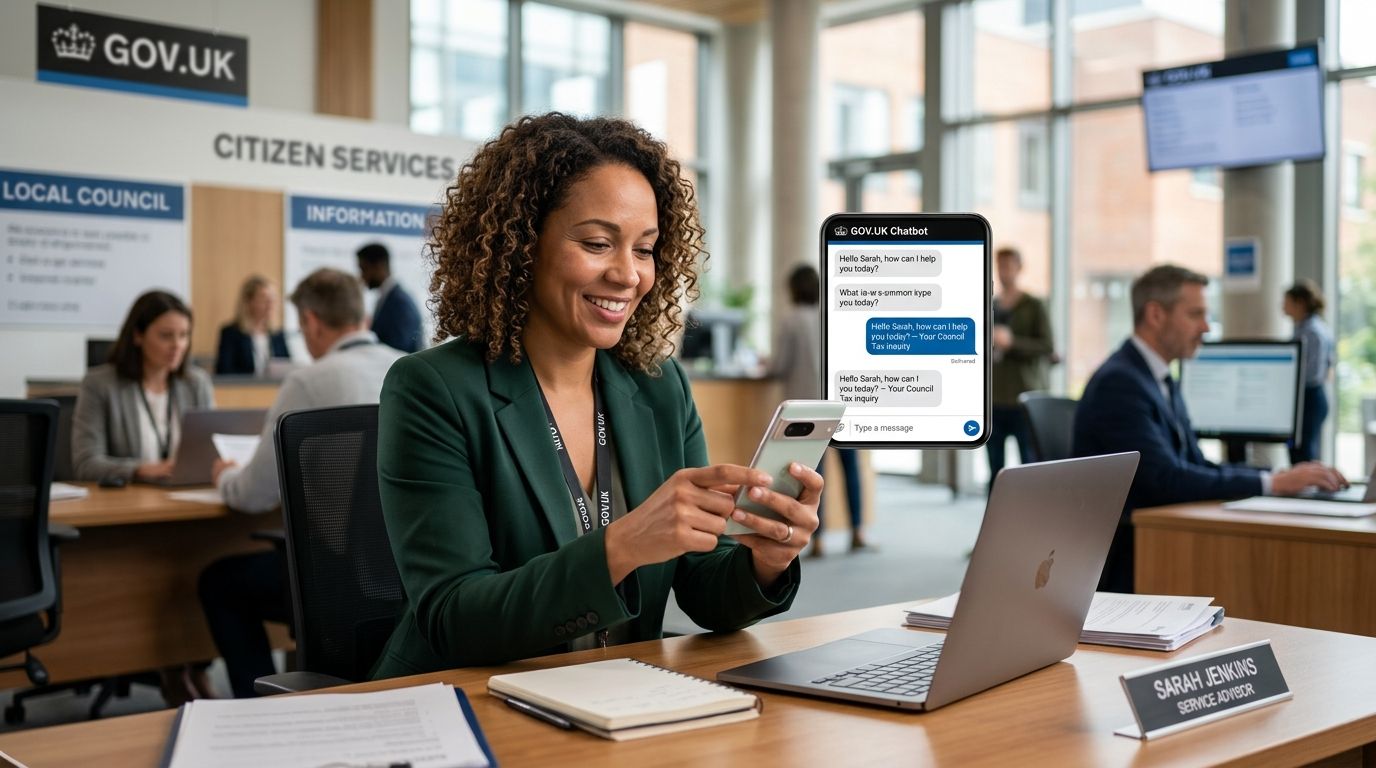
Conversational ads for government chatbots are ad units embedded directly in an AI assistant's chat interface, with the aim of generating incremental revenue for the team that built and maintains the assistant. The catch: most chatbots that citizens interact with are run by an agency itself, and agency-run digital properties are usually built and funded under rules that treat commercial promotion as out of scope entirely.
That distinction is the whole story for this segment. Conversational ads for government chatbots are viable in 2026, but almost never on the official .gov or state-run assistant — the workable segment sits one step removed, in the civic-tech vendors, quasi-governmental authorities, and benefits-navigator apps that serve citizens without being the agency's own branded property. Elo is built to slot into exactly that layer: an SDK that adds contextual, disclosed ad cards to a chat app without touching the underlying government workflow.
- Official agency-run chatbots rarely clear procurement and ethics review for conversational ads for government chatbots in 2026.
- The workable segment is government-adjacent: transit authorities, public benefit navigators, and civic-tech vendors not officially branded as the agency.
- Any ad shown next to a public-service conversation needs a strict brand-safety allowlist and a plain-language disclosure label, no exceptions.
- Elo's SDK adds ad cards without a rebuild, which matters when legal review is the real bottleneck, not engineering.
Why this matters for government chatbots
Citizens use government chatbots to renew a license, check a benefits claim, or find a public service — not to be sold something. That context sets a higher bar than a consumer app. Procurement codes and agency ethics guidance at the federal, state, and local level generally treat an official digital channel as noncommercial by default, which means the ad decision for a true .gov-hosted assistant is usually made before a developer ever opens the SDK docs.
The segment that actually moves in 2026 is one layer removed: contractors and non-profits building citizen-facing tools under contract, public authorities that already operate like enterprises (transit, utilities, public universities), and civic engagement apps that inform without claiming to speak for an agency. For those, conversational ads for government chatbots is a real, if narrow, revenue line — provided the disclosure and brand-safety work happens up front.
Building conversational ads for government chatbots: the step-by-step
Determine which tier of "government chatbot" you actually run
Not every citizen-facing assistant carries the same restrictions. Sort your app before doing anything else:
- Official agency-hosted assistant on a .gov or equivalent domain — treat ads as off the table until legal says otherwise
- Quasi-governmental authority (transit agency, public utility, port authority) — some precedent for sponsorship exists, but review is still required
- Third-party vendor tool delivered under contract, not branded as the agency itself — the most likely candidate for conversational ads
- Non-profit or civic-engagement app (voter guides, benefits calculators) that is adjacent to government but independently run
Route the ad decision through legal and procurement before writing code
Engineering is the fast part. The review cycle is the actual gate for conversational ads for government chatbots, and skipping it is the single most common way teams waste a sprint.
- Confirm whether your contract or charter prohibits commercial endorsement on the platform
- Ask procurement whether ad revenue counts as a conflict with existing funding sources
- Get a written answer, not a verbal one, before scoping the integration
- Loop in whoever owns public communications — they will have an opinion regardless
Restrict the advertiser pool with a strict brand-safety allowlist
Once a tool clears review, the advertiser categories matter more than in almost any other segment. A benefits navigator showing an ad for a payday lender undoes the trust the whole product depends on.
- Build a category allowlist before the first ad ever serves — utilities, insurance, local services tend to clear; political, financial-lending, and health-claims categories usually don't
- Require manual approval for any advertiser new to a public-sector-adjacent placement
- Set a blocklist for competitors of the agency's own referral partners
- Review the allowlist quarterly, not once at launch
This is where an ad SDK earns its place, but only after the first two steps are settled — a brand-safety allowlist with nothing to serve into is just a policy document.
Disclose every sponsored card in plain language
Citizens interacting with a government-adjacent tool assume neutrality by default. A native card that looks like a system response but is actually paid placement is the fastest way to lose that assumption.
- Label every ad card "Sponsored" or "Ad" in the same font weight as surrounding text
- Never phrase a sponsored card as an official recommendation or referral
- Keep the disclosure visible without a hover or tap — one line of text, always on
- Log every disclosed impression so a records request has an answer
Choose a monetization architecture that keeps ads separate from the official record
Government-adjacent tools often get FOIA-style records requests. Ad logic that lives inside the same conversation thread as citizen data creates avoidable exposure.
- Serve ad cards from a separate SDK layer, not baked into the LLM's own response generation
- Keep ad impression logs isolated from any citizen record or case file
- Confirm the ad vendor's data retention terms match your agency's own privacy posture
- Test that disabling ads entirely doesn't break the underlying assistant
Measure revenue without compromising the core service metric
The primary metric for a government-adjacent chatbot is task completion — did the citizen get their answer. Revenue is a secondary number that should never move at the expense of the first one.
- Track task-completion rate before and after ads go live, weekly
- Watch for ad-related drop-off in the specific flows citizens rely on most (benefits checks, license renewals)
- Cap ad frequency per session rather than per message, so one long conversation doesn't get saturated
- Report both numbers to whoever owns the contract, not just revenue
Build a non-ad fallback for the agencies that say no
Most official assistants will get a no on conversational ads, and the vendor needs a plan that doesn't depend on that revenue clearing review.
- Scope the product so ad revenue is additive, not load-bearing, to the business case
- Keep a version of the tool that runs with ads fully disabled for agencies that require it
- Document the compliance posture once so it's reusable across every new agency contract
- Revisit the decision annually — procurement guidance shifts, and 2026's no isn't permanent
Comparing the options for this segment
| Option | Best for | Key limitation | Verdict |
|---|---|---|---|
| Official .gov / state agency chatbot | Citizens needing authoritative answers directly from the agency | Procurement and ethics rules generally bar commercial ads outright | Skip |
| Quasi-governmental authority chatbot (transit, utility, public university) | Agencies that already operate with enterprise-style sponsorship precedent | Still requires case-by-case legal sign-off and carries public-perception risk | Hold pending legal review |
| Third-party civic-tech / benefits-navigator vendor tool, not .gov-branded | Contractors building citizen services under a separate brand | Must disclose the vendor relationship clearly to avoid implying agency endorsement | Buy |
| Non-profit civic engagement app (voter guides, civic education) | Independent organizations informing, not officially representing, government | Advertiser categories must avoid political conflicts of interest | Buy with a strict allowlist |
Common mistakes teams make in this segment
- Treating "government chatbot" as one segment. A city 311 assistant, a state benefits navigator, and a federal agency bot sit under different procurement rules — what clears for one gets rejected for another.
- Building the ad integration before the legal review finishes. Engineering time gets wasted when procurement says no after the SDK is already wired in.
- Using a generic ad network with no category controls near a public-service flow. A single mismatched advertiser category can end the whole program.
- Skipping disclosure because the ad card "looks native." Native design doesn't replace a plain-language label — it makes the lack of one worse.
- Assuming citizen trust doesn't matter because the ad unit is small. Trust in a public-service tool is binary; a single bad placement resets it to zero.
See how the SDK handles disclosure
Review Elo's ad card format before scoping a public-sector-adjacent integration.
FAQ
Can official government chatbots run conversational ads in 2026?
Almost never. Procurement and ethics rules at the federal, state, and local level generally treat an official .gov-hosted assistant as noncommercial by default, so ads are usually off the table before development starts.
What's the best segment for conversational ads for government chatbots?
Third-party civic-tech vendors and benefits-navigator apps that serve citizens under contract, but aren't branded as the agency itself, are the most workable segment in 2026. They still need legal sign-off and a disclosed, brand-safe ad setup.
Is it better to disclose ads or make them look native?
Disclosure wins every time in this segment. A native-looking card without a plain-language 'Sponsored' label risks the entire trust relationship a public-service tool depends on.
How much does it cost to add conversational ads to a government-adjacent chatbot?
Cost depends on the ad SDK and integration scope chosen, so check current terms directly with the vendor rather than relying on a fixed figure.
Do transit authorities and public utilities count as government chatbots for ad purposes?
They sit in a gray zone. Many operate with enterprise-style sponsorship precedent already, but they still need a case-by-case legal review before conversational ads for government chatbots go live.
What advertiser categories should be blocked in a public-sector-adjacent chatbot?
Political advertising, predatory lending, and unverified health claims are the categories most likely to break trust or violate a contract's neutrality requirements. Build the blocklist before the first ad serves.
Does adding ads slow down a government-adjacent chatbot?
Ad cards served through a separate SDK layer shouldn't add meaningful latency to the underlying assistant, but test task-completion speed before and after launch to confirm it in your own environment.
Should ad revenue be part of the core business case for a citizen-services chatbot?
No. Ad revenue should be additive, not load-bearing, since most official agencies will decline ads and the product needs to work without that revenue.
One last thing
The segment that actually converts in 2026 isn't the agency chatbot at all — it's the vendor layer around it. Teams that scope their compliance work once, reuse it across every new government contract, and keep an ads-off version ready for the agencies that say no are the ones still running conversational ads for government chatbots a year from now. The ones that build the ad integration first and ask legal second are the ones pulling it back out.