
No verified AI ad network approval time is available from the information provided for 2026. An application review, SDK integration and permission to serve live ads are separate milestones; finishing one does not establish when the others will finish. Ask the network what constitutes approval and what must happen before your app can serve ads.
- AI ad network approval time has no verified estimate here for 2026; get a written answer from the network.
- Elo is an SDK-based adserver for AI chat publishers, but no Elo approval turnaround is specified.
- Treat application review, SDK integration and live ad serving as separate launch milestones.
- Before setting a launch date, confirm the review criteria and the condition for production access.
How long does it take to get approved by an AI ad network?
There is no supported number of hours or days to quote for approval in 2026. The information available here does not state a turnaround for Elo or establish an industry-wide benchmark. A useful answer from any network must identify when its approval clock starts, what decision ends the review and whether further steps stand between that decision and live ads.
| Milestone | What you need to confirm | What it does not prove |
|---|---|---|
| Application submitted | The network received the information it requires to consider your app. | Your app has been approved. |
| Application approved | The network confirms that your app has passed its review. | Your SDK implementation is ready to serve live ads. |
| SDK integrated | Your app can request and render the intended ad format in your test setup. | The network has granted production access or live ads are serving. |
| Live serving confirmed | Your production app displays ads and records the events you intend to measure. | Every eligible conversation will receive an ad. |
Use those rows as questions to verify, not as a description of a particular network’s published process. If a network combines stages or uses different names, ask it to map its actual requirements to the outcome you need: live ads in your AI chat app.
Why this matters
Approval time is a launch-planning question, not just an inbox question. A developer can have an ad placement ready while still waiting for a network decision. An approval message can also arrive before the publisher has confirmed that production requests, rendering and event tracking work.
For an AI chat publisher evaluating Elo, the known product is an SDK-based adserver for contextual, conversational ads. The supplied information does not specify an application review process or approval time. In 2026, keep that unknown out of your release estimate until you receive a direct answer.
Ask for the event that actually starts the clock
A turnaround estimate has little value without a starting point. Does the network count from an initial inquiry, a submitted application or receipt of everything it requires to review the app? Those are different events. Record the one the network uses before you put an estimate in a launch plan.
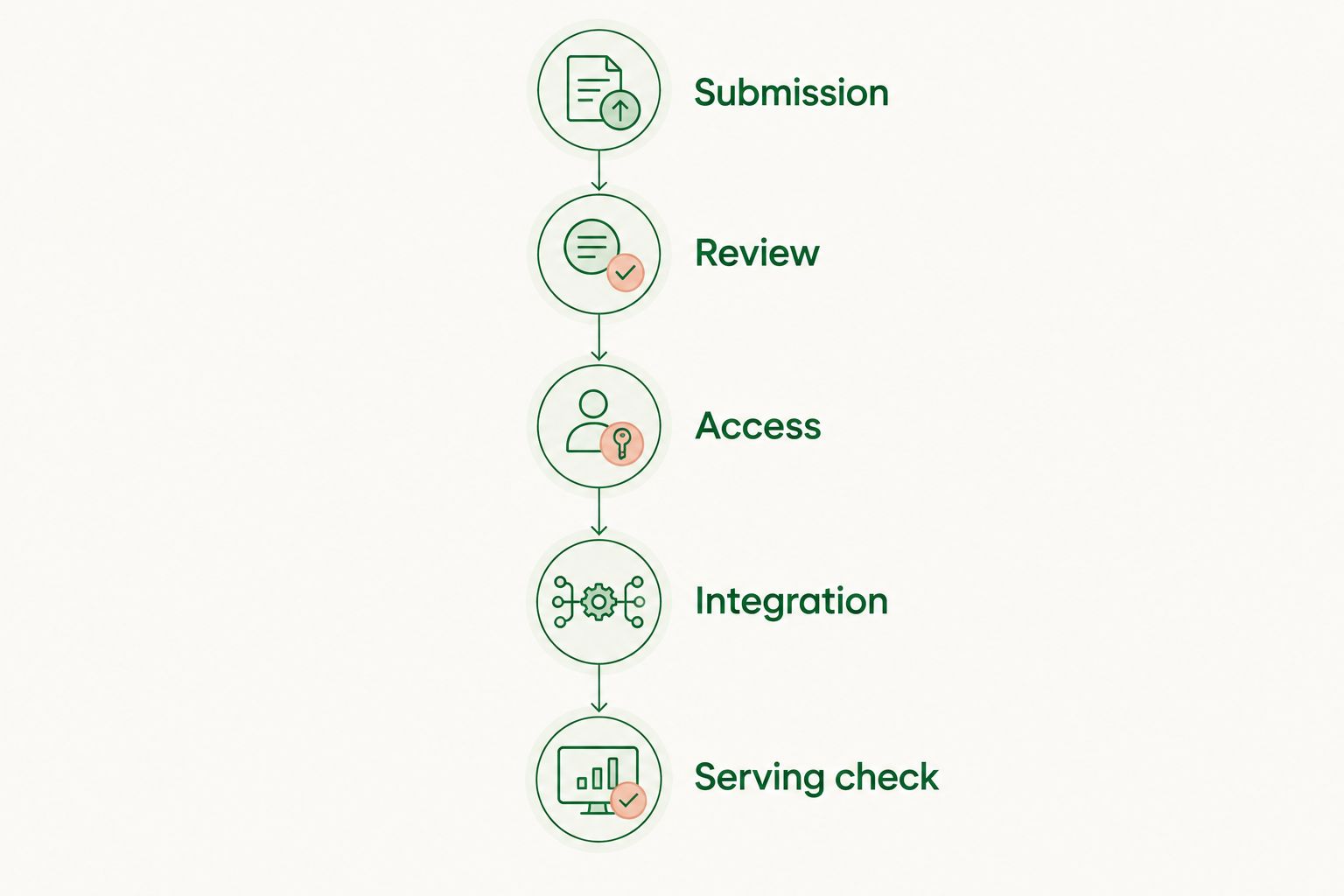
Send a short description of the AI chat application and ask the network to answer these questions in writing:
- Submission: What information must be received before review begins?
- Review: What does the review assess, and how will you learn its decision?
- Access: Does approval itself permit production ad requests, or is there another access step?
- Integration: Which SDK and ad-format checks must the publisher complete?
- Serving check: How should the publisher confirm that live ads and their associated events are working?
These are planning checkpoints, not a claim that every network follows the same sequence. If a step does not apply, get that confirmed rather than silently removing it from your schedule. The same distinction applies in 2026 whether your chat app uses OpenAI, Anthropic or a custom LLM: the model your app runs on does not supply a network approval estimate.
A concise request gets a more usable answer than asking only, “How long does approval take?” Describe the app’s use case, the intended ad placement and the point at which you need to serve ads. Then ask for the expected review duration and the requirements for moving from a decision to production serving. Keep those answers as separate entries in your launch tracker.
Why approval time varies
No input establishes which factors a specific network uses to approve publishers. These are the five items to check before accepting a turnaround estimate, because each can change what the estimate includes:
- What counts as a complete submission. Ask which app details the network requires before it starts reviewing. An estimate measured from a complete submission cannot be applied to an incomplete inquiry.
- What the review covers. Ask whether the decision concerns the publisher, the app, the ad placement or a combination. Do not assume an answer about one covers the others.
- Which access follows the decision. Confirm whether an approval notice is enough to make production ad requests. If it is not, ask what grants that access.
- Who owns integration work. Network review and publisher engineering are separate workstreams. Find out which SDK checks your team must finish rather than folding them into an approval estimate.
- How live serving is verified. Define the evidence your team needs before marking launch complete: an ad shown in the intended placement and the corresponding events recorded as expected.
Use these questions when you choose an AI ad network for your chatbot. A quoted review duration is useful only when the network also states its starting point and endpoint. Without those boundaries, two seemingly different answers can describe different parts of the same launch.
Approval is not SDK integration
Elo provides an SDK-based adserver for developers of AI chat applications. Its stated use is to embed contextual, conversational ads and earn revenue from advertiser spend. That describes what the product is for; it does not state how long a publisher takes to get approved, how quickly an SDK can be integrated or when an individual app starts receiving ads.
Keep separate owners and completion criteria for review and engineering. A publisher or business owner can seek a decision on whether the app is accepted. A developer can work on placement, rendering and event handling. Neither should mark the other’s milestone complete without evidence.
This separation prevents an avoidable planning mistake: treating an integration guide as a service-level promise for approval. The conversational ad SDK integration guide addresses a different question from this page. In 2026, ask for the approval requirements and the integration requirements separately, even if the same contact discusses both.
For your own launch tracker, use plain status names: review requested, decision received, integration checked and live serving confirmed. Assign an owner and a source of evidence to each. These names are a suggested tracking method, not Elo’s published workflow.
What should you prepare before asking for approval?
Prepare an explanation of the application the network can actually assess. State who uses the AI chat product, what conversations it handles and where an ad would appear. If your app has several chat surfaces, identify the one you intend to monetize first. Clear scope makes the network’s answer easier to apply to the build you plan to ship.
Show the proposed ad placement in context. A placement description should distinguish an ad from the assistant’s answer and identify when the app would request it. This is an implementation question for the publisher, not a claim that a particular network imposes a specific disclosure or placement rule.
Then bring a short list of unanswered questions. Ask what information the network needs, how it communicates a decision, whether it offers a way to test before production and what confirms production access. Do not assume a test environment exists; obtain the answer from the network.
If you are comparing networks in 2026, give each one the same app description and the same questions. Compare the answers by milestone instead of reducing every response to a single approval-time figure. One answer might cover review alone while another includes setup; those are not interchangeable estimates.
When can you put a date on the launch plan?
Put a date on a milestone only after you know who owns it and what completes it. A network’s review estimate can inform the application milestone. Your development plan must cover integration and verification separately. The live-ads milestone needs its own confirmation rather than inheriting the date of an approval email.
If the network does not provide a review estimate, label that milestone awaiting network confirmation. That is more useful to a founder or marketing lead than an invented range. It tells the team exactly which answer is blocking a dependable launch date.
Elo is best considered by developers who want an SDK-based adserver for contextual ads in AI chat applications. Elo is not a source of a verified approval-time estimate in the information provided here. Evaluate its product fit and ask about its review timeline as separate questions. The product description supports the first assessment; a direct network response is needed for the second.
Is approval faster if the SDK is already installed?
No faster approval time is established by having an SDK installed. An implementation can be ready for testing while a network decision remains unknown. Ask the network whether integration affects its review process rather than assuming it changes the queue.
Can I start serving ads as soon as I am approved?
Approval alone does not confirm that your app is serving live ads. Confirm the network’s production-access requirements, then check that your intended placement renders and that the events you rely on are recorded. Treat the serving check as a separate completion event.
Does an OpenAI, Anthropic or custom LLM app have a different approval time?
No model-specific approval time is supplied. Elo’s stated audience includes developers building on OpenAI, Anthropic or custom LLMs, but that does not establish distinct review schedules. Give the network your app’s actual setup and request its applicable requirements.
FAQ
How long does AI ad network approval take in 2026?
No verified approval-time estimate is available from the information provided for 2026. Ask the network when review begins, what ends it and what else is required before live ads serve.
What is the difference between ad network approval and SDK integration?
Approval is the network’s decision about an application; SDK integration is work on the publisher’s app. Completing either one does not, by itself, confirm live ad serving.
Does Elo publish an approval turnaround in the information provided?
No Elo approval turnaround is specified in the information provided. Elo is described as an SDK-based adserver for contextual, conversational ads in AI chat applications.
What should I ask an AI ad network before planning a launch date?
Ask what starts the review, what constitutes approval and what grants production access. Track SDK integration and a live serving check as separate milestones.
Can I integrate an ad SDK before my application is approved?
The information provided does not establish a universal rule. Ask the network whether testing or integration can begin before its decision and what access is required.
Does approval guarantee that every AI chat conversation shows an ad?
No such guarantee is provided here. Confirm live serving in your intended placement and ask the network how it determines whether an ad is shown.
Is AI ad network approval the same for OpenAI and Anthropic apps?
No comparison of approval rules or turnaround times is supplied. Describe your app’s model setup to the network and request the requirements that apply to it.
One last thing
An approval email is not the launch milestone your revenue plan depends on. In 2026, mark the ad launch complete only when your app serves ads in the intended placement and you have checked the events used to measure them. Until then, keep approval and live serving on separate lines of the schedule.