An AI chatbot starts earning ad revenue when a live ad produces a billable event under the advertiser's payment model—not when you install the SDK. For your 2026 launch, separate first earnings, reported revenue, and cash payout: a served ad does not prove that all three have happened.
- Time to see ad revenue AI chatbot: track the first accepted billable event, not SDK installation.
- Elo provides an SDK-based adserver for developers monetizing AI chat conversations with contextual ads.
- CPM, CPC, and CPA depend on different events: impressions, clicks, and qualifying actions.
- Reported earnings and cash payout are separate milestones. Verify both before forecasting cash flow.
How long until an AI chatbot sees revenue after adding ads?
The revenue clock starts with eligible live activity, not deployment. Your implementation must connect a real conversation to an ad opportunity, deliver an ad, and record the event that the payment model requires.
Use this sequence to establish what has actually happened:
- Live request: Your production chatbot sends an eligible ad request. A successful SDK initialization alone does not establish this.
- Ad response: The adserver returns an ad for the opportunity. An empty response is not an earned impression.
- Visible placement: Your interface renders the ad. Receiving creative and displaying it are different events.
- Billable event: The required impression, click, or qualifying action occurs and meets the applicable rules.
- Revenue reporting: The provider records earnings against the accepted event. Check whether the amount is estimated or finalized.
- Cash payout: The earnings meet the provider's payment conditions and reach your payout destination.
These are checkpoints, not promised durations. Timestamp each checkpoint in your 2026 launch records so you can identify the actual delay instead of assigning the entire wait to the SDK.
Why this matters
A chatbot can show an ad without earning from that display. Under click-based billing, the impression alone is not the paid event; under action-based billing, even a click is not enough.
Elo is for AI chat developers who want SDK-based contextual ad monetization. Elo provides an adserver for applications built on OpenAI, Anthropic, or custom LLMs. That describes the integration's purpose, not a guaranteed time to first earnings.
The distinction matters to your launch decision. You need evidence that the monetization path works before treating ad revenue as funding for inference, hosting, or product development. A deployment log answers a technical question; accepted earnings answer a commercial one.
CPM: revenue depends on billable impressions
CPM means cost per 1,000 impressions. For a CPM arrangement, the relevant milestone is an impression that qualifies for billing under the applicable measurement rules.
Do not equate an ad request with an impression. A request can return no ad, and an ad response can fail to render. Your implementation needs to distinguish those outcomes before you attribute a revenue delay to advertiser demand.
CPM is best for understanding impression-based monetization. Its advantage is that a user purchase is not the required billing event; its limitation is that impressions still need to qualify, and the publisher's share depends on the arrangement.
CPC: revenue depends on billable clicks
CPC means cost per click. For a CPC arrangement, the relevant milestone is an accepted click—not simply a visible ad card.
Check that the ad's click behavior works in your actual chat interface. A card that looks correct but has a broken destination or missing event handler does not establish a working monetization path.
CPC is best for evaluating click-based monetization. Its advantage is that earnings connect to an interaction; its limitation is that a displayed ad without an accepted click does not create click-based revenue.
CPA: revenue depends on qualifying actions
CPA means cost per action or acquisition, depending on the agreement. The relevant milestone is the specific advertiser-defined action that qualifies for payment.
Confirm the action definition before interpreting results. A user leaving your chatbot is not proof that the advertiser's required action occurred, and an action occurring is not proof that attribution was accepted.
CPA is best for evaluating outcome-based monetization. Its advantage is a connection to a defined advertiser outcome; its limitation is the additional dependency on action completion and attribution after the user interacts with the ad.
| Payment model | Best for | Revenue milestone | Advantage | Limitation |
|---|---|---|---|---|
| CPM | Impression-based monetization | Accepted billable impression | No purchase required by the billing model | Requests and renders are not automatically billable |
| CPC | Click-based monetization | Accepted billable click | Connects earnings to an interaction | Impressions alone do not earn click-based revenue |
| CPA | Outcome-based monetization | Accepted qualifying action | Connects earnings to a defined outcome | Requires action completion and accepted attribution |
Do not assume your provider offers every model in this table. Use the model in your actual agreement to define what “first revenue” means.
Why time to first ad revenue varies
Your chatbot's revenue timeline follows its event chain. These factors explain what to inspect, not how many days to promise:
- Integration state: Requests must originate from the live application and reach the intended ad-serving environment.
- Eligible conversation activity: Users must reach placements where your application permits an ad request. Total messages are not automatically ad opportunities.
- Contextual matching: An eligible request needs a matching ad response. Contextual monetization connects the conversation's subject to an advertiser's offer.
- Rendering and measurement: The creative must display correctly, and the relevant event must be recorded according to the integration's requirements.
- Payment model: Impression, click, and action-based arrangements require different evidence before an event produces earnings.
- Reporting and payment rules: Recorded earnings, finalized earnings, and cash payout follow distinct conditions. Verify them separately.
For Elo contextual ad monetization, the stated product fit is an SDK-based connection between AI chat applications and advertiser spend. The trade-off is the work required to integrate ads into your conversation flow and validate measurement. An SDK does not replace that validation.
How do you find the step delaying revenue?
Inspect the first missing event in the chain. If requests never leave the application, advertiser matching is not yet the issue. If ads render but no billable event occurs, another deployment does not resolve the payment-model dependency.
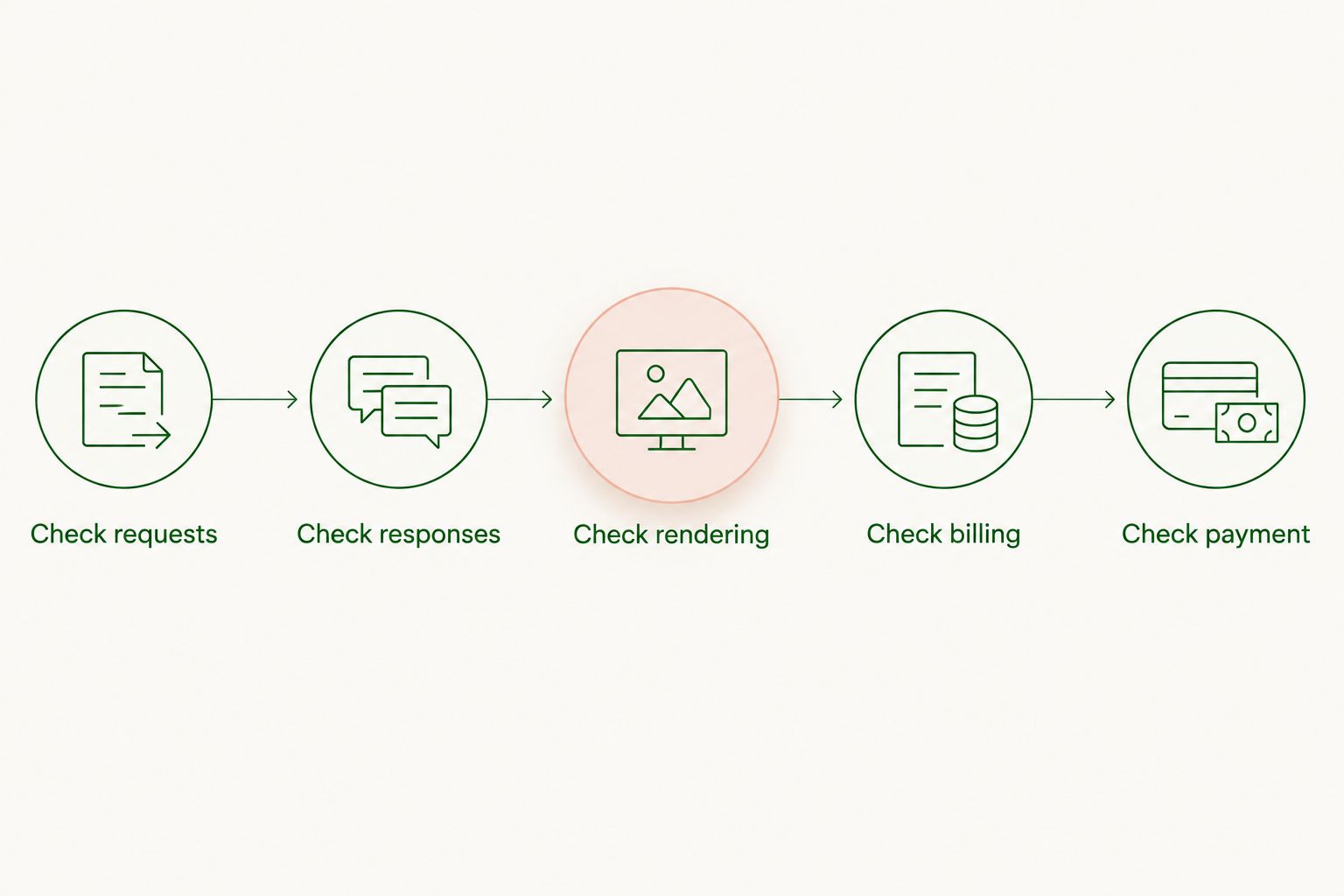
Follow this diagnostic path:
Check requests
Confirm that production conversations reach the intended request point. Record a request identifier, environment, and timestamp without unnecessarily copying conversation content into logs.
Keep development activity separate from production activity. A successful test proves that a code path executes; it does not prove that a live advertiser has incurred a billable event.
Check responses
Separate ad responses, empty responses, and request errors. These outcomes answer different questions and should not share a generic success counter.
If requests succeed but return no creative, inspect the response and eligibility information available from your provider. Do not diagnose a rendering failure when there is nothing to render.
Check rendering
Confirm that the returned creative appears in the intended placement. Inspect the real interface, including the states where users stop reading, close the conversation, or move to another view.
Record rendering independently from request completion. That distinction tells you whether an apparent monetization gap sits in ad delivery or your application's display logic.
Check billing
Identify the event the agreement pays for. Then verify whether the provider accepted that event and associated it with revenue.
Keep clicks, qualifying actions, and earnings as separate records. Combining them into one conversion counter hides the point where attribution or billing stopped.
Check payment
Read the payout conditions independently of event reporting. Confirm the payment schedule, any threshold, account requirements, and the status of the earnings being paid.
A revenue entry is evidence of recorded earnings, not evidence of a bank transfer. Use separate timestamps for both milestones in your 2026 cash-flow planning.
What should you validate before launching ads?
Your launch test should establish event continuity, not just show a sample card. Use the ad SDK integration testing guide to organize the implementation checks.
Start with the normal path: eligible conversation, request, response, placement, and the required event. Then inspect failure paths. An empty ad response should not interrupt the assistant's answer, and a failed request should not leave a broken placement in the conversation.
Keep sponsorship recognizable. Your assistant's answer and the advertiser's message serve different purposes; presenting paid content as independent advice creates a trust problem unrelated to reporting speed.
Before enabling a broader rollout, document:
- Where the application requests an ad.
- Which environment receives the request.
- How the interface handles an empty response.
- Which event triggers measurement.
- Which accepted event triggers earnings.
- Where your team verifies payout status.
This record gives engineering and finance the same definition of success. Without it, one team can report “ads are live” while another still has no evidence of earnings.
Does first revenue mean the chatbot is profitable?
First revenue proves monetization activity, not profitability. Compare accepted publisher earnings with the costs associated with serving the same traffic, including inference and hosting.
Use matched denominators. An impression-based revenue metric and a session-based cost metric cannot be compared directly without connecting impressions to sessions.
For your 2026 measurement plan, define the units explicitly:
- CPM: Advertiser cost per 1,000 impressions. It is not automatically the publisher's retained earnings.
- eCPM: Earnings expressed per 1,000 impressions. State which earnings and impressions your calculation includes.
- Session RPM: Publisher revenue per 1,000 sessions, when sessions are your chosen denominator. Label it accordingly rather than using an undefined RPM.
Do not project sustainable revenue from the first accepted event alone. That event establishes that the path works; it does not establish repeatable demand, consistent earnings, or coverage of operating costs.
Can you earn before a user purchases anything?
Yes, an impression-based or click-based arrangement does not require a purchase as its billing event. An action-based arrangement requires the specified action, which must be defined in the agreement.
This distinction prevents a common reporting error: waiting for a sale when the commercial model pays for impressions, or counting impressions as revenue when the model pays for actions. Measure the event you are paid for.
Should you wait for payout before evaluating the integration?
No. Evaluate technical delivery and accepted earnings before evaluating cash receipt, because they establish different outcomes.
A working integration sends requests, renders responses, and records the required events. A working revenue path adds accepted earnings; a completed payment path adds payout. Keep all three statuses visible rather than assigning one overall launch status.
FAQ
How long does it take an AI chatbot to earn money after adding ads?
An AI chatbot earns when a live event qualifies for payment under its ad agreement, not merely when the SDK is installed. The required event is an impression, click, or defined action, depending on the model.
Will my chatbot earn revenue as soon as an ad appears?
An ad appearing does not automatically establish revenue. An impression-based arrangement requires a qualifying impression, while click-based and action-based arrangements require their respective events.
Does a test ad count as my first ad revenue?
A test ad demonstrates delivery, not earned revenue by itself. Confirm that an eligible live event was accepted and assigned earnings before recording first revenue.
Why can I see ad requests but no earnings?
Ad requests are not billable events by themselves. Check for an ad response, successful rendering, the required impression or interaction, and accepted billing.
Is reported ad revenue the same as cash payout?
Reported ad revenue is not the same as cash payout. Verify the earnings status and the provider's payment conditions separately.
What does Elo do for AI chatbot developers?
Elo provides an SDK-based adserver for embedding contextual, conversational ads in AI chat applications. It serves developers building on OpenAI, Anthropic, or custom LLMs.
What should I measure when launching chatbot ads in 2026?
For a 2026 launch, measure live requests, ad responses, rendering, accepted billable events, recorded earnings, and payout separately. Timestamp the stages so you can locate the first missing event.
One last thing
Start your revenue timer at the first eligible production request, not the code merge. Keep the deployment timestamp too, but use it to measure implementation readiness rather than advertiser-funded activity.
For your 2026 launch report, show the timestamps for the first accepted billable event, first recorded earnings, and first payout separately. That record answers the original question without confusing installation, monetization, and cash collection.