
Yes—ad-supported monetization is viable for enterprise chatbots when the enterprise approves the placement, the workflow has relevant commercial intent, and measured publisher revenue exceeds the added operating costs. In 2026, treat ads as a controlled monetization option for approved, customer-facing conversations—not a default for employee workflows, confidential exchanges, or support tasks where an offer would distract from resolution.
- Enterprise chatbot ads belong in approved commercial workflows, not every conversation.
- Elo is best suited to developers seeking SDK-based contextual ads for AI chat applications.
- An ad supported monetization enterprise chatbot pilot must measure net revenue and task completion together.
- Keep sponsored placements separate from generated answers and exclude confidential tenant context.
Is ad-supported monetization viable for enterprise chatbots?
Yes, for approved commercial workflows; no, as a blanket policy across an enterprise deployment. The decision depends on what the chatbot does, which information it handles, and whether the enterprise customer accepts third-party advertising.
Enterprise describes the buyer, not the conversation. A public product-discovery assistant and an internal incident-response assistant need different monetization rules, even when the same company operates both.
The guide to launching an ad-supported AI chatbot covers the launch decision. For enterprise deployments, start by separating eligible conversations from prohibited ones.
| Deployment option | Best for | Advantage | Limitation | Recommendation |
|---|---|---|---|---|
| Public commercial assistant | Approved product or service discovery | A sponsored offer can address an explicit purchasing task | Relevance alone does not establish permission or profitability | Test within approved topics |
| Customer-support assistant | Optional discovery after the support task is resolved | Separates service delivery from commercial offers | An offer during an unresolved problem competes with the user's task | Keep resolution ad-free |
| Internal employee assistant | Confidential knowledge and operational workflows | An ad-free design avoids third-party commercial interruptions | It does not generate external advertising revenue | Keep third-party ads off |
| Mixed enterprise deployment | Platforms serving tenants with different requirements | Tenant-specific eligibility preserves customer choice | Policy enforcement and reporting require additional engineering | Enable only for approved tenants |
These are deployment recommendations, not earnings forecasts. A technically valid ad integration is not proof of a viable enterprise business model.
Why this matters
An enterprise chatbot has obligations beyond producing an answer. It must serve the contracted workflow, respect the customer's data boundaries, and preserve the distinction between assistance and sponsorship.
An ad can be relevant and still be inappropriate. A procurement question invites commercial options; a confidential procurement document does not automatically authorize its contents to become advertising context.
For your 2026 monetization plan, define success as positive net contribution without unacceptable changes to task completion, customer acceptance, or data handling. Ad revenue alone cannot answer that question.
Public commercial assistants: test approved intent
Best for: customer-facing discovery where users explicitly seek products or services. Start with a narrow topic that the enterprise customer has approved for sponsored placements.
The advantage is contextual fit. A conversation about selecting a business tool creates a clearer commercial placement opportunity than a conversation about resolving an account-access failure.
The limitation is permission. A useful offer still needs an approved placement, clear disclosure, and a context payload that excludes information the advertiser does not need.
Do not treat every mention of a product category as purchasing intent. Your application should distinguish discovery from complaints, troubleshooting, and discussions of confidential business plans.
Recommendation: test a defined discovery workflow, not the entire public chatbot. Document its eligible topics and exclusion rules before sending ad requests.
Customer-support assistants: resolve first
Best for: optional commercial discovery after the original support task is complete. The support answer must stand on its own, without requiring the user to view or select an advertisement.
This placement separates the service obligation from the offer. It also gives your team a concrete event to use when deciding whether a conversation becomes eligible.
The drawback is a smaller eligible inventory pool. Excluding unresolved complaints, billing disputes, and troubleshooting means total support traffic is not equivalent to monetizable traffic.
For a 2026 support pilot, measure resolution and escalation alongside advertising results. A revenue increase does not justify a deployment that sends more users back into the support queue.
Recommendation: keep the resolution path ad-free and test only separately approved post-resolution discovery.
Internal employee assistants: keep third-party ads off
Best for: internal knowledge retrieval, confidential analysis, and operational assistance. An employee asking about an incident, a personnel issue, or an internal document is performing a work task—not requesting a sponsored recommendation.
The advantage of an ad-free design is a simpler commercial boundary. The assistant remains focused on the employer's workflow rather than an external advertiser's objective.
The limitation is straightforward: this deployment does not earn third-party advertising revenue. Evaluate its business case through the service it delivers instead of trying to monetize every exchange.
Internal announcements and employer-selected resources are a separate design question. Do not classify them as external ad revenue unless an advertiser-funded arrangement actually exists.
Recommendation: exclude internal employee workflows from the initial advertising rollout.
Why enterprise chatbot ad viability varies
Enterprise approval, contextual relevance, and publisher economics determine whether a deployment deserves a pilot. Use these factors to define the scope:
- Workflow purpose: commercial discovery supports a different placement decision from incident response or confidential document analysis.
- Customer permission: enterprise buyers need to approve whether their deployment carries third-party ads.
- Context exposure: contextual matching requires a deliberate boundary around the information sent outside the application.
- Eligible inventory: only approved conversations and placements belong in the revenue denominator.
- Operating economics: compare publisher receipts with inference, serving, engineering, and ongoing operational costs.
- User outcomes: measure whether the sponsored placement changes task completion, abandonment, or support escalation.
Keep these decisions separate. Customer permission does not establish data permission, and contextual relevance does not establish positive contribution.
How do you test enterprise chatbot ads before rollout?
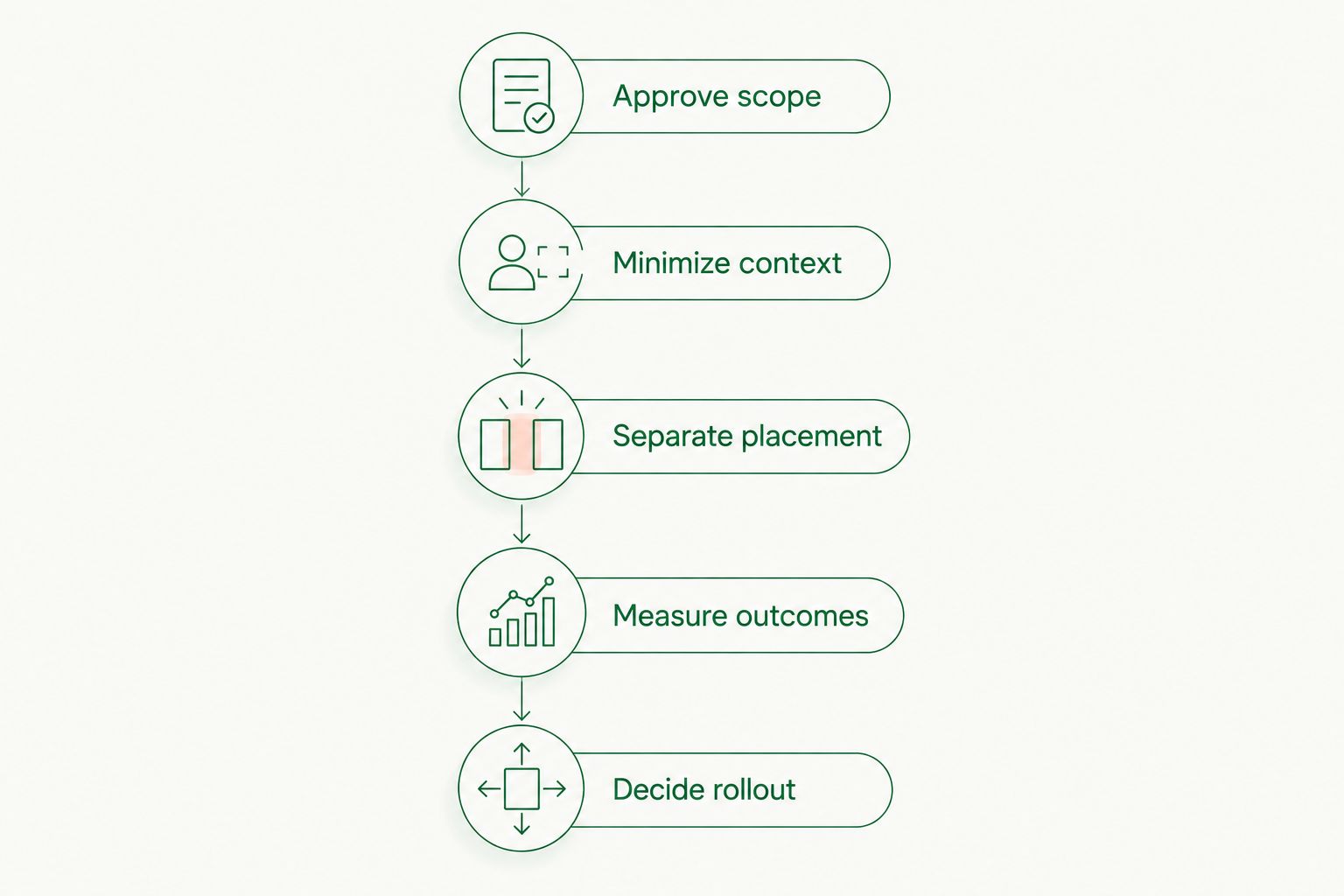
Use a gated pilot in 2026. The sequence is approval, data review, placement design, measurement, and a rollout decision—not SDK installation followed by a revenue target.
1. Approve scope
Name the tenant, workflow, eligible topics, and excluded topics. Identify who can authorize advertising and who can disable it.
Make the approval specific enough to implement. An instruction to show only relevant ads leaves unresolved questions about confidential context, competitor offers, and conversations that change topic midway through a session.
2. Minimize context
Inspect the proposed ad-request payload. Remove credentials, personal identifiers, tenant documents, and other information that is unnecessary for the approved placement.
Prefer an approved category or intent signal where it is sufficient. Contextual advertising still involves data handling; the word contextual does not remove that responsibility.
3. Separate placement
Render the sponsored offer separately from the assistant's answer, with a visible sponsorship label. Do not let advertiser copy become the source of truth for factual assistance.
Design an empty-ad response as a normal state. The chatbot should complete the user's task whether an eligible offer is returned or not.
4. Measure outcomes
Compare an ad-enabled cohort with an ad-free cohort using the same eligibility rules. Track publisher receipts, incremental operating costs, task completion, abandonment, and escalations.
Record placement events separately from answer events. A conversation that generated a response is not automatically a conversation that displayed an ad.
5. Decide rollout
Define acceptance criteria before reading the results. Expand only when the approved workflow meets the enterprise customer's requirements and your net-contribution test.
Keep a disable path independent of the answer pipeline. If the advertising component fails or a tenant withdraws permission, the assistant should still serve its core workflow.
Which numbers determine whether the pilot works?
Use your actual publisher receipts and application costs. Do not substitute advertiser spend for the amount your application receives, and do not count all chatbot traffic as eligible inventory.
Conversation RPM is publisher ad revenue per 1,000 conversations. State whether the denominator includes all conversations or only eligible conversations; otherwise comparisons hide differences in policy scope.
Impression eCPM is publisher ad revenue per 1,000 recorded ad impressions. Define the impression event before calculating it so requested ads and rendered ads do not get mixed together.
Contribution per 1 eligible conversation is attributable publisher revenue minus attributable operating costs, divided by eligible conversations. Report the cost assumptions with the result, including whether engineering and operational work are included.
| Metric | What it answers | What it does not establish |
|---|---|---|
| Conversation RPM | How much revenue the stated conversation pool produces | Whether excluded workflows could earn the same amount |
| Impression eCPM | How much recorded ad inventory earns | Whether the application is profitable |
| Eligible-conversation share | How much traffic passes enterprise policy checks | Whether advertiser demand matches that traffic |
| Net contribution | Whether receipts exceed the included costs | Whether users accept the placement |
| Task completion | Whether users finish the intended workflow | Whether the ad integration meets data requirements |
For 2026 reporting, keep the eligibility definition beside each result. A change in tenant policy can change the denominator without any change in ad performance.
Approve expansion on net contribution and workflow outcomes together. Do not use clicks as a substitute for either.
Where does an SDK-based adserver fit?
Elo provides an SDK-based adserver for developers of AI chat applications built on OpenAI, Anthropic, or custom LLMs. It lets developers embed contextual, conversational ads and earn revenue from advertiser spend.
Elo is best suited to developers seeking SDK-based contextual ads for AI chat applications. That describes its stated function, not an enterprise-security certification or a revenue guarantee.
The benefit of the Elo adserver is a defined route for adding contextual advertising to a chat application. The boundary is equally important: your enterprise deployment still needs approved context handling, placement rules, and measured economics.
For an Elo chatbot-ad integration, review the actual request payload, rendering behavior, reporting definitions, and contractual terms before approval. Treat required controls as acceptance criteria, not assumed features.
Can enterprise chatbots combine subscriptions and ads?
Yes, subscriptions and ads can be designed as separate monetization paths. Define advertising eligibility by the customer's agreement and the workflow, rather than assuming that every unpaid session should display an offer.
The advantage is flexibility across deployments. The drawback is additional entitlement and policy logic, especially when tenants have different advertising permissions.
Does contextual matching make enterprise chatbot ads safe?
No, contextual matching does not by itself establish acceptable data handling. Review what leaves the application, why it is needed, who receives it, and how the relevant terms govern its use.
Keep sensitive retrieved material out of the ad context unless its use has been explicitly reviewed and authorized. Relevance is not permission.
Can ads pay for enterprise chatbot inference?
Ads cover inference only when actual attributable publisher revenue exceeds actual inference costs for the measured scope. Covering inference alone does not establish profitability because serving, engineering, and ongoing operations also belong in the business case.
Measure the approved inventory pool. A forecast built on every enterprise conversation overstates the opportunity when policy excludes part of that traffic.
FAQ
Is ad-supported monetization viable for enterprise chatbots in 2026?
Yes, ad-supported monetization is viable for approved enterprise workflows when measured publisher revenue exceeds attributable costs and user outcomes meet the customer's requirements. It should not be the default for confidential or internal conversations.
What's the best enterprise chatbot workflow for testing ads?
Approved, customer-facing commercial discovery is the clearest starting point. Limit the pilot to explicit product or service discovery rather than enabling ads across every conversation.
Should an internal employee chatbot show third-party ads?
Keep third-party ads off internal employee workflows in the initial rollout. Evaluate those assistants through their work-related value rather than external advertising revenue.
Can a chatbot show ads without sending entire conversations?
Design the ad-request payload to use only the context needed for the approved placement. Confirm the integration accepts that payload and exclude unnecessary identifiers, credentials, and confidential documents.
How should an enterprise chatbot label sponsored recommendations?
Show a visible sponsorship label and keep the placement separate from the generated answer. The user should be able to complete the task without interacting with the offer.
What should happen when no eligible ad is returned?
The chatbot should continue without an ad. Advertising should not block the answer or introduce an error into the user's workflow.
Which metric proves enterprise chatbot ads are profitable?
Net contribution measures whether attributable publisher receipts exceed the costs included in your calculation. Report it alongside task completion and the eligibility rules rather than using ad revenue alone.
One last thing
Build the no-ad path first. An enterprise chatbot that handles an empty ad response correctly is easier to disable, test, and operate when customer permissions change.
For your 2026 launch, require the assistant to complete its task with advertising switched off. Monetization belongs beside the service—not inside the dependency chain that makes the service work.