
Yes. In 2026, GDPR compliance is required for conversational ads when your processing falls within GDPR’s territorial scope and involves personal data; calling an ad contextual does not create an exemption. Consent is not required for every advertising operation, but each personal-data processing purpose needs a lawful basis, and accessing or storing information on a user’s device triggers a separate ePrivacy assessment.
- GDPR conversational ads EU: compliance depends on personal-data processing and territorial scope, not the ad format.
- Contextual advertising still falls under GDPR when requests, identifiers, or logs contain personal data.
- Elo provides a conversational ad SDK for developers; publishers must assess their own integration’s data flows.
- Check GDPR lawful bases and ePrivacy consent separately before enabling ad requests.
Is GDPR compliance required for conversational ads in the EU?
Yes, when the ad workflow processes personal data within GDPR’s scope. That includes more than the text displayed in a sponsored card. Matching requests, session identifiers, IP addresses, impression logs, and conversion events all need examination.
For developers considering Elo, the relevant question is what the conversational ad integration sends, stores, and shares—not whether the interface looks like a banner or a chat response.
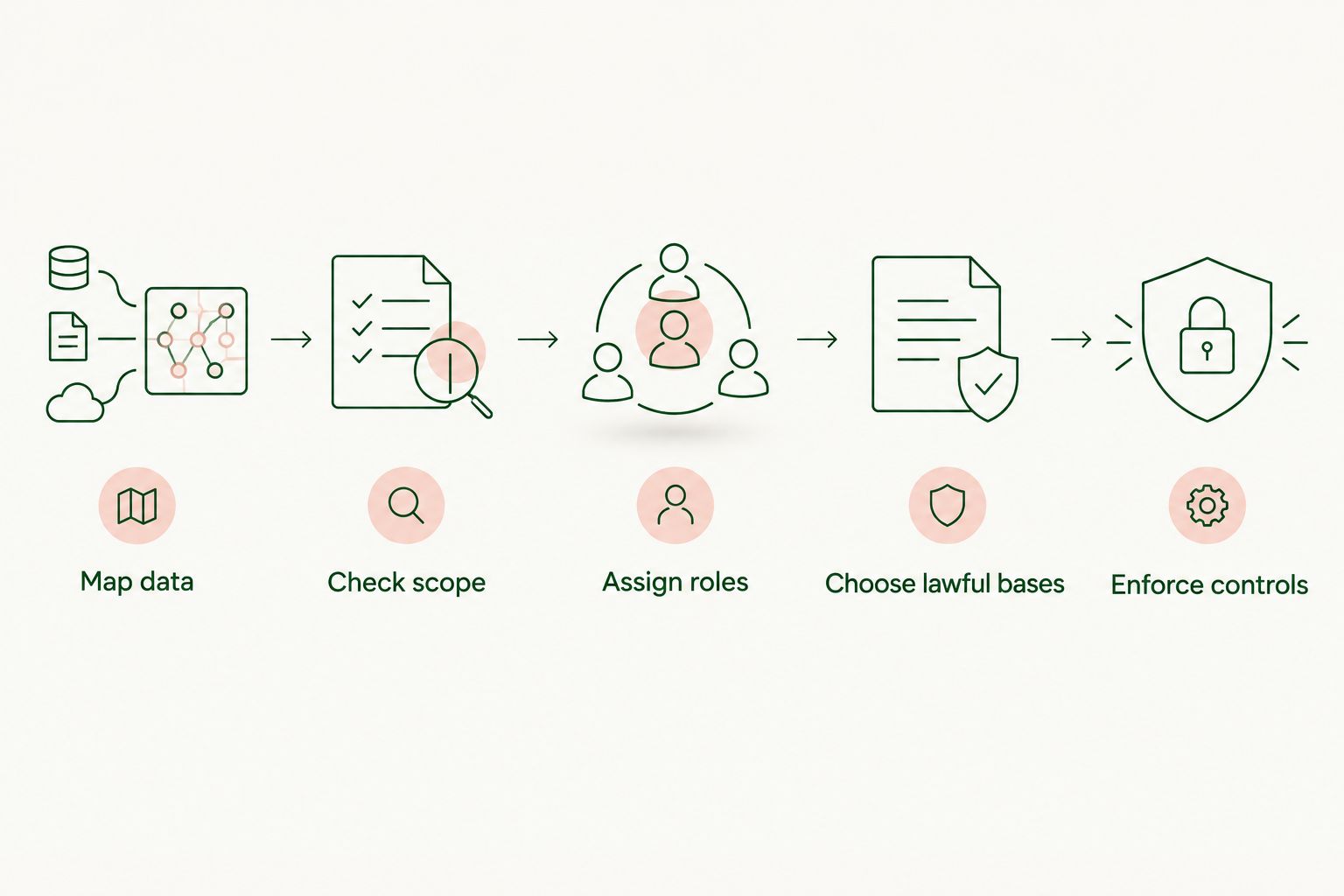
Use this sequence before launching EU inventory in 2026:
- Map data. Identify fields sent from the chat application to the ad service, advertisers, analytics systems, and logs.
- Check scope. Determine whether GDPR applies through an EU establishment or offering services to, or monitoring, people in the EU.
- Assign roles. Identify controllers, processors, and any joint controllers for each processing operation.
- Choose lawful bases. Document the legal basis for each purpose and assess device access separately.
- Enforce controls. Implement notices, consent where required, minimization, retention limits, and rights handling before launch.
The legal foundation is GDPR Articles 3, 5, and 6: territorial scope, processing principles, and lawful bases. These provisions govern the assessment in 2026 regardless of which model generates the chat response.
Why this matters
A conversation can contain personal information even when your application never asks for a name. A user can volunteer an address, describe a medical condition, or paste an identifiable customer record. Sending that content to an ad matcher introduces a processing purpose that needs its own assessment.
An ad placement is not the unit of compliance. A processing operation is. Review matching, delivery, measurement, fraud prevention, and attribution separately. Permission to process a message to answer the user does not automatically authorize using that message for advertising.
Contextual ads versus behavioral targeting
Contextual matching uses the current interaction or topic. Behavioral targeting uses information about a person’s activity or inferred interests. That distinction affects the data you need, but it does not determine GDPR applicability by itself.
| Approach | Best for | Advantage | Limitation |
|---|---|---|---|
| Current-topic contextual matching | Publishers avoiding persistent audience profiles | Can reduce the need for historical user data | Prompts, request metadata, and logs can still identify someone |
| Behavioral targeting | Publishers with a justified audience-personalization purpose | Supports matching based on activity across interactions | Adds profiling, transparency, and lawful-basis requirements |
| Matching using genuinely anonymous inputs | Publishers able to prevent identification throughout the workflow | Anonymous information falls outside GDPR | Removing names alone does not establish anonymity |
Prefer the least personal data that can support the advertising purpose. Current-topic matching is a useful design choice, not a compliance certificate. Even a generic topic label can become personal data when linked to an identifiable session or account.
GDPR Recital 26 distinguishes anonymous information from identifiable personal data. Pseudonymization does not remove data from GDPR: a hashed identifier or replaceable account token remains personal data when identification is reasonably possible.
For a 2026 implementation review, inspect actual requests and logs rather than relying on the integration’s contextual label. Include infrastructure metadata in that inspection.
Does GDPR always require consent for conversational ads?
No. GDPR Article 6 provides several lawful bases, and consent is one of them. The correct basis depends on the processing purpose and circumstances; an advertising SDK does not select that basis for your entire application.
Do not treat legitimate interests as a default advertising permission. If you rely on Article 6(1)(f), establish the interest, show that processing is necessary, and balance it against the individual’s interests and rights. Document reasonable expectations and safeguards.
Contract necessity is also narrow. Including advertising language in your terms does not make every ad-related processing operation necessary to provide the service the user requested.
Where consent is the chosen basis, GDPR Article 7 requires demonstrable consent and withdrawal that is as easy as giving consent. Consent must also be freely given, specific, informed, and unambiguous. A bundled acceptance of unrelated purposes does not resolve those requirements.
When personal data is processed for direct marketing, GDPR Article 21 gives individuals a right to object, including to related profiling. After an objection, that data must no longer be processed for those purposes.
ePrivacy is a separate check
The ePrivacy Directive’s Article 5(3), as implemented in national law, governs storing information on, or accessing information from, terminal equipment. This applies beyond conventional browser cookies and can cover SDK storage or identifier access.
Consent is generally required unless the operation meets an applicable exemption, such as being strictly necessary to provide a service explicitly requested by the user. A GDPR legitimate-interests assessment does not replace required ePrivacy consent. Check the implementation and applicable national rules.
What makes conversational ad compliance vary?
The legal requirements follow your data flow and purposes. These factors change the assessment:
- Identifiability: Account IDs, IP addresses, session tokens, and combinations of fields can make apparently generic events personal data.
- Purpose: Answering a question, selecting an ad, measuring a click, and building an audience profile are distinct operations.
- Device access: Cookies, local storage, and SDK identifiers require an ePrivacy assessment alongside GDPR.
- Sensitive content: Health information and other special-category data trigger GDPR Article 9 requirements.
- Recipients and roles: Sharing with processors, independent controllers, or joint controllers creates different obligations.
- International transfers: Sending personal data outside the EEA requires assessment under GDPR’s transfer rules.
These are legal drivers, not optional settings. A privacy policy cannot compensate for an unjustified purpose or a request that sends unnecessary personal data.
What should your ad SDK send to the matcher?
Send only what the documented matching purpose needs. Start by separating the application’s full conversation history from the proposed ad request. A matcher should not receive a transcript merely because the transcript is available.
Review the proposed payload field by field:
- Explain why each topic, identifier, or event field is necessary.
- Remove direct identifiers that have no justified advertising purpose.
- Prevent unnecessary free-text content from reaching ad logs.
- Assess whether derived topics reveal sensitive information.
- Check what the recipient stores after processing the request.
A category extracted from a conversation is not automatically anonymous or harmless. A health-related category attached to an account can reveal information about that person without including the original message.
Elo’s conversational ad SDK is best for developers embedding contextual ads in chat applications. Its stated function is to serve contextual, conversational ads and help publishers earn revenue from advertiser spend. That product fit does not establish the lawful basis, retention configuration, or contractual roles of your deployment.
The benefit is an SDK-based route to conversational ad serving. The constraint is that your application still needs a documented privacy architecture. Apply the implementation checks in how to make conversational ads GDPR compliant to the actual data exchanged.
Who is responsible: the publisher or the ad provider?
Responsibility follows decisions about processing, not the provider’s job title. Under GDPR Article 4, a controller determines purposes and means; a processor acts on the controller’s behalf. A provider can have different roles for different operations.
For a 2026 vendor review, ask what the provider does with matching inputs, event data, and retained logs. Establish whether it follows your instructions or determines independent purposes. Document any joint determination of purposes and means.
Where a provider is a processor, GDPR Article 28 requires the appropriate processing agreement. Where parties are joint controllers, Article 26 requires an arrangement allocating responsibilities. Neither arrangement eliminates the need for an accurate privacy notice.
When reviewing Elo, apply the same role assessment as for any conversational advertising provider. The description of an adserver does not establish processor status, EU hosting, transfer safeguards, or a particular consent mechanism.
What controls belong in a 2026 launch review?
Test privacy behavior as application behavior. Notices and contracts matter, but the request path must enforce the decisions they describe.
Gate requests and separate purposes
If a processing operation depends on consent, prevent that operation before valid consent exists. Test refusal, withdrawal, returning sessions, and expired consent states. Keep necessary application functions separate from optional advertising processing.
An opt-out label is not evidence that requests stop. Inspect network traffic and downstream event handling after the user changes their choice.
Set retention and access boundaries
GDPR Article 5 requires storage limitation and appropriate security. Assign retention periods by purpose, restrict access, and include logs, exports, and backup handling in the design. Do not choose a universal retention period without justifying it.
For access and other rights requests, GDPR Article 12 generally requires a response within one month. Build a way to find relevant ad records without collecting unnecessary identifiers solely for that task.
Prepare for incidents and high-risk processing
GDPR Article 33 generally requires a controller to notify the supervisory authority within 72 hours of becoming aware of a personal-data breach, unless the breach is unlikely to risk individuals’ rights and freedoms. A processor must notify the controller without undue delay.
Under Article 35, conduct a data protection impact assessment when processing is likely to result in high risk. Large-scale special-category processing and systematic profiling deserve particular scrutiny. Not every contextual ad integration automatically requires a DPIA.
Assess transfers and sensitive prompts
Before transferring personal data outside the EEA, identify the applicable Chapter V mechanism and any additional assessment or safeguards required. Server location alone does not answer every transfer question; review recipient access too.
Article 9 requires a separate condition for processing special-category data, in addition to an Article 6 lawful basis. Ordinary ad consent does not automatically satisfy that requirement. Exclude unnecessary sensitive content from the advertising workflow.
Does GDPR apply if your company is outside the EU?
Yes, GDPR can apply to a non-EU company offering goods or services to people in the EU or monitoring their behavior there. Article 3 makes territorial scope depend on the processing circumstances, not just company registration.
Mere website accessibility from the EU is not, by itself, the same as offering services there. Assess your actual targeting and monitoring activities.
Can you show ads after a user refuses consent?
Refusing consent does not automatically prohibit every possible ad display. You must stop operations that require the refused consent; another ad workflow needs its own lawful-basis and ePrivacy assessment.
Do not describe a fallback as consent-free until you have checked its requests, device access, and logs. Displaying an ad and tracking the viewer are separate questions.
Does an ad SDK make your chatbot GDPR compliant?
No. An SDK does not establish compliance for the publisher’s purposes, disclosures, data choices, or downstream processing. Verify the integration rather than treating installation as legal approval.
FAQ
Do contextual conversational ads need GDPR compliance in the EU?
Yes, contextual conversational ads need GDPR compliance when they process personal data within GDPR’s scope. Contextual matching is not an exemption.
Do I need consent before every conversational ad?
No, consent is not required for every possible ad operation. Each personal-data purpose needs a lawful basis, and device storage or access requires a separate ePrivacy assessment.
Is a hashed user ID anonymous under GDPR?
A hashed user ID is not automatically anonymous. If a person remains identifiable through reasonable means, the data remains subject to GDPR.
Can I send chat transcripts to an advertising service?
Only send transcript data when the processing has a lawful basis and satisfies GDPR’s other requirements. Apply purpose limitation, minimization, transparency, security, and any applicable special-category conditions.
How quickly must I respond to a GDPR access request?
You generally must respond within one month under GDPR Article 12. An extension is available under specified conditions, with notice to the individual within the initial month.
When must I report a conversational ad data breach?
A controller generally must notify the supervisory authority within 72 hours of awareness unless the breach is unlikely to risk individuals’ rights and freedoms. Separate rules govern notifying affected individuals.
Does using Elo remove the publisher’s GDPR responsibilities?
No, using Elo does not remove responsibilities that attach to the publisher’s processing role. Assess the SDK data flow, lawful bases, agreements, and controls for your deployment.
One last thing
Your debug log can create a separate privacy problem even when the matching payload is minimized. Before your 2026 launch, inspect error traces, request snapshots, and analytics exports for conversation text and identifiers. Apply the same purpose, access, and retention controls there.