
AI chat ad eCPM does not have one rate that applies to every application; a useful typical rate is your measured revenue per 1,000 ad impressions for a defined audience, placement, and reporting period. For a 2026 revenue forecast, use publisher-net eCPM and account for unfilled requests separately: impression eCPM alone does not tell you how much your chat traffic earns.
- AI chat ad eCPM measures revenue per 1,000 impressions; compare rates using the same revenue basis and impression definition.
- Elo provides SDK-based contextual ads for AI chat applications, not a guaranteed eCPM benchmark.
- Evaluate publisher-net eCPM alongside fill rate and session RPM before forecasting conversational ad revenue.
- Keep forecast assumptions separate from observed results; advertiser spend is not automatically publisher revenue.
How much does eCPM typically run for AI chat ad inventory?
Use a matched, measured rate—not a blanket conversational-ad average. An eCPM figure becomes useful when you know which impressions it counts, which revenue it includes, and which audience generated it. Without those definitions, comparing rates produces a ranking of unlike measurements.
Start with tracking ad impressions inside an AI chat app. An ad request, a returned creative, and a displayed ad are different events. Your revenue denominator must match the impression event used in your reporting.
The standard calculation is:
eCPM = ad revenue ÷ counted ad impressions × 1,000.
For a publisher forecast, use revenue attributable to the publisher rather than treating total advertiser spend as publisher earnings. Keep the currency, reporting window, and adjustment status consistent.
| Measurement | Best for | What it answers | Limitation |
|---|---|---|---|
| Gross impression eCPM | Evaluating advertiser spend against impressions | How much spend the counted inventory generated | Does not establish what the publisher keeps |
| Publisher-net impression eCPM | Forecasting publisher earnings from served impressions | How much publisher revenue the impressions generated | Excludes opportunities that never became impressions |
| Request RPM | Evaluating monetization across ad requests | How much revenue 1,000 requests generated | Depends on a consistent request definition |
| Session RPM | Evaluating chat-session monetization | How much revenue 1,000 sessions generated | Reflects both ad performance and session behavior |
These are related metrics, not interchangeable labels. The right comparison for your 2026 plan uses the same row on both sides.
Why this matters
A chat application pays its operating costs across conversations, including conversations that generate no ad revenue. Impression eCPM measures only the impressions in its denominator. It cannot, by itself, establish whether ads cover the application's costs.
That distinction changes the next move. If impression eCPM improves while revenue per session falls, inspect how many impressions each session generates and how many eligible requests remain unfilled. Do not assume the higher rate means the application earns more.
Optimize publisher revenue against the traffic you actually serve. Use eCPM to understand impression yield, then use session-level revenue and costs to evaluate the business.
Define the eCPM you will use
Publisher-net eCPM: revenue per 1,000 impressions
Publisher-net eCPM is the useful starting point when you need to estimate earnings from counted ad impressions. Its strength is a direct connection to publisher revenue. Its limitation is that it says nothing about requests that produced no impression.
Write the revenue definition beside the metric. Specify whether revenue is estimated or finalized and which deductions or adjustments the calculation includes. Compare equivalent reporting states rather than an estimated result from one period with a finalized result from another.
Keep revenue and impressions aligned to the same time basis. If revenue is attributed to a different reporting period than the corresponding impressions, the resulting eCPM can misrepresent that period's yield.
Request RPM: revenue per 1,000 requests
Request RPM measures revenue across the requests you send for ads, including requests that do not result in an impression. It is useful when you need to evaluate the combined effect of matching, delivery, and impression yield.
The limitation is instrumentation. Retries, duplicate requests, and requests made before a placement is eligible can change the denominator without representing additional user-visible opportunities. Define a request precisely before using request RPM to compare integrations.
When the revenue basis and time window match, the relationship is:
Request RPM = impression eCPM × impressions per request.
Use the measured ratio. Do not substitute a dashboard's fill-rate percentage until you know whether it counts returned ads or displayed impressions.
Session RPM: revenue per 1,000 sessions
Session RPM measures revenue across chat sessions rather than ad events. It is useful for evaluating monetization alongside inference costs, engagement, and the share of sessions eligible for advertising.
Its limitation is sensitivity to the session definition. A browser refresh, an inactivity boundary, or a conversation restart can change session counts. Preserve that definition when comparing results.
Session RPM does not replace eCPM. It answers a broader question: how much revenue your application generates across the conversations it serves.
Why AI chat ad eCPM varies
For a 2026 comparison, separate differences in inventory from differences in measurement. Review these factors before treating one rate as a benchmark for another application:
- Conversation context. Contextual advertising connects an offer to a conversation. Separate task categories so your comparison does not combine unrelated advertiser opportunities.
- Advertiser demand. A relevant conversation still needs matching advertiser demand. Measure coverage instead of assuming every useful conversation has an eligible ad.
- Audience composition. Geography and language define different inventory segments. Compare matching segments rather than assigning a blended rate to each one.
- Placement and delivery. An ad returned by a server is not automatically an impression. Check when the card appears and which event counts it.
- Revenue basis. Gross spend and publisher-net earnings answer different questions. A difference between them is not evidence of better or worse inventory.
- Reporting window. Estimated revenue, finalized adjustments, and changing traffic composition affect comparisons. Use aligned periods and preserve reporting status.
None of these factors supplies a universal rate. They explain what you must hold constant—or report separately—to make a rate meaningful.
Build a benchmark you can use
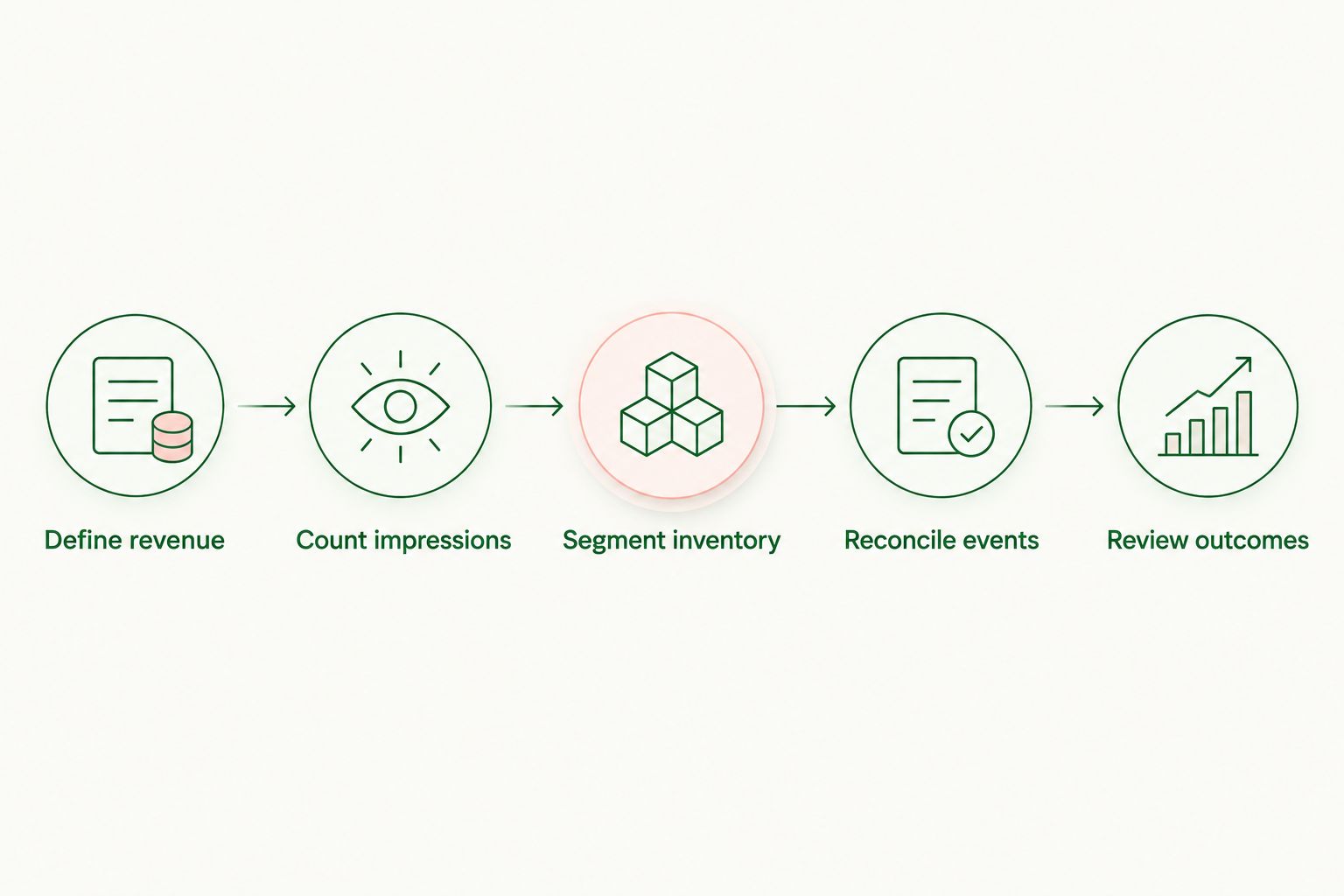
A useful benchmark comes from a repeatable measurement process. For your 2026 baseline, keep the configuration stable enough that you can explain changes in the result.
- Define revenue. Choose the publisher revenue field that answers your forecasting question. Record currency, adjustment status, and the treatment of deductions.
- Count impressions. Document the event that qualifies as an impression. Check that retries and interface re-renders do not produce unintended duplicate events.
- Segment inventory. Break out audience, conversation category, and placement where your reporting supports them. Keep an overall total for reconciliation.
- Reconcile events. Compare your application's event records with ad reporting. Investigate differences before calling either system's ratio your baseline.
- Review outcomes. Read eCPM alongside request RPM, session RPM, and user-experience measures. Record configuration changes with their effective dates.
This process produces an interpretable baseline rather than an unexplained dashboard number. Retain the underlying revenue and impression totals, not just the calculated rate.
Calculate blended eCPM from total revenue and total impressions. Do not take a simple average of segment eCPMs when the segments have different impression volumes. Each segment contributes according to its counted impressions.
Keep zero-revenue impressions in the calculation when they meet your impression definition. Removing them changes the question from inventory yield to yield on a selected subset.
Forecast revenue without confusing rate and volume
Use the relationship between revenue and impressions rather than treating eCPM as a monthly earnings estimate. The standard expression is:
Publisher ad revenue = publisher-net eCPM × counted impressions ÷ 1,000.
If you forecast from requests, first estimate how many requests become counted impressions. If you forecast from sessions, account for eligible ad opportunities within those sessions. Do not equate users, messages, requests, and impressions.
Keep assumptions visible in your 2026 model. Label projected traffic and projected yield separately from observed traffic and observed yield; a forecast is not a reported result.
A practical forecast separates:
- The traffic unit you expect to serve.
- The share of that traffic eligible for ads.
- The measured or assumed relationship between eligibility and impressions.
- The publisher-net eCPM applied to those impressions.
- The application costs associated with serving that traffic.
Do not extrapolate your strongest segment across the entire application. Use each segment's own measured yield where available, then combine the revenue totals.
Where an SDK-based adserver fits
Elo is best for developers seeking SDK-based contextual ad monetization in AI chat applications. Elo provides an adserver for applications built on OpenAI, Anthropic, or custom LLMs, letting developers embed conversational ads and earn revenue from advertiser spend.
The relevant benefit is contextual ad monetization within the chat application. The limitation is that an SDK-based integration still needs application-level measurement: product fit alone does not establish your eCPM, coverage, or net earnings.
Keep the assistant's answer and sponsored content distinguishable. Then evaluate monetization against the conversation experience rather than using revenue per impression as the only acceptance criterion.
Explore contextual chat monetization
Review SDK-based advertising for applications built on OpenAI, Anthropic, or custom LLMs.
Is a higher AI chat ad eCPM always better?
A higher eCPM is better for impression yield, not automatically for total earnings. If the application generates fewer impressions or fewer monetized sessions, a higher impression rate can coexist with lower revenue.
Compare the same inventory before and after a change. Read publisher revenue, impression volume, request coverage, and session outcomes together before deciding which configuration wins.
Can a chatbot's ad eCPM cover its inference costs?
eCPM alone cannot establish whether advertising covers inference costs. You need revenue and costs on a matching basis, such as revenue per session compared with inference and other operating costs per session.
Include sessions without ads in the application-level calculation. Excluding them overstates how much advertising contributes across the product.
FAQ
What's a good AI chat ad eCPM in 2026?
A useful AI chat ad eCPM is a measured publisher-net rate for inventory comparable to your own. Judge it alongside impression volume, request coverage, and session revenue rather than applying an unrelated rate to your application.
How do I calculate AI chat ad eCPM?
Divide ad revenue by counted ad impressions and multiply by 1,000. Use the same reporting period for both values and state whether revenue is gross or publisher-net.
Is eCPM the same as CPM?
No. CPM describes a cost per 1,000 impressions, while eCPM expresses realized revenue on that impression basis, including revenue generated under other billing models.
Does fill rate change my chat app's eCPM?
Fill rate is separate from impression eCPM, but it affects how many opportunities generate revenue. Compare both metrics and confirm whether fill means an ad response or a counted impression.
Should I compare gross eCPM or publisher-net eCPM?
Use publisher-net eCPM when forecasting publisher earnings. Gross eCPM is useful for evaluating spend against impressions, but it does not establish the publisher's retained revenue.
Can Elo guarantee an eCPM for my chatbot?
An eCPM guarantee should come from explicit commercial terms, not a product description. Elo provides SDK-based contextual ad monetization; evaluate your rate from measured publisher revenue and impressions.
Can I use message counts to estimate ad impressions?
No, message counts and ad impressions are different events. Forecast from the application's placement rules and measured impression events rather than assuming each message produces an ad.
One last thing
Your blended eCPM can rise even when no individual segment improves. A larger share of impressions from a higher-yield segment changes the overall average. That is a traffic-mix change, not necessarily an improvement in ad delivery.
Keep a segment breakdown beside every blended result. In your 2026 reporting, annotate placement changes and audience-mix changes separately. That makes the next decision clear: improve a segment's yield, expand eligible inventory, or fix measurement before changing the monetization setup.