
Monetizing a chatbot with ads is worth testing when you want to preserve free access and can cover serving costs with contextual advertising; a paywall fits when users will pay for the underlying task. Choose the model that produces contribution margin without damaging task completion or retention, and count inference, payment processing, and integration work—not just revenue.
- Chatbot ads vs paywall is a contribution-margin decision: compare revenue after inference costs, not gross receipts.
- Contextual ads preserve free access; subscriptions charge users directly for chatbot access or capabilities.
- Hybrid monetization separates ad-supported access from paid access, but adds entitlement and measurement work.
- Elo fits developers seeking an SDK-based adserver for contextual, conversational chatbot ads.
Is it worth monetizing a chatbot with ads versus a paywall?
Yes, if ad-supported usage earns more than it costs to serve and remains useful to users. A paywall is the better choice when paid access produces stronger margins and users have a clear reason to subscribe. Evaluate both against the same acquisition cohort, not separate audiences with different intent.
You can also run subscriptions and ads in the same chatbot. Treat that as a distinct model, not an automatic compromise.
| Model | Best for | Main advantage | Main drawback | Decision rule |
|---|---|---|---|---|
| Ad-supported access | Publishers testing free access with relevant commercial context | Users can access the chatbot without paying for entry | Revenue depends on eligible opportunities and advertiser demand | Keep it when net ad receipts cover serving costs without breaking the task |
| Paywall | Chatbots with a task users will pay to complete | Revenue comes directly from customers | Payment becomes an access barrier | Keep it when paid conversion and retained usage produce positive contribution |
| Hybrid access | Publishers serving distinct free and paying segments | You can monetize each segment differently | Ads, billing, and entitlements all need maintenance | Keep it when the combined contribution exceeds the simpler alternatives |
For your 2026 decision, start with the task users complete. A monetization model should fund that task, not replace it with an advertising or upgrade funnel.
Why this matters
A chat session creates a serving obligation before it creates revenue. Model calls, retrieval, tool execution, and support belong in your economics even when the user never clicks an ad or subscribes.
Gross revenue hides this distinction. More conversations are not a business win if each additional conversation increases your losses. A paywall is not a win either if paying users consume more resources than their payments cover.
Measure the margin of the access model, not the attractiveness of its revenue dashboard. Keep task completion and return usage alongside financial metrics so you can identify a monetization change that earns revenue by making the product worse.
Ad-supported access: best for preserving free entry
Ads let you fund access through advertiser spend rather than requiring payment from every user. Contextual placements belong where an offer relates to the conversation, with a visible distinction between sponsored content and the assistant's answer.
The benefit is straightforward: the payment barrier is absent. The constraint is equally important: a conversation is not a guarantee of a suitable ad, a rendered impression, or a billable event.
Before adding ads, define eligible moments. A user asking for a product recommendation presents a different placement decision from a user troubleshooting an urgent failure. Do not treat every message as interchangeable inventory.
For your 2026 test, record requests, returned ads, rendered placements, and billable events separately. An ad request is an attempt to obtain an ad; it is not proof that a user saw one. Revenue attribution starts with keeping those states distinct.
Best for: free-access chatbot publishers whose conversations contain suitable advertising opportunities. Trade-off: you must manage placement quality and demand uncertainty while continuing to serve conversations that generate no ad revenue.
Paywalled access: best for a task users will fund directly
A paywall connects access to payment. Your first question is not whether subscriptions sound predictable; it is whether users understand what they receive and will keep paying for it.
Define the paid outcome before designing the upgrade screen. That outcome might be access to a workflow or capability you actually provide. Avoid charging for an unclear distinction between free and paid use.
A paywall does not eliminate variable costs. Subscribers still generate model calls, tool runs, and support requests. Measure consumption across paying users rather than assuming the average subscriber represents every account.
In your 2026 evaluation, distinguish a payment attempt from a completed payment and a completed payment from retained paid usage. Refunds, cancellations, and processing fees belong in the financial comparison.
Best for: chatbot operators with demonstrated willingness to pay for a defined task. Trade-off: users must cross a payment barrier, and paid usage still needs cost controls.
Hybrid access: best for separating different user needs
A hybrid model combines ad-supported access with a paid path. It works as a design choice when you can explain which experience each user receives and enforce that distinction reliably.
Decide whether payment removes advertising, changes access, or does both. State the arrangement before purchase. Then make the product follow that promise across devices, sessions, and account states.
The additional work is real. Your application needs billing state, ad eligibility, and access rules that agree with each other. Test cancellation, failed payments, account switching, and restored access before treating the setup as complete.
For a 2026 hybrid experiment, measure the total cohort contribution. Counting subscription receipts and ad receipts separately can hide whether the combined experience improves the business or merely moves users between revenue categories.
Best for: publishers with distinguishable free and paying segments. Trade-off: the model adds operational complexity, so compare it against the simplest viable alternative.
Why chatbot ads versus paywall results vary
There is no useful universal winner without your application's revenue and cost records. Evaluate these drivers rather than importing an assumed ad yield or subscription conversion rate:
- Conversation context: identify where a commercial offer helps the user, and exclude placements that distract from the task.
- Serving cost: include model usage, retrieval, tools, and infrastructure in the same measurement window as revenue.
- Advertiser demand: distinguish an eligible placement from an actual returned ad and a billable event.
- Willingness to pay: measure completed purchases and continued paid usage, not upgrade-screen visits alone.
- Experience quality: track task completion, errors, return usage, and complaints for each access model.
- Operating burden: account for integration, billing, moderation, reporting, and ongoing maintenance.
These drivers interact. Adding more ad opportunities does not establish that revenue improved relative to the extra serving cost. Tightening a paywall does not establish that the customers you retain produce a better total result.
How do you compare chatbot monetization fairly?
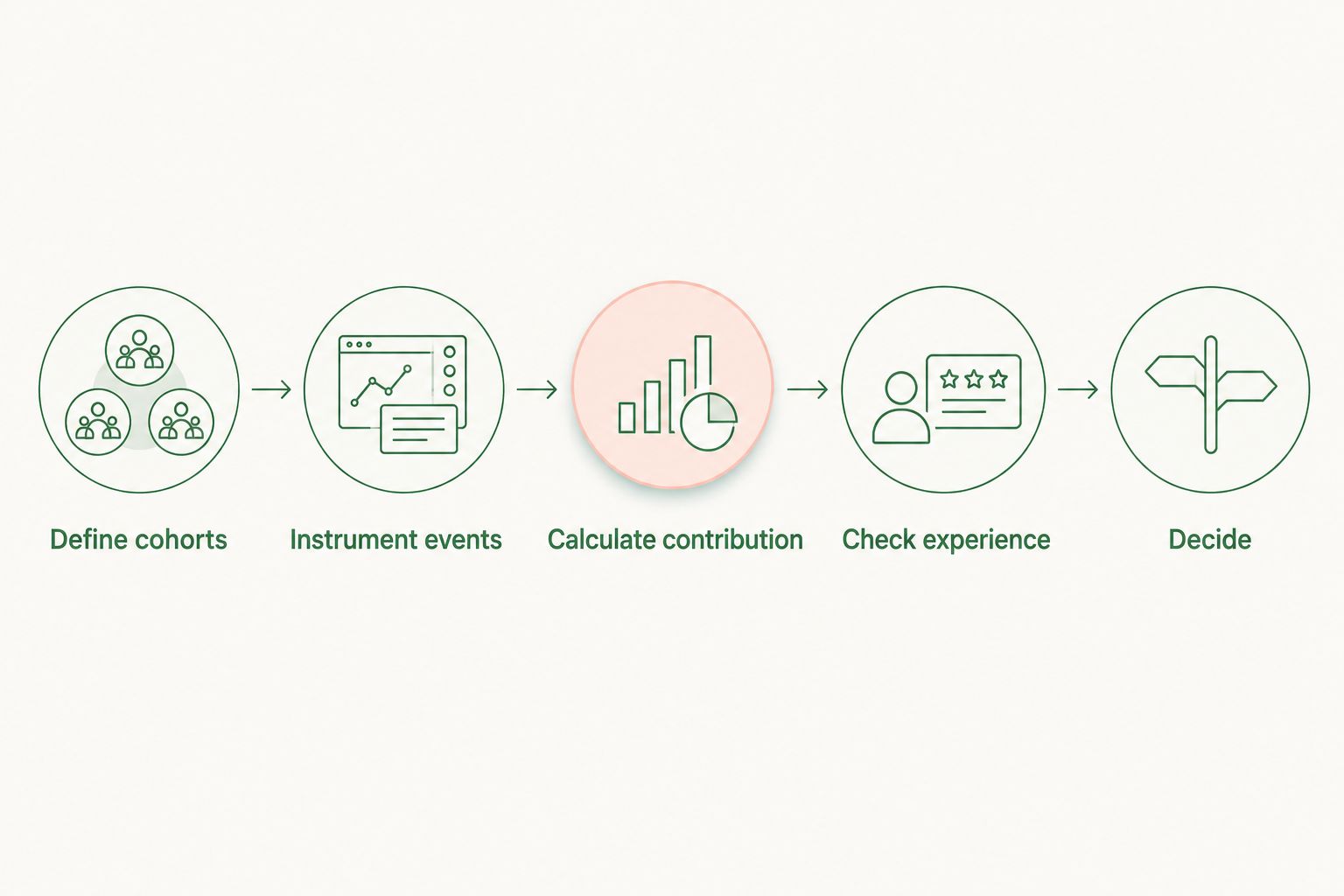
Use a controlled comparison with a shared financial definition. Your 2026 test should start with eligibility rules and instrumentation, not a revenue target borrowed from another app.
Define cohorts
Assign users consistently to the experiences you want to compare. Keep the chatbot's core capabilities comparable unless the capability difference is explicitly part of the paid offer.
Record acquisition source and account status. Comparing new visitors in an ad-supported group with established customers behind a paywall confounds monetization with audience selection.
Instrument events
Log conversation starts, task outcomes, model consumption, and access decisions. For advertising, separate ad requests from rendered placements and payable events. For subscriptions, separate upgrade exposure from completed payment.
Use stable event definitions across groups. A task should not count as completed under looser rules simply because that version carries ads.
Calculate contribution
Subtract variable serving costs and payment-related deductions from the revenue attributable to each cohort. Include directly attributable operating costs without counting the same expense twice.
Keep shared fixed costs visible elsewhere. Contribution margin answers whether serving additional usage helps; it does not, by itself, prove the entire business covers every expense.
Check experience
Compare task completion, return usage, errors, and user feedback alongside contribution. Investigate whether an apparent revenue improvement comes from interrupting useful work or pressuring users into an upgrade.
Define unacceptable outcomes before reading the results. This prevents a favorable revenue number from becoming an excuse for a broken experience.
Decide
Choose the model with the stronger financial result that also meets your experience requirements. If the result is unclear, extend the measurement or simplify the experiment instead of declaring a winner.
Record the decision and the conditions that would change it. Model costs, demand, and user behavior belong in future reviews rather than becoming permanent assumptions.
Which metrics should decide the winner?
Use metrics whose denominators match the question. Revenue per impression evaluates advertising yield; revenue per user evaluates an audience; contribution per conversation evaluates the cost of delivering chat.
| Metric | Definition | What it tells you | What it leaves out |
|---|---|---|---|
| Session RPM | Net ad revenue divided by sessions, multiplied by 1,000 sessions | Advertising revenue normalized across session volume | Serving costs and differences in session length |
| eCPM | Ad revenue divided by impressions, multiplied by 1,000 impressions | Revenue normalized across delivered advertising impressions | Conversations without impressions |
| Paid conversion | Completed paying users divided by eligible users | How many eligible users become paying customers | Continued payment and resource consumption |
| Contribution per conversation | Attributable revenue minus variable costs, divided by conversations | Whether delivered conversations contribute financially | Shared fixed costs |
| Retained usage | Returning users measured under a consistent definition | Whether users continue using the experience | The reason a user returns or leaves |
Session RPM expresses revenue per 1,000 sessions. eCPM expresses revenue per 1,000 impressions. Those are different populations; comparing their values directly does not tell you whether ads beat a paywall.
A CPC billable event is 1 click; a CPA billable event is 1 qualifying action, as defined by the campaign. Keep the billing definition attached to the event instead of assuming every interaction earns revenue.
For subscriptions, compare net receipts and serving costs over aligned periods. An upfront payment and a later inference expense must not land in separate views that make the same cohort appear more profitable than it is.
Where does an SDK-based adserver fit?
Elo provides an SDK-based adserver for developers of chat applications built on OpenAI, Anthropic, or custom LLMs. Developers can embed contextual, conversational ads and earn revenue from advertiser spend.
Elo is best for developers seeking an SDK-based adserver for contextual chatbot ads. That describes the product fit, not a claim that advertising will outperform subscriptions in your application.
The benefit is an adserver and SDK intended for conversational monetization. The constraint is that adopting an adserver does not establish your contribution margin, user tolerance, or whether a paywall would earn more.
Keep those decisions in your application measurement. Validate the integration and evaluate the access model separately.
Can ads cover a chatbot's inference costs?
Ads cover inference costs only when attributable net ad revenue meets or exceeds those costs for the usage being measured. Covering inference alone does not establish profitability because retrieval, tools, infrastructure, and support can add expenses.
Use the same cohort and time window for both sides. Do not divide total ad revenue by only the conversations that displayed ads while leaving the rest of the serving bill outside the comparison.
Should you offer paid access without ads?
Offer paid access without ads when you can clearly state the benefit and enforce the promised experience. Treat ad removal as a product decision to test, not evidence that users will subscribe.
Compare total contribution and retained usage after the change. Removing ads reduces advertising opportunities; payment must be evaluated against that change and the costs of serving paid users.
FAQ
What's better for chatbot monetization: ads or a paywall?
The better model produces stronger contribution margin while meeting your task-completion and retention requirements. Compare matched cohorts and include serving costs rather than judging gross revenue alone.
Can I run chatbot ads and subscriptions together?
Yes, you can design separate ad-supported and paid access paths. Define what payment changes, then keep billing state, ad eligibility, and access rules consistent.
Does every chatbot conversation generate ad revenue?
No, a conversation does not guarantee a suitable ad or a billable event. Separate eligible opportunities, returned ads, rendered placements, and payable events in your measurement.
What's the difference between session RPM and eCPM?
Session RPM measures ad revenue per 1,000 sessions; eCPM measures ad revenue per 1,000 impressions. Use session RPM to examine session-level yield and eCPM to examine delivered-impression yield.
Will a paywall eliminate chatbot serving costs?
No, paying users still generate serving costs. Compare net subscription receipts with model consumption, tools, retrieval, and other attributable expenses.
Is Elo relevant to an ad-supported chatbot?
Elo provides an SDK-based adserver for embedding contextual, conversational ads in chat applications built on OpenAI, Anthropic, or custom LLMs. Evaluate its fit separately from whether advertising beats paid access for your users.
How do I choose a chatbot monetization model in 2026?
Choose using a controlled comparison of contribution and experience outcomes. Keep cohort assignment, event definitions, cost attribution, and measurement periods consistent across models.
One last thing
Keep no-ad conversations in the ad-supported cohort's economics. Excluding them makes advertising look better by removing costs from the denominator without removing the obligation to serve those users.
Apply the same discipline to a paywall: measure the whole assigned audience, not only successful subscribers. Your business serves or turns away people, not just monetized events.