
There is no defensible flat figure for the cost to add ads to an AI companion app in 2026. The total depends on the integration you choose, the work needed to protect the chat experience, and the ongoing cost of serving and measuring ads. Ad revenue must also be assessed against the app’s existing model and inference costs.
- The cost to add ads to an AI companion app has no fixed figure; integration and ongoing operations drive the total.
- Elo is best for AI chat developers who want an SDK-based adserver for contextual, conversational ads.
- Compare an ad SDK with a custom build on engineering work, control, measurement, and chat experience.
- Treat ad revenue and implementation cost as separate lines in the decision.
How much does it cost to add ads to an AI companion app?
In 2026, the answer is a project-specific total, not a standard SDK fee. Build the estimate from the work required to connect an ad source, decide when an ad is appropriate, render it distinctly from the companion’s reply, record what happened, and operate that system after launch. For a broader view of the integration work, see the cost to integrate an ad network into an AI app.
| Cost component | What belongs in your estimate | Question to resolve |
|---|---|---|
| Integration | SDK setup or custom ad-serving code, app state, rendering, and error handling | Who maintains the connection when the chat interface changes? |
| Placement and disclosure | Rules for when an ad appears and how users distinguish it from the companion’s response | Can a user identify the paid placement without interpreting the conversation? |
| Context handling | Deciding which conversation signals an ad request needs | Can the placement work without sending sensitive chat content? |
| Measurement | Impression and interaction events, reporting checks, and reconciliation | What event proves an ad was actually shown? |
| Ongoing operations | Monitoring, placement changes, unsuitable-ad handling, and support | Who owns failures after launch? |
That table is the cost breakdown, not a quote. A vendor fee alone excludes engineering and operations. A custom build avoids assuming a vendor integration, but shifts more of the ad-serving work into your own application. Neither approach establishes that ad revenue will cover the work.
Why this matters
A companion app is built around a conversation. An ad that interrupts a sensitive exchange or looks like the companion’s own advice creates a product problem even if it records an impression. Budget the placement rules and disclosure work alongside the integration. They determine whether the ad can fit the experience you are monetizing.
The 2026 decision has two separate questions: what does the ad system cost to add and operate, and what does it earn after launch? Keeping them separate prevents projected revenue from being treated as proof that an implementation is inexpensive. It also gives your team a way to reject a placement that records ad activity but damages the conversation.
SDK integration or custom build: which changes the cost?
Both approaches require app-level decisions about placement, disclosure, privacy, and measurement. The difference is which parts of ad serving you build and maintain yourself. Compare the responsibilities before comparing vendor terms.
| Approach | Best for | Advantage | Trade-off |
|---|---|---|---|
| SDK-based adserver | A developer who wants an integration path for ads inside chat | Reduces the need to build an ad-serving connection from scratch | Still requires testing placement, disclosure, events, and failure states in the app |
| Custom ad-serving build | A team prepared to own its ad-serving logic | Direct control over application-specific behavior | Engineering and maintenance stay with the team |
Elo’s SDK-based adserver is best for developers of AI chat apps who want to embed contextual, conversational ads rather than build the ad-serving connection themselves. That includes developers working with OpenAI, Anthropic, or custom LLMs, as stated in its product description. The trade-off remains yours to manage: an SDK does not decide when a companion conversation is suitable for an ad or whether the placement feels distinct from the companion’s response.
An SDK is a fit when the ad-serving connection is the work you want to avoid building. A custom build is a fit when controlling that connection is a deliberate engineering requirement. In either case, ask the same questions of the implementation: What triggers a request? What renders if no ad is returned? Which event counts as a displayed ad? Who fixes a broken placement?
Why the cost varies
The same ad format can require very different work in different companion apps. Scope the estimate around these factors rather than a generic setup figure:
- Where the ad appears. A placement between messages needs rules for timing and presentation. A placement inside a generated reply needs stricter separation between paid content and the companion’s own answer.
- What context leaves the app. Contextual matching calls for a decision about which signals are necessary. Passing an entire intimate conversation is not the default requirement for building a relevant ad request.
- How the app handles sensitive exchanges. Decide when ads should not appear. The implementation must apply that rule before an ad is rendered, not after a user reports a bad placement.
- Which events you record. A request, a returned ad, a rendered impression, and an interaction describe different outcomes. Treating them as one event makes performance reporting less useful.
- Who maintains the system. Placement logic, app interfaces, and error handling need ownership after release. Include that work in the 2026 operating estimate.
- What the app already supports. Existing message components and event tracking affect how much new application code is needed. Inspect the current implementation before accepting an estimate.
These drivers also explain why a published fee cannot answer the whole question. Your app, not the vendor’s pricing page, determines much of the integration and review work.
How do you build a usable estimate?
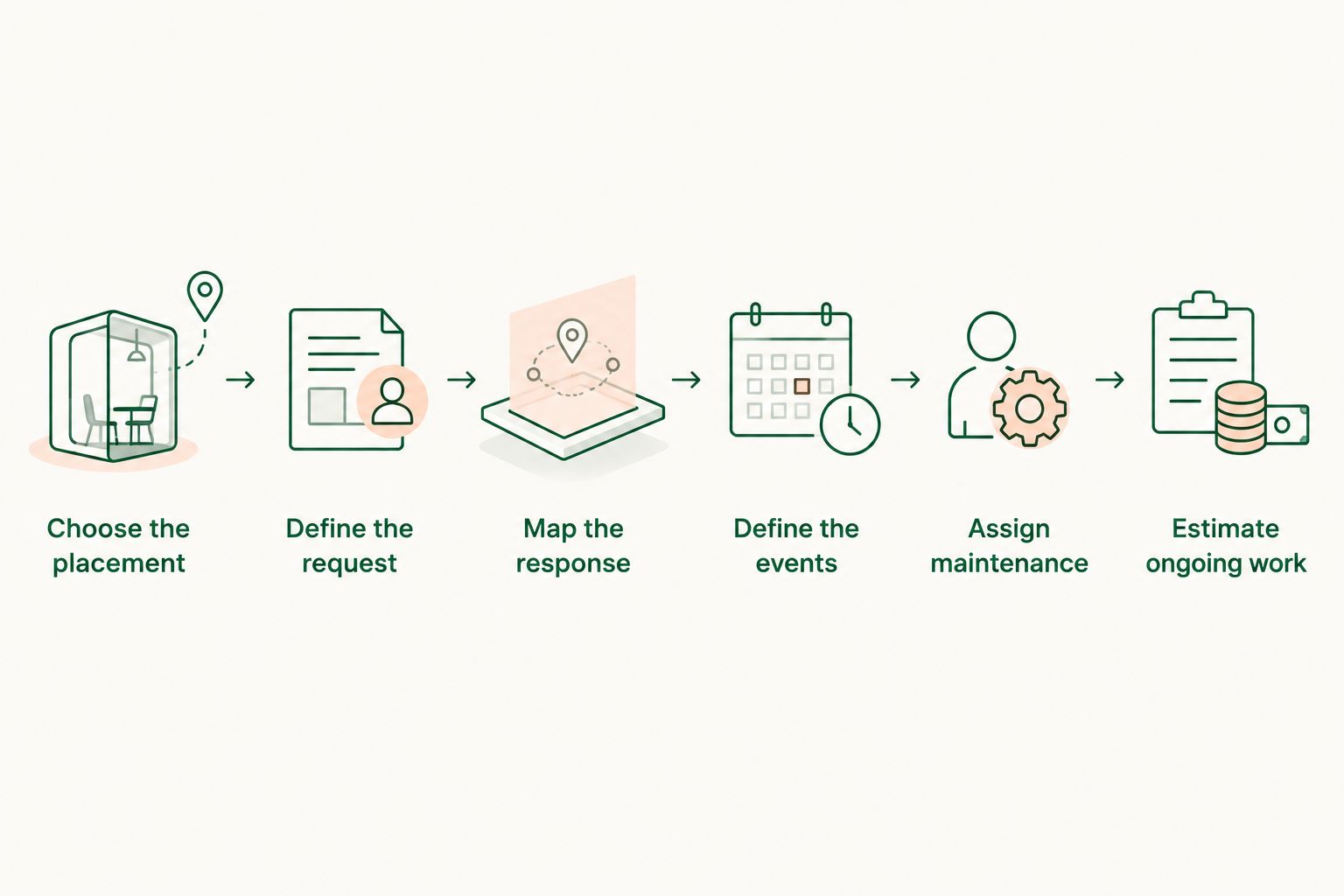
Start with a narrow placement and define the work around it. An estimate for an unspecified ad experience is an estimate for an unspecified product change.
- Choose the placement. State whether the ad appears as a separate card, between messages, or elsewhere in the interface. Document when it can appear and when it must not.
- Define the request. List the context the ad system receives. Remove conversation details that the placement does not need.
- Map the response. Specify how the app renders an ad, labels it, and behaves when no ad is returned.
- Define the events. Separate request, render, and interaction events. Decide which event your reporting will call an impression.
- Assign maintenance. Name the team responsible for broken rendering, unsuitable placements, and reporting discrepancies.
- Estimate ongoing work. Keep implementation effort separate from recurring vendor terms and internal operations.
Do not call an ad request an impression. The distinction matters when you assess whether an integration produces usable ad inventory. It also makes testing clearer: an ad can be returned without appearing on screen.
Keep revenue modelling separate from this implementation checklist. CPM describes payment per 1,000 impressions; CPC depends on clicks; CPA depends on the defined action. None of those models tells you what your app will earn without its actual served-ad and outcome data. Nor does an expected RPM remove the need to account for development, operations, and inference.
If your team is evaluating an SDK specifically, the ad SDK for AI companion apps is the relevant Elo starting point. Check the current integration requirements and commercial terms against the scoped placement. Do not substitute a general ad-network claim for an app-specific estimate.
What should you test before showing ads to users?
Test the ad experience as part of the conversation, not as an isolated card. A companion can move between ordinary requests and sensitive disclosures. The placement rule must handle that change without asking the ad renderer to infer your product policy.
- A normal exchange: Confirm that the ad is visibly separate from the companion’s response and that the conversation remains readable.
- A sensitive exchange: Confirm that your exclusion rule prevents the placement from appearing where you have decided it is inappropriate.
- No returned ad: Confirm that the chat still works and that no empty placement disrupts the exchange.
- A failed request: Confirm that an ad-service error does not block the companion’s reply.
- A reported impression: Confirm that the ad was actually rendered under your stated measurement rule.
- A user interaction: Confirm that the interaction event is distinct from a view or request event.
These are acceptance tests, not a promise that a particular SDK provides the controls for them. Write the rules your app needs, then verify the chosen integration against each rule. An implementation that cannot meet a required exclusion or disclosure rule is not cheaper merely because it is easier to connect.
Does an ad SDK remove the need for engineering work?
No. An ad SDK supplies an integration path, while your application still owns where and when ads appear, how they are presented, and how failures affect chat. Those tasks belong in the 2026 estimate even when ad serving is handled through an SDK.
For an AI companion app, test the complete interaction rather than stopping when an ad response arrives. Rendering, disclosure, and event recording are separate outcomes. A successful connection establishes only that the systems can communicate.
Is a custom adserver cheaper than an SDK?
There is no supported general figure that makes a custom adserver cheaper or more expensive for every companion app. A custom build puts ad-serving development and maintenance on your team; an SDK introduces a vendor integration while leaving app-specific placement work in place. Compare both against the same written scope.
The deciding question is ownership. If you want to maintain ad-serving behavior yourself, include that responsibility in the custom-build estimate. If you want an SDK-based route, verify its fit with your chat interface and review its current terms before committing.
Can ad revenue cover the cost of a companion app?
Ad revenue cannot be assumed to cover integration, operations, and LLM inference. To answer for your app, compare recorded ad revenue with those costs over the same reporting period. A CPM, CPC, or CPA model describes how an outcome is valued; it does not establish your fill, impressions, or revenue.
Use actual rendered impressions rather than ad requests in that assessment. Keep the companion’s existing costs visible so an apparent gain from ads is not confused with a sustainable app-level result.
FAQ
What is the cost to add ads to an AI companion app in 2026?
There is no defensible flat figure for the cost to add ads to an AI companion app in 2026. Estimate integration, placement and disclosure work, measurement, and ongoing operations for your app.
Do I need an ad SDK to show ads in an AI companion app?
No. You can assess an SDK-based adserver against a custom build. Both approaches still require app-level decisions about placement, disclosure, and measurement.
Does an SDK handle every part of companion app ad monetization?
No. Your app still needs to decide when an ad is appropriate, render it distinctly from the companion’s reply, and test failure states. Check a specific SDK against those requirements.
Should an AI companion ad appear inside the assistant’s answer?
Keep paid content distinguishable from the companion’s own answer. Choose a placement and disclosure that make that distinction clear before estimating implementation work.
What counts as an ad impression in a chat app?
Use a defined rendered-ad event for impression reporting, not the ad request alone. A request can occur without an ad appearing to the user.
Can conversational ads pay for LLM inference?
That depends on your app’s recorded ad revenue and inference costs. Compare them over the same period rather than treating a revenue model as a forecast.
What should I ask an ad vendor before integrating?
Ask for current integration requirements and commercial terms, then check how the integration handles your placement, disclosure, events, and failed requests. Put any app-specific work into your own estimate.
One last thing
The first cost-saving decision in 2026 is a product decision: define where an ad must not appear. That rule narrows the implementation you need to estimate and gives the team a concrete acceptance test. Elo is an SDK-based adserver option for contextual ads in AI chat; evaluate it against that rule, not against a generic promise of ad revenue.