Integrating an ad network into an AI chat app costs $0 in licensing fees when you use a revenue-share SDK — money only changes hands once ads actually serve. The real cost is engineering time, and the part teams underestimate isn't the initial code, it's the QA and ad-matching tuning that happens before launch, not after.
- Ad network integration costs $0 upfront with revenue-share SDKs like Elo in 2026.
- The real cost is engineering time — a lightweight SDK integration runs to about twelve lines of code.
- Ongoing cost comes from QA, matcher tuning, and frequency caps, not a subscription fee.
- Revenue share means Elo takes a cut of ad spend, so $0 upfront isn't $0 total once the app scales.
Why this matters
Founders shopping for an ad network usually ask the wrong question first. They want a dollar figure, but conversational ad SDKs like Elo don't sell licenses — they take a cut of ad revenue, so the sticker price is $0 and the actual line item is developer hours. That changes the budgeting question from "what does this cost" to "how many engineering days until this pays for itself," because a lightweight SDK that ships in an afternoon starts earning weeks before a heavier mediation stack does.
The trade-off is real: revenue share means Elo, like most conversational ad networks, takes a cut of every dollar earned, so a $0 upfront cost is not the same as a $0 total cost once an app scales past a few thousand daily conversations. For developers building on OpenAI, Anthropic, or a custom LLM stack, that structure keeps the integration cost tied to actual ad revenue instead of headcount or a fixed bill.
How much does it cost to integrate an ad network into an AI app?
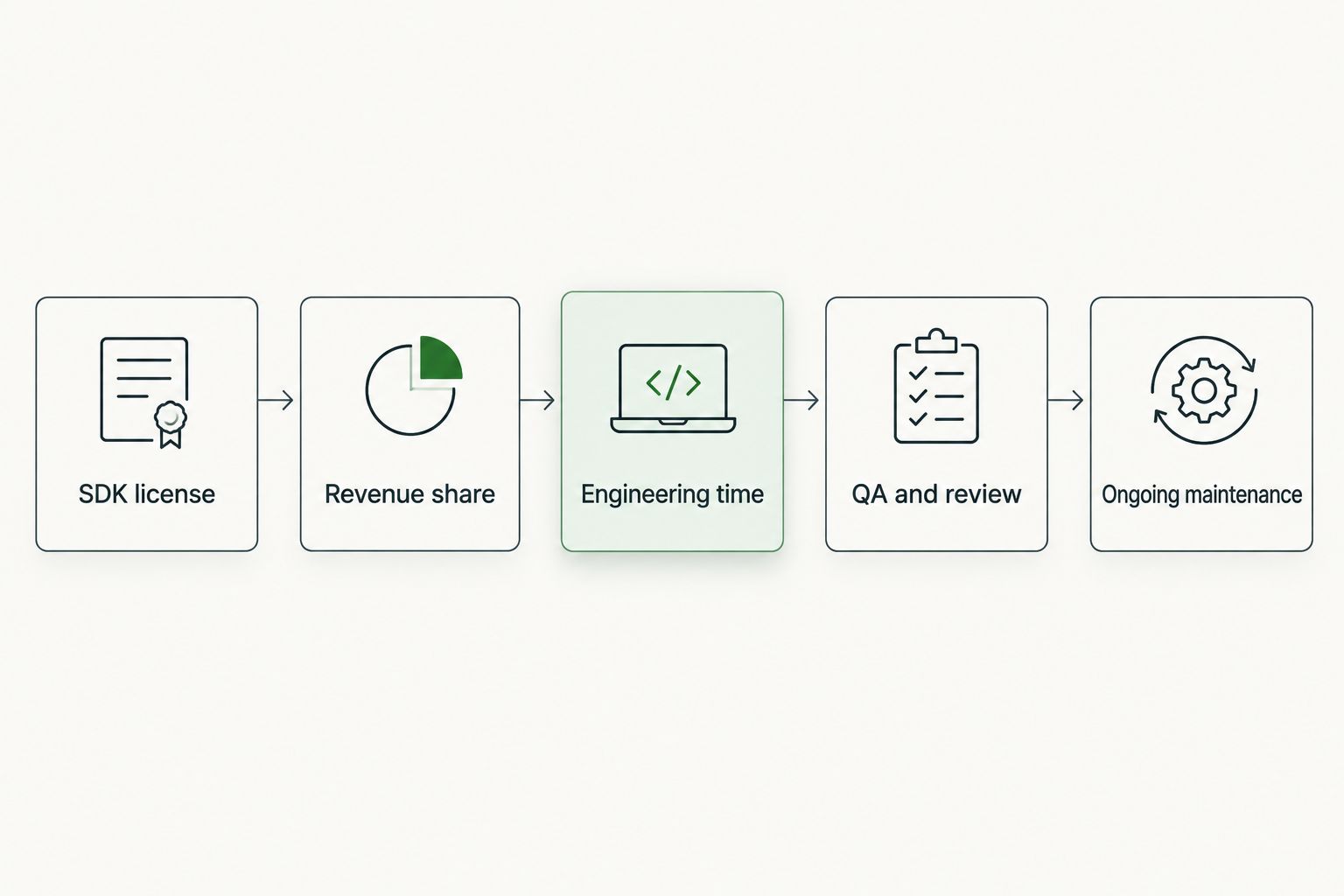
There's no invoice for adding a conversational ad network to an AI chat app. The ad SDK cost breakdown for most revenue-share networks looks like this:
| Cost category | Who pays | Typical structure |
|---|---|---|
| SDK license fee | Publisher (app developer) | $0 upfront with revenue-share networks |
| Revenue share | Deducted from ad revenue | Network keeps a cut once ads run |
| Engineering integration | Publisher's dev team | Hours to a few days for a lightweight SDK |
| QA and ad review | Publisher | One-time check before launch |
| Ongoing maintenance | Publisher | Matcher tuning and frequency-cap adjustments |
The number that actually matters is engineering time, not a subscription fee. A lightweight SDK adds a handful of lines of code — Elo's basic ad call runs to roughly twelve lines, which is why most teams treat this as a days-long task rather than a sprint.
Why integration cost varies
The $0 licensing baseline holds across most revenue-share ad networks, but the engineering-time side of the ledger moves for a handful of reasons:
- SDK maturity — a well-documented SDK with a self-serve dashboard needs less back-and-forth than one that requires manual onboarding calls.
- Number of platforms supported — an app shipping on iOS, Android, and web needs the SDK wired into each client, while a single web chatbot needs one integration pass.
- In-house vs. contracted development — a contractor billing by the hour turns a two-day integration into a line item; an in-house developer folds it into existing sprint work.
- Custom LLM stack vs. standard provider — apps built on OpenAI or Anthropic APIs usually integrate faster than apps running a custom RAG pipeline, because the matcher has more conversation structure to hook into.
- Ad review and brand-safety requirements — networks that vet every advertiser before launch add review time that has nothing to do with the code.
- Mediation across multiple networks — running two or three ad networks side by side for fill-rate reasons takes longer to wire up than a single SDK.
How to integrate an ad network into your AI chat app
The sequence is the same whether the app runs on OpenAI, Anthropic, or a custom model — only the hooks change:
- Pick the SDK. Compare options on the ad SDKs ranked by integration speed before committing — integration speed varies more than the feature list suggests.
- Add the SDK to your chat client. This is the part that takes a handful of lines of code, not a rewrite of the chat UI.
- Configure the matcher. Tell the network which context signals it can use — topic, intent, or conversation stage — to pick which ad card to serve.
- Set frequency caps and disclosure. Decide how often a user sees an ad per session and how it's labeled before QA, not after.
- Test before launch. Run through the ad SDK integration testing steps with real conversations before opening it to every user.
- Ship and watch the dashboard. Revenue-share networks pay out on actual ad spend, so the dashboard, not an invoice, is the first cost signal you'll see in 2026.
Related questions
Is there a free ad network for AI chatbots?
Yes — $0 is the standard upfront cost for revenue-share ad networks including Elo, because the network only earns money once an ad actually serves and converts or clicks. Engineering time to wire up the SDK is still a real cost, but there's no license fee, subscription, or setup charge in 2026.
How long does ad SDK integration take?
A lightweight conversational ad SDK typically takes hours to a few days, not weeks, because the code itself is small — Elo's basic integration runs to about twelve lines. Most of the remaining time goes to QA, frequency-cap configuration, and ad review rather than the SDK call itself.
Do ad networks charge a subscription fee?
No — most conversational ad networks built for AI chat apps run on revenue share instead of a subscription, so nothing is owed until ads actually run and earn money. That structure is why the $0 upfront figure holds across most of the market in 2026, not just for Elo.
FAQ
How much does it cost to integrate an ad network into an AI app?
It costs $0 upfront with a revenue-share SDK like Elo — the network takes a cut of ad revenue instead of charging a license fee. The real cost is developer time to add the SDK, configure the matcher, and set frequency caps.
Does Elo charge a monthly fee to integrate its ad SDK?
No, Elo runs on revenue share, so there's no monthly license fee for the SDK itself. Elo earns a cut of ad spend only after ads run in your app.
How many lines of code does it take to add an ad SDK to an AI chatbot?
A basic conversational ad integration runs to about twelve lines of code for Elo's SDK. Additional time goes into matcher configuration and testing, not the code itself.
Is integrating an ad network worth it for a small AI chatbot?
It depends on chat volume — a $0 upfront cost means there's little downside to testing it, since revenue-share networks only take a cut once ads actually serve. Low-traffic apps may earn modestly at first, but the integration cost stays the same regardless of volume.
What's the hidden cost of adding ads to an AI chat app?
The hidden cost is QA and ad-matching tuning, not the SDK license, which is $0 with revenue-share networks. Frequency-cap setup and brand-safety review typically take longer than writing the integration code.
Do I need a contractor to integrate an ad SDK?
Not usually — a lightweight SDK like Elo's runs to roughly twelve lines of code, which most in-house developers handle without outside help. A contractor makes sense mainly for apps running multiple platforms or a custom LLM stack.
Can I integrate more than one ad network at once?
Yes, running two or three networks side by side for fill-rate reasons is common, but it adds engineering time beyond a single SDK integration. Each additional network means another matcher configuration and review pass.
One last thing
The line item founders miss isn't the SDK, it's the chats that go unmonetized while the integration sits in a backlog. Every month an AI chat app runs without ad monetization is a month of $0 revenue on conversations that never converted into a sale anyway — the actual cost of integrating an ad network in 2026 is measured in delay, not dollars.