
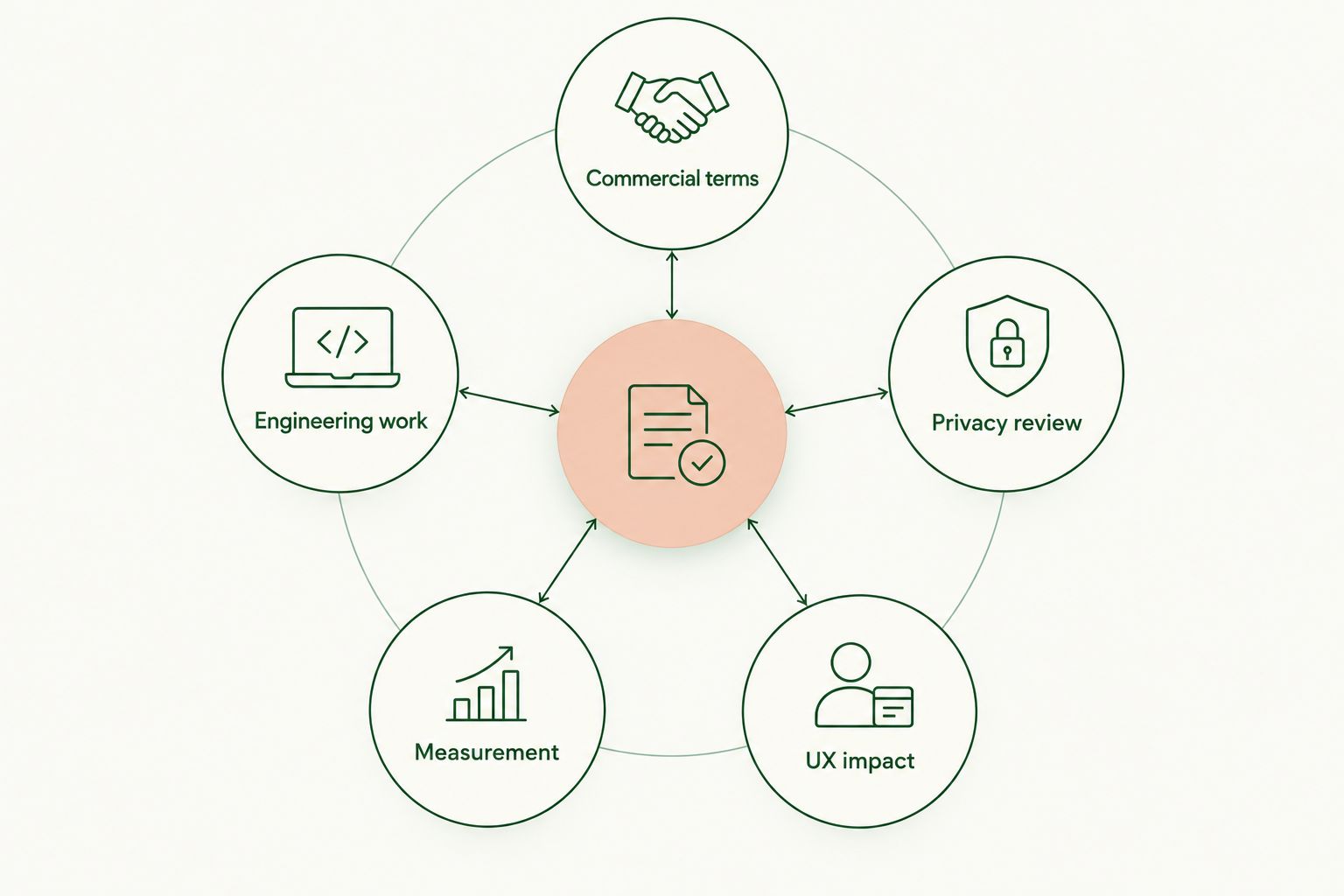
There is no universal ad SDK cost for an AI chatbot app in 2026. Your total cost combines the provider’s commercial terms with engineering, privacy, measurement, and user-experience work, so you need the current contract and an internal implementation estimate before setting a budget.
- The ad sdk cost for ai chatbot projects has no standard rate in 2026; contracts and implementation scope determine the total.
- Compare commercial terms, engineering work, privacy review, measurement, and UX impact before choosing an SDK.
- Elo fits developers seeking contextual conversational ads for OpenAI, Anthropic, or custom-LLM chat applications.
- Calculate net revenue after provider fees and operating costs; a low integration cost does not guarantee strong monetization.
Why this matters
An SDK quote covers only part of the decision. You also need to know what your team must build around it, which ad events you can measure, how ads fit into conversations, and how the provider gets paid.
Elo provides an SDK-based adserver for developers who want to place contextual, conversational ads inside AI chat applications. That product scope answers the technical-fit question, but every team still needs to compare current commercial terms and the internal cost of implementation in 2026.
A cheap contract becomes expensive when integration requires custom event handling, manual reporting, or repeated UX changes. A higher contract cost can still produce better economics when the SDK reduces development work and connects the app to relevant advertiser spend. Evaluate total cost and net revenue together.
How much does an ad SDK cost for AI chatbot apps?
The exact cost depends on the provider agreement and your implementation scope. Do not budget from a generic market estimate: request current terms, map the required engineering work, and calculate the effect on net ad revenue.
| Cost component | What to confirm | Why it changes the total |
|---|---|---|
| Provider terms | License, usage, revenue-share, minimum, support, and termination terms | Determines what you pay or retain under the contract |
| Engineering | SDK setup, authentication, event tracking, placement logic, and testing | Determines internal implementation labor |
| Infrastructure | Server calls, logging, storage, monitoring, and analytics | Adds operating cost outside the provider agreement |
| Privacy and compliance | Consent, data handling, disclosures, regional requirements, and review | Adds technical and legal work |
| User experience | Placement, frequency, relevance, fallback behavior, and controls | Affects whether ads support or damage the product experience |
| Measurement | Impression, click, action, revenue, latency, and retention reporting | Determines whether you can verify the economics |
This is the usable 2026 cost formula:
Total ad SDK cost = provider charges + implementation labor + infrastructure + compliance work + ongoing operations + UX impact.
The corresponding revenue formula is just as important:
Net ad revenue = advertiser-funded revenue − provider charges − internal operating costs.
Neither formula requires an assumed industry price. Both require terms and performance data from your own app.
Commercial terms: what belongs in the quote
An ad SDK agreement can use a license fee, usage charge, revenue share, minimum commitment, or a combination of terms. The label matters less than the complete payment structure.
Ask the provider to define:
- Which events create a charge or affect the revenue calculation.
- Whether commercial terms differ across CPM, CPC, and CPA campaigns.
- Which deductions occur before publisher revenue is calculated.
- Whether support, reporting, or additional environments carry separate terms.
- How invalid traffic, refunds, advertiser disputes, and adjustments are handled.
- How and when either side can change the agreement.
Do not compare a quoted fee from one provider with a revenue-share percentage from another as if they were the same unit. Convert each proposal into expected net revenue under the same traffic and engagement assumptions. Keep those assumptions identical across vendors.
Engineering work: what your team must build
The implementation estimate starts with your application architecture. An OpenAI app, an Anthropic app, and a custom-LLM application can expose different message objects, streaming behavior, tool calls, and client-server boundaries.
The engineering scope normally includes:
- Initializing the SDK in the correct application layer.
- Passing enough conversation context for ad matching without exposing unnecessary data.
- Defining when an ad request is allowed.
- Rendering a conversational ad without breaking the message flow.
- Recording impressions, clicks, actions, errors, and revenue events.
- Handling empty responses, timeouts, retries, and unavailable demand.
- Creating controls for testing, pausing, and changing placements.
Context passing deserves its own review. The matcher needs useful signals, but your application should not send every message field by default. Document the allowed context, excluded data, retention rules, and deletion behavior before implementation. The guide to matching ads to conversation context covers this decision in more depth.
Privacy review: data use changes the cost
Privacy work is part of implementation, not a final legal checkbox. Your team needs to know what data leaves the app, why it is sent, where it is processed, how long it is retained, and which controls apply to the user.
Build the review around specific data flows:
- User message enters the application.
- The application selects permitted context.
- The SDK or server sends an ad request.
- The provider returns an eligible ad response.
- The application renders or suppresses the ad.
- Measurement events return to the relevant systems.
Each handoff needs an owner and a documented purpose. Regional consent rules, sensitive topics, age-related restrictions, and customer contracts can expand the review. That work belongs in the 2026 budget because it directly affects architecture and launch readiness.
Measurement: prove the SDK’s economics
A cost comparison fails when providers report different metrics or apply different definitions. Set a shared measurement specification before launch.
Track the complete path from request to revenue:
- Eligible chat sessions.
- Ad requests.
- Returned ads.
- Rendered impressions.
- Clicks and attributed actions.
- Gross advertiser-funded revenue.
- Provider charges and adjustments.
- Net publisher revenue.
- Ad-response latency.
- Retention and engagement around exposed sessions.
CPM measures cost or revenue per thousand impressions. CPC measures cost or revenue per click. CPA attaches value to a defined action. These models answer different questions, so a high CPM does not automatically produce the best net result if fill, relevance, or retention is weak.
Create one event dictionary for your application, provider dashboard, and analytics stack. If the same event has different meanings across systems, reconciliation becomes an ongoing operating cost.
UX impact: ads must fit the conversation
Conversational ads occupy a different surface from display banners. The ad appears near generated responses, so placement, relevance, disclosure, and frequency affect whether users interpret it as useful or intrusive.
Budget for product work around:
- The point in a conversation where an ad becomes eligible.
- A clear distinction between generated content and sponsored content.
- Suppression during sensitive or inappropriate contexts.
- Frequency controls across sessions and users.
- Layout behavior on mobile, desktop, and embedded chat surfaces.
- Feedback and dismissal controls where the interface supports them.
The cost is not limited to design and engineering hours. Poor placement can affect engagement and retention, while weak disclosure can damage trust. Treat those outcomes as part of the business case rather than externalities that the SDK vendor owns.
Build internally or use a conversational ad SDK?
The correct option depends on which capabilities your team wants to own. Compare the alternatives on the same 2026 requirements.
| Option | Best for | Advantages | Disadvantages |
|---|---|---|---|
| Build an internal ad stack | Teams that require direct control over matching, serving, reporting, and advertiser operations | Full control over architecture and product rules | Requires engineering, advertiser operations, reporting, billing logic, and ongoing maintenance |
| Use general-purpose ad tooling | Teams adapting existing advertising infrastructure to a chat surface | Can fit an established ad-operations workflow | Chat context and conversational rendering can require custom work |
| Use a conversational ad SDK | AI chat developers seeking an SDK, contextual matching, and conversational ad delivery | Product scope matches the chat interface | Introduces a provider dependency and still requires integration, measurement, and UX review |
Elo is best for developers of OpenAI, Anthropic, or custom-LLM chat apps that need contextual conversational ads through an SDK-based adserver. The tradeoff is clear: you use an external adserver instead of owning the full serving stack, but you still own the quality of the integration inside your product.
Why ad SDK cost for AI chatbots varies
Six factors drive the difference between a small integration and a larger monetization project:
- Application architecture. Client rendering, server orchestration, streaming responses, and custom model gateways create different integration paths.
- Commercial structure. License, usage, revenue-share, and minimum terms produce different costs under the same traffic.
- Context requirements. Richer matching inputs require stricter decisions about data selection, privacy, and storage.
- Ad formats. Native cards, sponsored recommendations, and other conversational placements require different rendering and measurement logic.
- Analytics depth. Basic impression tracking costs less to operate than full revenue reconciliation and retention analysis.
- Compliance scope. Regions, user groups, sensitive topics, and customer agreements determine the required controls and reviews.
Ask every provider to price the same written scope. Otherwise, the cheapest proposal can simply be the proposal that excludes the most work.
How should you estimate implementation cost?
Use a task-level estimate rather than a single engineering guess.
- Document the chat architecture, supported models, clients, and deployment environments.
- Define eligible ad moments and excluded conversation contexts.
- Map data sent to the adserver and events returned to your systems.
- List rendering, disclosure, fallback, and frequency-control requirements.
- Define analytics events and reconciliation rules.
- Estimate build, review, testing, launch, monitoring, and maintenance work.
- Add the provider’s current commercial terms to the internal cost model.
- Compare net revenue under identical traffic assumptions.
Repeat the calculation when traffic, ad formats, regions, or provider terms change. A 2026 estimate based on one deployment scope should not be reused for a materially different application.
Evaluate Elo for your chat app
Review the SDK-based adserver for OpenAI, Anthropic, and custom-LLM chat applications.
Is revenue share cheaper than a subscription?
Neither structure is automatically cheaper. Revenue share changes with monetization performance, while a subscription creates a contractual cost independent of the revenue calculation; compare both using the same expected activity and internal operating costs.
The decisive metric is net revenue after every provider and operating cost. Contract labels do not answer that question.
How much engineering time should you budget?
Budget from the required tasks, application architecture, and review process rather than a generic SDK estimate. Include setup, context mapping, rendering, event tracking, failure handling, privacy review, QA, launch monitoring, and maintenance.
A short installation snippet does not represent the entire production integration. The surrounding controls determine whether the SDK is measurable, safe, and maintainable.
Which metrics determine whether the SDK is worth its cost?
Use net publisher revenue, fill rate, eCPM, ad-response latency, engagement, and retention. Compare exposed and unexposed sessions where your measurement design permits it, and reconcile provider reporting against your own event logs.
A provider can perform well on gross revenue while producing weaker net economics after charges and operating work. Your 2026 decision should use the complete result.
Is Elo the right ad SDK for your chatbot?
Elo fits developers who need an SDK-based adserver for contextual, conversational advertising inside AI chat applications. Its stated scope covers apps built on OpenAI, Anthropic, and custom LLMs.
The advantages are category alignment and support for multiple LLM approaches. The constraints are the same ones you should inspect with any external SDK: commercial terms, required data flows, implementation effort, measurement access, failure behavior, and provider dependency.
Choose Elo when its current terms, technical requirements, and expected net revenue beat the alternatives for your application. Skip any provider that cannot give your team enough information to model total cost and verify performance.
FAQ
How much does an ad SDK cost for an AI chatbot in 2026?
There is no universal ad SDK price for an AI chatbot in 2026. Total cost depends on provider terms, engineering, infrastructure, privacy, measurement, operations, and UX work.
Does Elo work with OpenAI and Anthropic chatbot apps?
Yes. Elo provides an SDK-based adserver for AI chat applications built on OpenAI, Anthropic, or custom LLMs.
What should an ad SDK quote include?
An ad SDK quote should define license, usage, revenue-share, minimum, support, adjustment, and termination terms that apply. It should also identify work and services excluded from the agreement.
Is revenue share better than paying an ad SDK fee?
Revenue share is better only when it produces stronger net economics under your application’s expected performance. Compare provider charges and internal operating costs under the same traffic assumptions.
What are the hidden costs of an AI chatbot ad SDK?
Hidden costs include integration labor, infrastructure, privacy review, analytics, revenue reconciliation, monitoring, maintenance, and UX changes. These costs sit outside the headline provider terms.
How do you compare ad SDKs for AI chatbots?
Compare technical fit, commercial terms, contextual matching, ad formats, data handling, measurement, latency, support, and expected net revenue. Use one written scope and one set of assumptions for every provider.
Can an ad SDK affect chatbot retention?
Yes. Placement, relevance, frequency, disclosure, and latency can change how users experience the chat product. Measure engagement and retention alongside ad revenue.
Should an AI chatbot build its own adserver?
Build an internal adserver when control over matching, serving, advertiser operations, and reporting justifies the engineering and operating work. Use an SDK when an external provider fits the product and produces better total economics.
One last thing
The contract rate is not the final cost. The useful 2026 decision metric is net revenue after provider charges, engineering, infrastructure, compliance, operations, and measurable UX impact.
Require every vendor and internal build proposal to use that same equation. It prevents a narrow SDK quote from winning against an option that produces better economics for the complete chatbot product.