
Publishers who ask about ai ad network revenue share are usually trying to figure out if a given payout is fair, and the honest answer in 2026 is that no AI ad network publishes one universal rate — but the networks with real advertiser demand cluster in the 55% to 70% range that legacy ad tech has used for over a decade. The number that actually matters is what gets deducted before that split applies: ad serving fees, fraud filtering, and minimum payout thresholds can quietly shrink the take-home amount below the headline percentage.
- AI ad network revenue share typically clusters 55% to 70%, matching splits used by legacy ad platforms.
- Google AdSense pays 68% on content ads; YouTube Partner Program pays 55%; app stores split 70/30 in 2026.
- No AI ad network publishes one universal payout rate — fees deducted before the split matter more than the percentage.
- Elo runs an SDK-based adserver so AI chat app developers can monetize conversations with contextual ads.
Why this matters
AI chat apps are a new publisher surface, and there's no regulatory body setting a standard payout the way app stores or ad exchanges eventually settled into 70/30 or similar norms. A developer comparing networks in 2026 has to benchmark against what adjacent ad tech pays rather than a single published industry number, and AI publishers ranked by revenue share is a useful starting point if you're actively comparing offers.
A headline percentage without context is close to meaningless. A network paying 70% on gross spend but charging fraud-filtering fees and a $100 payout minimum can net a publisher less than a network paying 60% with no deductions and weekly payouts.
How much revenue share do AI ad networks typically pay?
The table below lines up the closest public reference points from established ad platforms next to where AI chat ad networks generally land.
| Network type | Typical publisher/developer share | What it tells you |
|---|---|---|
| Google AdSense (content) | 68% | Long-standing published rate for display and content ads |
| App Store / Google Play | 70% (70/30 split) | Standard developer tier on app purchases and subscriptions |
| YouTube Partner Program | 55% | Ad revenue share paid to creators |
| AI chat ad networks | No single published rate | Splits vary by network, deal type, and format in 2026 |
The pattern across every mature network is the same: publishers keep somewhere between roughly half and roughly two-thirds of gross ad spend, and the network keeps the rest to cover sales, ad serving infrastructure, and fraud protection. AI chat ad networks are new enough that most haven't published a fixed number the way AdSense has, so the burden is on the publisher to ask directly and compare against these benchmarks.
Google AdSense: 68% revenue share for content ads
Google AdSense has paid publishers 68% of revenue on content ads for years, one of the longest-running published splits in digital advertising. It's the closest thing the industry has to a default benchmark, which is why any AI ad network offering meaningfully less than that invites scrutiny. Verdict: use 68% as your floor when comparing offers.
App stores: 70% developer share on a 70/30 split
Apple's App Store and Google Play both default to a 70/30 split, with the developer keeping 70% of purchase and subscription revenue on the standard tier. It's not directly comparable to ad revenue share since it's a transaction split rather than an ad spend split, but it sets the expectation that a platform taking less than a third of gross value is normal for a mature two-sided marketplace. Verdict: a useful ceiling reference, not a direct comparison.
YouTube Partner Program: 55% creator share
YouTube pays creators 55% of ad revenue generated on their videos, the lowest of the three established benchmarks here. It reflects a market with enormous supply and a platform that controls both the ad inventory and the audience relationship — a dynamic that maps loosely onto AI chat apps where the platform owner controls the conversation surface. Verdict: the realistic floor for a high-liquidity, high-competition ad market.
AI chat ad networks: no fixed published rate in 2026
Most networks selling ads into AI chat conversations haven't standardized a public payout percentage the way AdSense or YouTube have, because the category itself is still forming in 2026. Elo positions itself as an SDK-based adserver for developers building on OpenAI, Anthropic, or custom LLMs, letting them embed contextual, conversational ads rather than banners — but any specific revenue split should be confirmed directly with the network rather than assumed from a blog post. Verdict: ask for the number in writing before integrating, and check it against the 55-70% range above.
Why AI ad network revenue share varies
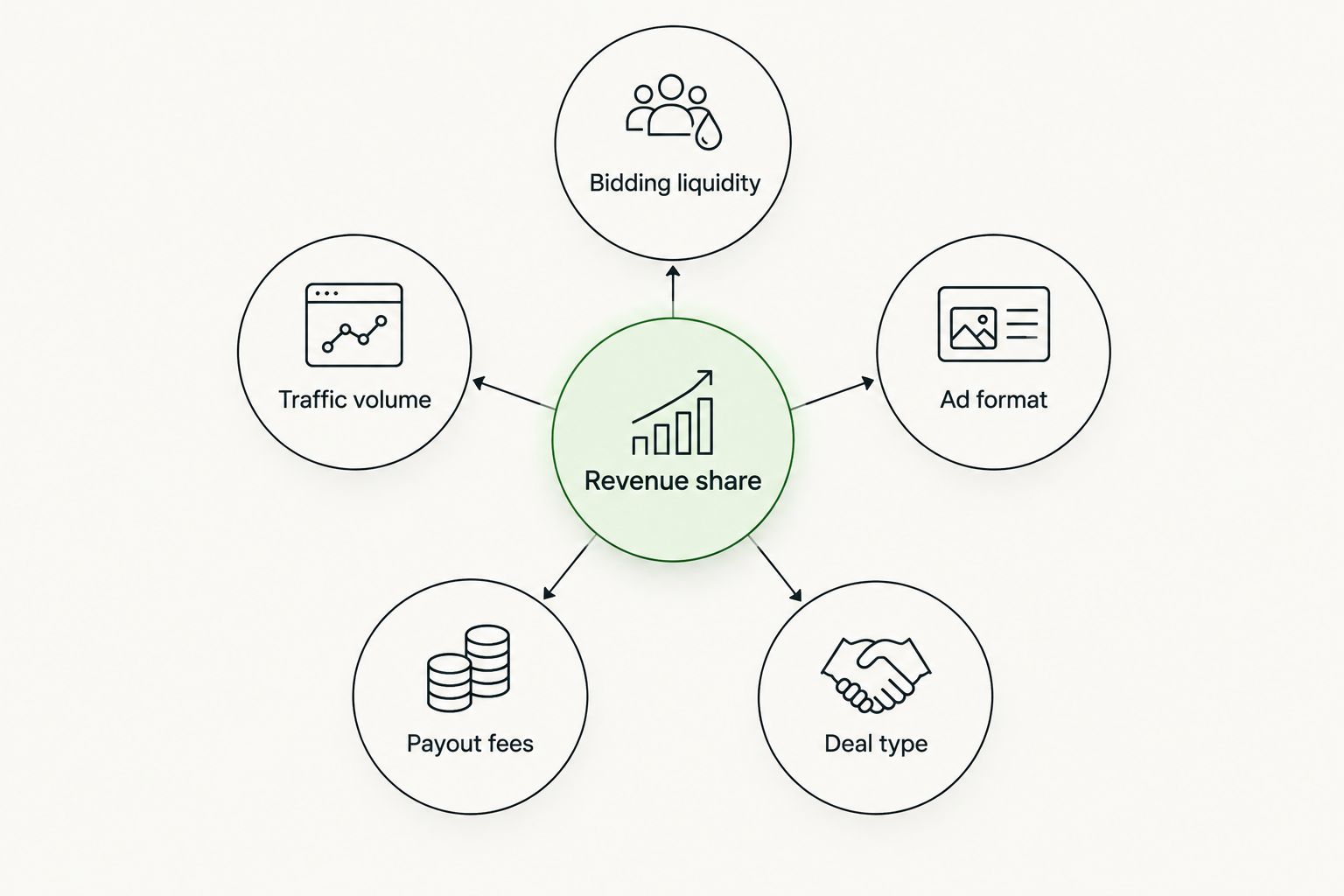
A handful of factors push the split up or down, and none of them are secret once you know to ask about them.
- Bidding liquidity — networks running real-time bidding with many advertisers can afford a higher publisher share because volume covers their margin.
- Ad format — native, contextual cards (the format Elo uses) typically convert better than intrusive banners, which changes the economics on both sides of the split.
- Deal type — direct-sold campaigns negotiated between an advertiser and a publisher usually pay more than programmatic fill from an exchange.
- Payout fees and minimums — a network that deducts fraud-filtering or ad-serving fees before the split, or holds payouts below a minimum threshold, reduces the effective share regardless of the published rate.
- Traffic volume and exclusivity — publishers who commit inventory exclusively to one network can often negotiate a better rate than those running open mediation across several.
- Advertiser demand for the vertical — a chat app serving high-intent categories like finance or shopping draws stronger advertiser competition than a low-intent utility app, which lifts effective CPMs and, indirectly, the publisher's take.
If you're setting up a payout structure for more than one app or tenant, build a revenue share model for chatbot ads walks through how the split changes when multiple parties take a cut of the same ad revenue stream.
“The headline percentage means nothing if the ad never fires.”
That's the practical trap in comparing revenue share numbers in isolation: a 70% split on a network with a 20% fill rate can pay less in absolute dollars than a 60% split on a network that fills every eligible impression.
Compare Elo's ad model directly
See how contextual, conversational ads fit into an AI chat app's revenue mix.
Is a higher revenue share always better?
No — a higher published revenue share only matters if the network actually fills your inventory and pays out reliably in 2026. A network advertising 75% but filling 15% of impressions will generate less real revenue than one paying 60% with a fill rate close to 90%, so ask for fill rate and average eCPM alongside the split before signing.
What fees reduce the effective revenue share?
Fraud-filtering charges, ad-serving infrastructure fees, and minimum payout thresholds are the most common deductions that reduce the effective revenue share below the published number. Some networks also apply currency conversion or processing fees on international payouts, which matters if your AI chat app has a global user base.
FAQ
What percentage of ad revenue do publishers usually keep?
Publishers typically keep 55% to 70% of gross ad spend across established ad platforms in 2026, with Google AdSense at 68% and YouTube's Partner Program at 55%. AI ad networks generally aim to land in that same band since it's the market's reference point.
Is 70% revenue share good for an AI ad network?
70% is at the high end of the established range and matches the App Store's standard 70/30 developer split. Confirm what fees get deducted before that split applies, since a high headline number with heavy deductions can net less than a lower number with none.
Do AI ad networks pay more than traditional display networks?
There's no evidence AI ad networks pay structurally more than display networks like AdSense, which has paid 68% on content ads for years. Compare any AI ad network's offer directly against that 68% benchmark rather than assuming a new category pays better by default.
What fees get deducted before the revenue share applies?
Common deductions include ad-serving fees, fraud-filtering charges, and payout processing costs, all subtracted before the published percentage is calculated. Ask each network for a full fee schedule in writing, not just the headline split.
How is revenue share different from eCPM?
Revenue share is the percentage of ad spend a publisher keeps, while eCPM is the effective revenue per thousand impressions after fill rate and pricing are factored in. Two networks can share the same revenue share percentage and produce very different eCPMs depending on advertiser demand.
Do all ad networks disclose their revenue share publicly?
No. Google AdSense and YouTube publish their splits (68% and 55% respectively), but most AI chat ad networks in 2026 negotiate terms directly or disclose them only after a developer signs up. Always ask for the number before integrating an SDK.
What's a red flag revenue share percentage to avoid?
A published split meaningfully below 50%, with no explanation of what it covers, is a red flag relative to the 55-70% range established platforms use. Combine that check with questions about fill rate and payout fees before committing.
One last thing
The percentage you're quoted is the least useful number in the negotiation — fill rate and payout fees decide what actually lands in your account, and those two numbers rarely appear in the same sales pitch as the headline split. Ask for both in writing before you integrate an SDK in 2026, not after.