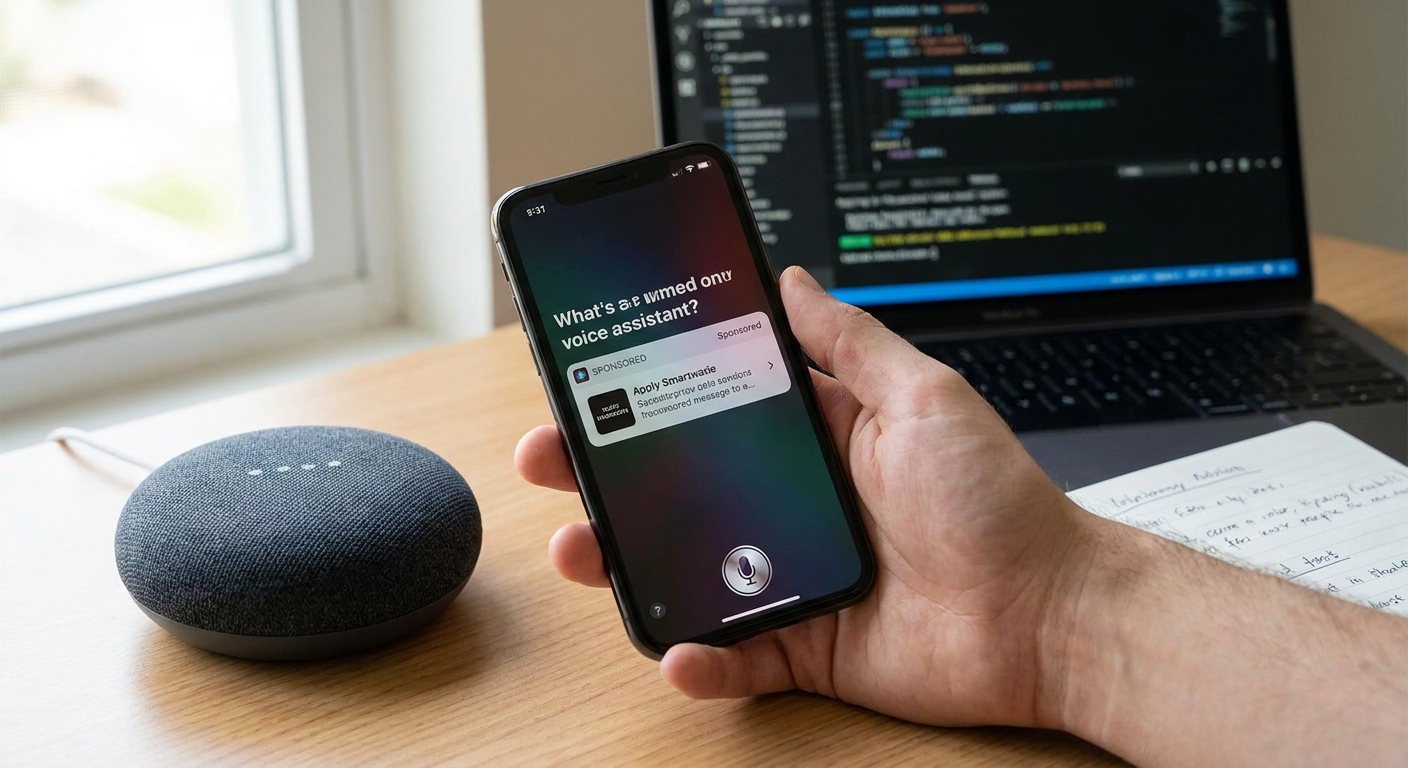
Voice assistants can't show a banner, a card, or a coupon code — every ad has to live inside the spoken conversation, which means native audio monetization works completely differently from chat or web. This guide walks through the SDK integration, turn-mapping, and compliance steps needed to add native ads to a voice AI assistant without turning it into a radio commercial.
- Adding native ads to a voice AI assistant means SDK-based ad mediation, not visual banners — the matching and delivery happen server-side.
- Insert sponsored lines after a natural pause in dialogue, never mid-turn, to cut ad fatigue in voice UI.
- Keep ad-fetch latency under 200ms or the sponsored line sounds like lag instead of a recommendation.
- Collect consent before the first ad request fires — GDPR and CCPA compliance can't be retrofitted after launch.
- Cap frequency at one sponsored mention per session in 2026; voice has no skip button so timing matters more than volume.
Why this matters
A chat interface can drop a native card next to the response and let the user glance past it. A voice assistant has no glance — the ad either gets spoken, or it doesn't exist. That constraint changes everything: matching has to be tighter, timing has to be exact, and one poorly placed sponsored line can end the session instead of getting ignored.
Developers building on OpenAI, Anthropic, or a custom LLM stack for voice products in 2026 are hitting the same wall chat developers hit two years earlier: usage is growing, but the assistant itself generates no revenue unless something inside the conversation is monetized. Native ads solve that without adding a paywall or a subscription tier.
What you'll need
- An ad SDK built for conversational surfaces, not a display or web SDK repurposed for chat
- A mapped conversation-turn structure showing where the assistant can insert a sponsored line without cutting off user intent
- A consent and compliance flow already wired into the voice pipeline, before any ad call fires
- A test environment using the same text-to-speech voice as production, so sponsored lines sound native
- An analytics hook that logs ad impressions per session for revenue-per-user tracking
The steps
1. Map your conversation turns
Before any SDK gets touched, chart where a sponsored line could fit without interrupting a task. A voice assistant answering a scheduling request has a natural pause after confirmation — that's a placement point. Mid-sentence, mid-command, or during an active task handoff is not. Get this map wrong and every later step compounds the mistake.
2. Choose an ad SDK built for chat and voice, not display
Display ad SDKs assume a screen. Voice needs a server-side matcher that returns text formatted for TTS, not HTML or image assets. Elo runs as an SDK-based adserver built for exactly this — developers on OpenAI, Anthropic, or custom LLM stacks integrate it to match and deliver contextual ads inside the conversation itself, not bolted on as a banner. Pick an SDK that returns plain, speakable copy by default.
3. Wire consent before the first ad call
Consent has to be captured and logged before the SDK ever requests an ad, not after the first sponsored line plays. Retrofitting consent into a live voice pipeline means re-architecting the request flow — do it in the initial build instead. This step alone determines whether the integration is GDPR-defensible in 2026.
4. Match ads to context, not keywords alone
Keyword matching on a voice transcript produces mismatched, tone-deaf placements — a support call about a canceled flight is not the moment for a travel-booking ad. Context matching looks at intent and conversation state, not just the last utterance. Ad mediation built for voice AI assistants routes requests across multiple demand sources so a mismatch in one network doesn't kill the placement entirely.
5. Convert the ad unit into a spoken, native format
The SDK response needs to read like a recommendation, not a script. "Since you're planning that trip, here's a fare alert worth checking" works. A read-aloud banner headline does not. Strip any HTML, truncate to a single sentence where possible, and test the TTS output at production speed before shipping.
6. Test the integration end-to-end before launch
Run the full request-to-speech pipeline in a staging environment with real conversation scripts, not synthetic test strings. Testing the ad SDK integration before launch catches latency spikes, malformed TTS output, and consent-flow gaps before a real user hears any of it. Skipping this step is the single most common cause of launch-day ad complaints.
7. Launch with a frequency cap
Start at one sponsored mention per session, not per turn. Voice users can't scroll past an ad the way chat users skim past a card, so over-serving burns trust fast. Avoiding ad fatigue in AI chat interfaces applies directly to voice — the frequency logic is the same, the tolerance is lower.
“A voice interface has no skip button — one badly timed ad can end the session, not just get ignored.”
8. Monitor revenue and iterate weekly
Check impressions-per-session and revenue-per-active-user on a weekly cadence for the first month, then monthly after. Matcher drift shows up fast in voice because there are fewer placement slots per session to average out a bad match.
Add native ads to your voice assistant
Integrate contextual, spoken-native ads without touching your conversation UX.
Troubleshooting
- Sponsored line interrupts an active task. The turn map was built off a text transcript, not the actual audio timing — rebuild it against recorded session audio, not just the text log.
- Ad-fetch latency adds noticeable lag. Anything over 200ms of added wait time before the assistant speaks reads as a stall. Move the ad request earlier in the response pipeline so it resolves in parallel with the LLM's own generation.
- Users complain the ad sounds robotic. The SDK returned copy formatted for a screen, not speech. Force plain-sentence output and re-test at production TTS speed.
- Ad matches feel random or off-topic. The matcher is running on keyword extraction instead of conversation context — check whether the ad SDK ingests intent state or only the last transcript line.
- Session drop-off spikes right after a sponsored mention. The frequency cap is too aggressive. Pull back to one mention per session and re-measure before adjusting anything else.
- Compliance review flags the launch. Consent wasn't logged before the first ad call. That's a build-order problem, not a copy problem — fix the request sequence, not the disclosure language.
Tools and resources
- A conversation-turn map (spreadsheet or state diagram) showing valid ad-insertion points
- A staging environment with production-identical TTS settings
- Revenue-per-user measurement for chatbot ad placements to track whether the integration is actually generating meaningful RPM once live
- A consent-logging layer wired ahead of the ad request, not after
- A rollback plan that disables ad calls without redeploying the whole voice pipeline
What to do next
Once the SDK is live and frequency capping is stable, the next problem is almost always ad fatigue creeping back in as session volume grows — revisit the frequency-cap guide monthly rather than setting it once and forgetting it. Pair that with the revenue-per-user tracking from step 8 so drift gets caught before it shows up as a drop in weekly RPM.
FAQ
What's the best way to add native ads to a voice AI assistant?
Integrate an ad SDK built for conversational surfaces, map your conversation turns for valid insertion points, and convert every ad unit into a single spoken sentence rather than reusing display ad copy. Consent and frequency capping have to be built in from day one, not added after launch.
Is voice ad monetization different from chat ad monetization?
Yes — chat can show a visual native card the user glances past, but voice has no visual layer, so every ad has to be spoken. That means tighter frequency caps, stricter latency budgets, and copy written for text-to-speech, not screens.
How much can a voice AI assistant earn from ads in 2026?
Revenue depends on session volume, advertiser demand in your category, and how tightly ads match conversation context — there's no fixed rate. Tracking revenue per active user weekly is the reliable way to see what your specific traffic actually generates.
Do voice ads need disclosure?
Sponsored content in a voice assistant should be identifiable as an ad in the same way any native placement needs disclosure, and consent for ad personalization has to be captured before the first ad request under GDPR and CCPA.
Can I run ads on a Claude-based or custom LLM voice assistant?
Yes — ad SDKs built for conversational apps work across OpenAI, Anthropic, and custom LLM stacks since the matching happens on conversation context, not the underlying model provider.
How do I avoid ad fatigue in a voice interface?
Cap sponsored mentions at one per session rather than per turn, and only insert them at natural pauses in the dialogue. Voice tolerance for repeated ads is lower than chat because there's no way to scroll past a spoken line.
Is consent required before showing a sponsored recommendation?
Yes — consent needs to be logged before the ad SDK makes its first request, not after the sponsored line has already played. Retrofitting consent into a live pipeline is far harder than building it in from the start.
How long does SDK integration take for a voice assistant?
Timeline depends on how well the conversation turns are already mapped — teams with a clear turn structure integrate faster than teams still figuring out where ads should live in the dialogue. Testing the full pipeline end-to-end before launch is the step most teams underestimate.
One last thing
The instinct with voice monetization is to treat it like chat with extra steps — same matcher, same frequency logic, just spoken out loud. It isn't. Chat users can ignore a card with their eyes; voice users can't ignore a sentence spoken directly to them, which means the tolerance for a bad match is lower and the cost of over-serving is higher. Build the frequency cap tighter than you think you need in 2026, and loosen it later once the revenue-per-user data says it's safe.