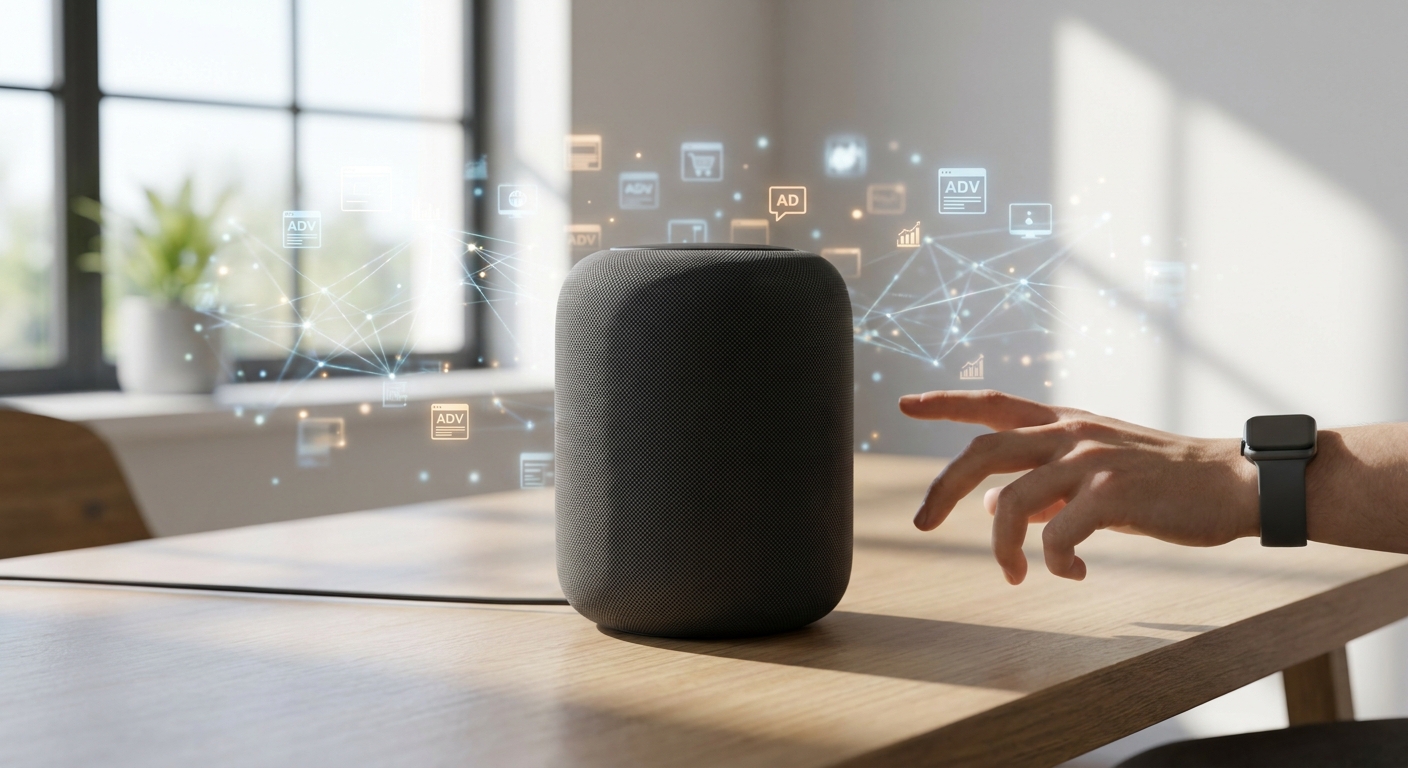
Voice AI assistants don't have banners, click targets, or scroll depth — they have turns of spoken or transcribed dialogue, and that changes everything about how ad mediation has to work. This guide breaks down what actually matters when you pick ad mediation for voice AI assistants built on OpenAI, Anthropic, or a custom LLM stack in 2026.
- Ad mediation for voice AI assistants has to fit inside spoken turns, not visual real estate — Elo's SDK integrates in about twelve lines of code.
- Custom LLM voice apps need a matcher tuned to intent, not keyword lookup; Elo's contextual advertising for custom LLM chatbots is built for that.
- OpenAI GPT-based voice assistants get the fastest path to production in 2026; Anthropic Claude apps need stricter transcript handling. Buy for both.
- Skip any mediation vendor that only ships banner cards — voice sessions have no banner to show. Match the SDK to your model stack first.
Why this matters
A voice session is short, often under two minutes, and every millisecond of added latency is audible dead air. Text-chat ad mediation was built for a UI that can render a card while the user reads the rest of the response; voice can't do that. If the ad copy isn't spoken cleanly, or the pause before it lands feels wrong, users hang up.
That's a different engineering problem than mediation for OpenAI GPT chat apps, where a native card can sit quietly below the response text. Voice-first apps need the matcher, the pacing, and the ad format to work with zero screen at all.
Who this is for
This guide is for developers and product leads shipping a voice-first assistant — smart speaker skills, in-car voice agents, IVR replacements, or voice-first customer support bots — running on OpenAI's Realtime API, Anthropic's Claude, or a custom LLM pipeline, who want ad revenue without wrecking the conversation.
What to look for in ad mediation for voice AI assistants
TTS-readable ad delivery, not visual cards
If the mediation layer's default unit is a banner or a card, it's built for chat UIs, not voice. The ad copy needs to be short enough to speak naturally and phrased so it doesn't sound like an interruption when read by text-to-speech.
Latency overhead per turn
Voice UX generally targets response latency budgets under 300ms to avoid audible dead air, and an ad decision that adds a noticeable pause will get noticed before the ad copy does. Ask any vendor for their p95 decision time, not just their average.
Intent-based contextual matching
Keyword matching on a voice transcript misses tone, urgency, and half-finished sentences — voice transcripts are messier than typed chat. A matcher built on intent, not string matching, is what keeps the ad relevant instead of random.
Revenue model flexibility
Voice sessions vary wildly in length — a 15-second command versus a 90-second troubleshooting call — so a mediation layer locked into one pricing model (say, CPM only) leaves money on the table. Look for CPM, CPC, and CPA support in the same SDK.
Multi-model SDK support
Voice assistants get rebuilt on new model backends more often than chat apps do. A mediation SDK that only supports one framework becomes a rebuild the day you swap OpenAI for Claude or move to a custom RAG pipeline.
Transcript privacy handling
Voice transcripts capture more incidental personal detail than typed chat — names, locations, account numbers said out loud. The mediation layer needs a clear answer for what gets passed to the matcher and what gets stripped before matching.
Top picks by integration path
OpenAI GPT-based voice assistants — the default pick. If you're running the Realtime API or an Assistants-based voice pipeline, this is the most mature integration path in 2026, and the fastest to ship. Verdict: Buy if your voice assistant already runs on OpenAI infrastructure.
Custom LLM voice assistants — the flexible pick. Built for teams running their own inference stack instead of a hosted API, this path matches on intent signals extracted from the transcript rather than a fixed prompt template. Verdict: Buy if you control your own model layer and need the matcher to adapt to a non-standard output format.
RAG-based voice assistants — the knowledge-base pick. Voice agents that pull answers from a retrieval layer (support bots, internal tools, in-car assistants referencing a manual) need ad matching that reads the retrieved context, not just the user's spoken query. Verdict: Buy for any voice assistant answering from a document store rather than pure generation.
Claude-based voice assistants — the safety-conscious pick. Teams on Anthropic's Claude models tend to have stricter content and transcript-handling requirements, and this integration path is built around that constraint rather than around it as an afterthought. Verdict: Buy if your assistant runs on Claude and compliance review is part of your launch checklist.
A fifth path exists for voice-first customer support bots specifically — see Related guides below for that one, since it deserves its own read.
See ad mediation for voice AI assistants
Twelve lines of code to add contextual ads to your voice or chat assistant.
What to avoid
- Mediation SDKs that only ship a visual ad unit. If the demo only shows a card in a chat window, ask directly how it handles a voice-only session — a lot of vendors don't have an answer.
- Fixed-format ad copy that can't be shortened for TTS. Ad copy written for reading, not hearing, sounds robotic and gets skipped or muted.
- Single-model lock-in. A mediation SDK tied to one LLM provider becomes a migration project the moment you change model backends, which happens more often in voice than in chat.
Verdict comparison
| Integration path | Latency sensitivity | Matching basis | Model support | Verdict |
|---|---|---|---|---|
| OpenAI GPT-based voice | High | Intent + transcript | OpenAI Realtime/Assistants | Buy |
| Custom LLM voice | High | Intent + custom context | Any custom stack | Buy |
| RAG-based voice | Medium-High | Retrieved context + query | RAG pipelines | Buy |
| Claude-based voice | High | Intent + transcript, compliance-first | Anthropic Claude | Buy |
| Customer support voice bots | Medium | Intent + ticket context | Multi-model | See dedicated guide |
FAQ
What is ad mediation for voice AI assistants?
Ad mediation for voice AI assistants is the layer that decides which ad to insert into a spoken conversation, matches it to the transcript's intent, and delivers it in a format text-to-speech can read naturally. Unlike chat mediation, it has no visual card to fall back on.
Does ad mediation add latency to a voice assistant?
Any mediation layer adds some decision time, and the target for voice UX is generally under 300ms to avoid audible dead air. Ask vendors for their p95 decision latency, not just an average, before integrating.
Can voice AI assistants use the same ad mediation SDK as chat apps?
Some SDKs support both, but a mediation layer built only for visual chat cards won't translate to voice without a TTS-readable ad format. Check whether the vendor has a dedicated voice output mode before assuming parity.
Is contextual matching better than keyword matching for voice ads?
Yes — voice transcripts are messier than typed chat, with half-finished sentences and filler words, so keyword matching misses context that intent-based matching catches. This matters more in voice than in text-based chat.
How much code does it take to add ad mediation to a voice assistant?
Elo's SDK integrates in about twelve lines of code for chat and voice-adjacent apps built on OpenAI, Anthropic, or custom LLMs. Actual integration time depends on how your voice pipeline passes transcripts to the mediation call.
What revenue models work for voice ad mediation?
CPM, CPC, and CPA models all apply, and the right one depends on session length — a 15-second voice command monetizes differently than a 90-second troubleshooting call. Look for an SDK that supports more than one pricing model.
Do voice AI assistants need special privacy handling for ads?
Voice transcripts often capture more incidental personal detail than typed chat, so the mediation layer needs a clear policy on what gets passed to the ad matcher. This is a bigger risk in voice than in chat because users say things out loud they'd never type.
Which model backend has the most mature voice ad mediation support in 2026?
OpenAI's Realtime and Assistants API paths currently have the most mature integration options for voice ad mediation in 2026, with Anthropic Claude and custom LLM paths built around stricter transcript-handling requirements.
One last thing
The teams that get voice ad mediation wrong almost always ship a chat-first ad unit and bolt voice on later — the ad copy reads fine on screen and sounds wrong out loud. Build the TTS-readable version first in 2026, and the chat card becomes the easy add-on, not the other way around.