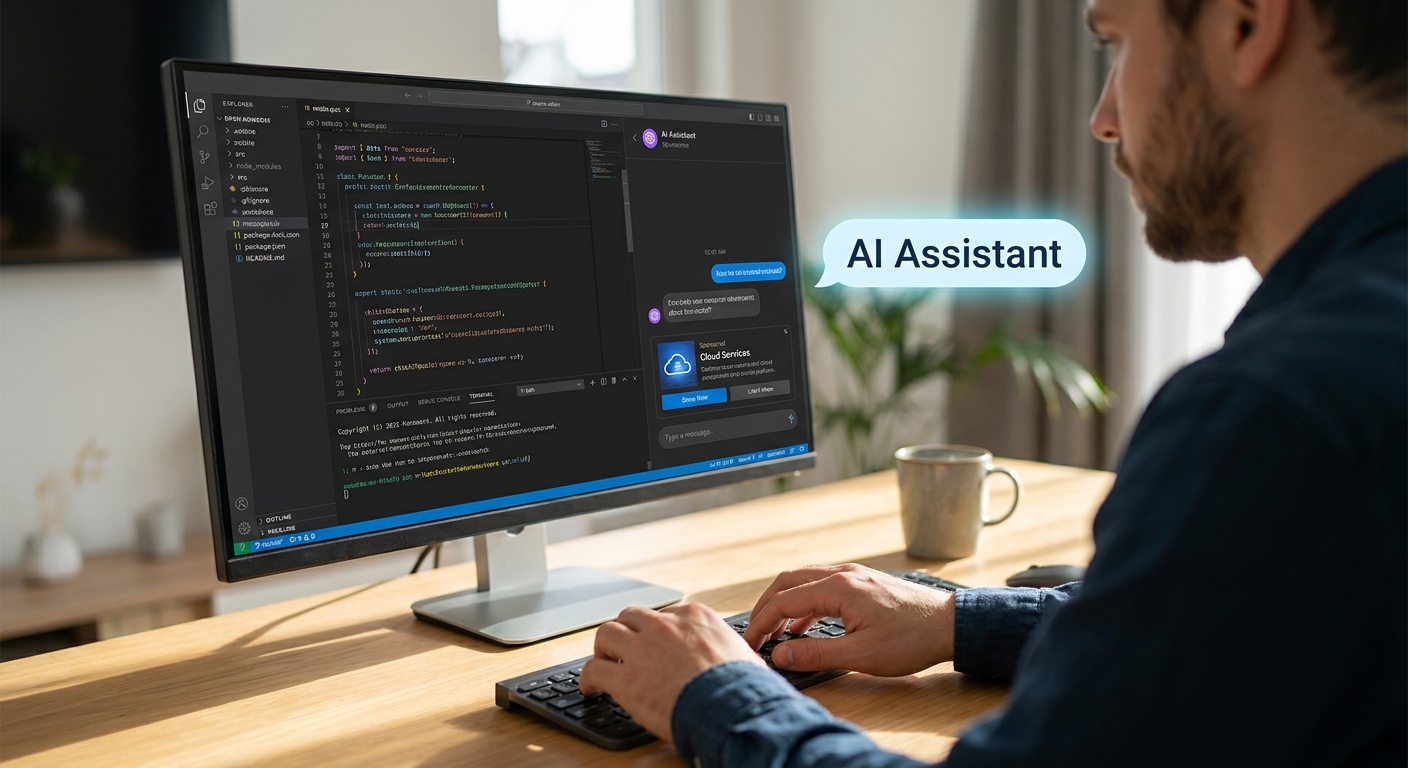
AI coding assistants log thousands of chat turns per developer every month, and most of those turns never convert into a paid seat. In-chat ads for AI coding assistants monetize that traffic directly, inside the conversation, without a banner stapled to the sidebar.
- In-chat ads for AI coding assistants work best as native cards matched to code context, not banners bolted onto a chat panel.
- Browser-based copilots get the highest fill rates because query intent is explicit: library name, framework, or error message.
- Custom LLM coding assistants need contextual advertising built for self-hosted models, not a generic display SDK.
- Claude-based coding tools need a matcher built for Claude's response format, not a repurposed OpenAI integration.
- Multi-model coding assistants that route between providers need ad mediation, not a single-network SDK.
Why this matters
A coding assistant with 50,000 monthly active developers and a 2% paid-conversion rate is leaving 98% of its traffic unmonetized. In-chat ads change that math without touching the free tier's core experience. The mechanics are covered in detail in how to monetize an AI chatbot with conversational ads, but the short version: a matcher reads the conversation context and inserts a relevant offer as a native card, not a pop-up.
Coding assistants are a specific case. The queries are technical, the users are ad-averse, and the chat UI is often embedded inside an IDE panel or browser extension where a banner would break the layout. Getting in-chat ads right for this audience in 2026 means matching the criteria below before picking an integration path.
Who this is for
This guide is for developers and product leads running AI coding assistants — IDE copilots, browser-based coding tools, Slack or Discord dev bots, or a custom LLM wrapper — who have real chat volume and no monetization layer yet. If your coding assistant is pre-launch or has fewer than a few hundred daily active developers, ad revenue won't move the needle yet; fix distribution first.
If you're already past that stage and asking how to turn chat volume into revenue without adding friction, the rest of this guide is for you.
What to look for in in-chat ads for AI coding assistants
Code-context relevance
A developer asking about a null pointer exception in Java should not see a generic productivity-app ad. The matcher needs to parse the actual query — language, framework, error type — and surface something relevant, like a dev tool or cloud service. Generic keyword matching built for retail chat misses this entirely.
Non-blocking rendering
Any added latency inside a code completion flow gets noticed immediately. The ad has to render as a native card after the model's response, not delay it. If the SDK sits in the request path instead of the response path, skip it.
Model coverage across OpenAI, Anthropic, and custom LLMs
Coding assistants increasingly route between models depending on the task. An ad layer tied to one model's output format breaks the moment you add a second one. Look for a matcher that works against the response text itself, not a specific model's formatting quirks.
Fill rate for a technical audience
Developers are the hardest audience to sell generic ads to, but the best audience to sell dev tools, cloud infrastructure, and API products to. Fill rate depends on whether advertiser demand actually targets technical buyers, not household consumer categories.
Revenue transparency
You need to see CPM, CPC, and CPA broken out per placement, not a single opaque payout number once a month. A dashboard or event log that shows which conversations earned what is the difference between optimizing and guessing.
Native card format, not a banner
A card that reads like part of the chat — same font, same bubble style — gets read. A banner injected into an IDE sidebar gets ignored or blocked by the extension host. Format is not cosmetic here; it's the difference between revenue and zero clicks.
See the SDK before you pick an integration path
Twelve lines of code, native cards, revenue from every chat.
Top picks by integration path
The default pick for browser-based copilots
Browser-based coding copilots and web IDE extensions have the cleanest ad-matching signal: the query text is explicit, the response is rendered in a controllable panel, and there's no cross-model routing to account for. Ad monetization for browser-based AI copilots integrates as a native card inside the existing chat panel, adding zero layout changes. Verdict: Buy.
The pick for teams running their own model
If your coding assistant runs on a fine-tuned or fully custom LLM instead of a hosted API, the matcher needs to work off raw response text rather than a provider's structured output. Contextual advertising for custom LLM chatbots is built for exactly that case — no dependency on OpenAI or Anthropic's response schema. Verdict: Buy if your monthly active developer count is already in the thousands; Consider if you're still under a few hundred.
The pick for assistants that route across models
Some coding assistants pick a model per task — one for autocomplete, another for refactoring, a third for chat. Ad mediation SDK for multi-model LLM apps sits above the routing layer so ad matching doesn't break when the underlying model changes mid-session. Verdict: Consider — worth the extra integration step once you're running more than one model in production.
The pick for Claude-based coding tools specifically
Claude's response formatting differs enough from OpenAI's that a generic matcher built for GPT output underperforms on Claude-based assistants. Ad mediation SDK for Anthropic Claude apps is tuned to Claude's response structure rather than adapted from a GPT integration. Verdict: Consider if Claude is your primary or sole model in 2026.
What to avoid
- Generic display ad SDKs retrofitted for chat. Built for retail and consumer apps, they match on broad keywords and surface ads that feel out of place next to a stack trace.
- Banner units inside an IDE panel. They break the layout, get blocked by extension hosts, and train users to ignore the entire sidebar.
- A single-model-only integration when your roadmap includes a second model. Ripping out and replacing the ad layer later costs more engineering time than choosing a mediation-ready SDK up front.
Verdict comparison
| Integration path | Best for | Model coverage | Verdict |
|---|---|---|---|
| Browser-based copilots | Web IDE extensions, in-browser chat panels | Single model, explicit query text | Buy |
| Custom LLM coding assistants | Self-hosted or fine-tuned models | Any model, response-text based | Buy / Consider |
| Multi-model LLM apps | Assistants routing across providers | OpenAI, Anthropic, custom | Consider |
| Claude-based coding tools | Anthropic-only coding assistants | Claude specifically | Consider |
FAQ
What are in-chat ads for AI coding assistants?
In-chat ads for AI coding assistants are native ad cards inserted into the chat response based on the developer's query context, rather than banners placed outside the conversation. They run through an SDK that matches the ad to the code question being asked.
Do in-chat ads slow down code completion?
They shouldn't, if the ad renders after the model's response rather than inside the request path. Any SDK that adds perceptible latency to the completion flow fails the non-blocking criterion and should be skipped.
Can I run in-chat ads in a Claude-based coding assistant?
Yes, but a matcher built specifically for Claude's response format performs better than a GPT-adapted integration. Ad mediation SDK for Anthropic Claude apps is built for that response structure.
How much revenue can an AI coding assistant earn from in-chat ads?
Revenue depends on daily active developers and how much advertiser demand exists for dev-tool and cloud-infra categories, which is broken out per placement on a CPM, CPC, and CPA basis in the dashboard rather than a single flat rate.
Do developers actually respond to ads inside a coding assistant?
Developers respond to native cards matched to their actual query, like a relevant dev tool or API, far more than to generic banners. Format and relevance drive engagement more than placement frequency.
What's the difference between in-chat ads and a banner ad in a dev tool?
A banner sits outside the conversation and gets ignored or blocked by extension hosts. An in-chat ad renders as part of the chat bubble itself, styled to match the surrounding text.
Does an ad SDK support coding assistants that route across multiple models?
Ad mediation SDKs built for multi-model LLM apps sit above the model-routing layer so ad matching keeps working when the assistant switches between OpenAI, Anthropic, or a custom model mid-session.
How long does it take to integrate an ad SDK into a coding assistant?
Integration is designed to take a small amount of code — Elo's SDK is built around a twelve-line integration for the core matcher call, with additional setup depending on which model routing you're running in 2026.
One last thing
The chats that don't convert are the ones with the most monetization upside, because they're the traffic you'd otherwise earn nothing from. A developer who asks a coding assistant a question and never upgrades to a paid seat still generated a chat turn with a matchable context — that's revenue sitting on the table in every free-tier session running in 2026.