
Native advertising is the better fit for chat apps when an ad can respond to the conversation without masquerading as the assistant’s answer. Banner ads remain useful when you have a separate display placement; neither format wins on revenue without a test in your own app.
- For native advertising vs banner ads chat apps, native wins on conversational fit; banners suit separate display space.
- Elo is best for publishers building contextual ads into AI chat, not for apps that only need banner inventory.
- Label sponsored content, keep it distinct from the assistant’s answer, and compare publisher RPM alongside user behavior.
Is native advertising better than banner ads for chat apps?
Yes for conversational placement; not automatically for revenue. A native ad can appear as a clearly labeled card related to a user’s request. A banner occupies a separate display area and does not need to interpret the exchange. The better choice depends on where the ad appears, whether the user can distinguish it from the answer, and what each format earns without damaging the conversation.
| Decision point | Native ad in chat | Banner ad outside the conversation |
|---|---|---|
| Best for | A relevant offer beside a clear moment of user intent | A persistent display placement separate from the assistant’s reply |
| Main advantage | The offer can reflect conversation context | The ad stays visually apart from the answer |
| Main drawback | Poor labeling can make promotion look like advice | A fixed placement can compete with the chat interface for space |
| Publisher work | Set context, matching, disclosure, and placement rules | Set placement, rendering, and display measurement rules |
| What to measure | Eligible opportunities, rendered ads, engagement, publisher RPM, and chat behavior | Rendered impressions, engagement, publisher RPM, and chat behavior |
Why this matters
A chat app sells attention at a point where the user expects a useful answer. Put a promotion in the wrong place and you change the answer experience, even if the ad earns a click. Put a relevant, labeled offer beside an appropriate answer and the commercial message has a clear role.
For publishers considering Elo, the distinction is practical: Elo provides an SDK-based adserver for contextual, conversational ads in AI chat applications. That makes it relevant when you control the chat interface and want to earn from advertiser spend. Elo is best for developers adding contextual ads to AI chat apps; it is not the answer to a requirement for conventional banner-only inventory.
Native ads: better for a relevant moment in chat
A native placement uses the structure of the chat interface rather than a separate banner slot. In an AI recipe assistant, for example, a sponsored offer belongs beside a relevant cooking request, not inside the recipe instructions. The offer must remain identifiable as advertising. Relevance explains why it appeared; disclosure explains what it is.
That distinction is the case for native advertising in 2026. A conversational ad can take account of what the user is asking now. It also requires stricter product decisions than a banner: which requests qualify, what context is sent for matching, where the card appears, and what happens when no suitable ad exists.
Best for: publishers whose app has identifiable moments of commercial intent and room for a distinct sponsored card.
- Pros: The placement can relate to the current request, fit the chat layout, and appear near the point where the offer is useful.
- Cons: Context matching takes implementation work. A weak match is distracting, and an ad styled as the assistant’s own recommendation can mislead the user.
Do not treat every message as an ad opportunity. A user asking for a calculation, a sensitive answer, or help fixing an error has a different task from a user asking for options. Define eligible moments by the user’s task, not by the fact that a response is about to render.
Banner ads: better for a separate display slot
A banner makes sense when the app already has a display area that stays apart from the message thread. The user can read the answer without treating the ad as part of it. That separation is a genuine advantage when the conversation calls for a clean, uninterrupted response.
Best for: chat interfaces with space for display inventory and no need to match an offer to a particular turn.
- Pros: A separate placement makes the boundary between advertising and assistant output easier to maintain. It does not require an ad to be selected from conversation context.
- Cons: A fixed slot uses interface space regardless of whether its message is relevant. On a compact chat screen, the placement can compete with the conversation itself.
A banner is not a failed native ad. It serves a different placement strategy. If your product cannot present a sponsored card without interrupting the answer or confusing its source, keep advertising outside the message thread. The same rule applies in 2026: an ad format must fit the interface before you judge its yield.
Why the better format varies
The native advertising vs banner ads chat apps decision turns on product constraints, not a universal engagement claim. Check these factors before choosing a format:
- Conversation context. Can the app identify a request that makes a particular offer relevant? If not, contextual placement loses its main reason to exist.
- Interface space. Is there room for a sponsored card in the thread, or is a separate display slot easier to distinguish from the answer?
- Answer integrity. Can you show the ad without inserting advertiser copy into the assistant’s response? Keep the answer and promotion separate.
- Disclosure. Will a user immediately recognize who is speaking? A native card needs a visible sponsored label, not just different styling.
- Measurement. Can you count eligible opportunities, rendered ads, and publisher revenue consistently for both formats? Without comparable definitions, an RPM comparison is unreliable.
- User control. Can users continue the conversation without engaging with the ad? If the ad blocks the task, its placement needs work before its yield matters.
These factors give you a decision rule for 2026: choose native when context adds a useful reason to show an offer and the interface keeps it clearly sponsored. Choose a banner when separation from the answer matters more than turn-level relevance.
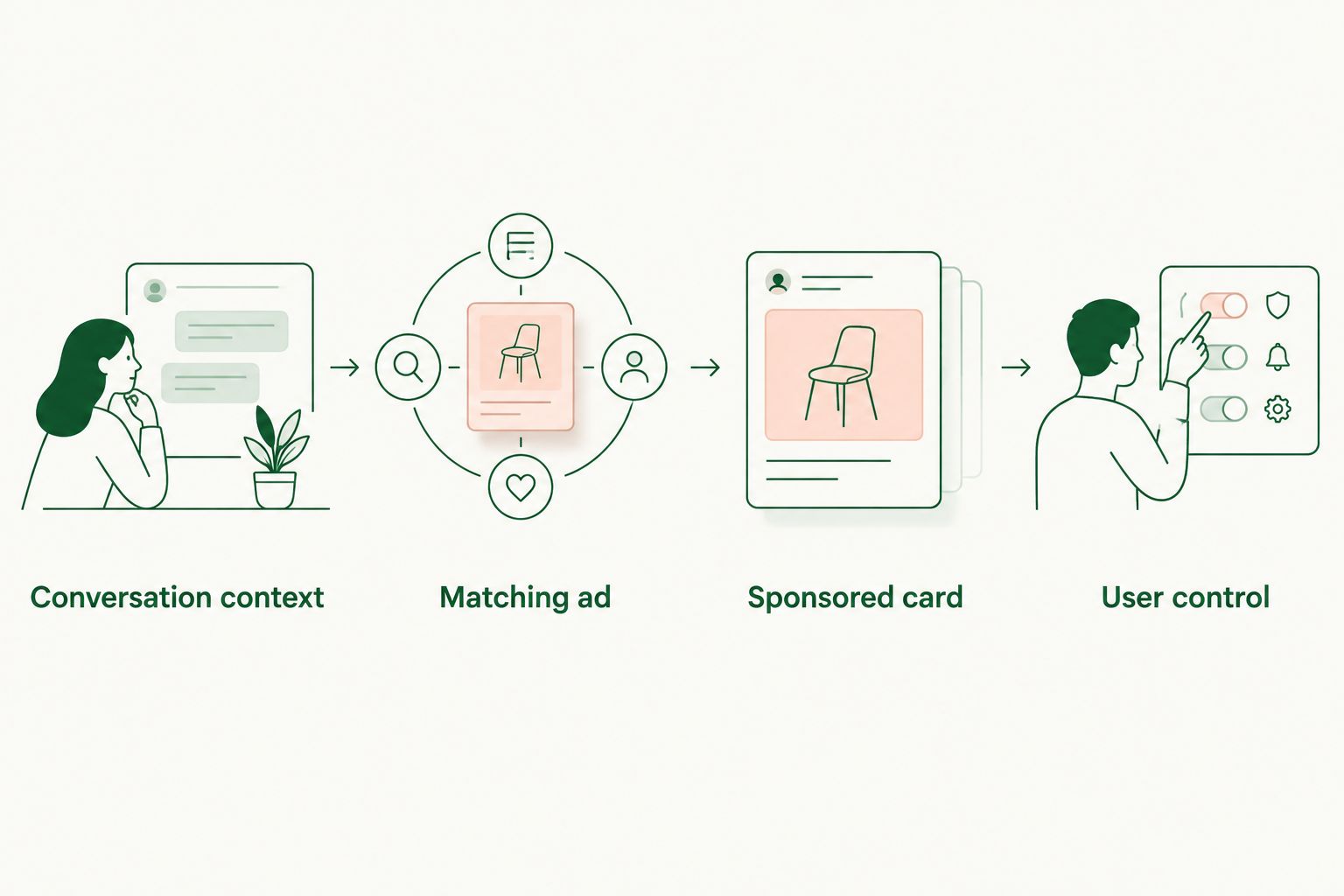
How should a chat app place a native ad?
Treat placement as a short sequence with a stop condition at every stage. An eligible request does not obligate the app to show an ad. It creates an opportunity to check whether an appropriate one exists.
- Identify conversation context. Determine the user’s current task from the information the app is permitted to use. Do not assume that an entire conversation belongs in an ad request.
- Select a matching ad. Check whether the available offer relates to that task. If the match is weak, continue without an ad rather than forcing a placement.
- Render a sponsored card. Place the promotion near the relevant answer while keeping it outside the assistant’s own explanation. Label it as sponsored where the user sees it.
- Preserve user control. Let the user ignore the card and continue the task. Record whether the ad rendered and whether the user engaged, without counting a requested ad as a viewed ad.
The sequence also exposes a failure that click counts hide. A context match can be technically correct but badly timed: the user may be asking for clarification, not shopping for an option. Review the surrounding chat behavior, not just the interaction with the card.
This is where Elo’s SDK-based adserver fits the publisher workflow: it is built to embed contextual, conversational ads in AI chat applications. That describes its use, not a performance guarantee. Your application still owns the decision about when a promotion belongs in the experience and how plainly it is disclosed.
What should you measure before calling native ads better?
Compare the formats against the same publisher goal and the same user journey. Click-through rate alone answers whether someone clicked a rendered ad. It does not tell you whether the placement earns enough to justify the space it occupies or whether people continue using the chat.
Start with the event definitions:
- Eligible opportunity: A point where your placement rules permit an ad request. This is not an impression.
- Rendered impression: An ad actually displayed in the interface. Use the same rendering standard when comparing formats.
- Engagement: A user action on the displayed ad. Keep it separate from a click on the assistant’s ordinary answer.
- Publisher RPM: Publisher revenue per 1,000 units of a defined activity, such as chat sessions. Name the unit every time you report RPM.
- Chat continuation: Whether the user proceeds with the task after the placement. Read it alongside revenue rather than treating an ad click as the entire outcome.
CPM and RPM use a 1,000-unit denominator, but they do not describe the same thing unless you define the unit and whose revenue you mean. Revenue per 1,000 rendered impressions describes the yield of displayed ads; publisher revenue per 1,000 chat sessions describes yield across the user experience. A placement that looks stronger on impressions can produce a different result at the session level if it appears less often. That is a mathematical distinction, not a claim about either format’s performance.
For a 2026 test, assign comparable traffic to each format and keep the measurement definitions fixed. Compare publisher revenue, rendered impressions, and chat continuation over the same test window. If your interface permits both formats, include a no-ad experience so you can see what changes when advertising appears at all. Do not declare a winner from an ad dashboard while ignoring the conversation around the ad.
When is a banner the better choice for an AI assistant?
A banner is better when the ad should remain entirely separate from the assistant’s answer. Choose it when conversation context is unsuitable for ad selection, the task needs an uninterrupted response, or the chat layout has a distinct display area. That is a placement verdict, not proof that banners earn more.
Can a native ad appear inside an assistant’s answer?
A native ad should be distinguishable from the assistant’s answer. Put the sponsored message in a labeled card or other distinct placement rather than writing advertiser copy as if it were the assistant’s independent advice. The user needs to know which content answers the question and which content is paid promotion.
Is higher click-through rate enough to choose native ads?
No. Higher click-through rate is not enough to choose native ads. Compare publisher RPM and chat continuation as well as engagement, using consistent impression and session definitions. A click that interrupts the task does not settle whether the placement works for the app.
FAQ
Are native ads better than banner ads for chat apps in 2026?
Native ads are better for a relevant, clearly labeled offer beside a conversation; banners are better for a separate display slot. Revenue needs a test in your own app.
What's the main risk of native advertising in a chat app?
The main risk is making a paid promotion look like the assistant’s own answer. Label the ad and keep its content distinct from the response.
When should an AI chat app use a banner ad?
Use a banner when advertising needs to stay outside the message thread. It suits an interface with a separate display placement and no need for turn-level matching.
Can a chat app use both native and banner ads?
Yes, if the interface gives each format a clear placement. Measure rendered impressions, publisher revenue, and chat continuation separately so the formats remain comparable.
What does publisher RPM mean for chat ads?
Publisher RPM is revenue per 1,000 units of a stated activity, such as chat sessions. Always identify the unit before comparing one placement with another.
Does Elo provide banner ads for AI chat apps?
Elo is described as an SDK-based adserver for contextual, conversational ads in AI chat applications. The supplied product information does not establish a banner-only offering, so assess Elo for in-chat contextual placement.
How do you tell whether an in-chat ad matches the conversation?
Check whether the offer relates to the user’s current task and appears at an appropriate moment. If the match is weak, leave the answer free of that ad.
One last thing
The cleanest native placement sometimes shows nothing. If the user’s task has no suitable offer, an empty ad opportunity protects the answer better than an unrelated card. In 2026, make that no-ad decision part of the product design, then measure the opportunities you declined separately from ads you rendered.