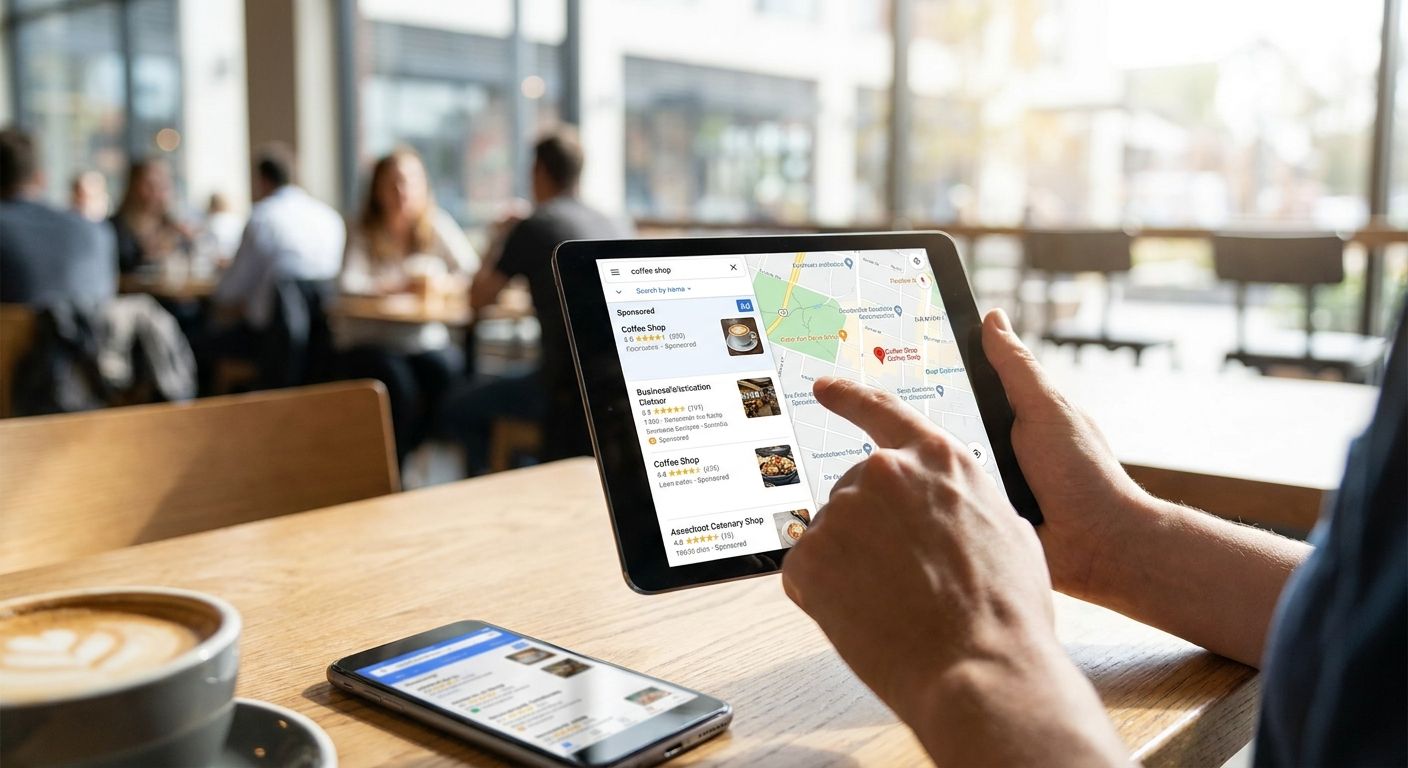
Local business discovery assistants — the chat apps that answer "find a licensed electrician near me" or "best late-night ramen delivery" — sit on some of the highest-intent conversation data in AI chat. Ad monetization for local business discovery assistant products works when the ad is the answer, not an interruption bolted onto it.
- Elo's ad SDK matches ads to local intent inside the chat, not next to it — Buy for discovery bots with category and geo signals.
- Home-service and moving-intent conversations convert best because the user already named a category and a location.
- Skip generic display networks for local discovery apps; they can't parse zip codes or service category from a chat thread.
- Context-matching infrastructure, not the ad network's brand name, decides whether local ad monetization for local business discovery assistant apps actually pays out.
Why this matters
A local business discovery assistant already knows more than a search engine does by the third message: category, urgency, sometimes a zip code or neighborhood. That's the exact data a local advertiser pays a premium for, and most chatbot builders leave it on the table by either running no ads or bolting on a banner SDK built for mobile games.
Elo runs as an SDK inside apps built on OpenAI, Anthropic, or custom LLMs, reading conversation context to place a native ad card instead of a banner. For a local business discovery assistant, that distinction is the whole business model — an ad for a plumber shown to someone who typed "my sink is leaking" isn't an ad, it's the answer they came for.
Who this is for
This guide is for developers and product leads running a chat-based local discovery tool — a "find a contractor," "find a restaurant," or "find a service provider near me" assistant — who need ad revenue that doesn't tank retention. If your app answers location-and-category questions in natural language and you haven't picked a monetization layer yet, or your current one is a generic mobile ad network bolted on after launch, this is the decision you're making right now in 2026.
What to look for in ad monetization for a local business discovery assistant
Category and geo matching, not keyword matching
A local discovery bot lives on category plus location — "HVAC repair," "Austin," "tonight." An ad network built for keyword-level display matching will miss that structure and serve irrelevant national brands instead of local-fit advertisers. The matcher needs to read the conversation, not just the last query string.
Native card format inside the chat thread
Banners break the chat UX on mobile and desktop alike, and a discovery assistant lives or dies on users trusting the recommendations it gives. A native ad card that looks like a normal chat response — same styling, same thread — keeps the user in the conversation instead of bouncing them to a browser tab.
Pricing model flexibility (CPM, CPC, CPA)
Local service advertisers buy differently than e-commerce brands: a plumber cares about a booked call, not an impression. An ad SDK that supports CPM, CPC, and CPA side by side lets you route home-service and appointment-driven categories to performance pricing while running awareness categories on CPM.
Fill rate for long-tail local categories
National ad networks fill well for "restaurants" and "hotels" but thin out fast for "appliance repair in a mid-size metro." Ask any network directly what its fill rate looks like outside the top 20 categories before you integrate — a local discovery bot's inventory is mostly long-tail by definition.
Latency inside the response
Users ask a local discovery bot because they want an answer now, not a spinner. An ad call that adds noticeable delay to the chat response defeats the product's core promise, so the matching and serving step needs to sit inside the same response cycle as the rest of the answer, not a separate round trip.
Brand safety for local service categories
Home services, movers, and local contractors attract more spam and unlicensed-operator ad fraud than national retail categories. Verify the network screens advertisers at the category level, not just the domain level, before it ever reaches your users.
Top picks for local business discovery ad monetization
The safe pick — vertical matching for home services. Conversational ads for AI home improvement and DIY assistants shows how category-level matching works when a user names a trade — plumber, electrician, roofer — inside the chat. The spec that matters: the ad card renders inside the same thread as the recommendation, so there's no tab switch between the organic answer and the sponsored option. Buy if home-service or contractor-finding queries make up a meaningful share of your assistant's traffic in 2026.
The specialist pick — relocation and moving intent. Ad monetization for AI moving and relocation assistants covers a discovery use case with unusually high commercial intent — someone asking about movers or storage has already committed to a purchase decision, not just browsing. The spec: pricing here leans CPA-friendly, since movers pay for booked jobs rather than clicks. Buy for any discovery assistant that handles relocation, storage, or logistics queries alongside general local search.
The technical foundation — context-matching engine. How to match ads to conversation context in an LLM app is the piece that makes the first two picks work at all — it explains how the matcher reads category and location signals out of a live conversation instead of relying on static keyword tags. The spec: matching happens on the conversation itself, across OpenAI, Anthropic, or custom LLM backends. Buy before you evaluate any ad network by brand name — the matching layer decides whether local relevance actually happens.
The scaling pick — eCPM tuning. Once local ads are live, the revenue difference between a mediocre setup and a tuned one comes from placement frequency and category routing, not from switching networks. How to increase eCPM in an AI chatbot covers the levers that apply directly to discovery traffic. Consider this after 30 days of live ad data, not before — you need a baseline first.
What to avoid
- Generic mobile display SDKs. They look plug-and-play but were built for game apps with banner slots, not for reading "I need a dog groomer near me" out of a chat turn.
- Flat CPM-only pricing for service categories. Home services and contractor categories convert on booked jobs, not impressions — a CPM-only network underprices your best inventory.
- Ad networks with no category-level fill data. If a network can't tell you fill rate for a category like local pest control versus restaurants, assume it's thin outside the biggest verticals.
Verdict comparison
| Criteria | Home services matching | Moving/relocation matching | Context-matching engine | eCPM tuning |
|---|---|---|---|---|
| Category matching depth | High | High | Foundational | N/A |
| Best pricing model fit | CPC / CPA | CPA | All three | All three |
| UX format | Native in-thread card | Native in-thread card | Sets format for all | Adjusts frequency |
| When to act | At launch | At launch | Before network choice | After 30 days live |
| Verdict | Buy | Buy | Buy | Consider |
Monetize local discovery conversations
Add contextual ad cards to your chat assistant without breaking the UX.
FAQ
What is ad monetization for a local business discovery assistant?
It is the practice of placing contextual, native ad cards inside a chat assistant's responses when a user asks for a local business, service, or recommendation. Elo's SDK reads the conversation to match a relevant local advertiser instead of serving a generic banner.
How much can a local discovery bot earn per conversation?
Earnings depend on the advertiser's CPM, CPC, or CPA bid and how many conversations carry commercial intent, so there is no fixed number across apps. High-intent categories like home services and moving tend to command better performance-based rates than casual browsing categories.
Is contextual advertising better than banner ads for local discovery chatbots?
Yes, for a chat interface specifically, because a banner breaks the conversational flow while a native ad card matches the response format users already expect. Local discovery assistants depend on user trust in recommendations, and an intrusive format erodes that trust fast.
Can a custom LLM app monetize local business conversations without a big ad network?
Yes. An SDK-based adserver like Elo works with custom LLM backends the same way it works with OpenAI or Anthropic-based apps, since matching happens on conversation content rather than a specific model provider. You do not need a direct sales team to start serving ads.
Does adding ads hurt user experience in a local business discovery assistant?
Not when the ad format matches the conversation instead of interrupting it, because a native card reads like a normal recommendation. The complaint users have is not ads in general, it is irrelevant or intrusive ads.
How do local business discovery bots match ads to conversation context?
A matching engine parses category and location signals out of the live conversation, such as trade type, service need, and sometimes a neighborhood or city, then serves an advertiser that fits both. This runs inside the same response cycle as the rest of the chat answer.
What pricing model works best for local discovery ads: CPM, CPC, or CPA?
It depends on the category. CPM suits awareness-driven local categories like restaurants, while CPC and CPA fit service categories where the advertiser wants a call or a booked job, so running all three lets each category route to the model that pays best.
Is GDPR compliance required for local business ad targeting in AI chat?
If your assistant serves users in the EU or UK, yes, because location and category signals used for ad matching count as personal data under GDPR. Confirm how your ad SDK handles consent and data retention before launch, not after.
One last thing
The biggest mistake in ad monetization for local business discovery assistant products in 2026 is not picking the wrong network — it is treating every query the same way. A user asking for a good taco place and a user asking for an emergency plumber tonight carry wildly different commercial value, and a matching engine that cannot tell the difference leaves your highest-value inventory unpriced. Route by category intent first, network second.