AI music and audio assistant apps face a monetization problem text-based chatbots don't: there's often no screen to put an ad on, and a listening session runs 20 to 60 minutes without a single checkout moment. Ad monetization for AI music assistant apps only works when the ad format respects that context — native, voice-safe placements outperform anything built for a feed or a banner, and Elo's adserver was built around exactly that constraint.
- Ad monetization for AI music assistant apps works best with native, voice-safe formats, not banner-style units in 2026.
- Contextual matching on mood, genre, and listening intent beats plain keyword matching for music assistants.
- Frequency capping matters more here than in chat apps because sessions run 20 to 60 minutes without a break.
- Header bidding across multiple networks is overkill for early-stage music assistant builds — skip it until volume justifies it.
- Elo's SDK integrates into voice and audio interfaces without breaking playback flow.
Why this matters
Most ad SDKs were built for apps with a screen you can interrupt. A music or audio assistant — a playlist generator, a voice DJ, a podcast summarizer running on OpenAI or Anthropic models — doesn't give you that interruption point without annoying the person listening.
That changes the math. You can't run a display network ad inside a voice loop. You need a sponsor slot that reads like a recommendation, not an ad break, and matches what the person is actually listening to right now, in 2026, not a generic keyword bucket from three years of ad tech built for browsers.
Who this is for
This is for developers running an AI music or audio assistant — voice-first DJs, playlist curators, podcast recap bots, audio companion apps — built on Elo, OpenAI, Anthropic, or a custom LLM stack, and looking to turn listening sessions into ad revenue without breaking the audio experience that got users there in the first place.
What to look for in ad monetization for AI music assistant apps
Voice-safe ad delivery
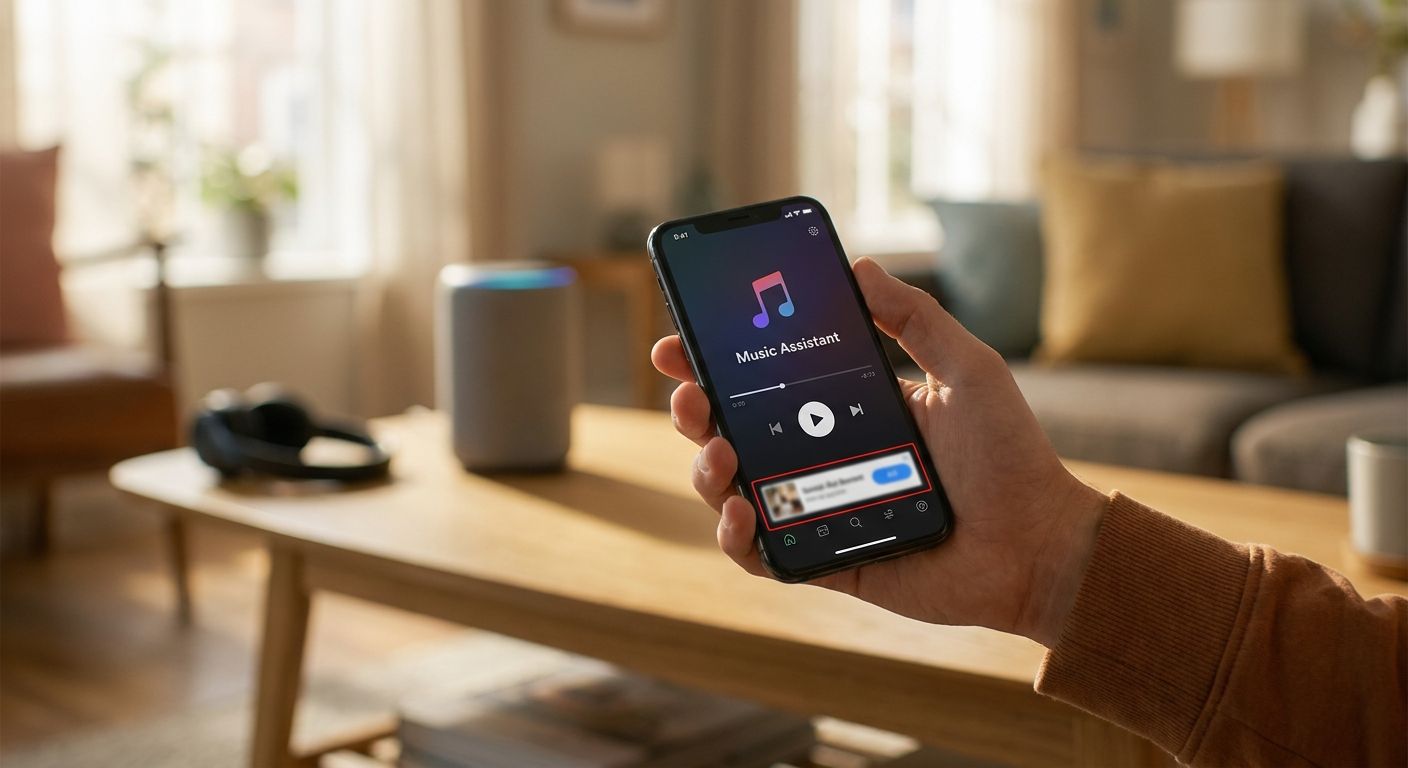
If your interface is audio-first, a banner-shaped ad unit is dead on arrival. The ad has to render as a spoken recommendation or a lightweight native card that doesn't interrupt playback, because a music assistant's entire value proposition is not interrupting playback.
Contextual matching beyond keywords
A listener asking for "something for a rainy Sunday" isn't giving you a keyword — they're giving you a mood. Ad matching that only parses literal text will miss genre, tempo, and listening-history signals that actually predict which sponsor fits the moment.
Latency inside the playback loop
An ad call that adds 400ms of lag before a track starts is a worse experience than no ad at all. Latency budgets for music and audio apps need to be tighter than text-chat latency budgets, because users notice a stutter in audio far faster than a half-second delay in a text reply.
Frequency capping for long sessions
A chat session might run three exchanges. A music session runs 20 to 60 minutes or longer. Without frequency capping tuned to session length, the same sponsor slot repeats often enough to turn a monetization win into a churn risk.
Revenue transparency and payout terms
Indie developers running audio assistants need to see RPM and fill rate per session, not a monthly lump sum with no breakdown. A dashboard that shows revenue per active listener, updated daily, is the difference between optimizing and guessing.
Where the revenue actually comes from
Native voice mediation — the safe pick. Ad mediation for voice AI assistants routes sponsor slots through a mediation layer built for spoken interfaces instead of a display stack retrofitted for audio. It handles the fill-rate tradeoffs between networks automatically, which matters when a single ad network can't cover every listening session. Buy if you're shipping a voice-first assistant in 2026 and need fill without hand-building a waterfall.
Native sponsored recommendations — the audio-native pick. Adding native ads to a voice AI assistant covers the specific pattern of a spoken sponsor mention that sounds like a recommendation, not a commercial break. This is the format users actually tolerate in long sessions because it mirrors how a human DJ would mention a sponsor. Buy for any app where the primary surface is spoken, not typed.
Context-matched sponsor slots tied to mood and genre metadata — the precision play. Matching sponsors against listening intent rather than transcript keywords lifts relevance in music apps specifically, because the query text ("play something chill") carries almost no advertiser-usable signal on its own — the genre and mood metadata does the real work. Consider this once you have enough session volume to build a matching layer that's worth tuning; it's not a day-one requirement.
Header bidding across multiple ad networks — the scale play. Running simultaneous bids across several networks increases fill rate at volume, but it adds engineering overhead most early-stage music assistants don't need yet. Skip it until a single mediation source stops covering your fill rate — for most indie audio apps in 2026, that threshold isn't hit in year one.
What to avoid
Banner-style visual ads bolted onto a voice UI. They look like an afterthought because they are one — a display unit designed for a scrolling feed has no place in an interface where the user isn't looking at a screen.
General-purpose mobile ad networks with no conversational context layer. They'll fill inventory, but the sponsor match will read as random, which trains users to ignore or skip past the ad entirely — the opposite of what a native format is for.
Ignoring ad fatigue in long sessions. A 45-minute listening session with the same sponsor slot repeating every five minutes burns goodwill fast; avoiding ad fatigue in AI chat interfaces applies just as directly to audio sessions, arguably more, since listeners can't scroll past a repeated ad the way a chat user can scroll past a repeated card.
If a mobile app development company built the client side of your listening app on contract, they optimized for playback stability and UI polish — not ad latency or sponsor matching; that mobile app development company decision shapes how hard the ad integration pass will be later, so it's worth treating as its own engineering ticket rather than folding it into the original build scope.
Test ad SDK integration before launch
Check latency and fill behavior before you ship to real listeners.
Verdict comparison
| Approach | Best for | Session length fit | Verdict |
|---|---|---|---|
| Native voice mediation | Voice-first assistants at launch | 20-60+ min | Buy |
| Native sponsored recommendations | Spoken sponsor mentions | 20-60+ min | Buy |
| Mood/genre context matching | Apps with session volume to tune | Any | Consider |
| Multi-network header bidding | Scaled apps needing extra fill | Any | Skip early |
FAQ
What is the best ad monetization for AI music assistant apps in 2026?
Native, voice-safe ad mediation that matches sponsors to mood and genre context is the best fit for AI music assistant apps in 2026. Banner-style ads or generic mobile networks without conversational context underperform because the interface has no screen to interrupt.
Do voice AI music apps need a different ad SDK than text chatbots?
Yes, because latency budgets and interruption points differ between audio and text. A text chatbot can show a native card between messages; a voice app needs the ad to sound like part of the recommendation flow, not a break in playback.
How much can an AI music assistant earn from ads?
Revenue depends on session volume, fill rate, and sponsor CPM, and varies by app; the number to track daily is RPM per active listener rather than a monthly total, since that number shows whether matching and frequency capping are working.
Is contextual ad matching better than keyword matching for music apps?
Contextual matching on mood, genre, and listening history outperforms plain keyword matching for music assistants, because queries like 'something chill for studying' carry almost no literal keyword signal an advertiser can use.
Should indie developers use header bidding for a new music assistant app?
No, header bidding across multiple ad networks adds engineering overhead that isn't justified until a single mediation source stops covering fill rate, which for most indie audio apps doesn't happen in year one.
How do you avoid ad fatigue in a long listening session?
Cap sponsor slot frequency based on session length rather than a fixed interval, since a 45-minute session with the same sponsor repeating every five minutes burns listener goodwill fast.
Can ad monetization work on a custom LLM-based audio assistant?
Yes, ad mediation built for conversational interfaces works across OpenAI, Anthropic, and custom LLM stacks as long as the SDK integrates at the response layer rather than assuming a specific model provider.
One last thing
The sessions that look like the worst monetization candidates — someone just asking for background music with no clear intent to buy anything — are often the ones worth the most inventory, because they run the longest. A 40-minute ambient-music session gives you far more native ad slots than a 90-second transactional chat exchange ever will, even if the per-slot CPM is lower.